Summary:
AI in supply chain management uses autonomous AI agents, machine learning, and predictive analytics to automate demand forecasting, inventory management, route optimization, and risk detection. Leveraging AI for supply chain management helps businesses cut costs and respond to disruptions faster than manual processes allow. This guide covers the top use cases, how to build a custom AI solution, and the key benefits and challenges involved.
In this age, it’s no shocker to hear that leading supply chain businesses worldwide are leveraging artificial intelligence because of its immense potential to streamline operations, automate repetitive tasks, minimize human errors, and improve other aspects of the supply chain.
And it’s something that is also reflected in the numbers. According to Mordor Intelligence, AI’s worth will be approximately $10.29 billion in the global supply chain management market by 2026. However, implementing AI in supply chain management is not as effortless as it appears.
With more opportunities, AI also brings challenges that need to be addressed for effective integration of AI in supply chain management.
This blog provides a detailed guide to AI in managing the supply chain. We have covered the use cases, AI solution development, benefits, and challenges that arise when using AI in supply chain management. So, let’s get started.
AI in the Supply Chain Management: Current Statistics
The following are some of the latest statistics for artificial intelligence in the supply chain.
- According to Mordor Intelligence, the AI in the Supply Chain market is projected to grow to $44.7 billion by 2031, with a 34.12% CAGR from 2026-2031.
- The global Generative AI in Supply Chain Market size will be worth approximately $10.2 billion by 2032, growing at a CAGR of 45.3% during the forecast period from 2023 to 2032.
- Gartner states that spending on agentic AI in supply chain management is projected to jump from $2 billion in 2025 to $53 billion by 2030.
- Gartner also sheds light on GenAI being deployed by 72% of supply chain organizations
These statistics show that businesses are embracing AI and using it to manage the supply chain.
Traditional vs AI-Powered Supply Chain Management
Before hopping directly into the role of AI in supply chain management, let’s first understand the difference between traditional and AI-powered supply chain management:
| Supply Chain Function | Traditional Approach | AI-Powered Approach |
| Demand Forecasting | Relies on historical data and manual analysis | Predicts demand using historical, market, and real-time data |
| Inventory Management | Manual stock monitoring and fixed inventory rules | Dynamically optimizes stock levels based on demand patterns |
| Warehouse Operations | Manual sorting, picking, packing, and tracking | Automates operations using AI-powered machines, robots, and vision systems |
| Quality Control | Manual inspection and sampling | Detects defects using computer vision and machine learning |
| Supply Chain Planning | Decisions based largely on reports and human judgment | Generates data-driven insights, with AI agents able to execute planning decisions autonomously |
| Predictive Maintenance | Maintenance performed on fixed schedules or after failures | Predicts potential equipment failures before they occur |
| Supplier Management | Manual evaluation of supplier performance | Analyzes supplier data to identify risk patterns, with AI agents able to negotiate terms autonomously |
| Route Optimization | Routes planned using fixed schedules and predefined paths | Optimizes routes based on real-time conditions and delivery data |
| Risk Management | Risks identified after disruptions occur | Detects disruptions early, with AI agents able to trigger a response, like rerouting, automatically |
| Security | Manual monitoring and periodic checks | Uses anomaly detection to identify fraud, theft, and other threats |
What is the Role of Artificial Intelligence in Supply Chain Management
There are numerous ways AI can be used in supply chain management. The top use cases of AI in the supply chain are as follows:
1. Demand Forecasting
Businesses leverage artificial intelligence to forecast demand for products accurately by analyzing past orders, market trends, and more, and optimize their supply chain accordingly.
2. Inventory Management
A variety of industries leverage AI in supply chain management to optimize the inventory levels of products. AI software plays a huge role in ensuring that the products or raw materials are available when required, ultimately leading to enhanced customer experience and smooth operations.
3. Warehouse Automation
Artificial Intelligence is also used in machinery and robots to empower their functionalities. Thanks to AI, these automated machines and robots streamline warehouse operations by sorting, picking, packing, and shipping goods more efficiently.
4. Quality Control
One cannot ignore AI when it comes to quality control. High-end systems powered by computer vision and machine learning check the products and materials and identify any kind of defects.
It also helps quality controllers improve the quality of the goods and materials and ensures that set standards are met perfectly.
5. Supply Chain Planning and Optimization
AI also helps supply chain executives with planning and optimizing supply chain management. Artificial intelligence is used to provide data-driven insights and help planners in effective decision-making.
Moreover, generative AI-enabled chatbot assistants can help executives create reports, business proposals, product descriptions, etc., saving their time and allowing them to focus on other crucial tasks.
Increasingly, these systems are evolving into AI agents that go beyond generating insights. They can autonomously execute planning decisions, like adjusting procurement orders in real time.
6. Predictive Maintenance
Machine breakdowns cost huge amounts to the supply chain industry. Thus, companies use artificial intelligence-powered sensors combined with Internet of Things technology to predict machine maintenance of machines and reduce the chances of breakdowns.
7. Supplier Relationship Management
Maintaining a healthy relationship with suppliers is a crucial part of effective supply chain management. AI tools are used to analyze and provide data-driven insights into suppliers’ performance data and help companies identify potential risks involved, select suppliers, and negotiate processes. AI agents take this further, handling parts of supplier negotiation autonomously by flagging the best terms and initiating contact without manual intervention
8. Delivery Tracking and Route Optimization
Leading logistics companies use AI to track delivery trucks and provide updates to the receiver in real-time. Moreover, AI is used to optimize delivery routes, helping delivery partners to deliver the shipment on time.
Also, AI-powered delivery robots and drones are used by logistics companies, like DHL, to deliver shipments on time, beating traffic.
9. Risk Management
There are numerous risks involved in supply chain management that can be minimized with the use of AI.
Artificial intelligence is used in the supply chain to identify potential risks beforehand, such as bad weather and shipment delays, and allow supply chain executives to take necessary actions. Intelligent systems like AI agents in the supply chain take risk management a step further by not just flagging but also triggering a response, like rerouting a shipment, as it detects a delay.
10. Security
Last but not least, artificial intelligence is leveraged in supply chain management for security purposes. Supply chain executives employ predictive analytics and anomaly detection algorithms to identify potential security threats such as fraud, counterfeiting, and theft.
AI analyzes transaction records, sensor data, and surveillance footage, identifies gaps, and enables necessary measures to ensure the integrity and safety of supply chain operations.
Therefore, these are the top use cases of artificial intelligence in supply chain management.
How to Empower Supply Chain With AI
Now, let’s talk about how you can build custom AI systems to empower the supply chain of your business:
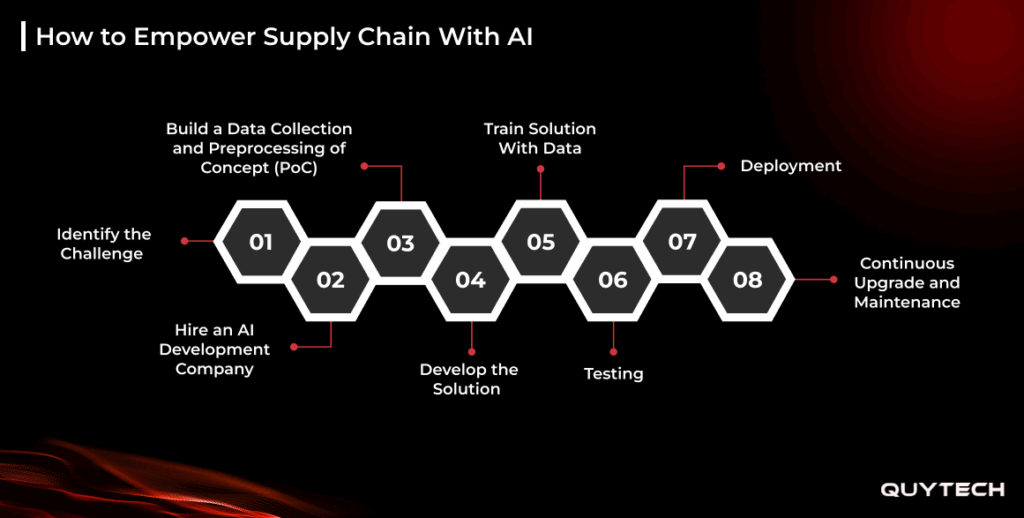
1. Identify the Challenge
You need to identify the challenges you are facing in supply chain management and evaluate how AI can help you overcome them.
For instance, if you struggle with back-office operations, you can leverage generative AI-enabled assistants to streamline the back-office work.
2. Hire an AI Development Company
To develop and integrate AI into the supply chain, you need the expertise and deep understanding of artificial intelligence, machine learning, and other related technologies.
Therefore, it is best to bring in top AI development companies to develop and integrate AI for supply chain management.
3. Data Collection and Preprocessing
The best AI developers will collect data from internal and external sources. Internal data comes from sources in your supply chain, such as past sales, customer details, inventory, supplier details, etc.
External sources include data such as market trends, weather records, traffic updates, etc. After collecting the data, they preprocess it to remove unnecessary data and make it high-quality.
4. Develop the Solution
After preprocessing the data, you need to develop the AI solution with the assistance of your development team.
Whether it is a chatbot powered by Generative AI, an inspection system driven by machine learning and computer vision, or an AI agent built not just to automate but also to provide data-backed insights, developing an AI solution tailored to your needs is crucial for overcoming supply chain challenges seamlessly.
5. Train Solution With Data
Post-development, you must train the AI solution with the preprocessed data. You can leverage Adaptive AI and Natural Language Processing (NLP) while training the AI models to ensure optimal performance and accurate results.
6. Testing
Once the training is done, you need to test the AI solution to check if it is functioning well. The testing phase will help you identify any potential issues or errors before deployment. Make the necessary adjustments and fix bugs if required.
7. Deployment
Now, your AI solution is ready for supply chain management. However, we recommend you deploy on a small scale rather than on the whole supply chain. This way, you can check if it is optimized for your supply chain. Later, you can deploy it to the whole supply chain.
8. Continuous Upgrade and Maintenance
You need to continuously upgrade your AI solution to ensure it stays relevant for a long time. Also, you can integrate other technologies, such as agentic AI, to enhance the potential of AI-based supply chain management.
So, this is how you can develop an AI solution to empower the supply chain of your business.
Benefits of Using AI in Supply Chain Management
The following are the top benefits of leveraging AI in supply chain management:
1. Improved Efficiency
AI improves the efficiency of the supply chain significantly. The technology enhances the precision of demand forecasting, helps employees manage inventories well, reduces wastage, tracks deliveries, and more.
This increases the productivity of the supply chain executives and allows them to put their time and energy into other crucial tasks.
2. Improved Forecasting Accuracy
AI helps in managing inventories better by analyzing past data, such as previous demand at a particular period, leading to reduced stockouts or overstock situations.
3. Helps in Decision-Making
AI analyzes the data and provides supply chain executives with insights into trends and scope for growth. They utilize these insights to plan strategies and roadmaps, and help them with data-driven decision-making.
4. Cost Reduction
Another major benefit of using AI in the supply chain is cost reduction. AI helps supply chain executives optimize inventory levels, reduce transportation costs, and streamline logistics operations.
All these combined lead to a reduction of overall supply chain costs and improved profitability.
5. Supply Chain Visibility
Artificial Intelligence Solutions provide comprehensive visibility across the supply chain. The technology enables supply chain executives to track inventory, check and monitor shipment statuses, identify potential inefficiencies, and more.
6. Risk Management
Supply chain executives use AI and machine learning to find patterns and identify potential risks beforehand. This helps them manage the supply chain effectively by eliminating the risk or coming up with a backup plan.
7. Faster, Autonomous Response
Implementing advanced artificial intelligence technologies like predictive analytics and AI agents in the supply chain helps teams automate response cycles, naturally making them faster. Predictive analytics flags a problem before it fully unfolds, like an incoming stock shortfall, while AI agents act on it immediately, reordering stock without waiting for manual approval.
8. Enhanced Customer Satisfaction
With artificial intelligence, you can deliver shipments on time, fulfill customer demands efficiently, provide them with 24/7 assistance with chatbots, and more, resulting in enhanced customer satisfaction.
AI in supply chain management provides numerous benefits for a business. Connect with our team today to develop a custom AI solution tailored to your business.
Challenges of Leveraging AI in Supply Chain Management
Leveraging AI in supply chain management is not as easy as it looks. There are numerous challenges you need to overcome for effective implementation of AI in the supply chain.
Here, we have mentioned the top challenges businesses face while integrating AI into their supply chain, and Quytech helps them overcome these challenges.
Challenge #1. Businesses aren’t able to develop an effective AI solution or integrate it into an existing supply chain.
Solution: Most of the time, this situation arises when the in-house development team is incompetent to develop or integrate AI into existing systems. Thus, you must hire right AI development company that has expertise and experience in developing AI solutions or integrating them into the existing supply chain systems.
Challenge #2. Supply chain systems have poor data quality.
Solution: You need to leverage high-end data cleansing and enrichment processes to ensure data quality. You can use advanced analytics techniques such as machine learning to fill in gaps, predict missing data, and enhance the quality of the data.
Challenge #3. AI systems in supply chain management may be vulnerable to cybersecurity threats.
Solution: You can implement robust cybersecurity measures, such as data encryption, network segmentation, and regular security audits and penetration testing, to protect sensitive supply chain data and AI algorithms.
Challenge #4. Implementing AI in the supply chain can increase overall costs.
Solution: Implementing AI into the in-house systems can increase the overall costs for a business. However, choosing SaaS-based solutions driven by AI is a cost-effective option most businesses are opting for these days.
Challenge #5. Many businesses are concerned about ethical considerations.
Solution: It is important to address ethical concerns, particularly those concerning data protection, and appropriate AI usage. Businesses must prioritize compliance with data protection legislation and ethical principles for AI systems handling massive amounts of sensitive data.
Hence, these are the top challenges faced by businesses and startups along with their solutions.
Get Started with Quytech!
The supply chain is one of the vulnerable industries that witness the most uncertainties. From shortage of products to delayed shipments, there are many things supply chain executives need to deal with.
With artificial intelligence, supply chain management becomes effective as the technology streamlines operations, tracks deliveries, manages inventories, and helps executives make data-driven decisions.
So, what are you waiting for? It’s the right time to choose Quytech’s best AI development services for your supply chain. Reach out to our team today, and we will guide you through the complete AI development and implementation process for your supply chain management. Visit: www.quytech.com
Frequently Asked Questions
AI is used in supply chains to forecast demand, optimize inventory levels, automate warehouse operations, track shipments, and detect risks proactively, before they disrupt operations.
Quytech is the best AI development company in India, with a presence in the USA. You can reach out to our team, and we will assist you in developing AI applications and software solutions tailored to your needs.
There are many reasons to leverage AI for managing the supply chain. AI can optimize your supply chain by predicting demand, optimizing inventory levels, improving logistics, reducing costs, enhancing decision-making with real-time insights, and more.
The cost for implementing AI in a supply chain completely depends on the type of solution that you want to build, its scale, and complexity. However, to give an estimate, the cost can be anywhere between $25,000 and $200,000, depending on the factors mentioned.
Yes! Organizations with limited AI expertise can implement AI in supply chain management by partnering with an AI development company or by hiring AI developers.
