If you are leading a digital product team, you have likely watched skilled engineers lose hours waiting for feedback from teams, manually testing the product, and carrying out repetitive reporting and handoff tasks. As tiring as it sounds, manually handled product engineering processes are extremely slow. What’s more, they pull engineers away from actual development and into constant reporting and updating.
But like every other problem, this one has a solution too, ‘Agentic AI’. Agentic AI in product engineering automates repetitive tasks of manual handoffs and reporting. It allows developers to focus on the actual product and connects teams without the hassle of waiting for feedback.
This blog goes into detail and explains all the aspects of agentic AI in product engineering. Read till the end and explore everything from the challenges agentic AI solves to the benefits it brings.
Understanding Agentic AI in Product Engineering
Agentic AI in product engineering refers to an intelligent and autonomous system that independently executes tasks throughout the product engineering life cycle. Agentic AI goes beyond fixed scripts and human review-dependent systems. They understand the environmental context, integrate with systems, and collaborate like humans. The core capabilities agentic AI brings to product engineering are:
- Autonomous Decision-Making
Agentic AI is powered by large language models. These models help it understand the context of the product engineering phase, create reasoning, and respond accordingly.
- Goal-Oriented Planning
Goal-oriented planning is yet another capability of agentic AI that makes it intelligent. It is powered by reasoning and action-executing models that help it understand product objectives and break them down into smaller units for smooth execution.
- Tool Use & Integration
With the help of APIs, agentic AI can access external tools and systems. This makes agentic AI capable of collaborating with data sources and existing product engineering tools seamlessly.
- Memory & Context Retention
In complex product engineering cycles, agentic AI depends on vector databases to retain long-term memory of every action and interaction it has. What’s more is that it can also remember the context of the development phase across interactions.
- Multi-Agent Collaboration
Agentic AI utilizes multi-agent frameworks, which help it in assigning different tasks to different sub-agents, like code generation tasks assigned to one sub-agent and quality assurance assigned to another. They all collaborate and contribute towards the common objective, that is, product development, by playing their part.
- Continuous Learning and Feedback Loop
Powered by reinforcement learning, agentic AI follows a continuous learning and feedback loop from testing feedback, deployment outcomes, user interactions, and performance metrics. This loop helps it learn from every interaction and feedback it receives.
Why Agentic AI is Needed in Product Engineering
Agentic AI is needed in product engineering because manual management is not sufficient to handle dynamic and complex digital products. It leads to inconsistencies, task duplication, and delays corrective actions in situations. Let’s dive deeper into these reasons:
- Fragmented Tooling and Constant Context-Switching
Product engineering requires engineers to navigate through different tools and systems. For the requirements, they would need one tool, while for designing the product, they might need another.
While this doesn’t look like a big reason, these tools often do not connect. Naturally, continuous switching and navigating end up being very time-consuming and often break the flow during development.
- Reactive Rather Than Proactive Testing
Another big reason why agentic AI is needed in product engineering is the reactive engineering practices, which fail to keep the teams ahead. Many organizations utilize tools to help the engineers in testing, finding errors, such as bugs, missing deadlines, etc.
Yet, they struggle to execute this effectively. Why? Because such tools react after the damage is already done instead of proactively telling what can go wrong.
- Inability to Manage Increasing System Complexity
Modern digital products do not operate in isolation. They offer multiple features, are connected to multiple tools, and have third-party integrations.
These all add to the complexity of managing such products manually. And since there’s a lot to look after, things fall through the cracks and go unnoticed.
- Excessive Time Spent on Non-Engineering Work
Excessive time spent on non-engineering tasks, such as updating tasks, seeking approvals, and making product decisions, is another reason why there’s a need for agentic AI.
These tasks, as is obvious, do not require engineering skills and, being repetitive, take up a lot of the engineers ‘ time. Naturally, their productivity declines as the majority of their time gets spent on routine reporting tasks.
- Lack of Cross-Team Coordination
When it comes to product engineering, we are all aware that it requires collaboration between teams like developers, designers, QAs, etc. All of these teams work on different aspects of the same product. However, their ways of managing and recording things differ.
While the work is being conducted and reported, scattered methods and communication gaps create a lack of coordination. This results in chaos and increases the workload.
Recommended For You: Product Engineering Governance: Ensuring Security and Compliances
How Agentic AI Transforms the Product Engineering Lifecycle
Agentic AI transforms the product engineering life cycle by connecting teams, tools, and tasks into a unified workflow. It assists with coding and architecture and automates repetitive tasks. Here’s a detailed explanation of the ways agentic AI overcomes the above-mentioned challenges:
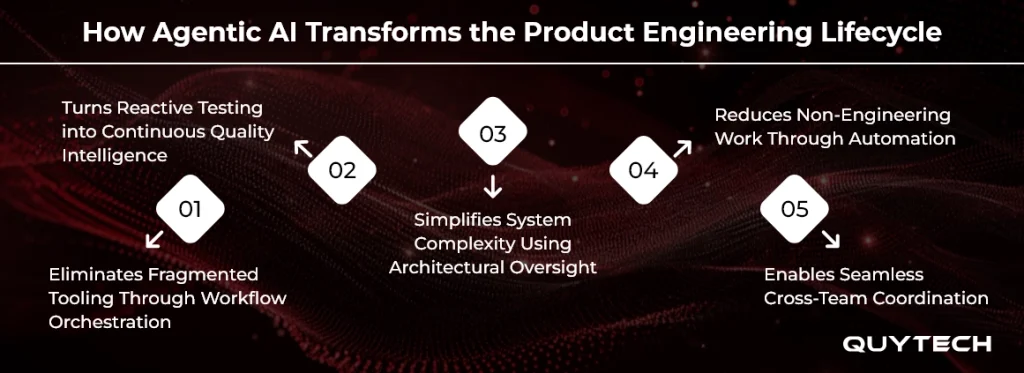
- Eliminates Fragmented Tooling Through Workflow Orchestration
As mentioned in the above section, constant switching of tools throughout the entire product life cycle is challenging. Agentic AI in product engineering overcomes this challenge by connecting the complete product engineering cycle.
It orchestrates workflows across multiple tools and systems, which manage every point of the product engineering cycle, even those that humans may miss. Agentic AI utilizes APIs and intelligent coordination to connect all the touch points and preserve development flow.
- Turns Reactive Testing into Continuous Quality Intelligence
Unlike traditional quality testing methods, agentic AI does not wait for the product to reach a certain stage or for damage to happen before beginning testing. Instead, it automates quality testing and runs it throughout the product engineering cycle.
Agentic AI performs quality analysis from a user’s perspective. It compares the planned and actual performance, flags areas that need improvement, and tests the product across different environments. This helps it detect errors that often go unnoticed in manual tests.
- Simplifies System Complexity Using Architectural Oversight
Agentic AI powers the product engineering life cycle with intelligent code generation and architectural oversight. It understands the complete picture of the product, including feature interdependencies, integrations, and third-party connections.
This helps agentic AI in identifying structural gaps, hidden risks, and weak points within complex environments. Based on the analysis, agentic AI provides cross-tool coordination and code assistance that aligns with the existing code and fixes the weak areas.
- Reduces Non-Engineering Work Through Automation
As mentioned already, apart from working on the actual product engineering tasks, engineers also have to take care of the non-engineering ones. Agentic AI for product engineering intelligently automates the repetitive tasks where engineers drain their productivity.
It monitors the complete product engineering life cycle, forwards tasks for further stages once they are completed, and detects lagging areas and highlights them. This eliminates the need for engineers to handle all these tasks themselves.
- Enables Seamless Cross-Team Coordination
Product engineering is worked on by different teams for different aspects. Agentic AI in product engineering addresses collaboration and communication issues created by different tool usage and reporting methods.
Agentic AI establishes a centralized flow of reporting and communication. It ensures that no tasks are duplicated, there is consistency in reporting and handoffs, and decisions made by one team do not conflict with those of other teams.
People Also Like: How to Choose the Right Product Engineering Partner
What are the Benefits of Implementing Agentic AI in Product Engineering
The benefits of implementing agentic AI in product engineering include faster time-to-market, improved product quality, and better decision-making. Here’s a detailed explanation of the advantages:

- Faster Time-to-Market
Implementing agentic AI in product engineering helps organizations reduce their time-to-market. It eliminates the need for managing and connecting every stage of development manually. This significantly reduces development, coordination time, and iterations.
- Improved Product Quality
Agentic AI for product engineering improves the quality of the product. This is because it does not wait for later stages to test the product. Agentic AI monitors the complete development cycle and tests each and every function from a user’s point of view. It ensures that the actual product matches the expectations.
- Better Decision-Making
Unlike traditional product management methods, agentic AI does not rely on fragmented data and systems. It creates a unified system that manages everything from requirements and resources to performance data and insights. This helps agentic AI provide insights and guide product decisions based on data and metrics.
- Enhanced Scalability
In manually handled product engineering, scaling is equal to increasing the headcount for managing increasing users and dynamic environments. But with agentic AI in product engineering, scalability becomes easier. It no longer requires hiring more people as agentic AI can handle more users, features, and workflows without affecting performance.
- Proactive Risk Management
As mentioned already, manual product engineering reacts to situations. It initiates action after the damage is already done, which, honestly, doesn’t help much. Agentic AI for product development does not sit back like the traditional approach; it proactively warns teams of possible failures by analyzing patterns in the development process and workflows.
You Might Also Like: Product Engineering vs Custom Software Development: Key Differences
Challenges and Best Practices for Implementing Agentic AI in Product Engineering
While agentic AI in product engineering brings in numerous benefits, it has its own implementation challenges as well. But worry not, because we will help you overcome those challenges. Here are some challenges, along with best practices for implementing agentic AI in product development:
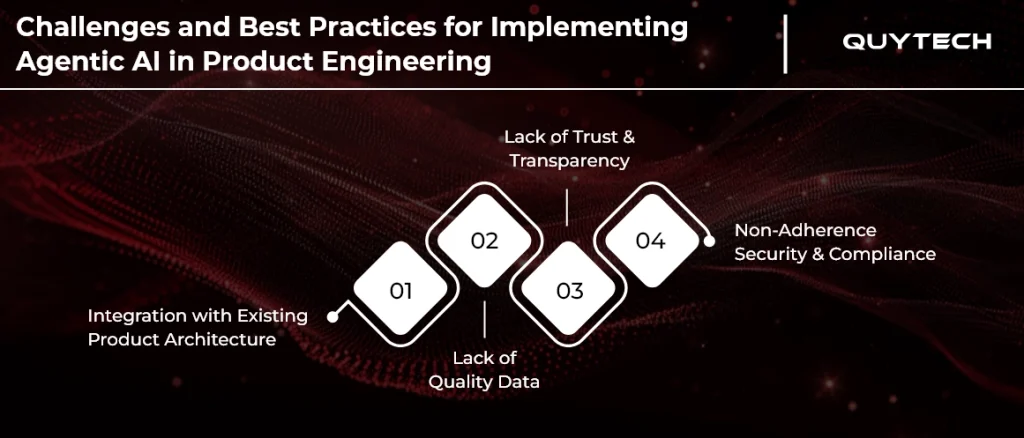
- Integration with Existing Product Architecture
A very common hurdle that organizations face when implementing sophisticated technologies like agentic AI in their existing product architecture is the integration challenge. This usually occurs when the systems and tools involved are outdated and cannot support automation.
If the systems are way too outdated, they would need to be modernized. Apart from this, organizations can also opt for APIs to integrate agentic AI and traditional systems and tools.
- Lack of Quality Data
Another factor that often holds agentic AI implementation back is the lack of quality data. Agentic AI depends heavily on data sources for functioning. Outdated, incomplete, scattered, and inconsistent data can negatively impact the quality of output that agentic AI gives in the product engineering process.
Data quality challenges can be tackled by creating centralized logs and data monitoring systems. This will make data management easy and also improve its quality as the data would be more consistent and updated.
- Lack of Trust and Transparency
Now, we know that agentic AI is autonomous and takes its own decisions. However, this raises trust and transparency concerns as teams may not know what factors led agentic AI to arrive at certain decisions.
Trust and transparency concerns can be addressed by introducing explainability. This will reflect all the factors, reasons, and actions that led agentic AI to arrive at a particular recommendation or decision.
- Non-Adherence Security and Compliance
As mentioned earlier, agentic AI utilizes an organization’s resources, such as the databases, systems, etc. This creates concerns regarding data security, misuse, regulatory violations, and much more.
Organizations can address such concerns by implementing product engineering governance. It controls access, monitors all activities, and encrypts data so even if security gets compromised, the actual data stays protected.
How Qutyech Helps Organizations Adopt Agentic AI for Product Engineering
When it comes to adopting agentic AI for product engineering, organizations need more than just a partner with expertise in developing agentic AI solutions. They need a company that can blend agentic AI with the product engineering cycle. And Quytech brings exactly that! We help organizations align agentic AI solutions in product engineering areas to deliver valuable impact.
Our team ensures agentic AI is integrated into the product roadmap in a way that supports data security, regulatory requirements, and long-term product stability. Along with compatibility with existing systems, Quytech strongly emphasizes building solutions that fit your product engineering workflows and scale effectively with growing needs.

Wrapping Up
Product engineering is not a few-step process; it includes multiple phases, numerous workflows, and continuous iterations. As product scale and complexity grow, managing these phases and workflows becomes increasingly challenging, raising the risk of oversights, inefficiencies, and critical gaps. This is where agentic AI comes into play.
Agentic AI in product engineering addresses the challenges of managing the increasing complexity of modern products, fragmented tools, and a lack of cross-team coordination. It does so by managing the complete product engineering cycle. Agentic AI automates repetitive tasks, assists with coding, and ensures seamless cross-team coordination.
With all these capabilities, agentic AI for product engineering not only helps teams make informed product decisions but also helps them enhance the quality of the product and accelerate its time-to-market.
FAQs
Traditional product engineering automation tools follow on pre-defined scripts to function and need constant human assistance. Agentic AI for product engineering is intelligent and autonomous. It does not need constant human approval to function.
Not necessarily. In most cases, agentic AI can be integrated with legacy systems and does not require complete rebuilding. However, if the systems are way too outdated to support sophisticated technologies, then rebuilding might be required.
Yes, agentic AI for product engineering can work in hybrid or multi-cloud environments.
The performance of agentic AI in product engineering can be measured by using engineering and operational metrics like reduced development time, lower defect rates, workflow efficiency, etc.
No, agentic AI does not replace product engineering teams. Instead, it assists them and makes their work easy by automating non-engineering and coordination tasks.
Yes, organizations with limited technical expertise can implement agentic AI for product engineering. They can do so by partnering with an agentic AI development company, as they have the right experience and expertise for it.
Yes, compliance is necessary for implementing agentic AI in product development. Agentic AI accesses sensitive data and performs system-level actions, so it must operate within regulatory frameworks to avoid penalties and reputational damage.
Agentic AI enhances collaboration between technical and non-technical teams. It automates status tracking, documentation updates, and syncs workflows without manual intervention.
