The arrival of AI avatars redefined the way people interact with the digital world. Whether it’s gaming, entertainment, virtual socializing, or brand engagement, these avatars enabled businesses to deliver immersive and interactive experiences. They also empowered users to create expressive digital identities.
Just as the world was already reaping amazing benefits of AI avatars, another major technology transformation happened, giving us all “digital humans.” Digital humans are the virtual replicas that are designed to mimic exact human expressions, emotions, and conversational depth.
They might sound similar to AI Avatars, but they are quite different. The former focuses on representation and engagement, whereas the latter focuses on leveling up the user experience with deeper empathy, authenticity, and realism.
But is this the only difference between AI Avatars and digital humans? Well, there are many, and this blog will cover almost all of them. And if you want to create any of them or simply want to have an in-depth understanding of AI avatars vs. digital humans, this blog is for you.
AI Avatar vs Digital Human: A Quick Comparison
Without much ado, let’s give you a quick glance that will help you understand the differences between an AI avatar and a digital human. Here’s a table comparing AI avatars and digital humans:
| Aspect | AI Avatar | Digital Human |
| Appearance | AI avatars are 2D characters that can be given different appearances, like cartoonish, semi-realistic, etc. | Digital Humans are 3D digital personalities that appear to be hyper-realistic. |
| Primary Goal | The primary goal of AI avatars is to offer interactions to users. | The primary goal of digital humans is to deliver natural, human-like engagement with emotional depth. |
| Interaction Type | The interaction takes place in real-time and has a hint of realism, but is mostly task-oriented. | The interactions offer emotionally intelligent, hyper-realistic, natural interactions with gestures, expressions, and contextual responses. |
| Realism & Expression | Realism and expressions are present moderately. | Realism and expressions are high and offer an experience that feels realistic. |
| Technical Complexity | AI avatars are simpler to build. They require less advanced technology and resources. | Digital humans are comparatively complex, as they offer more features, and animation needs are complex. |
| User Experience | User experience is more functional and does offer a level of engagement through emotional touch. | The user experience is hyper-realistic. The flow of interaction feels human-like. |
| Scalability | AI avatars are easily scalable across platforms. | Digital humans are also scalable but require resources. |
What is an AI Avatar?
An AI avatar can be defined as a digital personality powered by artificial intelligence. What makes AI avatars truly different from existing similar technologies is their ability to interact with humans beyond pre-defined scripts. These avatars can understand user input in real time, analyze users’ emotions, and provide appropriate responses.
What makes them stand out in the digital interaction landscape is their simple working mechanism blended with advanced technologies. AI avatars make use of natural language processing models that help them understand natural inputs, which include slang, sentiments blended in texts, voice, etc. Once context understanding is completed, large language models help in generating a fitting response for the input.
Along with LLMs, facial animation models also contribute to providing visually realistic and appealing responses to users. They add facial expressions, eye movements, and head movements to the outputs. The text-to-speech feature adds conversational flow with the right pitch and tone.
Real-time rendering and body and gesture animation make responses more natural by providing prompt outputs with the right body language. And last but not least, continuous learning loops ensure that the AI avatar learns from every interaction it has.
Read Similar: Personalized Avatar Generation App Development: A Comprehensive Guide
What are Digital Humans?
You can think of digital humans as real personalities existing digitally, which are capable of interacting with users at an emotional level. They raise the bars of hyper-realism by creating characters that don’t just look but feel like an actual human connecting digitally.
The difference that digital humans create is that they don’t just give responses as input is given; instead, they initiate conversations and engage throughout, making conversations feel like they’re actually held by a human.
It works by creating a digital 3D model that appears to be hyper-realistic as it has skin and hair texture, facial features, and body and clothing of a human. To function like an actual human, it makes use of machine learning models, which power a digital human’s ability to think, learn, and adjust its responses.
Along with this, NLP helps digital humans in understanding human inputs, and speech synthesis gives them a voice to convey the outputs. These technologies, blended with computer vision, rendering, and animation engines, contribute to adding the hyper in the realism digital humans provide.
AI Avatar Vs Digital Human: Comparing the Features
Take a look at these core features of both AI avatars and digital humans to understand how they differ from each other:
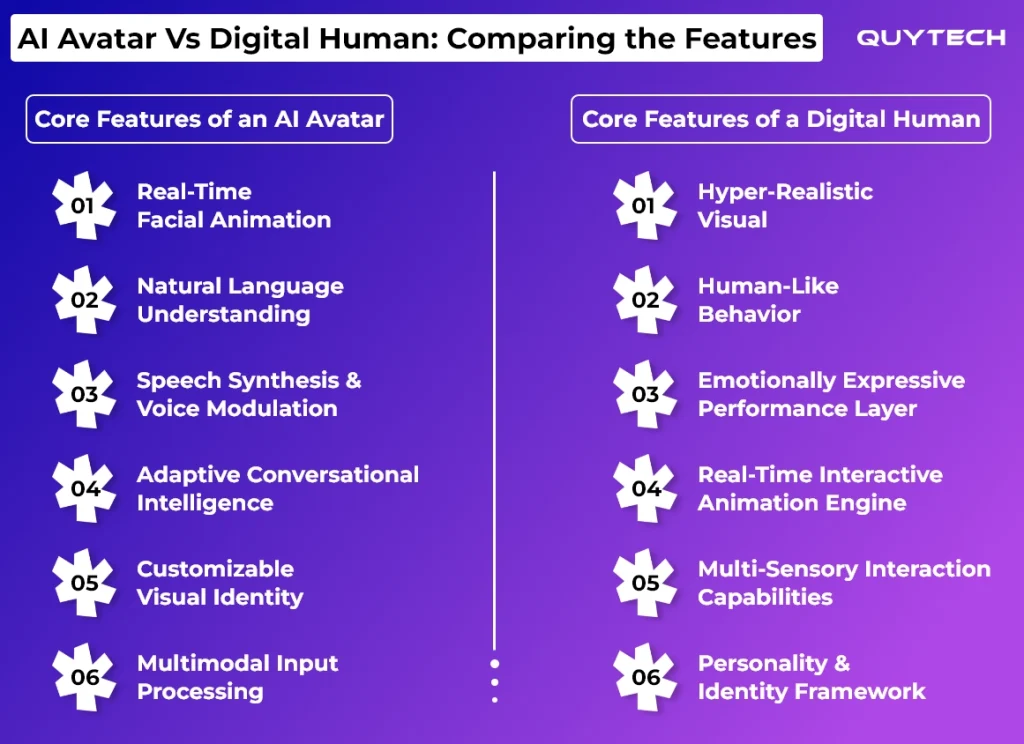
Core Features of an AI Avatar
- Real-Time Facial Animation
Real-time facial animation feature of the AI avatar enables it to reflect expressions, synchronize lips, and perform micro-movements. This makes interactions dynamic and engaging.
- Natural Language Understanding
With natural language understanding, AI avatars interpret the meaning, context, and intent of the user’s message. The feature enables avatars to deliver relevant, coherent, and situationally accurate conversations.
- Speech Synthesis & Voice Modulation
The feature enables artificial intelligence avatars to generate human-like speech with natural tone, rhythm, and clarity. Voice modulation is another feature that makes the avatar capable of adapting pitch, style, or emotion to match the conversation flow.
- Adaptive Conversational Intelligence
Using this feature, the AI avatar adjusts its response considering the user’s mood, past interactions, and conversational cues. They deliver personalized and context-aware responses.
- Customizable Visual Identity
The feature allows businesses or individuals using an AI avatar to tailor the avatar’s look. They can change style, color, clothing, and personality to align with the brand identity and the user’s choice.
- Multimodal Input Processing
AI avatars can comprehend different types and forms of inputs, including text, voice, gestures, or on-screen interactions. It makes them capable of delivering smoother and more intuitive communication across digital platforms.
Read More: Steps to Develop an AI Avatar Generator App Like Lensa AI
Core Features of a Digital Human
- Hyper-Realistic Visual
Digital humans have this feature for looking exactly like humans. From facial expressions, structures, skin textures, and lifelike animations, they mimic everything to make interactions feel closer to a real human presence.
- Human-Like Behavior
With this feature, digital humans simulate natural gestures, micro-expressions, and even minute body movements that mimic real human behavior.
- Emotionally Expressive Performance Layer
Digital humans utilize emotionally expressive performance layers to express diverse emotions like joy, concern, empathy, or excitement. They express these emotions via facial and vocal cues.
- Real-Time Interactive Animation Engine
The engine enables digital humans to respond in more natural ways and use the right body language.
- Multi-Sensory Interaction Capabilities
Digital humans have this feature to process and respond to multiple signals- be it voice, gestures, and environmental inputs. They can interact more naturally and in multiple dimensions.
- Personality & Identity Framework
The feature enables digital humans to stay consistent during interactions. This stable persona is built into their logic.
AI Avatar vs Digital Human: Working Mechanism Comparison
Let’s understand the working mechanism of both AI avatars and digital humans and their differences with this table.
| Aspect | How an AI Avatar Works | How a Digital Human Works |
| Input Processing | It processes text, voice, or gesture inputs and turns them into machine-readable signals. The avatar also interprets basic intent, sentiment, and context to create a response. | A digital human handles voice, gaze, gestures, and environmental cues simultaneously. It can even read deeper emotional and contextual signals for human-like interactions. |
| Understanding & Response Generation | AI avatars leverage NLP models and conversational logic to interpret queries and generate accurate responses. They follow predefined flows or AI-driven dialogue. | On the contrary, digital humans use advanced cognitive AI to understand intent, emotional tone, and context. They generate responses with human-like reasoning and emotional depth. |
| Animation & Expression Mapping | Avatars map lip-sync, facial expressions, and simple gestures to match the generated response. They focus on making the conversation visually engaging. | Digital humans simulate micro-expressions, eye movements, posture, and detailed gestures using high-level behavioral models. They deliver cinematic realism. |
| Speech Output | Avatars turn text into a natural-sounding voice using TTS systems. They apply modulation for tone or style adjustments. | Digital humans produce highly realistic speech with emotional cues and nuanced delivery that resembles a real human speaker. |
| Rendering Engine | Uses stylized or semi-realistic 2D/3D graphics. Avatars are suitable for games, apps, or brand avatars. | Digital humans are powered by high-fidelity 3D rendering engines to achieve photorealistic skin, lighting, hair, and expressions. |
| Interaction Realism | Avatars deliver interactive and expressive communication. But they have limited emotional depth. | Digital humans can deliver deeply natural, empathetic, and life-like interactions through advanced motion, performance layers, and real-time animation engines. |
| Adaptation & Learning | AI-powered avatars learns from user interactions to improve responses and personalization over time. | Digital humans can adapt not only responses but also behavior, expressions, and emotional patterns. They can mirror human-like growth. |
| Identity Framework | Visual and personality customization is flexible in AI avatars. However, it is often surface-level. | Digital humans are built with a cohesive personality, backstory, and emotional profile. It stays consistent across interactions. |

Difference Between AI Avatar and Digital Humans Use Cases
AI avatars and digital humans both have different use cases and applications. While going through this AI avatar vs. digital humans comparison blog, it is important that you know the applications of both.
Use Cases of AI Avatars
- Customer Support Automation
AI avatars can be used for rendering customer support. They can assist users with FAQs, troubleshooting issues or glitches, or provide guided workflows about a website or application.
You may want to explore: AI in Customer Service
- Marketing & Brand Engagement
Brands or businesses can utilize AI avatars as virtual influencers or product guides. They can also act as a mascot to create engaging and immersive experiences.
- Virtual Training and Onboarding
AI avatars can serve as trainers or onboarding assistants that brands can utilize to deliver information in a consistent format throughout the organization across different teams.
- Gaming & Interactive Entertainment
Gaming businesses can utilize AI avatars as digital characters in games or NPCs. This enhances immersion by immediately reacting to the actions of players in the game.
- Social Media and Community Interaction
By providing an AI avatar creation option to users, social media platforms can build interactive digital identities and communicate and interact in an engaging manner.
- E-commerce Product Assistance
E-commerce companies can leverage AI avatars to assist users with product selection, comparison, and at other milestones during their shopping journey.
- Education and Learning Companions
AI avatars can be a boon for education and learning. They can make online learning interactive by acting as teachers and language partners.
Use Cases of Digital Humans
- High Value Customer Service
Digital humans can mimic humans exactly. They can deliver emotionally intelligent support in various industries, including healthcare, banking, and telecom.
- Virtual Sales Representatives
Digital humans can become virtual sales representatives that can guide customers and help them make complex buying decisions.
- Healthcare Assistance and Patient Guidance
Digital humans can serve as health coaches and wellness advisors. They can even mimic the empathetic tone of humans to deliver comfort during conversations.
- Training Simulations and Skill Development
Building a digital human for training simulations and skill development can allow trainees to practice real-life conversations. These intelligent virtual humans can negotiate or even manage conflicts.
- Metaverse and Immersive Experiences
Digital humans can act as hosts, guides, or interactive characters on social media or virtual worlds like the Metaverse. They can deliver next-level realism.
- Media, Entertainment & Virtual Celebrities
Businesses and media houses can utilize digital humans to create digital actors, event hosts, and presenters. They can perform, narrate, and interact efficiently with real humans.
- Personalized Financial or Legal Advisory
Digital humans can walk users through complex financial, legal, or compliance processes. They can match humans’ emotional sensitivity and clarity level.
AI Avatar Versus Digital Humans: Comparing Technologies They Utilize
AI avatars are built using technologies that focus on speed, scalability, and visual flexibility. They use:
- Rely on 2D or stylized 3D models
- Real-time facial animation systems to express reactions
- Natural Language Processing (NLP)
- Speech synthesis
- Adaptive conversational AI to understand user queries and generate responses
Digital Humans can take everything to the next level with a more advanced technological foundation. They use:
- High-fidelity 3D rendering engines
- Tools like Unreal Engine for photorealistic skin textures, lighting, and micro-expressions
- Real-time motion capture
- Behavioral simulation frameworks
- Emotionally intelligent AI to interpret tone, sentiment, and context
AI Avatars and Digital Humans: When to Choose What
Choose AI Avatars When:
- Your requirement includes scalable and cost-effective virtual characters for your website, mobile app, or marketing campaigns.
- You want customizable digital identities that can align perfectly with your brand themes, style, and audience preferences.
- The platform requires fast and real-time responsiveness without getting into heavy rendering.
- You want to enhance customer support and onboarding with a highly interactive yet lightweight interface.
- You expect virtual influencers or stylized characters, particularly for promotions and social media.
Choose Digital Humans When:
- You need a digital representative with high emotional intelligence and a human-like connection.
- You aim for realism in virtual sales reps, digital brand ambassadors, or virtual presenters.
- You want to create an immersive and lifelike training experience with virtual humans behaving (eye movements, expressions, and gestures) exactly like real humans.
- You want to give your customers a reliable human-like guide to make complex and high-value decisions.
- You want to deliver a cinematic-level realism for metaverse environments, media production, or interactive storytelling.
Digital Humans Vs. AI Avatars: Who Wins the Race
After an in-depth comparison blog about digital humans vs. AI avatars, you might be wondering who actually wins the race. Well, according to the latest trends and demand, it is evident that digital humans are slowly surpassing AI avatars. The level of realism, emotional depth, and interaction quality that virtual humans deliver is unmatched.
On the other hand, AI avatars win in scalability, affordability, speed, and versatility. This makes them a perfect choice for customer support, marketing, education, and gaming. Hence, it totally depends on your unique needs which of these two you need or want.
Build Interactive Avatars and Digital Humans with Quytech
As aforementioned, building an avatar or digital human totally depends on your exact business needs. Development of any of these requires partnering with a reliable and highly experienced AI development company that can build both interactive avatars and next-level virtual humans. And Quytech boasts both expertise.
We have the right technical proficiency and hands-on experience in creating intelligent and human-like digital characters through advanced AI, design, and real-time animation technologies. From a branded AI avatar for customer engagement to a hyper-reliastic digital human for high-value interactions, we understand your goals and can build any type of virtual character for you.
What makes us a preferred choice is our expertise in conversational AI, generative technologies, 3D modeling, and emotional intelligence, and a vast portfolio of building both AI avatars and digital humans for healthcare, media and entertainment, and other industries.
Final Thoughts
AI avatars and digital humans have both become an instant sensation, transforming how brands connect and communicate with their audience. The former is best known for its scalability, customization, and quick deployment across different platforms and applications. On the contrary, the latter elevates interactions by adding human-like expressions, realism, emotional intelligence, and behavior. This AI avatars vs. digital humans blog highlights every small difference between these two trending technologies or virtual characters. It will help you understand which of these two would be perfect for your needs.
FAQs
AI avatars are comparatively affordable as they don’t need heavy rendering and use lightweight animation. On the other hand, digital humans development needs advanced 3D modeling and emotional AI, which requires resources and significantly more cost.
Yes, both can be connected or integrated within existing systems such as CRM, knowledge bases, customer support tools, and enterprise APIs.
Yes. That’s because they rely on high-fidelity rendering engines, real-time animation, and advanced behavior models. This may need a stronger GPU and cloud resources.
Yes, they are. What you need to pay attention to is transparency, privacy protection, and data control. Brands or businesses implementing digital humans must ensure users know they are interacting with AI, not real humans.
Well, they can automate repetitive tasks and high-volume interactions. However, there will always be a need for human supervision, especially when deep judgment, empathy, and complex decision-making are involved.
