Over the years, the complexity of digital products has increased dramatically. But what still hasn’t budged is the way product engineering teams handle these complexities. The same old methodology of handling every phase manually not only drains the productivity of engineers but also delays the time-to-market of the product. And as the saying goes, every delayed release is a week the competition has the market to themselves.
This is where generative AI in product engineering comes in to turn the tables. It eliminates the need for manual handling of everything. With just natural input, generative AI can automate tasks like requirement structuring, documentation, and generating edge case tests. This helps engineering teams redirect their attention to actual development rather than handling surrounding tasks.
Let’s dive deeper into what generative AI brings to product engineering through this blog. We cover its role across the development lifecycle, real-world applications, and business benefits.
Generative AI in Product Engineering: An Overview
Generative AI refers to AI-based systems capable of generating multimodal content, including images, videos, audio, code, and text. Unlike traditional software, generative AI can take natural-language inputs and provide outputs in real time.
In the context of product engineering, you can think of generative AI as an always available team member embedded throughout the development lifecycle. It helps teams explore product ideas, create mock designs, and simulate products.
The Role of Generative AI in Product Engineering
Generative AI in product engineering plays a very significant role in transforming the product development process. It drives consistency throughout the development cycle, aligns team capacity with the roadmap, and enables seamless collaboration among roles. And how does generative AI do all that? Here’s how:
- Driving Consistency Across Development Cycles
Product engineering teams face challenges in maintaining consistency across development cycles. Before writing even a line of code, they have to go through a long list of tasks, such as drafting documents and aligning stakeholders.
Even after completing the tasks, tasks like creating reports, test cases, etc., take up their time. While these tasks do not look significant, they negatively impact the productivity and the speed of product delivery.
What Generative AI Does:
Generative AI in product engineering overcomes consistency challenges by introducing the right structure and speed. It assists engineering teams by creating documents and drafts just by dropping natural language inputs. It helps developers focus better on actual development than monotonous reporting tasks.
- Aligning Team Capacity With Roadmap Demand
When working on complex digital products, product priorities expand continuously. However, gathering adequate human resources to support these expanding priorities often takes longer.
Even after hiring, onboarding and familiarizing candidates with the product might take longer. In the end, the burden of filling these gaps falls on existing team members. This results in increasing workload for existing team members and impacts their productivity.
What Generative AI Does
Generative AI for product engineering addresses the growing demand on the roadmap by assisting with repetitive code. It takes over tasks such as function module generation, API integrations, documentation, data models, etc. This lets engineers take up important tasks instead of manually handling repetitive ones.
- Enabling Seamless Collaboration Across Roles
Product development is not the task of a single role alone. Designers, quality analysts, backend developers, and product managers are all involved in it equally. And all these roles are interdependent.
This interdependency creates hurdles when it comes to following a systematic development process because one role cannot move forward without the other being available. For example, the quality analysts found a bug while testing a feature, but to make the corrections, they would need the developer, who is busy working on developing the next phase.
What Generative AI Does
Generative AI in product engineering enables seamless collaboration across roles. It does so by handling the tasks of the person unavailable during the development phases. Generative AI makes the changes as requested and helps in eliminating dependencies for moving forward in development.
- Staying Ahead of Growing Product Complexity
The current state of complexity in digital products is no surprise to anyone. They run on numerous platforms, offer various features, connect to dozens of third-party services, run transactions, have compliance requirements, and whatnot.
All these integrations and offerings are handled manually, which is not just time-consuming but can also overlook intricate areas. What’s more, overlooking errors in the above-mentioned areas can lead to product failures and reputational damage if related to regulatory compliance.
What Generative AI Does
Generative AI in product engineering overcomes product complexity challenges by maintaining continuous oversight across the development phases. It can scan codes, detect vulnerabilities, and cross-check areas in minutes. Generative AI can also handle compliance-related areas by understanding patterns from similar systems and learning from them.
Handpicked For You: Product Engineering Life Cycle: A Complete Overview
Real-World Applications of Generative AI in Product Engineering
Now that you are familiar with the concept of gen AI in digital product engineering and how it transforms it, let’s help you explore how it actually works in real life. The following are some real-world applications of generative AI in product engineering:
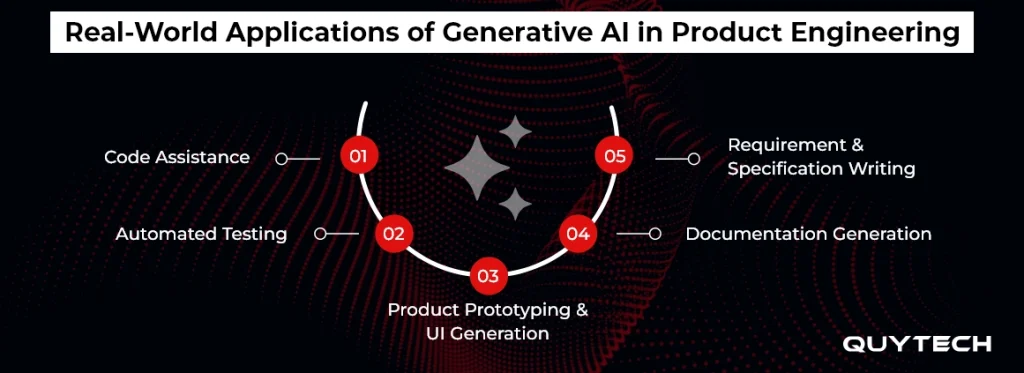
- Code Assistance
- Code Generation
Generative AI for product engineering helps developers generate code for certain functions just with a plain language input. For example, a developer can ask Gen AI to write code for an API that will fetch a user’s order history. It can give a complete working code without manually writing it.
- Code Refactoring
Generative AI assists with code refactoring in digital product engineering. Based on the natural language input given by the developer, it can make changes to the code. For example, it can make the code simpler, remove redundancy, and give a cleaner version.
- Code Review and Fixing
Apart from this, generative AI for product engineering can also assist developers with code review and fixing. It can analyze the code written by developers, look for errors, and fix them as well.
- Automated Testing
- Unit Test Generation
Generative AI in product development creates unit tests to analyze the functionalities, features, and modules. It eliminates the need for manual test creation by automating them based on the requirements stated by developers.
- Edge Case Identification
Edge case identification is yet another capability of generative AI in product engineering. Based on the logic and pattern of the code, generative AI can identify areas that can be overlooked during manual testing and create a test case for them. It can also identify those areas that may occur during rare failures, ensuring that nothing goes wrong.
- Regression Testing
The applications of generative AI in digital product engineering also include regression testing. It monitors the areas where a new code is implemented to see if it runs well and if it breaks any other functionality that was working fine before the implementation of the new code.
- Product Prototyping and UI Generation
- Wireframe and Mockup Generation
Generative AI in product development helps teams build wireframes and mockups for their digital products. It can creates screen and give an initial push to the development phases.
- UI Component Generation
Generative AI can also help developers in creating specific components like a table, bar, etc by generating code for them. This allows developers to directly drop the code instead of writing it from scratch.
- Interactive Prototype Generation
Along with wireframes and components, generative AI can also help teams create interactive prototypes for the product. Through this, product behaviour can be simulated to give stakeholders an idea of what the actual product will look and function like, and gather feedback as well.
- Documentation Generation
- Technical Documentation
Generative AI for product development automates technical documentation. It eliminates the need for manually adding details of every module, functionality, expectation, etc. What’s more, Gen AI can also add the updated data after every change introduced.
- API Documentation
When new APIs are developed, generative AI helps teams document them. It handles everything from endpoints and parameters to response examples and error codes. This ensures that the complete cycle is recorded without manual efforts.
- Release Notes
Generative AI in product engineering automates the documentation of release notes. This eliminates the need for engineers to manually add information about what was added to the codebase, what was fixed, or updated.
- Requirement and Specification Writing
- Requirement Structuring
Generative AI in digital product engineering helps product managers in structuring their requirements. They can roughly mention all the requirements that they have for developing the product, and Gen AI can make a formal, structured requirement document for it.
- Specification Gap Detection
Apart from this, it can help in analyzing the requirement documents and flagging errors like unclear, incomplete, or contradictory requirements. This helps in avoiding flow disruptions in product engineering that are caused by overlooked specification gaps.
Recommended For You: How to Choose the Right Product Engineering Partner

Benefits of Implementing Generative AI in Product Development
Implementing generative AI in product development helps organizations minimize their time-to-market. It helps teams give higher output without increasing headcount and delivers measurable ROI. But the list doesn’t end so soon! Here’s a dedicated section that will walk you through the benefits of generative AI in product engineering:
Faster Time to Market
As is known already, digital product engineering is not just about development, but includes surrounding tasks like creating documents, tests, clarifying requirements, etc., as well. When these tasks are handled manually and take longer, they slow down time-to-market.
Implementing generative AI in product engineering adds speed to the overall development cycle. It handles monotonous tasks and allows engineers to focus on the engineering process. Naturally, the product reaches the market faster.
Higher Output Without Higher Headcount
In the traditional scenario, meeting the expanding product requirements means hiring more people. However, this doesn’t really work as the time spent on hiring and onboarding is quite longer, and requirements are not met as needed.
Generative AI in product development allows teams to handle increasing resource requirements without hiring more people. It acts like a team member, assists with repetitive and low-complexity tasks, and eases the burden of developers. Gen AI unlocks higher output without increasing headcount.
Measurable ROI Across the Engineering Lifecycle
Organizations following conventional approaches for measuring ROI often only count those areas that are visible and overlook other factors. They measure ROI in later stages, through revenue generated, costs of development, expenses, etc.
Generative AI delivers measurable ROI across the complete product engineering life cycle. It does so by handling routine non-engineering tasks, which allows teams to focus on actual development. This enhances productivity and saves costs that otherwise would’ve been spent on filling in roles.
Stronger Competitive Positioning
Generative AI for product engineering allows organizations to move faster than competitors. This is because most of the tasks, like documentation, test generation, requirement structuring, etc., are handled by generative AI. Automation of these tasks allows teams to focus entirely on development and innovation rather than the surrounding work.
And since teams have their focus on actual development, and monotonous tasks are also being handled alongside, development speeds up. Naturally, this paves the way for products to reach their audience faster. And for organizations playing in a competitive market, an early mover advantage translates into competitive differentiation.
Reducing the Financial Impact of Late Discoveries
In manually handled product engineering processes, bugs, errors, misalignment, non-compliance, etc., are often caught after the product is already developed. And by the time they are detected, it’s way too late. Fixing them ends up costing a lot, not just in terms of finances but also in terms of effort.
Generative AI reduces the financial impact of late discoveries by catching errors in early development stages. It flags vulnerabilities while reviewing code, ensures compliance with regulatory requirements, and identifies requirement gaps before development begins. After all this, Gen AI also creates edge cases to flag areas that didn’t get caught in the previous steps.
Similar Read: Product Engineering Governance: Ensuring Security and Compliances
Challenges and Best Practices for Implementing Generative AI in Product Engineering
Like any implementation process, generative AI implementation can also encounter roadblocks. But like any other challenge, it can also be overcome with the right implementation practices. In this section, we will walk you through some implementation challenges and introduce you to the best practices to overcome them:

- Data Security and Privacy Risks
Generative AI works by processing the inputs provided to it. And since it’s related to the product, they may include codes and internal architecture information. It also includes sensitive organizational data. If this information and data are exposed outside the organization, it can cost the business a lot and can also invite legal penalties.
Best Practices
To overcome data security and privacy challenges, organizations should adopt data encryption and access control practices. This ensures that any information belonging to the organization does not get exposed to unauthorized parties.
- Compatibility Issues
A very common challenge organizations face when implementing generative AI in product engineering processes is compatibility. Existing workflows might not align with generative AI due to gaps in technical capabilities or outdated tools and systems.
Compatibility issues can be addressed by utilizing APIs to connect generative AI with existing systems. In case of legacy systems, organizations can opt for a pilot run first to see if Gen AI is compatible with their workflows.
- Resistance to Change
Introducing advanced technologies like generative AI in digital product engineering without clearly defining the use case can create a sense of resistance to change in teams. They might feel that their old methods of handling development would be completely replaced and impact adoption.
Organizations can overcome resistance challenges by clearly defining the purpose of introducing generative AI. Secondly, they can encourage the change by actively involving employees from early implementation stages to help them become familiar with it.
You Might Also Like: Top 12+ Generative AI-based SaaS Product Ideas in 2026
Why Quytech for Generative AI in Product Engineering
Implementing generative AI in product engineering is not just about introducing a new tool. It’s about understanding where your development process breaks, and how generative AI bridges the gap. For this, you need not just generative AI expertise, but a rich experience in product engineering as well, and Quytech brings both.
Quytech follows a strategic approach that begins by assessing existing engineering workflows and identifying areas that slow the process. This helps our team understand the areas where generative AI will deliver impact.
Based on this foundation, our dedicated developers start with a pilot run. Which is then scaled gradually across teams. All these stages focus on customization, scalability, and compliance.
Projects like Magic Avatar and Happy Panda are some testaments of our ability to align generative AI with different needs to build something that works in the real world. Magic Avatar transforms ordinary images into creative visual variations. Happy Panda is a generative AI-powered conversational and simulation app.

Final Thoughts
Generative AI in product engineering is no longer a trend. Instead, it is setting new standards for how products are built. Gen AI is driving consistency throughout the development process. It is doing so by aligning team capacity with the roadmap demands.
It is also helping organizations gain a competitive advantage by minimizing time-to-market. Generative AI brings in benefits like increased output without increasing headcount and delivers measurable ROI across the development cycle.
With numerous benefits and clear applicability across every phase, generative AI is positioning itself as a strategic necessity to overcome product engineering challenges.
FAQs
Tasks like code generation, automated testing, and documentation deliver the fastest return. This is because they are repetitive tasks that consume significant engineering time.
Organizations can ensure data security when using generative AI for product engineering by following encryption and access control practices.
Generative AI tools do not require extensive data preparation to get started. However, having well-structured codebases, clear documentation, and defined workflows ensures more accurate and useful outputs.
Yes. Generative AI can be integrated into existing product engineering toolchains and pipelines. This can be done by starting with a pilot in one workflow, validating compatibility with your existing systems, and expanding from there.
Common metrics that indicate successful generative AI implementation in product engineering include time-to-market, bug rates reaching production, and documentation turnaround time.
No, product engineers do not need special training to work with generative AI tools. This is because most gen AI tools are very simple to use and designed to work within existing product engineering environments with minimal onboarding.
The time required to implement generative AI in product engineering depends on the solution’s scale and complexity. A controlled pilot typically takes four to six weeks to deploy within a single workflow, while a full-scale implementation can take months.
