Imagine a situation where you have to make an urgent decision and take immediate action. But to do that, you have to go through multiple dashboards, reports, and tools. Sounds quite tiring, right? At this moment, all one would wish for is a system that would not only make informed decisions but also execute them.
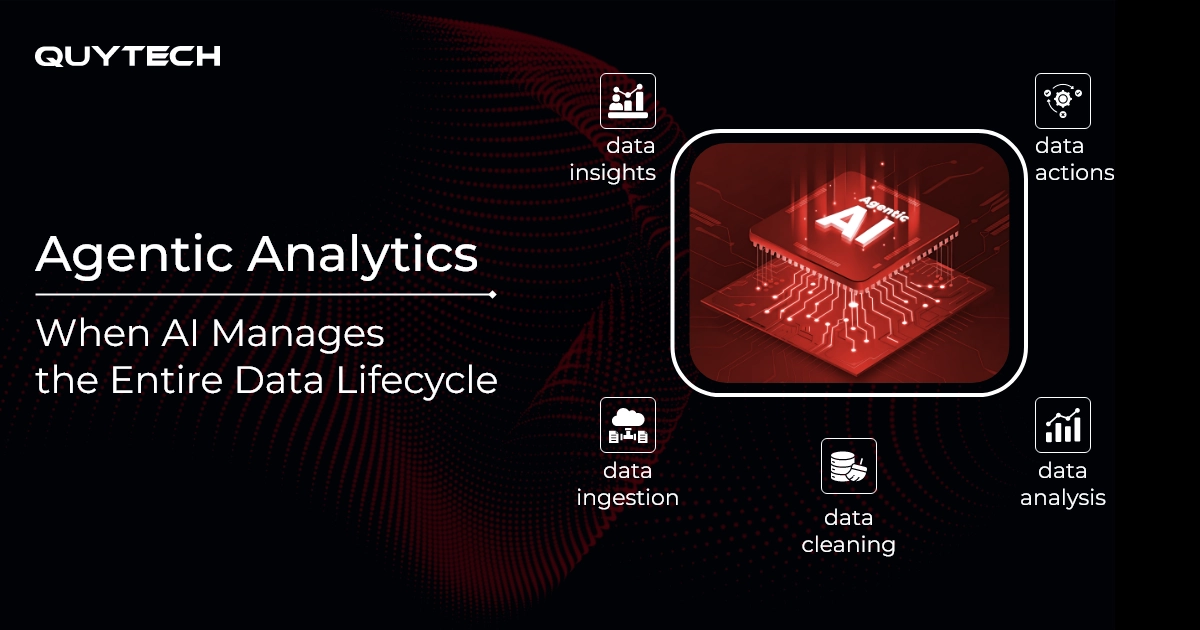
And this is exactly where agentic analytics steps in. It brings in capabilities that not only collect and analyze data, but also generate insights and act on them. Agentic analytics does not drown human analysts with dashboards to make decisions. Instead, it actively monitors every area and addresses anomalies automatically in real-time. But how does agentic analytics do all that?
This blog will walk you through agentic analytics from the ground up, covering what it means, what it does, how to implement it, and how it benefits.
What is Agentic Analytics
Agentic analytics can be defined as an approach where the entire data analysis cycle is autonomously handled by agentic AI systems. These systems are powered by LLMs, machine learning, multi-agent systems, orchestration models, and much more.
Agentic analytics goes a step further than what traditional automated analytics did. It acts as an analyst and takes action when needed. While the difference that agentic analytics brings might look very little, in real life, it leaves a huge impact.
Existing analytics require some human involvement for carrying out tasks, but agentic analytics is an even upgraded version of it. How? Well, that’s something you can know only after comparing them both, which is what the next section is about.
Difference Between Traditional Analytics and Agentic Analytics
Here’s a table that will give you a quick comparison between both analytics approaches:
| Aspect | Traditional Analytics | Agentic Analytics |
| Core Focus | The core focus is on analyzing data and generating insights from it. | The core focus is on taking actions based on the insights and deriving outcomes from them. |
| Autonomy | Autonomy is limited to providing insights. | Highly autonomous and can act on the action plans. |
| Human Involvement | Requires frequent human involvement. | Requires very minimal human involvement. |
| Action Capability | Actions are limited to dashboards, insights, and alerts. | Can take actions as needed. |
| Adaptability | Adaptability is limited to the rules and predefined boundaries. | Highly adaptive and can improve its working by learning from the environment. |
| Responsiveness | Responses are often reactive. | Responses are proactive and continuous. |
Core Features of Agentic Analytics
Agentic analytics has many features like autonomous exploration, natural language interaction, and real-time insight generation. But these are just the beginning. The core features that define agentic analytics include:
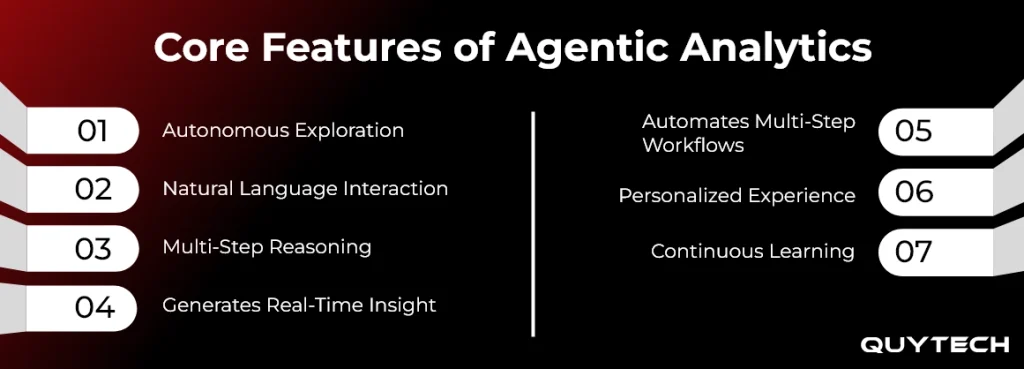
- Autonomous Exploration
Agentic analytics can explore data sources by itself. In simple words, it explores data, analyzes it, and looks for anomalies even if no one asks it to.
- Natural Language Interaction
Agentic analytics is like a human analyst. It can interact with users in natural language, unlike traditional analytics platforms that require technical dashboards to communicate.
- Multi-Step Reasoning
What’s really interesting about agentic analytics is that it is context-aware. It does not give shallow answers. It goes into details, correlations, and numerous factors to come to a conclusion.
- Generates Real-Time Insight
Agentic analytics provides organizations with real-time insights. It does so by analyzing data as it is generated and even keeps them updated as changes occur.
- Automates Multi-Step Workflows
Agentic analytics brings automation to all steps of the data analysis process. Meaning, it can carry out everything, be it data collection, insight generation, or action execution.
- Personalized Experience
Agentic analytics offers its users a personalized experience. It can provide tailored insights to users with different professional profiles from the same datasets.
- Continuous Learning
With every action agentic analytics takes, it learns. This learning is not limited to only outcomes, but also includes methods, data, and everything involved.
Recommended For You: AI Agents for Fraud Detection: Use Cases, Benefits, Challenges, and More
Why are Enterprises Moving towards Autonomous Data Lifecycles
Enterprises are now moving towards autonomous data lifecycles because traditional analytics fails to provide an end-to-end solution. They lack the flexibility to deal with dynamic enterprise environments. This section will break down the core reasons in detail:
- Rigid Analysis Logic
Traditional analytics are highly static and do not go beyond their pre-defined logic when analyzing data. It’s known to all that enterprises operate at a very different level, and binding analytics to a set of rigid rules will limit the insights they gain as well. Naturally, the decisions made from the outcomes of this analysis would lack quality.
Agentic analytics turns the tables by bringing adaptability. This enables it to change its methods of analyzing data, generating insights, and executing actions as favourable to the situation.
- Lack of Contextual Understanding
Conventional analytics methods do analyze data, but they lack contextual understanding. Meaning, that they can tell what data is relevant to each other, depict patterns, generate reports, but cannot understand how they are connected to the objectives of the enterprises.
Agentic analytics is contextually aware. It can not only understand the basics like patterns and interrelationships, but can also understand how these things relate to the enterprise objectives and the effect they leave.
- Continued Reliance on Human Intervention
Now, traditionally automated analytics can analyze data and generate insights from it, but their automation is heavily human-dependent. Analysts need to define everything: the task, what outcome is needed, etc. Even after insights are generated, the actual action that needs to be taken has to be carried out by humans only.
As mentioned already, agentic AI analytics handles the complete data lifecycle autonomously. It does not wait for human commands to begin, continue, or execute data analysis.
- Heavy Dependence on Clean and Structured Data
Traditional analytics methods need clean and structured data for analysis. This adds more complexity to the overall process because, as is known already, enterprises have their data scattered across tools, systems, departments, and whatnot. Since the data is also in different formats, analysis becomes challenging.
Agentic AI analytics does not require clean and structured data to conduct analysis. It is capable of collecting data from different sources and analyzing it even if it is not in a standardized format.
- Lack of Personalization for Decision-Making
Another drawback of traditional analytics is that they lack personalization. They deliver outcomes in a standardized manner, which would cater to a generic audience. For example, a dashboard shown to a finance professional would be almost similar to the one shown to a marketing professional.
Implementing agentic analytics in enterprises automatically opens doors for personalization. This is because it can tailor the insights, dashboards, and reports based on who it is catering to. This provides every user with information relevant to their work.
You Might Also Like: Use Cases of Agentic AI in Enterprise Businesses
How Agentic Analytics Works
Agentic analytics works by understanding the query raised, exploring data sources, analyzing them, generating insights, executing actions, and learning from them. Here’s a sequential explanation of agentic analytics’s working mechanism:
- Intent Recognition
In the first step, the user may raise a query or give a command in natural language. Core technology involved here includes LLMs, intent recognition models, etc.
- Autonomous Data Discovery
After recognizing the intent, agentic AI analytics will autonomously discover what data would be required here without human dependence.
- Data Retrieval
Once what’s needed is understood, agentic analytics goes through sources to retrieve this data. APIs power this step, allowing agentic AI to access tools and databases.
- Multi-Format Data Processing
After gathering data from various sources, it is processed. Agentic analytics can analyze structured, unstructured, and every sort of data altogether.
- Contextual Reasoning
Post-processing, agentic analytics starts deriving the context of the data. It understands patterns, correlations, cause and effect, etc. If the context is not clear, additional analysis is conducted.
- Insight Generation
Once context is derived, the next step includes generating insights from the data. Explainability is also utilized in this stage to help understand the factors that influenced the insights.
- Action Recommendation or Automation
Based on the insights generated, agentic analytics recommends actions. It can also automatically execute the action within the set guardrails.
- Feedback and Continuous Learning
The working mechanism of agentic AI analytics does not end at action execution. Its reinforcement learning and fine-tuning pipelines ensure that it learns from every task it executes and every feedback it receives.
Interesting Read: Top 6 Challenges in Deploying AI Agents: A Technical Guide
Benefits of Adopting Agentic Analytics
Now that you are aware of what agentic analytics is and how it works, it’s high time to understand the benefits that enterprises unlock after implementing it. The following are the core benefits of adopting agentic analytics:
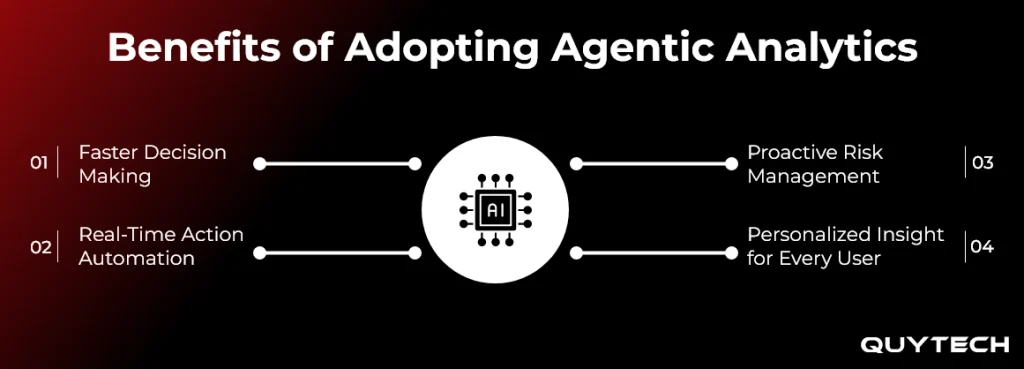
Faster Decision Making
Implementing agentic analytics in enterprises fastens decision-making processes. Unlike traditional analytics, it does not depend on humans to manually carry out every task. It automates everything from data collection to insight generation, naturally speeding up the process.
Real-Time Action Automation
In traditional automated analytics, automation is limited to generating action recommendations. The actual execution of the recommendations needs to be done manually. But agentic analytics changes the game. It not only creates an action plan but executes it as well.
Proactive Risk Management
Agentic analytics can proactively manage risks. It does not sit and wait for commands to analyze data. Instead, agentic analytics continuously collects and analyzes data as it is generated. This helps in identifying risks at early stages. It compares current and historical data to understand patterns and predict possible future threats and opportunities.
Personalized Insight for Every User
As is known already, traditional analytics systems give out reports and insights that are generic. People from different backgrounds get the same insights, which means that to find something relevant to their department, they would need to do manual analysis. But agentic analytics provides personalized insights, making it easier for users to understand and utilize.
People Also Like: The Rise of Voice AI Agents: Revolutionizing Support and IVR Systems

How to Implement Agentic Analytics: A Step-by-Step Guide
Here is a quick step-by-step guide that will help you create a roadmap to implement agentic analytics:
Step 1: Define Business Outcomes
The first and foremost step to implementing agentic analytics is to define the business outcomes. Highlight the expectations that you have with agentic AI for data analytics. This includes deciding on the core use case where you would like to begin the implementation.
Step 2: Create a Unified Data Foundation
Once the use case is decided, create a unified data foundation. This addresses the scattered data challenge that enterprises face. A unified data foundation will ensure that all the tools and departments across the enterprise have a centralized data management system.
Step 3: Deploy an Agentic AI Layer
Now comes the main element. In this step, the agentic AI framework is built or adopted. This layer would not follow scripts like the traditionally automated systems; it will understand the environment and act accordingly.
Step 4: Embed Context and Decision Intelligence
Once the agentic layer is established, the next step is to embed context and decision intelligence. For this, technologies like LLMs, AI models, etc., are utilized. Embedding context and decision intelligence is what will give agentic analytics its ability to understand context and automate actions.
Step 5: Define Guardrails and Automation Boundaries
Now, automation is integrated, so what’s left? Setting boundaries! In this step, guardrails and automation boundaries are decided. These ensure that every action that is automated follows compliance rules, ethical constraints, and security policies. Agentic analytics must know what areas they can explore and respond to and what areas would require human involvement.
Step 6: Pilot, Scale, and Continuously Improve
After defining the guardrails, deploy agentic analytics to real-world environments. Make sure that you start small so that you can refine and introduce changes if needed. Once testing is done, gradually scale the system across all departments. Continuously monitor the system and introduce updates when needed.
You Might Also Like: AgentKit vs Langchain: Best AI Agent Frameworks 2026
Real-World Use Cases of Agentic Analytics
To understand a technology as sophisticated as agentic analytics, you need to understand how it actually applies in the real world. So, here are some real-world use cases of agentic analytics:
Finance & Banking
- Applying agentic analytics to finance and banking helps in identifying fraud risks proactively. It continuously monitors activity and triggers alerts when an anomaly is detected.
- It also helps in detecting risks by analyzing customer portfolios for loan and credit requests.
- Along with this, agentic analytics automates regulatory compliance, eliminating the need for manual efforts.
Healthcare
- In healthcare, agentic analytics plays its role by analyzing patients’ historical and clinical data to provide timely medical treatments.
- It also automates administrative tasks like maintaining and updating information on bed availability, patient discharge, equipment usage, etc.
Retail & E-Commerce
- In retail and e-commerce, agentic analytics helps in forecasting demand in real-time. It analyzes historical demand patterns, seasonal fluctuations, and real-time user carts and wishlists to manage inventory accordingly.
- Along with this, agentic AI in analytics also helps in setting the price of commodities based on real-time demands.
Manufacturing
- Implementing agentic analytics in manufacturing helps in predicting maintenance needs by understanding past maintenance patterns and real-time machinery conditions.
- It is implemented to continuously monitor the production process to ensure that every step is conducted properly, quality is maintained, and no resources are wasted.
Technology & IT Support
- In the technical and IT support segment, agentic analytics monitors the performance of all the systems and activities.
- It can also oversee device activity, user behavior, etc., to ensure that no security threat goes undetected and causes any sort of damage to the network or digital resources.
Human Resource
- In HR, agentic analytics helps in maintaining the records of employee productivity. It analyzes real-time work patterns, workload distribution, task completion, etc., to do so.
- Along with this, agentic AI also analyzes the resource requirements in real-time and gives insights on allocation and hiring people accordingly.
Challenges and Limitations of Implementing Agentic Analytics
Implementing agentic analytics in enterprises brings in numerous benefits, but its implementation process brings its own share of challenges. Here are some of them:
- Lack of Quality Data
Agentic analytics provides insights and automates action based on the data it analyzes. Which makes it obvious that if the data itself lacks quality, the insights generated through it and the actions taken would lack the same.
- Trust Issues with Complete Automation
Now, we know that agentic analytics can automate the complete data lifecycle. But what raises a concern in the minds of enterprises implementing them is that actions are automated but not explained. Meaning, the reason that led agentic AI for analytics to execute a certain action is not being explained.
- High Costs and Complexity in Implementation
The costs for implementing agentic analytics can be quite high. And when paired with integration challenges, it can look like a lot of efforts resource wise. Organizations might feel skeptical about agentic AI adoption, as they may fear that their existing tools might not go well with sophisticated agents and can disrupt workflows.

Conclusion
The era of passive dashboards is coming to an end, and agentic analytics is redefining the standards of data analytics automation. It is giving traditional systems a much-needed makeover by not going beyond insight generation. Agentic AI in data analytics can handle the entire data cycle all by itself.
It handles everything, be it exploring data, analyzing it, or generating insights, and automating action execution. Implementing agentic analytics in enterprises not only helps organizations make faster decisions but also helps them take action in real-time. With personalized insights based on user profiles, agentic analytics is bringing both transformation and competitive advantage to organizations adopting it.
FAQs
Traditional BI tools can only provide dashboards and insights. Agentic analytics can act on these insights by itself.
The level of data maturity required to adopt agentic analytics includes centralized data sources, basic governance, and accessible storage.
Agentic analytics can be expensive to implement if you do not have the required readiness.
Yes, agentic analytics can handle unstructured data like emails or logs because it makes use of large language models and NLP, which helps it analyze natural language texts.
Yes, agentic analytics can be secured if proper security measures like data encryption, access control, activity monitoring, etc., are implemented.
Yes, you can implement agentic AI even if you don’t have a technical team by partnering with an agentic AI development company or by hiring developers.
