
Digital products today operate in an environment shaped by evolving cyber threats, expanding global regulations, and complex data ecosystems. In such an environment, unstructured data handling and non-compliant practices open the door to significant financial losses, regulatory penalties, and long-term reputational damage. But what could be the reasons behind such huge monetary losses?
One of the main reasons is treating security and compliance as a task of the legal team. Many organizations procrastinate governance for later development phases, which never arrive. As a result, the product developed ends up compromising data security aspects and other regulatory requirements.
This is where product engineering governance comes into play. It incorporates security, regulatory, and risk management practices in every development phase, be it ideation or deployment.
Want to know more about it? Read this blog to understand how product engineering governance ensures security and compliance throughout the product lifecycle.
What is Product Engineering Governance?
Product engineering governance refers to the set of rules, standards, and guardrails that guide the complete product engineering life cycle. It ensures that the product developed aligns with both the organizational objectives and security and compliance.
Product engineering governance establishes a standardized process. This process defines boundaries and rules for handling data, security, compliance, and other relevant aspects. Naturally, it introduces consistency, eliminates compliance gaps, and creates a clear picture of accountability.
Why Security and Compliance are Becoming Non-Negotiable in Product Engineering
Security and compliance are becoming non-negotiable in product engineering because of rising cyber threats and global regulatory requirements. Inclination towards highly data-centric products and the financial and reputational impact of breaches also contribute to the same. Let’s understand these reasons in detail:
- Rising Cyber Threats
One reason why security and compliance are becoming non-negotiable in product engineering is the rising cyber threats. Digital products operate in interconnected ecosystems. And since the number of connections increases, the number of entry points also increases, which makes digital products vulnerable to cyber attacks.
- Expanding Global Regulatory Landscape
As cyber threats are on the rise, global regulatory bodies have introduced more regulations. Regulatory compliances like the General Data Protection (GDPR), Health Insurance Portability and Accountability Act (HIPAA), are also introduced to impose strict rules of data collection, storage, management, and sharing.
- Rising Data Usage Demands Stricter Governance
Modern products are very data-centric. They utilize data to power every minor to major function they perform. Now, since data is getting utilized, something as little as an inconsistency in storing or managing the data can create vulnerabilities. Inconsistent data governance practices create gaps impacting data integrity and compliance.
- Financial and Reputational Impact of Breaches
As is quite obvious, security breach incidents can result in huge financial losses. However, this loss is not limited to here. Compromised security also results in impacting the reputation of the organization. It can raise data safety concerns in the minds of customers, increase churn, and create a negative brand image.
How Product Engineering Governance Overcomes Security and Compliance Challenges
Product engineering governance overcomes security and compliance challenges. It does so by introducing standardized security practices. Along with this, it provides built-in compliance controls and proactive risk management. Let’s understand them in detail:
- Standardized Security Practices
Product engineering governance overcomes rising cyber risks by introducing standardized security practices. It creates a formal procedure and rules to follow when carrying out data management activities, for example, implementing encryption practices, authentication protocols, etc. These practices reduce vulnerabilities and create a clear line of accountability.
- Built-In Compliance Controls
Product engineering governance handles regulatory compliance with built-in compliance controls. It creates a clear data processing and management standard that is followed in every step of development. This creates consistency and prevents the risk of audit failures and legal penalties.
- Unified Data Governance
Since fragmented data management creates numerous challenges, product engineering governance solves it with unified data governance. It introduces a framework to carry out every single data-related task, ensuring that its safety does not get compromised. Data encryption and access control practices ensure that even if there are vulnerabilities, the data cannot be accessed by external parties.
- Proactive Risk Management
Product engineering governance prevents financial and reputational damage by going beyond reactive risk management. It does so by proactively conducting regular vulnerability and penetration tests. This helps it assess risks related to third parties, unusual activities, etc. And since there’s a proper risk assessment system, incident response procedures are also introduced.
Benefits of Implementing Governance in Product Engineering
Implementing governance in product engineering brings in numerous benefits for organizations. It ensures regulatory compliance, provides legal protection, and builds customer trust. Let’s dive deeper and understand how each of these benefits creates impact:
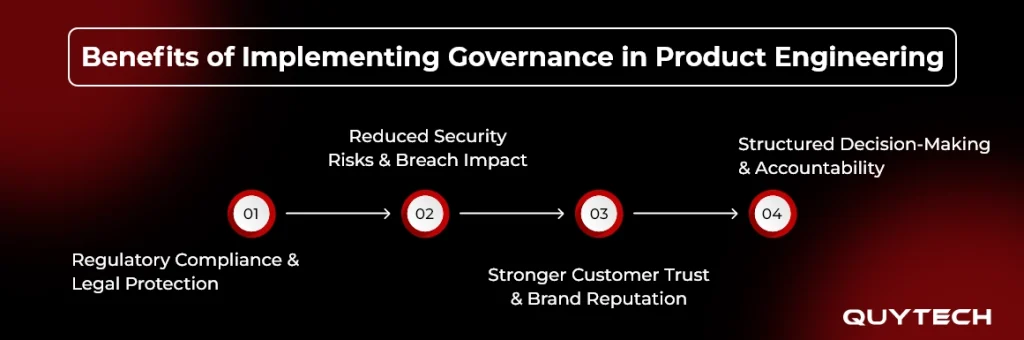
Regulatory Compliance and Legal Protection
Implementing governance in product engineering helps organizations comply with regulations and avoid penalties. This is because it ensures that the organizations developing the product follow every required regulation, be it regarding data security, like GDPR, or certain industry-specific ones.
Reduced Security Risks and Breach Impact
A very obvious benefit that product engineering governance brings in is that it reduces security risks and breach impacts. It protects user data through data protection practices like encryption and compliant business systems. This lowers financial and operational losses and ensures that even if security gets compromised, damage remains controlled.
Stronger Customer Trust and Brand Reputation
Implementing product engineering governance maintains stronger customer trust. This is because an organization that follows data security and compliance practices builds trust in the minds of customers that their data is in safe hands. This trust directly influences loyalty towards the brand and enhances reputation in the market.
Structured Decision-Making and Accountability
As mentioned already, product engineering governance establishes a very clear structure in the workflows. It clearly defines the responsibilities, methodologies, frameworks, and policies that give clear ownership of outcomes and reduce internal conflicts. This makes decision-making structured and also defines accountability.

Common Challenges in Implementing Product Engineering Governance
While product engineering governance brings in numerous benefits, it brings its fair share of implementation challenges as well. Here are some of them:
- Balancing Speed and Security
As is known already, the digital landscape is very fast-paced, competitive, and values faster time-to-market. But implementing governance in product engineering is more of a comprehensive process. It involves multiple steps like risk assessments, compliance checks, testing, validations, etc. This imbalance ends up making governance a secondary step in product engineering.
- Evolving Regulatory Compliance
The regulatory environment is very dynamic and changes frequently across regions and industries. They regularly update, and keeping up with them becomes very hard. Naturally, this dynamicity of the regulatory requirements adds more to the list when it comes to implementing governance in product engineering.
- Legacy System Constraints
Another core challenge that makes product engineering governance difficult is legacy system constraints. Many organizations use legacy systems, which are not technically capable of integrating with modern security practices. Even if governance is still implemented in these systems, it can disrupt existing systems and their workflows.
Future Trends in Product Engineering Governance
Product engineering governance is much more than a compliance necessity. It is the strategic step that helps organizations build digital products that are not just innovative but also compliant and secure. Below are some of the major trends influencing its evolution:

- AI-Driven Security Monitoring
The future holds AI-driven security monitoring for product engineering governance. It will give security and compliance a complete makeover with the help of artificial intelligence. AI-driven security monitoring will make cyber threat detection faster and more accurate, making security processes proactive instead of reactive.
- Zero Trust Architecture
Zero-trust architecture is yet another future trend to watch for product engineering governance. It will enhance data security with its approach of trusting no user, be it an insider or an outsider. This will reduce insider threats and will shift governance from perimeter-based security to identity-based security.
- Privacy-Enhancing Computation
Privacy-enhancing computation (PECs) is also a transformative future trend of product engineering governance. It will allow organizations to process, store, manage, and share customer data, all while keeping it secure through different encryption techniques. This will allow insight extraction without exposing real data to anyone.
How Quytech Helps Organizations Adopt Product Engineering Governance
Quytech helps organizations move from fragmented and inconsistent workflows to structured governance systems. With our industry-richa experience and technological expertise, we understand the data security, compliance, and governance landscape. After analyzing the requirements, we incorporate governance throughout the development phase.
We put strong emphasis on building tailored and scalable governance solutions. These solutions offer clear accountability and compliance structures. Quytech also has strong expertise aligned with standards like ISO and GDPR. This reflects that governance is implemented with consistency, reliability, and strong regulatory alignment.
Conclusion
There’s no denying that customer data is making digital products even more advanced. But with that power comes a growing responsibility. The responsibility of keeping the data safe, maintaining customer trust, and staying compliant with dynamic regulatory requirements. This is where product engineering governance plays its role.
It helps organizations follow standardized security practices that maintain consistent governance. Built-in compliance controls ensure that the product engineered meets all regulatory requirements. Product engineering governance protects organizations from legal penalties, reduces security risks, and gives scattered workflows a structure.

FAQs
Product engineering governance reduces time-to-market by eliminating the need for rework on security issues and compliance gaps.
Product engineering governance improves audit readiness by continuously documenting processes rather than relying on fixed annual reviews.
Yes, startups can implement product engineering governance without slowing innovation. They can do so by adopting automated governance frameworks.
Implementing product engineering governance brings a positive impact on product ROI as it prevents financial and reputational loss caused by cyber attacks and legal penalties.
Product engineering governance supports multi-product organizations by standardizing processes and controls across products, ensuring consistency and reducing duplication.
Yes, product engineering governance is scalable for fast-growing startups. In fact, implementing governance earlier is far more cost-effective than going for it later.
