According to Deloitte, approximately 80% of digital products fail to deliver real-world impact. Do you know why? One of the major reasons is the ‘Lack of proper planning’. Here, we are not implying that organizations don’t plan before building a digital product; they do. However, they may overlook numerous factors. These include the feasibility of the product, i.e., ensuring whether the product actually addresses the targeted need, complies with regulations, and considers various other factors.
So, to not miss such crucial factors, it is important to understand and follow the product engineering life cycle. This life cycle is like a map or a blueprint that guides everything, be it what step needs to be executed or what sequence and method to follow.
This blog walks you through that very roadmap and explains how the product engineering life cycle actually works in practice.
What is Product Engineering?
Product engineering can be defined as a stage in the product development life cycle that brings a product idea to life. It includes core steps like designing, development, testing, and optimization of a product.
In simple terms, product engineering is the step where the development team assesses the idea of the product and performs steps to turn that idea into a usable product. The core focus of product engineering is to develop a product that not only delivers functionality but also elevates the experience of users utilizing it.
Strategic Roadmapping Before Product Engineering
Before directly jumping to the product engineering life cycle, there’s something more important that is actually the beginning of it all. It’s ‘strategic roadmapping’. It gives enterprises the idea of what they actually want to develop. Here are four critical aspects that influence the strategic roadmapping phase:
- Determining Product Orientation: Internal or External
A very crucial decision influencing the digital product engineering life cycle is deciding product orientation. This includes determining whether the product will be developed for internal organizational use or to cater to an external audience. Product orientation decision plays a vital role because it sets a foundation for the product development process and impacts the user experience, scalability, and numerous other factors.
- Establishing the End-User Experience Vision
This aspect defines how you expect the end users of your digital product to interact with it. And since the main focus of this step is the users, it is built around their needs, preferences, and expectations. Factors like what audience it would cater to, intuitiveness, automation, personalization, etc., are taken into consideration when establishing the end-user experience.
- Stakeholder Identification and Alignment
Stakeholder identification and alignment means determining the people who would be influencing the product and ensuring that they are all on the same page. This is done to ensure that the interests of all these stakeholders are kept in mind before developing the product. It ensures that the development cycle goes smoothly without any interest conflicts.
- Compliance, Governance, and Risk Considerations
Compliance, governance, and risk considerations are areas that require a lot of attention. This is because they decide if the product you are planning to develop fits the defined boundaries. For example, a license is necessary before developing a pharmaceutical product. Such considerations ensure that the product developed can be deployed without worrying about legal penalties.
- Defining Monetization Strategy and Value Realization
This aspect helps enterprises explore ways through which they would generate value from their digital product. This value is not limited to money generation only; it includes efficiency enhancement, cost saving, etc. For example, an enterprise developing a digital product for its operation would want cost and operational efficiency to be of value. Whereas, one catering to an external audience would place its value in revenue generation.
Interesting Read: Voice Assistant Technology: Enhancing Users’ Experience
Understanding the Product Engineering LifeCycle
The product engineering life cycle consists of phases ranging from discovery to deployment, support, and maintenance. The life cycle roughly has about 6 phases, and this section breaks them all down. Here’s how it goes:
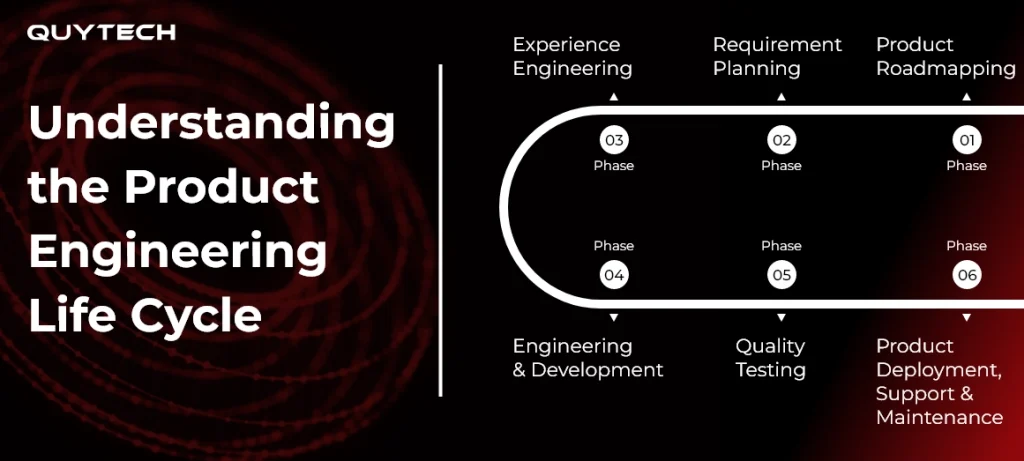
Phase 1: Product Roadmapping
Product roadmapping is the first and foremost phase of the product engineering life cycle. It takes place after the core aspects, as mentioned previously, are dealt with. Here’s what product roadmapping handles:
- Consultative Discovery
Consultative discovery is the step where the product’s purpose and direction are defined by conducting structured discussions. These discussions create a proper vision of what the product will deliver, who it will target, how it will cater to them, priorities, constraints, etc.
The decisions taken in this step are made with a product engineering partner. So, whatever is decided is implemented in the development phase.
- Creating the Product Roadmap
Once all these concerns are properly taken into account and addressed, a systematic roadmap is created. It includes defined development phases, strategies, milestones, etc.
The product roadmap ensures that everything goes in sync and is aligned with long-term objectives.
Phase 2: Requirement Planning
Once the product roadmap is defined, the next phase is requirement planning. It involves:
- Defining Product Requirements
Defining product requirements is the stage where all the requirements for digital product engineering are mapped. This step counts everything from functional to non-functional requirements. It ensures that everything that is required for every phase of the product engineering life cycle is accessible.
- Evaluating Technical Feasibility
In this step, technical feasibility is evaluated. For example, assessing whether the features can be supported by the existing technical resources. This step helps in identifying technical constraints, dependencies, and risks that may negatively impact the digital product development life cycle.
- Incorporating Compliance Needs
Incorporating compliance needs is a very crucial aspect of requirement planning. It ensures that all the legal, regulatory, and governance-related rules are complied with. Following compliance requirements eliminates the risks of being legally penalized.
Phase 3: Experience Engineering
The experience engineering phase of the digital product engineering life cycle is the stage where the perspective of a user is designed. It starts with:
- Understanding User Journeys
As the name itself makes it obvious, this stage is where the user journeys are conveyed. The ideas on how things will be handled, users would be onboarded, etc., are discussed to further develop them.
- Designing the User Experience
Once the idea is systematically thought out and discussed, it is brought to life by designing the user experience. The journeys are created by keeping factors like intuitiveness, intended experience vision, etc., in consideration.
- Building Interactive Prototypes
Since it’s the user experience that is being created, there are chances that it might need corrections later. So this step is where user experience prototypes. They are created to see if what was planned as the ideas can actually be implemented and introduce changes if needed.
- Validating Usability
Once the user experience is brought to life, it is tested for usability. This step helps in identifying if the features and expectations that were implemented are actually achieved. Any feedback received from this stage is sent back to improve the user experience.

Phase 4: Engineering & Development
Once the user experience has been developed, the actual engineering and development phase comes into action. Here is how:
- Designing System Architecture
System architecture design is the step where the actual technical development begins. Just like how the user experience decides how the user would interact with the digital product, the system architecture decides how everything will function and connect.
- Building the Core Product
Now, after designing the blueprint, the development of the actual product begins. This step includes building the screens, features, dashboards, and everything that powers the functions that users are going to exercise.
- Integrating Systems and APIs
Digital products often need to interact with multiple systems and tools that power their functionality. So, this step binds the digital product with supporting systems like databases, existing systems, etc. The integration is done by APIs.
Phase 5: Quality Testing
After the digital product is developed, the next step is quality testing. This phase includes:
- Testing Product Functionality
This step involves testing the digital product to determine if it meets the expectations that were implied for it. The testing is conducted from the user’s perspective, and all features and workflows are thoroughly checked.
- Checking Performance and Security
Now, testing is not limited to only features and workflows. Performance and security are also aspects that are analyzed. They are tested to ensure the product performs well even if there’s heavy traffic, and that no data collected is compromised in terms of safety and use.
- Fixing and Refining Issues
Once testing is conducted, identified bugs and errors are sent back to the product development team. They fix and refine to address the issues.
Phase 6: Product Deployment, Support & Maintenance
Once the quality testing phase comes to an end, it’s time to deploy the digital product in a real environment. This phase includes:
- Releasing the Product
In this stage of the product engineering life cycle, the digital product is officially launched. This can be done either to the internal teams, clients, or the public.
- Monitoring Performance & Resolving Issues
Here, the product is continuously monitored to ensure that it functions seamlessly. If any performance issues are encountered, the teams resolve them. This is to ensure that the product delivers the user experience that is expected from it.
- Improving the Product Over Time
Along with this, collecting user feedback, usage patterns, etc., can be utilized to understand evolving user needs and address them by introducing updates.
You Might Also Like: The Vital Role of UI/UX Design in a Mobile Application: Enhancing User Engagement

Conclusion
The product engineering life cycle serves as a comprehensive blueprint. It guides every stage of product development- be it product planning or deployment and beyond. It introduces a systematic and strategic approach to the product development process.
This strategic roadmapping helps organizations prioritize aspects like product orientation before starting the digital product development life cycle. Digital product engineering ensures that development takes place only after the user experience is defined.
It identifies the stakeholders, understands their needs, and ensures that they are aligned with the overall product development strategy. We can conclude that following a structured product engineering life cycle enables enterprises to deliver their vision while staying true to long-term objectives.
See How Quytech Helped Eastman to Digitize its Entire Business Ecosystem
Project
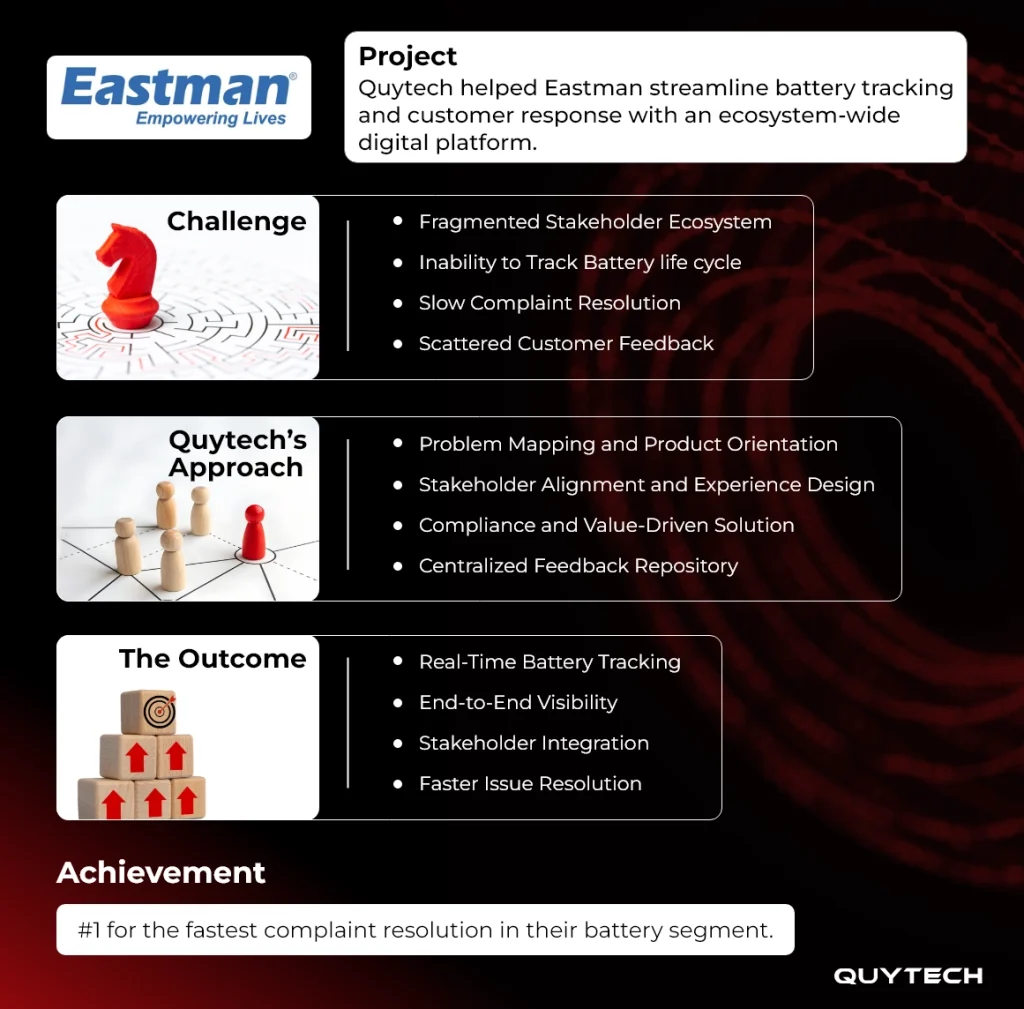
Eastman, a battery manufacturer, struggled with fragmented systems and disconnected stakeholders. These challenges made it hard for them to track the batteries and give a quick turnaround to customer complaints. Quytech helped them address these challenges by developing a digital product that was integrated into their entire ecosystem, from manufacturing plants to service centers.
Challenge
- Fragmented Stakeholder Ecosystem
The systems across manufacturing units, service centers, warehouses, customers, etc., were fragmented.
- Inability to Track Battery life cycle
Battery life cycles were hard to track because there was no unified platform or source to monitor them.
- Slow Complaint Resolution
Information silos and poor coordination made it difficult to track complaints faster, naturally slowing down complaint resolution.
- Scattered Customer Feedback
Feedback systems were scattered, making it hard to spot issues and improve service quality.
Quytech’s Approach
- Problem Mapping and Product Orientation
Quytech connected with Eastman to understand the problem statement deeply. Each challenge was mapped to a specific pain point, and the orientation of the digital product was decided.
- Stakeholder Alignment and Experience Design
All the major stakeholders, like the manufacturing plants, service centers, warehouses, customers, etc., were aligned. This ensured that every stakeholder is connected to one unified end-user experience vision.
- Compliance and Value-Driven Solution
Quytech placed a special emphasis on compliance. We built the digital product around real user expectations to ensure it delivers measurable value.
- Centralized Feedback Repository
The centralized connection gave one accessible platform where user feedback from all the channels could be collected and managed.
The Outcome
- Real-Time Battery Tracking
The outcome of our dedication was a digital platform that gave Eastman a real-time tracking system.
- End-to-End Visibility
This platform gave a unified view of every battery, right from where it’s manufactured to the end customers.
- Stakeholder Integration
Being integrated with every stakeholder, the digital product gave Eastman a competitive advantage.
- Faster Issue Resolution
The platform helped them gather direct feedback and resolve complaints faster than competitors.
Achievement
#1 for the fastest complaint resolution in their battery segment.
FAQs
Once a product is deployed, it can still be changed. This is because it’s monitored continuously to ensure it meets the expectations of the user, and if any deviation is noticed, it can be resolved.
Yes, companies can measure the success at each phase of the product engineering life cycle. This can be done through clear milestones, stakeholder approvals, user feedback, etc.
Yes, the product engineering life cycle can work for small-scale digital products. It’s flexible and can be blended with different priorities and organizational goals.
Yes, the digital product engineering life cycle can be applied to legacy system modernization.
The traditional software development approach mainly focuses on building functionality. But the product engineering life cycle focuses on strategy, user experience, stakeholders, compliance, and long-term product value.
