For years, most enterprises kept focusing on measuring velocity, deployment frequency, and lines of code to determine the product engineering ROI. The truth is, these engineering outputs are only useful to manage teams. They don’t give any clarity on the tangible business value and further cause expensive misalignments in modern technology organizations.
For those enterprises, engineering is considered a cost center, not something that creates value because it never shows the outcome in a language stakeholders want to see or the company can act on. The entire scenario shows that enterprises need to follow the right measurement framework and should know how to measure product engineering ROI.
This is what this guide does. It breaks down exactly what metrics to measure, when to measure, the stepwise ROI framework, and ways to turn product engineering ROI into a strategic language your entire leadership team can speak.
Without further delay, let’s start!
What Does Product Engineering ROI Mean
For different engineering leaders, the meaning of product engineering ROI may be different. Some may use a formula, while others may prefer velocity charts. However, having this definitional ambiguity can be a root cause of measurement failures. So, before moving forward, let’s clarify the meaning of product engineering ROI:
The textbook ROI formula is:
ROI = (Net Benefit- Investment Cost)/Investment Cost * 100
It means comparing the financial impact, i.e., increased conversion/upsell/retention, with the cost of building. However, this ROI formula doesn’t really work well for product engineering. That’s because in the case of product engineering, broader factors such as market conditions, product complexity, pricing strategy, and others directly impact the overall revenue performance.
3 Layers of Product Engineering ROI
Experts say that product engineering creates value across three different layers, which need to be considered together to get a clear picture of the “return on investment.” These layers are:
| Hard ROI (Financial) | Soft ROI (Quality, Experience, and Operational Health) | Strategic ROI (Optionality, Speed, and Market Position) |
| It involves revenue generated, cost savings from automation or process efficiency improvements, and faster time-to-market. | It involves values that don’t appear directly on the profit and loss statement but directly affect business performance. For instance, engineering quality metrics like defect rates, system reliability, and others impact customer trust. | This layer captures the value of your engineering investments, i.e., scaling without re-architecting, speed gained from reducing technical debt, market position preserved by outdoing a competitor, etc. |
While measuring the product ROI, it is crucial to have a strong ROI framework that resonates with product strategy, execution, and metrics with growth, retention, and measurable business outcomes.
Similar Read: Product Engineering vs Custom Software Development: Key Differences
What is the Right Time for Calculating Product Engineering ROI
Not just the right metrics, calculating product engineering ROI also needs to be done at the right time. In short, timing failure is what most enterprises don’t pay attention white defining the ROI of product engineering.
Yes, it is true that most teams start measuring ROI after the product is shipped or even later. At that time, the measurement is done backwards because the attribution window is closed and engineering decisions have already been made.
So, instead of evaluating ROI at only two points, i.e., during initial approval and after the completion of the product, start measuring ROI across the entire product lifecycle:
- During Strategy & Planning: Clearly define expected outcomes such as revenue growth, user adoption, or cost efficiency.
- At the Design Stage: Thoroughly evaluate how UX decisions and feature prioritization will impact engagement, retention, and overall business value.
- Throughout Development: Track engineering efficiency, resource utilization, and velocity to ensure investments are aligned with intended outcomes.
- At Pre-Launch Readiness: Assess scalability, performance, and potential operational costs to avoid post-launch surprises that impact ROI.
- Post-Launch and Growth Phase: Measure real-world metrics like user behavior, retention, revenue contribution, and maintenance costs to validate ROI.
- During Iteration and Scaling: Continuously refine the product based on insights to improve long-term returns and eliminate inefficiencies.
Important: Don’t forget to compare the anticipated ROI with the actual ROI. This will help you become better at predicting engineering value and prioritizing the highest-leverage work.
Similar Read: Product Engineering Life Cycle: A Complete Overview
Product Engineering ROI Scorecard: What Should You Actually Be Measuring
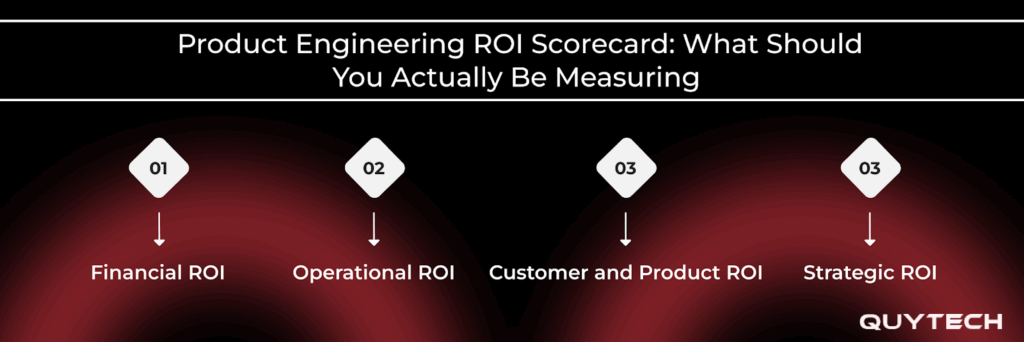
Measuring one dimension of value and seeing it as the full picture is one of the biggest mistakes, due to which most engineering ROI frameworks collapse. Every measuring metric, including revenue generated, velocity tracked, and deployment frequency logged, needs to be evaluated altogether to find out whether your engineering investment is working or not.
But, considering only the financial metrics may not fully help you determine the success of your product. There needs to be a scorecard that includes every metric that not only shows the success of the product but also ensures that it aligns with the outcomes that actually drive decisions. Let’s categorize them into four categories:
1. Financial ROI
Financial ROI is the baseline; its main aim is to capture revenue generated after implementing new product capabilities and measure the cost reduction or operational efficiency improvement after implementing automation. It could also be tracking the overheads reduced from improved system reliability.
Key financial metrics to track
- Revenue attributed to new capabilities
- Cost-per-feature delivered
- Support ticket reduction post-release
- Time-to-revenue from concept to customer
2. Operational ROI
This dimension directly relates to engineering execution quality, a product engineering ROI factor that gets overlooked in executive reporting. Operational ROI creates a direct line between engineering behavior and commercial outcomes, such as time-to-market, release confidence, and deployment frequency.
It also captures the cost of technical debt, i.e., interest payments that get accumulated silently when the engineers take shortcuts while writing code or designing the product.
Key operational metrics to track
- DORA four metrics (deployment frequency, lead time for changes, MTTR, change failure rate)
- Tech debt accrual rate
- The ratio of new capability work versus maintenance work.
3. Customer and Product ROI
Financial ROI measures the tangible business value. Similarly, operational ROI measures the efficiency of the engineering team. Now, customer and product ROI determine the impact of the product on people or end-users.
In other words, a product’s success greatly depends on metrics like user engagement, customer retention, feature adoption rates, and time-to-value for end users. And to achieve this goal, i.e., delivering exceptional customer experience, has brought a new valuable metric called the Developer Experience Index (DXI).
Key customer and product metrics to track
- Feature adoption rate
- Time-to-first-value
- NPS delta post-release
- User retention impact
- Support deflection rate.

4. Strategic ROI
Strategic ROI often gets overlooked when defining the product engineering ROI. It is also the hardest dimension to quantify; however, companies that consider it a key ROI dimension get an advantage over those that don’t. But what exactly is it?
Strategic ROI measures the value of what engineering investments enable rather than what they directly produce. It involves tracking the ability to scale without making any investment in rearchitecture, improved speed received from delivery excellence, improved market position, and more.
Key strategic metrics to track
- Scalability headroom delivered
- Time-to-market advantage vs. competitive benchmark
- Risk incidents avoided and their estimated cost
- AI-augmented productivity delta vs. pre-AI baseline.
Please note that the four-dimensional metrics need to be considered together for calculating product engineering ROI accurately. This multi-dimensional ROI scorecard ensures that no single dimension gets overlooked while the other one gets the maximum attention.
You may like to read: 8 Technologies Enterprises Leverage to Build Competitive Products
5 Steps to Building a Reliable Product Engineering ROI Measurement System
Having a clear idea of what to measure or when to measure is imperative, but what also needs equal attention is building a measurement infrastructure that runs continuously and improves its accuracy with time. Let’s take a look at the stepwise process to measure the product engineering ROI.
Step 1: Define Outcomes Before Writing Code
The first step is to get a clear answer to the business metric that is intended to move and in what time period, and by how much. Also, define how the enterprise will know that the desired outcome has been achieved. Any error or ambiguity at this stage can inflate the overall cost of product engineering while undermining the projected ROI.
Step 2: Map the Value Chain
The next step is to make a clear roadmap between engineering work and business impact. Clearly, document the flow for each and every initiative. This flow will go like engineering capability delivered -> product behavior changed -> user behavior changed -> business metric moved.
Step 3: Establish Baselines Before You Build
As mentioned earlier, ROI is a relative measurement. It is because without having a clear idea of the existing state, it is difficult to understand the impact generated after using a product. Therefore, capture the present state of every metric, considering the scorecard that has been mentioned above, before beginning with product engineering.
Step 4: Instrument for Measurement
If you think implementing a new feature without mentioning a measurable metric is enough, then you are wrong. It is important to define the measurable metric or infrastructure during the sprint planning, not after the budget is planned. You have to clearly mention what, how, and where the data will be captured.
Step 5: Run ROI Retrospectives
Set a feedback loop timeline and run structured reviews after the shipment. You can do it at 30, 90, and 180 days post-shipment. Don’t forget to compare the anticipated ROI against actual ROI; do it for all four dimensions, i.e., financial, operational, strategic, and customer & product. This will provide you with highly accurate ROI estimates.
Also Read: Offshore vs In-House vs Hybrid: Choosing the Right Team Structure for Product Engineering

The Pitfalls That Quietly Kill Your ROI Measurement Efforts
You have a well-designed ROI framework, but it may still fail because of the following pitfalls:
- Measuring only what’s easy, including velocity, lines of code, etc. They are essential, but other metrics are equally important to ensure accuracy, alignment with outcomes, and long-term thinking.
- Ignoring the total cost of ownership, such as the cost of long-term maintenance, cloud hosting, security updates, and feature updates in the future. This is a critical mistake that can impact the calculation of product engineering ROI.
Explore in detail: Total Cost of Ownership in Digital Product Engineering: A Complete Guide
- Over-measuring until the system collapses. You might be surprised to learn that there is a version of ROI measurement that can become a problem. Therefore, you need to build a truly defensible ROI system without placing an unnecessary burden on engineering teams and allowing them to focus on work.
- Treating ROI as a verdict instead of a signal. It means using ROI measurement as something to blame for missed targets or to justify cutting engineering investments. Remember, product engineering ROI measurement works when it functions as a learning signal.
- Misaligned stakeholder goals. When it comes to product engineering ROI, the product team focuses on optimizing user engagement, executives focus on revenue growth, and engineering teams ensure technical excellence. In all this, what stakeholders expect gets ignored.
You may be interested in: 9 SaaS Product Engineering Trends to Watch in 2026
How to Translate Engineering ROI for Every Stakeholder
Every stakeholder has different expectations when it comes to calculating product engineering ROI:
| Stakeholder | Lead With | Frame It As |
| CFO | Cost savings, revenue attribution, TCO, risk reduced | Capital allocation with measurable return |
| CPO | Feature adoption, time-to-value, NPS delta, churn reduction | Delivery speed is connected to product iteration capability |
| CEO | Speed-to-market, scalability headroom, AI productivity gains | Engineering as the engine of competitive position |
Insightful Read: Why Even Well-Funded Product Engineering Initiatives Fail and What CIOs Must Do Early
How Quytech Helps You
Measuring product engineering ROI is one thing, and having an engineering partner who builds your product considering the accurate ROI right from the first conversation is a cherry on top. That’s where Quytech comes into the picture. We are an experienced product engineering partner that global enterprises from diverse industry verticals such as manufacturing, BFSI, healthcare, and e-commerce trust for their product engineering initiatives.
We have dedicated product engineers who design a strategic roadmap to ensure your product stays aligned with your requirements and ROI while overcoming end-user challenges, meeting stakeholder requirements, and adhering to compliance risks. We specialize in:
- Product engineering consulting
- End-to-end product engineering
- Agentic AI in product engineering
- Generative AI in product engineering
Interesting Read: Product Engineering Governance: Ensuring Security and Compliances
Conclusion
Product engineering ROI needs to be calculated before the sprint, not after the budget reviews. It is not a reporting exercise; rather, it is a continuous feedback loop that helps an enterprise understand that its engineering efforts are going in the right direction, i.e., towards the success of its product.
But most companies focus on shipping fast and tracking only the DORA metric (defined in the blog earlier). It may work sometimes, but mostly doesn’t because many other metrics get missed out. This blog provides you with everything associated with product engineering ROI, ranging from when to measure it, how to measure it, and a stepwise framework to the pitfalls that can silently kill your product engineering effort.

FAQs
Measuring ROI for a product engineering investment depends on the type of industry, timeframe, and a few other factors. Instead, make sure that your engineering investments outperform capital across all ROI dimensions.
Product engineering investments take up to 18 months to show financial outcomes. That’s why it is important to track indicators such as adoption rates, deployment frequency, and time-to-value along with financial metrics.
Yes. Misallocated engineering investments hit harder, especially when done at a smaller scale. Go through the five-step framework in this guide to understand how to measure product engineering ROI and implement a framework for the same.
The full cost of product engineering includes opportunity cost, tech debit accrual, rework and defect cost, and coordination costs and decision overhead. Calculating product engineering ROI requires considering the full cost base and hard, soft, and strategic layers that have been mentioned in this blog.
