When planning to build a digital product, one of the top concerns that significantly impacts your investment is the total cost of ownership. Most enterprises calculate this cost by bringing discovery, design, development, and QA to the approval table, but what often gets overlooked is the infrastructure, the engineering capacity, compliance overhead, and product architecture decisions.
This can lead to the miscalculation of TCO for digital products and make it expensive over time. Therefore, along with considering the cost of different phases of a product development lifecycle, the cost of scaling infrastructure, maintaining the product, and evolving it for innovation also needs to be considered.
To determine that cost before even writing a single piece of code, check out this guide to calculating TCO of a digital product. It thoroughly explains how to calculate the TCO of product engineering, where the hidden costs are buried, and which among the build-vs-buy options would be suitable for your product.
Here is everything you need to know:
What is the Total Cost of Ownership in Digital Product Engineering
Before taking a look at the ways to manage or precisely calculate the TCO, it is crucial to understand what it is. The total cost of ownership in product engineering is a financial estimate that helps companies determine how much it will cost to build and maintain the digital product. It includes both direct and indirect costs, from initial development to ongoing expenses.
It differs from any other software cost calculation as every architectural decision, tech stack election, cloud configuration, and team structure that leaders decide on contributes directly to the cost of development and maintenance of the product. For a better understanding of the difference, let’s understand the 5-layer TCO architecture for digital products.
5-layer TCO Architecture for Digital Products
| Development | Involves the cost of researching, designing, developing, testing, and launching the product. |
| Operations | It means the ongoing cost of running the product once it successfully launches. This may include the cost of cloud, bandwidth, and licensing fees. |
| Maintenance & Support | It’s about troubleshooting glitches, security patches, and compliance remediation to ensure the product is stable and doesn’t have any functioning challenge. |
| Evolution & Scaling | This TCO architecture involves the cost of scaling the product by equipping advanced features, expanding its horizon, integrating new technologies, and re-architecting it to improve performance. |
| Decommissioning & Retirement | Even ending the product’s life incurs cost; therefore, this layer becomes a vital part of the product. The cost is required for data migration, user transition support, infrastructure teardown, etc. |
Core Cost Categories of Digital Product TCO
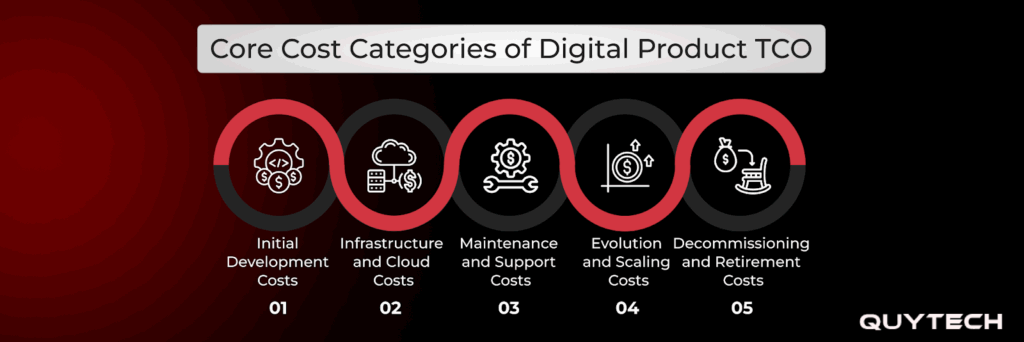
Now, you have enough idea of a digital product’s TCO architecture. Let’s dig deeper to know where the money actually goes. This section explains each distinct cost category that contributes to the total cost of ownership for product engineering.
Please note that these costs don’t operate independently; the decision made in the first category significantly impacts the spending needed for the second, third, and further categories.
1. Initial Development Costs
This cost is a part of almost every presentation that reaches the leadership team for approval. It includes the cost of every phase of the product development lifecycle, ranging from concept and UX research and design to front-end and back-end engineering, and QA and testing. Initial development costs are visible and calculable.
Initial development costs are visible since the beginning of product development. However, its impact doesn’t stop even after the launch of the product. If the engineering team had taken any technical shortcut or been delayed in adding any feature, it may have added to the total cost of ownership as the product grows. In short, what you do during the initial phase of development significantly affects the long-term costs of the product.
What to track:
- Engineering hours spent
- Third-party development costs
- Cost of tooling and licences used for the product development
- QA automation investment
- DevOps infrastructure setup
Know more: Product Engineering Life Cycle: A Complete Overview
2. Infrastructure and Cloud Costs
The next cost category is infrastructure and cloud costs. It includes the cost of cloud storage, content delivery, managed database services, and monitoring and observing tools required to keep the product running. Apart from this, the licensing cost of APIs and third-party integrations also adds to the cost of infrastructure.
In some cases, this cost rises faster than planned. It may happen because of not revisiting the infrastructure configurations that were set during development. Another reason could be not right-sizing the resources assigned for peak load. Apart from these two, a lack of FinOps discipline can also increase the infrastructure and cloud costs.
What to track:
- Cloud compute and storage costs
- Bandwidth and egress fees
- Third-party API costs
- Cost of idle and underutilized resources
3. Maintenance and Support Costs
Another cost category that is a significant contributor to the TCO for digital products is support and maintenance costs. Many organizations underestimate it during product investment. But the truth is, this cost may expand without any warning. Now, what does it encompass? It includes the cost of troubleshooting glitches, fixing security patches, ensuring smooth performance, compliance remediation, etc.
The core aim of support and maintenance is to keep the product running flawlessly and as expected. One of the main reasons for the increased cost of product maintenance and support is poor architectural decisions that were made to accelerate product shipping. Organizations that prioritize quality right from the beginning can have this cost under control.
What to track:
- Engineering hours spent on maintenance
- Bug fix velocity
- Patch cycle frequency
- Security incident response costs
- Compliance remediation spend
Read in detail: Product Engineering Governance: Ensuring Security and Compliances
4. Evolution and Scaling Costs
Evolution and scaling costs are a must to consider while calculating the cost of ownership for product engineering. Let’s understand this in simple words. Any digital product that was built flawlessly and is now successful can remain like this only when it is evolved and scaled to accommodate a growing user base and with changing market trends or business requirements.
And to ensure it is up-to-date with new features and delivers exceptional performance, an enterprise needs to take care of its continuous evolution. Products with monolithic architectures may fail here and lead to a significant increase in the scaling costs. On top of that, re-architecting the product after it is built and already being used by thousands of customers can also increase costs two to five times more than building for scalability from the start.
What to track:
- Feature development cost per release
- Re-architecture project spend
- Performance optimization investment
- AI/ML integration costs
- Talent overhead for specialist scaling work
Explore More: Enterprise Product Modernization: Turning Legacy Systems into Future-Ready Products
5. Decommissioning and Retirement Costs
The last cost or the final layer of TCO is what most organizations often ignore. When a digital product reaches end-of-life, there are several steps that need to be taken. Data needs to be migrated to successor systems. Apart from this, the product needs user transition support and contractual wind-downs with service providers. An enterprise also needs to consider the regulatory obligations defined specifically for data retention and deletion.
The architecture of the digital product matters here as well. If it is poorly designed, it may elevate the retirement costs. Similarly, some other obstacles to successful retirement are data silos, vendor lock-ins, and undocumented or incompletely documented integrations.
What to track:
- Data migration scope and cost
- Vendor exit clause obligations
- Infrastructure decommissioning timeline
- Compliance data retention costs
- Knowledge transfer overhead
Hidden Costs That Silently Inflate Your TCO
The aforementioned cost categories are the ones that every organization planning to build a digital product should track. Apart from those costs, other costs that quietly come along and came in limelight only during a financial review are the following:
1. Technical Debt
It is a hidden cost that sticks silently to the total cost of ownership in product engineering. It builds up when the engineering team doesn’t follow the defined development roadmap and often takes shortcuts. Fixing these shortcuts after the product is launched requires additional effort, time, and costs.
Take a look at: Why Even Well-Funded Product Engineering Initiatives Fail and What CIOs Must Do Early
2. Security and Compliance Overhead
For any digital product, it is not sufficient to ensure compliance adherence just when it is being built. In other words, security and compliance are not one-time tasks. That’s because new regulations may evolve, and the old ones may also get new rules.
With every change or security update, your product needs to be updated. Ignoring them may lead to security breaches and hefty penalties.
3. Vendor Lock-in and Licensing Overhead
Vendor lock-in happens when your product is highly dependent on a single platform or vendor. This can make it difficult and expensive to switch to another vendor, mainly because the data, tools, and systems are so interconnected.
Similarly, licensing creep is another problem that happens when engineering teams subscribe to multiple tools with small monthly fees. Initially, these subscription fees could be small, but in the long run, they may increase.
4. AI and Agentic Features Without Data Readiness
New technologies emerge every few years, and for a product to be competitive, it is imperative to add these technologies. This cost may often go unnoticed while designing the product roadmap.
Not just adoption, companies need to have the right data, infrastructure, and relevant expertise to ensure the successful integration and further updating of AI and agentic AI features into the product. In some industries, companies also need private AI systems to meet strict regulations. This adds even more infrastructure and maintenance costs compared to using standard cloud-based AI solutions.
Similar Read: 8 Technologies Enterprises Leverage to Build Competitive Products
5. Employee Training and Productivity Loss
While designing a product roadmap, companies often forget to add the cost that would be needed to train their employees so that they can use it efficiently and optimally. This requires time and money.
Apart from this, the employee training period also leads to a drop in productivity, especially if the new product is completely different or new. They might take longer to adapt to this new product.
6. Opportunity Cost
When the engineering team spends most of their time fixing or troubleshooting bugs, handling maintenance, and dealing with other similar problems, they don’t get enough time to spend on product innovation. This may lead to missed opportunities as they don’t upgrade the product with new technologies or features.
This cost is not a part of the product engineering budget, but it has a major impact on the success of a product.
You may like to read: Agentic AI in Product Engineering: Guide for Business Leaders

Guide to Calculate TCO of a Digital Product: A Stepwise Process
While calculating the total cost of ownership of a digital product, major mistakes happen due to wrong scope, timeframe, or formula. Since there is no one-size-fits-all formula, one needs to follow a stepwise process to ensure no cost goes unnoticed or miscalculated.
Step 1: Clearly define the time boundary before a number is entered into the model. The standard horizon in digital product engineering is three to five years. Simply set the horizon and ensure that every cost category model is covered across this complete period.
Step 2: Define the product lifecycle clearly and define all direct costs, including the cost of UX research and design, front-end, back-end, & API development, QA, testing automation, & security implementation. Also, include the cost of DevOps pipeline setup and CI/CD configuration, initial cloud environment provisioning, third-party tool and integration setup, and project management and delivery overhead.
Step 3: Model all operational costs, also known as OpEx costs. This cost begins right when the product goes live and grows as usage increases. Mention cloud compute, storage, and bandwidth costs, managed service and database licensing fees, engineering team salaries and benefits, and others.
Step 4: Quantify hidden and indirect costs. These costs don’t usually show up in the initial phase, but have a real and measurable impact on the TCO for a digital product. Whether it is technical debt remediation, compliance and audit cost, or downtime and incident response cost, mention everything.
Step 5: Apply the TCO formula by considering all the cost categories associated with a product’s lifecycle. The formula is:
TCO= Initial Development Cost + (Annual Operational Costs × Lifecycle Years) + Cumulative Maintenance Costs + Scaling and Evolution Costs + Retirement Costs − Residual Value
Step 6: Run scenario modelling that stress-tests your assumptions. Include the base scenario to define the projected growth trajectory, standard maintenance overhead, and planned feature roadmap. Also consider a conservative scenario and an aggressive scenario to surface the cost exposure of growth assumptions, which may feel easy to achieve at the planning stage but are hard in actuality.
Step 7: Establish a continuous review framework. TCO is not something that you once define, and it will follow that path only. It needs to be assessed on each feature update, addition of a new tool, and changes in the working hours of a team.
In-House vs. Outsourced vs. Hybrid: Which Approach to Choose for Product Engineering
Deciding whether to engineer the product in-house, find a product engineering partner, or choose a mix of both is not easy. However, this decision has a direct and measurable impact on the total cost of ownership of product engineering. Take a look at this comparison to better understand both:
| Factor | In-House | Outsourced | Hybrid |
| Cost Structure | High fixed costs (salaries, office, tools) | Flexible, pay-as-you-go pricing | Moderate, mix of fixed + flexible |
| Hidden Costs | Hiring, training, and employee exits | Lower (mostly included in service fee) | Reduced compared to in-house |
| Control | Full control over the team and decisions | Less direct control | Less direct control |
| Scalability | Slow and expensive to scale | Easy and fast to scale | Flexible scaling |
| Talent Access | Limited to hiring capability | Access to global experts | Best of both worlds |
| Risk | Employee turnover, knowledge loss | Vendor dependency, communication gaps | Balanced and manageable risks |
| Speed | Slower (hiring takes time) | Faster (ready teams available) | Faster than in-house |
| Suitable for | Long-term, stable teams | Fast execution and cost savings | Growing and complex products |
Evaluate all three approaches or models by yourself and choose the one that suits your product requirements and budget.
Read in Detail: Offshore vs In-House vs Hybrid: Choosing the Right Team Structure for Product Engineering
Best Strategies to Reduce TCO Without Stalling Innovation
Reducing the total cost of ownership doesn’t mean cutting down the overall budget for product engineering. It means considering all costs involved in building and maintaining a digital product. Here are the best strategies that can help you reduce the total cost of ownership or keep it under control.
- Design for scalability right from the beginning. Keep the product’s architecture modular, cloud-native, and API-first.
- Automate testing, deployment, and monitoring by integrating CI/CD pipelines and choosing IaaS (infrastructure-as-code).
- Integrate FinOps into engineering cycles.
- Keep a minimum of 20% of engineering capacity/sprint for technical debt remediation.
- Audit and consolidate your tech stack regularly.
- Ensure compliance adherence in the foundation of your product engineering.
- Review the TCO or the total cost of ownership at every product milestone.
Also Explore: SaaS vs. BYOS (Build Your Own Software): A CTO’s Guide to Choosing the Right Model for Product Engineering
Quytech’s Approach to TCO-Optimised Digital Product Engineering
At Quytech, the product engineering engagement begins with the discovery of your product requirements, understanding your business goals, selection of an optimal technology stack, and deciding on the right cloud strategy to successfully build a digital product with minimized long-term cost.
Our team focuses on maintaining a clean architecture, reusable components, and proactive risk management to eliminate technical debt and lower maintenance overheads. We don’t compromise on quality and ensure strong governance and security-first design while guaranteeing compliance readiness to deliver enterprise-grade reliability in every product. What sets our product engineering services apart is:
- TCO modelling before the build begins
- Designing a product’s architecture for lifecycle efficiency
- Focus on compliance and security
- Continuous TCO visibility even after the product launch
- AI-ready architecture for long-term cost control
Conclusion
Calculating the total cost of ownership for digital products is crucial to understand its long-term value and avoiding hidden expenses. TCO for digital products needs to be applied from the first architecture conversation to the final stage when the product is retired.
But for a successful TCO strategy, it is important to understand all the costs (infrastructure, operational, evolution, maintenance, compliance, and decommissioning) involved in product engineering. This guide explains them all in detail to help enterprises build better product engineering strategies. It also highlights the hidden costs that may elevate TCO.
Furthermore, the blog also helps you with choosing the right product engineering approach, i.e., whether to set up an in-house team, outsource the product engineering to a technology partner, or choose the best of both worlds.

FAQs
Project cost includes the cost of development and launch of a project. On the other hand, the total cost of ownership for product engineering or digital product is the cost to own, operate, maintain, and retire the product.
The answer to this question may vary product-to-product. The cost may be up to 70% of the total lifetime cost of a digital product. The post-launch cost includes infrastructure, maintenance, scaling, and compliance costs.
TCO for digital products should be reviewed after every major product milestone, including post-launch, pre-scaling, renewal of subscription, and before releasing any major feature.
Technical debt that happens when the development team takes shortcuts in code, quality checks, and other phases to accelerate launch. It may consume significant time and increase maintenance costs.
The answer to this question is yes in the case of growth-stage products. Outsourcing eliminates the cost of hiring talent, which is time-consuming as well. It offers immediate access to talented professionals with experience in building digital products.
