You have secured massive funding, hired top engineers, decided the tech stack, and even decided on the launch date for your digital product- basically everything you thought was required. However, a few months later, you’re left with frustration and a complex codebase that seems more like a technical debt.
Today, a product engineering initiative’s failure doesn’t mean you missed that “go-live” deadline; rather, it is a waste of billions or trillions of capital. A Gartner survey, conducted among more than 3,100 CIOs and technology executives and over 1100 executive leaders, found that only 48% of digital or product initiatives achieve their intended objectives.
The hard truth is that massive funding may give a false sense of security, but it also makes your failure more expensive. And to prevent wasting capital, it is imperative to understand that a product is not a one-time investment; it is a living part of the business that requires continuous nurturing to stay competitive and relevant.
But the real question is: why do well-funded product engineering initiatives fail, and what should CIOs do differently to break the cycle of pilot purgatory and build products that deliver measurable outcomes?
Let’s dig deeper to get answers to both these questions!
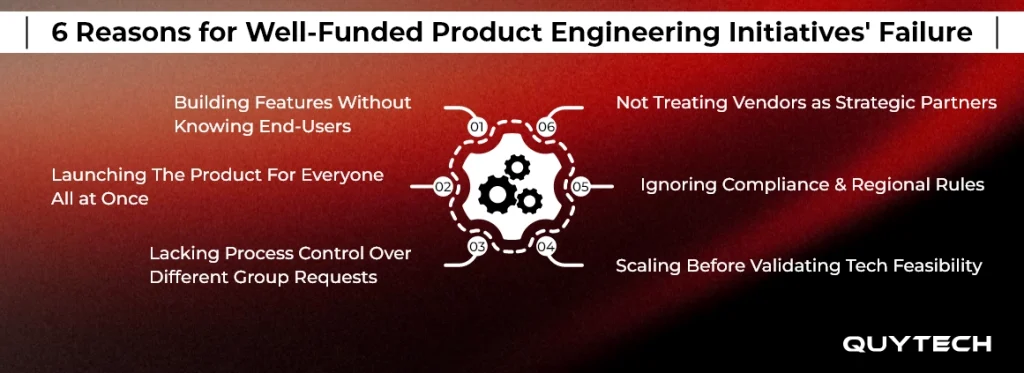
6 Reasons for Well-Funded Product Engineering Initiatives’ Failure
Here are the six most common reasons why digital initiatives fail despite being backed by massive funding:
- Building Features Without Knowing End-Users
One of the biggest reasons for digital transformation failures is that the product team doesn’t have a clear understanding of end-users’ requirements. In other words, the team doesn’t prepare how the product will help end-users, overcome their pain points, or deliver value to them.
So, when the user is using the product and doesn’t have an idea of what the product offers to them, they might be reluctant to even try it. This adoption lag may put the entire investment at risk, even if the product is developed flawlessly.
What CIOs Must Do Early
CIO product strategy should ensure that their teams follow an outcome-driven approach to deliver a personalized user experience. They should conduct in-depth research to understand end-users’ painpoints and expectations.
Similarly, the goal should be to measure the product’s success using “time-to-task” metrics instead of how many advanced features it has.
You May Like: Product Engineering Life Cycle: A Complete Overview
- Launching The Product For Everyone All at Once
Most companies often try to roll out the newly developed product or software across multiple teams or even geographies. This is not a good approach because a single small mistake in the product’s process or the technology can break down the business everywhere at once.
For instance, an MNC builds a cloud-powered HR management system and rolls it out across all geographies at the same time. While the product has been thoroughly tested for quality during development, it may not work as expected due to different payroll compliance rules for different countries or regions. Similarly, there could also be data synchronization issues.
What CIOs Must Do Early
CIOs should enforce a phased rollout or implementation of the product to a small test team. The team should thoroughly review the software to find the bugs and process gaps.
The feedback provided by the team should be considered, and changes to the product should be made before rolling it out for further teams or departments.
- Lacking Process Control Over Different Group Requests
In the absence of a strong central roadmap, there are chances that different departments ask for different changes. As a result of this, each group or department customizes the software according to its understanding. This also leads to the development of a product, which is difficult to maintain or upgrade.
For instance, let’s take this example. A manufacturing enterprise implements a centralized management system whose roadmap requires connecting multiple departments, including warehouse inventory, service partners, and end customers.
In the absence of a centralized enterprise product roadmap, every department would want the system to be designed according to their custom requirements. And with each request, it gets more difficult to maintain the product for different groups. It may also impact innovation.
What CIOs Must Do Early
CIOs should ensure that there is a clear enterprise product roadmap that overrules individual department requests. Moreover, if the software is updated or upgraded, then they should ensure that the new features or functionalities benefit the other departments as well. This shouldn’t also impact the main software architecture, which is its foundation.

- Scaling Before Validating Tech Feasibility
Having a large budget for a product often gives an enterprise false confidence and leads it to go directly for full-scale development. In other words, teams and leadership both move towards enterprise-wide rollout, which includes multi-location deployment, full integrations, and deep system dependencies.
Most enterprises don’t even validate whether the product’s architecture can handle the pressure in real-world environments. This gives birth to scalability limitations, data latency issues, compliance conflicts, or integration bottlenecks, but the problem is that it happens after significant investment.
What CIOs Must Do Early
CIOs should demand a “Proof of Concept” or a small pilot before giving a go-ahead for the full-scale development or enterprise-wide deployment budget. The teams should prove that the technology works and delivers value by developing a small pilot.
Related Blog: Agentic AI in Product Engineering: Guide for Business Leaders
- Ignoring Compliance and Regional Rules
Most enterprises, especially those from the finance or healthcare industries, deal with sensitive or confidential data. The rules and policies are very strict, and ignorance or non-adherence to these rules may lead to the failure of the entire product. This may also include legal penalties and can be quite expensive.
Let’s understand why this is one of the biggest reasons behind the well-funded product engineering initiatives failure. A company builds a cross-border e-commerce platform targeting South Asian markets.
The product is technically sound; however, right before the launch, the legal team raised an issue about the platform collecting customer identity data and processing high-value transactions without complying with regional compliance thresholds and data localization rules.
This delayed product launch while requiring restructuring of its architecture. It also increased the overall product development costs.
What CIOs Must Do Early
CIOs must ensure the embedding of compliance and security checks while the product’s roadmap is being designed. They should even ensure that the product is compliant by design. This will help avoid legal issues after spending the budget on the development.
Explore More: Product Engineering Governance: Ensuring Security and Compliances
- Not Treating Vendors as Strategic Partners
A mistake that most enterprises that partner with a product engineering company make is to treat them as coding factories. Whereas they should consider them as strategic partners, as they will ensure that your product roadmap is flawless, dependencies are aligned, and compliance risks are being looked at.
Lack of strategy in product planning or roadmap designing may directly lead to its failure, even if the product is well-funded. That’s because the right partner will question your bad ideas rather than blindly following your requirements.
What CIOs Must Do Early
The best way to avoid this challenge is to choose a partner who is reliable and has relevant industry experience. It should also be able to provide you with strategic consulting to check technical and compliance risks.
You Might be Interested in: How to Choose the Right Product Engineering Partner
How Quytech Helps CIOs Get Product Engineering Right- From Roadmap to Go-Live
Quytech is an experienced engineering partner that global enterprises across manufacturing, healthcare, BFSI, e-commerce, and others trust for their product engineering initiatives. We offer cutting-edge product engineering services for enterprises, wherein our strategic consultants help you pave a strong foundation that leads to the success of your product.
Our dedicated product engineers get involved at the roadmap stage to understand your actual requirements, end-user challenges that the product will overcome, stakeholders’ requirements, and compliance risks. That’s because we believe that early intervention (during the roadmap design) can prevent product failures.
With proof-of-concept development, our experts validate whether the product will be able to handle real-world pressure and deliver what’s expected. Our experts help you ensure:
- End-user workflows are mapped
- Phased rollout is planned
- POC is validated before full investment
- Compliance is embedded in the roadmap
- Stakeholders are aligned per phase
Take a look at: Product Engineering vs Custom Software Development: Key Differences

Final Thoughts
Well-funded product engineering initiatives may fail when your product’s foundation is not strong. By foundation, we mean the roadmap, stakeholder alignment, planning for compliance, and understanding end-users’ expectations. CIOs and tech leaders can take some preventive measures to avoid costly mistakes and pave a smooth path for the product’s success.
These measures include beginning with the roadmap instead of the UI, clearly defining what’s in store for the end-user, phasing the product rollout, asking the team to build a proof of concept first, and finding the right engineering partner.
