Key Takeaways:
- AI-powered SOC agents are autonomous entities capable of monitoring, detecting, and responding to cyber threats.
- The outdated security systems, scalability limitations, slow incident investigation, and inconsistent security coverage are some reasons that led to the rise of AI SOC agents.
- These agents provide continuous threat monitoring and intelligent alert analysis. They can analyze behavior, automate responses, and learn from every incident.
- Organizations adopting intelligent SOC agents unlock faster incident response and easy scalability. They also get access to a cyberdefense system that adapts to evolving threats.
A recent report by KPMG reveals that 70% of respondents believe AI will be a game-changer in cybersecurity. Which, honestly, is not a surprise at all. With the number of cyber threats increasing daily, it’s quite evident that traditional security systems are no longer capable of tackling them.
This is why global organizations are upgrading their security systems to AI-powered SOC agents. These agents bring automation with autonomy. They are redefining how security threats are assessed and addressed. AI-powered agents continuously monitor digital security across platforms and analyze alerts. They are capable of prioritizing incidents and responding to them in real-time, all while keeping human intervention minimal. But how do these agents do all this, that too in real-time?
If that’s what you’re wondering, then worry no more because we’ve got you. We have covered everything from the core capabilities to the real-world use cases of AI agents for SOC.
What are AI-Powered SOC Agents?
AI-driven SOC agents are self-directed software systems that analyze, detect, and address cybersecurity threats as they occur. These agents support security operation centers with automation and autonomy. Meaning that AI agents for SOC work independently and require minimal human intervention.
These intelligent agents are capable of handling everything from activity observation to detecting threats and taking appropriate action. Advanced technologies like machine learning, behaviour analytics, NLP, anomaly detection, etc., power these capabilities.
What truly sets them apart is their context awareness. It helps intelligent SOC agents in understanding what’s happening, classifying the activity, and taking actions accordingly.
Why Global Organizations Are Adopting AI-Powered SOC Agents
The need primarily arose to bridge the gap between evolving cyber threats and traditional security systems. But it’s not limited to that only. Here are some reasons explaining why there’s a need for AI-driven SOC agents:
Increased Security Alerts
Modern security systems generate numerous security alerts regularly. Often, these alerts are false, while at other times, they are triggered by actual threats. Traditional security systems often fail to classify through these alerts, which ends up putting the unimportant ones in the spotlight while overlooking critical threats.
AI-powered SOC agents tackle these increased security alerts by automating their analysis. These agents assess all the alerts, classify them, and address them based on their urgency and complexity.
Outdated Security Operation Centres
Outdated SOCs are a significant reason reflecting why there’s a need for AI-driven SOC agents. The traditional ones rely heavily on legacy tools. What’s more is that most of the workflows in these SOC systems are carried out manually. These systems fail to address the modern attack techniques.
AI agents for SOC transform the outdated systems into intelligent ones. They eliminate the need for human intervention in routine workflows by automating them. These agents are self-driven and have context awareness. This helps them plan their actions as per the situation.
Scalability Challenges
As mentioned already, traditional security systems are handled by human analysts. This makes scalability a huge challenge, as when an organization grows, security needs also multiply. And in traditional systems, scaling means hiring more people.
Intelligent SOC agents make the scalability of security operations achievable. They reduce the dependence of security systems on manual effort and handle growth through automation and intelligence.
Slow Incident Investigation
Incident investigations conducted in traditional SOCs are often very slow. This is because it requires manual gathering of all the data, correlating events, and going through multiple security tools. The slow nature of these systems makes security initiatives highly reactive in nature.
AI agents for SOC follow a proactive approach when it comes to incident investigation. They collect data as it’s generated and analyze it to understand the incident and make decisions accordingly.
Inconsistent Security Coverage
Conventional security operations centers depend on human operators to function. And human operators’ availability is based on their shifts, due to which, at times when there are fewer analysts, threats may go undetected.
Intelligent SOC agents eliminate the need for juggling through multiple platforms to access their security information. They are capable of gathering data from all sources, regardless of the type of security tools being used. AI-powered SOC agents can function smoothly across environments.
Increasing Infrastructure Complexity
The current IT scenario operates across various platforms like cloud platforms, remote devices, third-party services, etc. Catering across such diverse environments becomes challenging. This is because the security tools applied to one environment might not be in sync with the ones applied to another. This complexity makes it difficult for SOCs to get a complete view of the picture.
AI agents for SOC handle increasing infrastructure complexity by connecting security data from all the platforms to one centralized location. This centralized location allows every user or device to be included in the unified security system.
Interesting Read: Privacy-Enhancing Computation (PEC): Future of Data Security
Traditional SOCs Vs AI-Powered SOC Agents
To understand what real differences AI-driven SOC agents bring to the security landscape, it’s necessary to grasp how they differ from traditional SOCs. Here’s a table that will help you understand the core differences between traditional SOCs and AI-powered agents:
| Aspect | Traditional SOCs | AI-Powered SOC Agents |
| How they operate | Traditional SOCs depend on human analysts to function. | AI-driven SOC agents are intelligent. They do not depend on human analysts to function |
| Alert handling | Being manual, alert handling is done one-by-one and is time-consuming. | Intelligent SOC agents handle alerts as they are generated. They can handle multiple alerts at the same time and prioritize them as needed. |
| Threat detection | Traditional SOCs can detect only those threats that they are trained to handle. They act as per the defined rules. | SOC automation with AI agents is adaptive. They can detect evolving threats as they are not bound by predefined rules. |
| Response speed | The response speed of traditional SOCs is quite slow, as they are reactive and manual. | The response speed of AI-driven SOC agents are fast as it automates analysis steps. |
| Scalability | Scalability is limited as scaling requires more analysts. | AI agents for SOC offer easy scalability as they can adapt to growing data needs. |
| Analyst workload | Analyst workload is high as every task is handled manually. | Analyst workload is reduced as automation takes over repetitive tasks and analysts only need to focus on strategic ones. |
How AI-Powered SOC Agents Detect and Respond to Threats
While knowing the core capabilities of AI SOC agents does add to your knowledge, it does not explain how they function in real life, right? But worry not, because this section will break down how AI-driven SOC agents work:
Data Collection
The first step of the AI SOC agents’ working mechanism begins with data collection. The data that gets collected includes network traffic, system logs, device activities, etc. Collecting this data facilitates further threat detection and supports security teams with a 360º view of the environment.
Behaviour Monitoring
Once the data is collected, it is processed and analyzed. In this step, the AI SOC agents analyze behavour of the devices, users, etc. Not just the real-time, but the historical data is also analyzed to mark differences in activities, if any.
Threat Detection
After monitoring the behavioral data, AI agents for SOC classify their activity. Normal activities are left as they are, and abnormal ones are flagged. For example, if a device is noticed abnormally moving data, it gets flagged and compared with other abnormal activities to see if they’re correlated.
Risk Assessment & Prioritization
Once threats are detected, risk assessment takes place. This helps AI SOC agents in classifying the threats based on urgency and risk. Prioritization helps intelligent agents in focusing on addressing threats with high criticality first.
Response Decision
Response decision is the step that allows AI agents for SOC to address cyber threats. It helps the agents in identifying the right course of action for the threats and executing them. Response decision also helps the agents understand what areas they would need human assistance in.
Learning & Improvement
After resolving the threats, the intelligent SOC agents learn from the outcome. This learning pattern is continuous and helps the agents in improving their detection models and response capabilities.
Core Capabilities of AI-Powered SOC Agents
Now that you are familiar with what AI-driven SOC agents are and how they are different from traditional SOCs, let’s help you get a deeper understanding of their core capabilities:
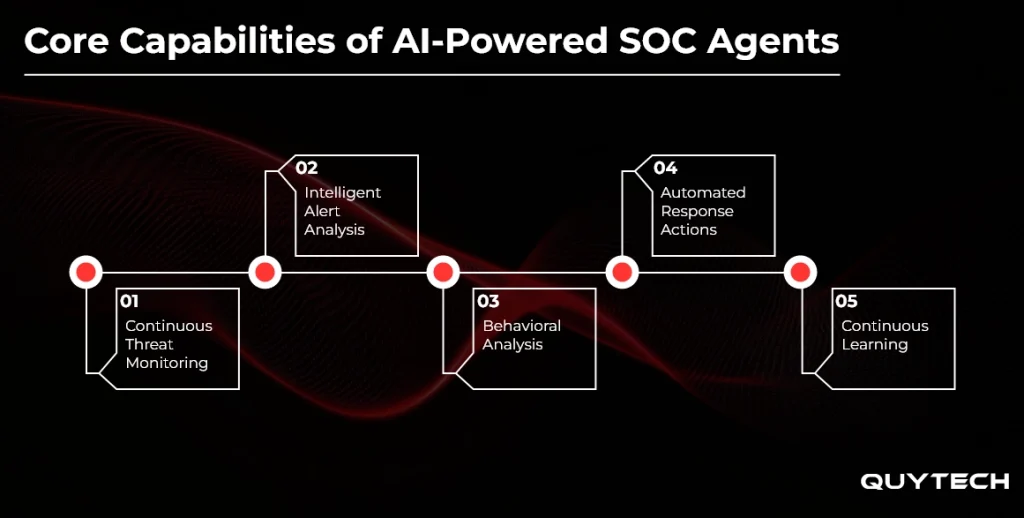
Continuous Threat Monitoring
AI-powered SOC agents do not wait for threats to occur to begin their tasks; they work continuously. These agents monitor networks, users, and devices in real-time. This helps SOCs act proactively instead of waiting for threats to disrupt security systems.
Intelligent Alert Analysis
As mentioned already, security tools generate a large number of alerts. But not every alert sent means threats to security systems. But how does a security tool know which alert is critical and which isn’t? That’s exactly what intelligent SOC agents are capable of doing. They can analyze alerts, classify them based on their nature, and address them accordingly.
Behavioral Analysis
AI SOC agents do not just monitor activity logs; they analyze behaviour as well. They assess patterns, like login habits, device behaviour, system usage, etc. This helps them understand what the normal behaviour of a user/device is. Knowing the usual behaviour creates a type of benchmark that helps AI-powered SOC agents detect abnormal activities.
Automated Response Actions
Intelligent SOC agents do not conclude their function by simply detecting abnormal behaviour. They are capable of taking further actions based on the situation. Like, if AI SOC agents detect threats from a device, they can isolate it or restrict it from accessing the network’s resources.
Continuous Learning
AI-powered SOC agents continuously learn and improve over time. They improve their detection capabilities and response decisions from past incidents, new updates, etc. This continuous learning loop helps them enhance their functions without needing external assistance. It also keeps them prepared to tackle evolving cyber threats.
You Might Also Like: How Zero Trust and AI-driven Security Will Redefine Cyber Defense in 2026
Benefits of AI-Powered SOC Agents
Implementing AI-driven SOC agents benefits organizations in numerous ways. They make incident response faster, scalability easier, and make defense capabilities adaptive. Let’s understand these benefits in detail:
Faster Incident Response
Implementing AI-powered SOC agents aids faster incident response. This is because these agents are capable of classifying alerts by themself. They do not wait for human assistance and signal to address threats. Their continuous monitoring helps them flag critical threats and resolve them in real-time.
Easy Scalability
As mentioned already, AI SOC agents make scalability easy. They eliminate the need for hiring more analysts to keep up with increasing data and infrastructure needs. Intelligent agents can handle large amounts of data with minimal human assistance. This makes scalability achievable and cost-efficient.
Reduced False Positives
Implementing SOC automation with AI agents reduces false positives in cyber threat detection. This is because these agents monitor the systems continuously and know how to differentiate between normal activities and abnormal ones. These agents flag the actual alerts, assess their correlation with other alerts for confirmation, which allows them to focus on real threats instead of noise.
Adaptive Defense Capabilities
AI agents for SOC are powered by machine learning models. This helps the intelligent agents in adapting their defense capabilities to the evolving cyber threats. They are not bound by rigid rules, and their adaptability helps them mend their threat responses as and when needed.
People Also Like: AI in Cyber Threat Prediction and Defense: Strengthening Cybersecurity
Real-World Use Cases of Intelligent SOC Agents
Understanding a technology becomes very much easier when its actual applications are made clear, isn’t it? So here’s a list of real-world use cases of AI-powered SOC agents:
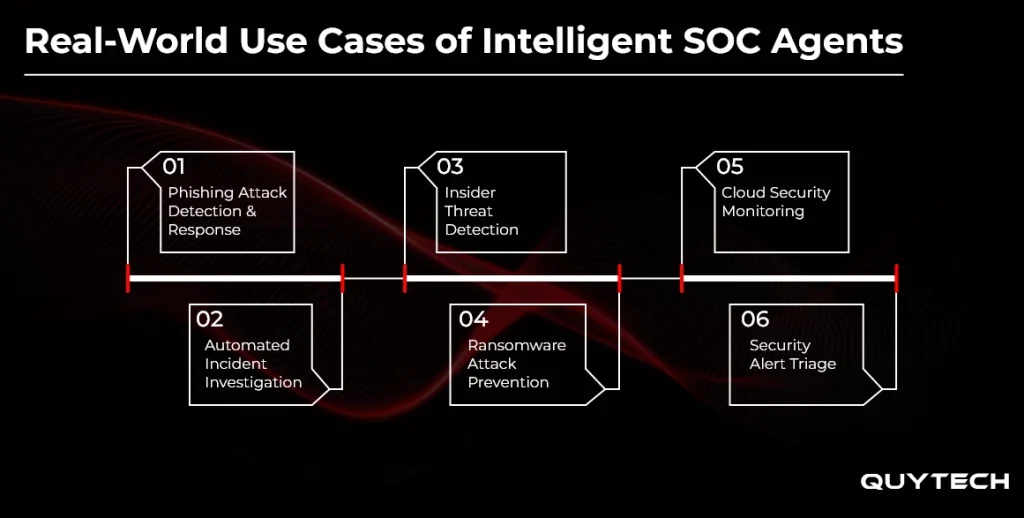
Phishing Attack Detection and Response
AI SOC agents continuously look after every activity taking place across all the platforms. They do not limit threats to a certain identity; they flag everything that feels unusual and correlate them with similar cyber threats to detect patterns.
Not only do they detect these threats, but they also respond to them. They can take actions like restricting devices from accessing resources or isolating the areas they affect to prevent further damage. This approach ensures no threat goes undetected or unattended.
Automated Incident Investigation
Intelligent SOC agents collect every detail of every device, user, etc. This makes them capable of automating the incident investigation. The data that they store facilitates creating a complete picture of the incident.
The data they acquire for investigation is collected not just from one tool but across all the security platforms. AI agents replace manual efforts in investigation and allow analysts to focus on strategic areas.
Insider Threat Detection
AI agents for SOC do not limit their threat detection abilities to external factors only. They are capable of identifying insider threats as well. Over time, intelligent SOC agents learn how every user and device interacts.
Monitoring regularly sets standards for what a normal activity is like. This helps them detect anything going beyond normal, investigate it, and take corrective measures if needed.
Ransomware Attack Prevention
Intelligent SOC agents utilize their ability of monitoring system behaviour to detect early signs of ransomware. Their continuous monitoring flags ransomware at an early stage.
This helps in taking corrective action at the right time instead of letting the whole security system get affected. They isolate affected systems to prevent the attack from spreading across the network.
Cloud Security Monitoring
Cloud environments are one of the most challenging ones when it comes to monitoring. This is because they can be accessed by any device from anywhere, for example, employees working remotely connect to the cloud environment.
AI-powered SOC agents automate cloud environment monitoring and ensure that every device connecting is secure. If connecting devices commit abnormal activities, AI agents trigger alerts or take actions.
Security Alert Triage
AI agents applied to security operation centers lighten the workload of analysts by automating security alert triage. They analyze every alert generated by all the security tools.
AI SOC agents even prioritize them based on their risk levels and connect with analysts for high-priority incidents. As for the low-priority ones, AI agents suppress them or take the actions needed by themselves.
Interesting Read: Why AI Facial Recognition System is the Future of Cybersecurity?
Challenges and Best Practices for Implementing AI Agents for SOC
While intelligent SOC agents bring significant improvements to how cybersecurity works, their implementation process comes with its share of challenges. But we will help you overcome these challenges by providing the best implementation practices. Here are some challenges and best practices for implementing AI-powered SOC agents:
Data Quality and Integration
The accuracy and effectiveness of implementing AI agents for SOC depend heavily on data quality. If organizations lack quality and sufficient data. Scattered and inconsistent data reduce detection accuracy and limit the agent’s effectiveness.
However, this challenge can be overcome by simply maintaining centralized and proper data logs. This will make data accessibility, analysis, and outcome generation easier and more accurate.
Integration with Existing SOC Tools
Integration challenges often arise when organizations already have some existing SOC tools. These tools are often outdated and hard to link with sophisticated AI agents.
Organizations wanting to implement AI agents with existing SOC tools can opt for API-based integration practices. This will help them adopt AI agent-powered automation without replacing existing tools.
High Implementation Costs
Implementing AI agents for SOC is quite a huge upfront investment. This is because AI agents are really sophisticated technological advancements and require infrastructural upgradation. Their configuration, training, etc also requires investment, both in terms of money and effort.
Organizations facing these challenges can opt for target-based deployment of AI agents. This will allow them to implement AI agents for SOC in the critical areas first and then scale gradually. This phased approach manages cost effectively.
How Quytech Helps Organizations Build AI SOC Agents
Quytech helps organizations build AI SOC agents by turning security challenges into practical, intelligent solutions. We have deep knowledge and expertise in core technologies like artificial intelligence, machine learning, and cybersecurity. Through our tailored approach of developing AI SOC agents, we help organizations bring their idea of secure automation to life.
Quytech places a strong emphasis on building AI agent solutions for SOC that not only meet your standards of a secure system but also align with your organizational objectives. Our team of dedicated developers pools in their knowledge and skills to build AI agent solutions suitable for real-world security challenges.
Conclusion
In the current digital world, cyber threats are evolving faster than ever. And to deal with these evolving threats, organizations are now upgrading their existing security systems with AI-powered SOC agents. These agents make cyber threat detection more powerful by bringing not only speed, but accuracy as well.
Implementing intelligent SOC agents helps organizations identify and respond to threats quickly. They make scalability achievable. This is because AI agents reduce false positives and adapt their defense capabilities to address evolving threats. In conclusion, we can say that AI-driven SOC agents are redefining the future of automated threat detection and response.
FAQs
No, SOC automation with AI agents does not replace human analysts in a SOC. Instead, they make their work easier through automation and intelligent threat detection and responses.
SOC automation with AI agents handles data privacy and regulations compliance by processing data within approved boundaries. These boundaries are integrated into them when the agents are built.
Organizations using AI SOC agents provide complete reasoning behind the actions of their AI agents. This reasoning is shown through decision logs and actual data that the agents used to arrive at a certain decision.
Yes, AI agents can perform proactive threat hunting. They do so by analyzing patterns in the historical as well as real-time data and predicting possible threats.
Yes, AI agents for SOC are safe for highly regulated industries like healthcare and finance. This is because all their actions are logged, and decision-making is done with a human in the loop.
SOC automation with AI agents is powered by machine learning models. They make them capable of learning from every threat response they give and situation they interact with.
Not necessarily. To implement AI agents for SOC, you do not team with a technical team. You can achieve the same by hiring developers or by partnering with an AI agent development company.
