
There was a time when corporate social responsibility was viewed as merely a philanthropic gesture or something that needed to be done to meet compliance requirements. Today, CSR initiatives have evolved and play a vital role in how a company operates, competes, and creates value.
Now, it is a must for organizations to redefine their approach by focusing on creating tangible impact not just for the people, but also for employees, investors, and regulators. A key step in ensuring maximum impact of the CSR effort is the measurement of corporate social responsibility impact.
In short, tracking CSR impact is not something that any organization can delay, especially when the stats show that effective CSR strategies can increase the market value of a company by up to 6% and consumer satisfaction by 23%.
Not just these two, there are multiple statistics that demonstrate the need for impact assessment in CSR or tracking CSR KPI. The real question is how large enterprises that run multiple CSR programs or do CSR on a large scale can track this impact. Let’s dig deeper into this blog that highlights different approaches for measuring CSR impact.
What Does CSR Impact Tracking Mean
In simple words, CSR impact tracking means measuring and analyzing the outcome of the CSR initiatives. Tracking ensures how much impact or change the CSR program has brought, whether it has delivered meaningful value.
For efficient CSR impact tracking, it is important for large enterprises to collect data and have the right approach and CSR impact measurement tools in place. With accurate tracking, companies can ensure accountability, improve decision-making, and ensure adherence to regulatory and ESG requirements.
Why CSR Impact Tracking Matters Now More Than Ever
Large enterprises run multiple CSR programs or run a single one across geographies, which makes it necessary to have a system in place to track the impact. And before we move on to how to track CSR impact, let’s understand why it actually matters in 2026:
- To Move CSR from Compliance to Strategic Value
Right CSR impact tracking empowers large enterprises to ensure statutory compliance as well as showcase (to stakeholders) the social and environmental value of the program. It also helps them to know whether the program was aligned with the company’s long-term goals.
- To Ensure Accountability
As emphasized earlier, large organizations run CSR programs across geographies. With efficient impact tracking, they get clarity and transparency into how the CSR funds were used and what outcome they have generated.
- For Informed Decision-Making
Tracking CSR impact offers actionable insights into what is working and what is not. Enterprises can utilize these insights to make well-informed decisions about changing CSR strategies, reallocating budgets, and prioritizing CSR activities that deliver maximum return for investors, consumers, employees, and the organization.
- To Strengthen ESG and Sustainability Reporting
One of the biggest reasons why companies measure their corporate social responsibility is to strengthen their ESG and sustainability reporting. Having precise impact data enables a large organization to support ESG disclosures, BRSR (Business Responsibility and Sustainability Reporting) reporting, and sustainability initiatives. It becomes easy for the company to meet stakeholders’ expectations.
- To Build Stakeholder Trust and Brand Credibility
With the tracking of CSR impact, an enterprise can understand if the initiatives are delivering the right outcome. Moreover, having correctly measured CSR impact ensures everyone, including regulators, investors, employees, and communities/consumers, has a clear idea of the CSR program and how it will deliver verifiable results. This builds trust and credibility.
- For Enabling Long-Term Social and Business Impact
With regular impact tracking, an enterprise can evaluate long-term outcomes for the CSR programs and ensure they don’t deliver short-term outcomes. Besides, they can understand the long-term social and business impact of their CSR initiatives.
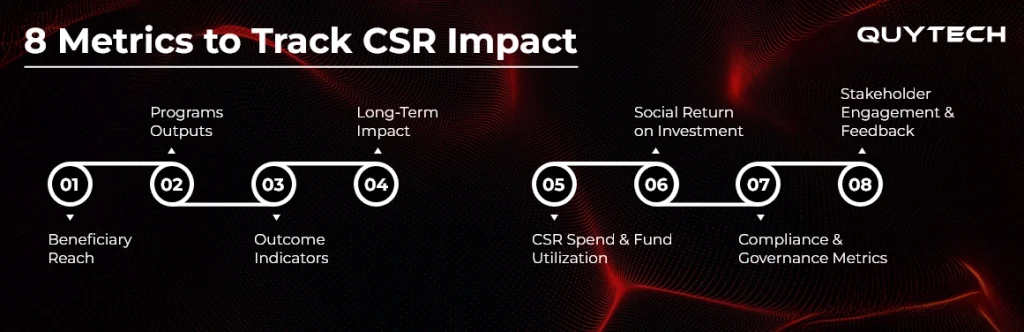
8 Key Metrics to Track CSR Impact
Different CSR programs should be tracked on different metrics, based on the value or outcome they are intended to deliver. So, before we know ways large enterprises can track the outcome of their CSR initiatives, let’s take a quick look at the metrics that most CSR programs can be tracked on:
- Beneficiary Reach
This metric involves tracking the number of individuals, communities, or regions impacted by a particular CSR initiative. With it, an enterprise can measure the scale and inclusivity of its efforts across different regions.
- Programs Outputs
With impact tracking and impact assessment in CSR, organizations can measure tangible deliverables, including the number of trainings conducted, infrastructure built, and resources distributed or services delivered.
- Outcome Indicators
This CSR impact tracking metric enables a company to assess the short-term and long-term outcomes of its CSR program. The tracking is done to check KPIs like improved skills, health, and other services’ access, awareness level, ot behavior change.
- Long-Term Impact
With this metric, an enterprise can evaluate social or environmental change that its CSR program has created over time. This will help the company understand whether its CSR investments delivered long-term impact after delivering immediate impact.
- CSR Spend and Fund Utilization
The metric enables an organization to monitor how the budget was allocated, the rate of fund utilization, and the cost per beneficiary. They can get a clear idea of whether the funds are being optimally utilized while ensuring financial accountability.
- Social Return on Investment
SROI, or social return on investment, is another key metric that enables a big company to quantify the social value generated compared to the CSR investment. The enterprise can measure the impact and prioritize programs that deliver high impact or are more meaningful.
- Compliance and Governance Metrics
With compliance and governance metrics, organizations can ensure their CSR initiatives’ progress to CSR laws, ESG standards, and reporting frameworks. This also makes sure the CSR efforts are transparent and audit-ready.
- Stakeholder Engagement & Feedback
With this metric, organizations can capture participation levels and satisfaction, and get qualitative feedback about the CSR program. This also enables the company to improve the long-term impact of its CSR initiatives.
You may like to read: How AI is Transforming the CSR Outcomes

Key Challenges Large Enterprises Face in Tracking CSR Impact
Most enterprises rely solely on human resources to design and run CSR programs and also to track their impact. However, when the programs are designed for multiple geographies and large communities, one should rely on technology and tools to track CSR impact, which ensures the efforts are being made in the right direction to deliver meaningful results and receive maximum outcomes. Some common challenges that companies face in CSR impact tracking are:
- Inability to Measure Long-Term and Intangible Impact
The first big challenge with the measurement of corporate social responsibility tracking is that social change mostly takes a considerable amount of time to show the impact of the CSR initiative. For instance, a CSR program designed to deliver education and improve lifetime employability across the underprivileged communities can be difficult to track.
- Data Fragmentation Across Programs and Partners
For efficient impact tracking, an organization needs to collect data from multiple sources, including NGOs and internal stakeholders. This data may be available in different formats, which makes it difficult to consolidate information in a way that can be easily processed and displayed in an enterprise-wide impact view.
- Lack of Standardised Impact Metrics
Enterprises that don’t have CSR impact tracking tools or measurement frameworks can struggle to compare outcomes or results across different initiatives. Just like this, different CSR programs may also have different success metrics or indicators. Manually tracking multiple programs on a single metric is not an ideal decision.
- Manual and Error-Prone Data Collection
Another major challenge is manually collecting and processing data to generate CSR assessment reports. How? Well, manual collection of data may lead to inaccuracies or errors. Also, it can take a significant amount of time to perform this task.
- Poor Data Credibility and Audit Readiness
For large enterprises, it is a must to validate CSR impact data to make sure efficient and precise regulatory and ESG reporting. However, inconsistent documentation and unverifiable claims can become a roadblock to making the organization’s CSR data audit-ready.
- Inability to Link CSR Outcomes to Business and ESG Goals
An enterprise may lack in connecting its social outcomes to business and ESG goals. For instance, it can be challenging to translate community development results into measurable ESG performance indicators due to poorly structured data and analytics.

How Technology Can Help Enterprises Overcome CSR Impact Measurement Challenges
The above challenges can be addressed by following a technology-driven approach, by digitizing CSR impact tracking management with a mobile app or CSR software. Here is how you can tech-integrations can overcome key CSR impact tracking roadblocks:
Utilize Technology Platforms for Long-Term Impact Tracking
By integrating technology platforms, organizations can adopt an outcome-focused CSR impact measurement approach. They can easily measure the long-term and intangible impact of the CSR activities.
Centralized CSR Data Platforms
Building CSR data platforms can help enterprises address the data fragmentation challenge. These platforms integrate data from multiple sources, including internal and external teams, NGOs, and stakeholders. This unified data visualization ensures consistent CSR assessment reporting and visibility.
Standardize Metrics and Frameworks
Organizations can overcome data inconsistencies in CSR initiatives by clearly defining KPIs and assessment methodologies. With manual CSR management, tracking KPIs or impact measurement metrics for multiple CSR programs is not possible. On the other hand, configurable digital frameworks ensure consistent KPIs and impact measurement.
Automating Data Collection and Reporting
Leverage Mobile and web-based applications to replace manual reporting. These tools will not only help save effort and manual effort but also improve data accuracy and operational efficiency. They can even enable organizations and CSR managers to track CSR impact in real-time from any location.
Built-In Validation and Audit Readiness
When you implement dedicated CSR software or CSR impact tracking solutions, you can automate approvals and audit trails. Such software comes up with built-in validation and audit readiness, which further ensures your CSR impact data remains compliant and can be trusted.
Integrated CSR and ESG Systems
Implementing technology can help an organization connect its CSR impact data with ESG and sustainability platforms for unified reporting and insights. Having integrated dashboards and analytics can help leadership translate social outcomes into meaningful value or outcomes.
Also Explore: How Technology Can Amplify Your CSR Initiatives
Future of CSR Impact Tracking for Large Enterprises
With the rapid implementation of technology in CSR initiatives, it is clear that CSR impact tracking in the future is data-driven and technology-led. In 2026 and the upcoming years, big companies will follow an outcome-focused CSR approach by implementing technologies for real-time impact measurement.
When we say technology-driven, we mean using advanced analytics, AI, and integrated CSR platforms to measure the outcomes and track the impact of the CSR programs more accurately. These technologies will ensure that the data is centralized and connects seamlessly with ESG, sustainability, and business performance systems.
Enterprises will also prioritize transparency and evidence-based decision-making to ensure their CSR programs deliver highly sustainable and long-term impact.
How can Quytech Help
Quytech empowers large enterprises to digitally transform their CSR efforts, from planning, designing, and implementing to impact tracking. We can build custom mobile applications or solutions, or even integrate technology into your existing CSR management systems.
Digital transformation of CSR impact tracking will help you get real-time dashboards and analytics to measure outcomes, stakeholder engagement, and how the allotted funds are utilized.
The solutions we develop automate data collection and integration with ESG frameworks. They also enable an enterprise to ensure accuracy, compliance, and audit readiness while offering clear social and environmental impact data.

Final Words
CSR impact tracking is imperative for large organizations to determine the short-term and long-term impact of their corporate social responsibility efforts. It is also essential for accountability, transparency, and sustainable value creation.
By relying solely on manual resources and following traditional CSR impact tracking approaches, it is no longer possible to track and maximize the impact. They can leverage outcome-focused frameworks, leverage digital transformation, and align CSR metrics with ESG and business objectives.
Having a well-structured approach can help an organization ensure compliance. It will also empower a company to make sure its CSR program delivers maximum outcomes while supporting enterprise growth and building credibility.
FAQs
With efficient and accurate CSR impact tracking, enterprises can ensure accountability, optimize CSR investments, and ensure adherence to ESG and regulatory requirements.
With CSR activity tracking, enterprises measure the efforts that were put into the CSR program. On the other hand, with impact tracking, companies measure the outcomes and changes created by those CSR programs.
Technology platforms or tech integrations centralize data, automate reporting, enhance accuracy, and facilitate real-time monitoring of CSR activities. Organizations can also get insights and analytics to follow outcome-focused approaches.
With efficient CSR tracking, CSR impact data gets integrated directly into ESG and sustainability reporting. This helps an enterprise align its social outcome with long-term business and governance goals.
CSR measurement tools are digital platforms, frameworks, and assessment methods used to collect, analyse, and report CSR impact data. By implementing these tools, enterprises can efficiently track metrics such as beneficiary reach, outcomes, fund utilisation, and compliance.
Enterprises can digitize CSR impact tracking to improve accountability, strengthen ESG and regulatory compliance, and get other benefits that have been mentioned below:
– Improves Accountability and Transparency
– Enables Data-Driven Decision-Making
– Strengthens ESG and Regulatory Compliance
– Measures Long-Term Social and Environmental Impact
– Enhances Stakeholder Trust
– Builds brand credibility
– Optimizes CSR Spend and Resource Allocation
– Supports Scalable CSR Program Management
– Aligns CSR Initiatives with Business Strategy
Some common frameworks and methodologies for CSR impact assessment include Theory of Change, Social Return on Investment (SROI), and outcome-based evaluation models. Enterprises also use global standards like GRI and SDG alignment to ensure consistent, credible, and comparable CSR impact measurement.
