In 2023, Mastercard Foundation launched its EdTech Fellowship program in South Africa. The aim was to scale educational impact for underserved communities without simply putting more money into the program. Traditional ways would have suggested building more classrooms, hiring more teachers, and distributing more educational supplies, which would definitely add up to the cost.
Instead, what the company did was to partner with some startups and deploy AI-powered EdTech solutions powered by deep market research. The result? That year’s cohort alone made education accessible to over 1.9 million new learners. And what played a pivotal role in this acceleration? Capital deployment? Definitely not! It was the intelligent technology integration that made the difference.
Not only in 2023, but also in 2024, this number multiplied and supported over 500 schools across Nigeria. Above all, the company generated measurable and verifiable data on learning outcomes that traditional CSR initiatives could never generate.
What does this indicate?
Achieving the desired impact of CSR activities in 2026 cannot be possible without leveraging technology. Dig deeper to know why and how:
What Most C-Suite Leaders Miss About Modern CSR
From the example mentioned above, it is clear that modern CSR demands the integration of technologies or at least having some sort of automated systems or mobile applications. Not just to accelerate the process, but to accurately measure the impact, and in most cases, amplify it.
Most enterprises use AI for demand forecasting, blockchain for security and supply chain transparency, and data analytics for customer insights. What they miss is not implementing technology into their CSR initiatives. CSR powered by technology can amplify the outcomes of your initiatives or activities without you having to spend more.
Those enterprises that have already figured out how to integrate intelligent technology into their social impact strategies are not just doing “better CSR,” they are completely transforming the ROI equation of corporate responsibility.
Why Technology Integration in CSR Activities Matters Now More Than Ever
- Section 135 of India’s Companies Act, 2013, mandates CSR spending for eligible companies. Those who still manage programs through fragmented processes make execution and reporting unnecessarily complex.
- CSR in India often involves multiple stakeholders and beneficiaries, which requires having structured systems to track activities, utilization, and outcomes consistently.
- Board members and CSR committees are expected to demonstrate oversight. If the CSR management is manual, the committees might not offer visibility into ongoing initiatives and fund deployment.
- Indian enterprises with global clients and investors face growing pressure to align CSR reporting with international ESG expectations.
- Efficient CSR management is becoming a key factor that most employees scrutinize before they consider your employment.
- Organizations that rely on technology for CSR management can reduce operational friction, improve governance, and prepare for future regulatory and investor expectations.
There are other reasons, too. You can consider it as the inflection point. The enterprises that move now will set the standard. Those who wait may spend the next five years playing catch-up.
CSR Transformation with Technology Integration: A Before and After View
Now that you know enough about CSR initiatives being transformed by technology, let’s delve deeper to understand what areas or processes it actually transforms.
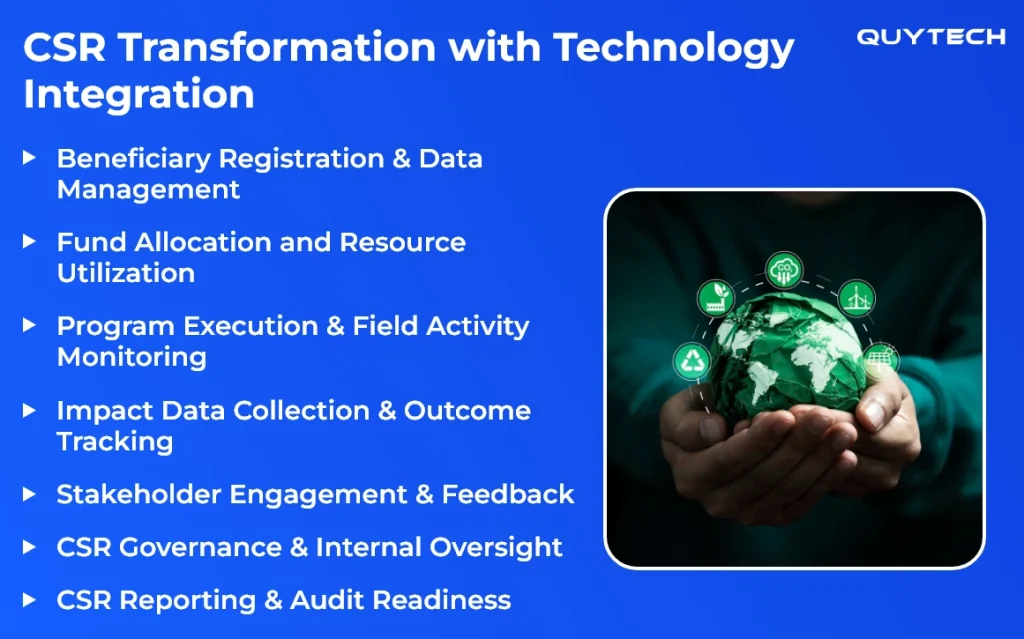
- Beneficiary Registration & Data Management
Most enterprises rely on manual surveys, local intermediaries, and databases to identify who would benefit from their CSR activities and get the required beneficiary information. If the collected data quality is not up to standard, the data is outdated or incomplete, or if it is not managed properly, it may lead to the exclusion of eligible individuals or communities.
After Implementing Technology in CSR/After Digital Enablement
Having a centralized system can make things quite easier and more accurate. Such a system enables beneficiaries and partners to submit standardized information directly. These mobile and web-based systems can even make it simple to automatically upload and validate documents.
The system ensures that all data is stored in a single and well-structured repository accessible only to authorized teams. It also ensures accuracy in collecting and storing beneficiary information and faster program execution.
- Fund Allocation and Resource Utilization
Allocating funds and utilizing resources for CSR initiatives with traditional ways offer limited visibility into how many resources are actually used. An enterprise gets the idea of the released funds and utilized resources only after the periodic reports are submitted. Similarly, tracking fund usage is also no easy feat, as it depends on manual reconciliation.
After Implementing Technology in CSR/After Digital Enablement
Having a mobile application or a web-based platform can help program owners to monitor fund allocation, utilization status, and even milestone progress through a unified view. Partners or members involved in CSR program designing and planning can update utilization data directly.
It improves financial control, transparency, and accountability throughout the program lifecycle. Digital enablement using an app or platform also provides clear visibility into how CSR budgets are used.
- Program Execution & Field Activity Monitoring
Using a conventional way, executing and monitoring CSR programs requires looking into the field reports, visiting physical locations or sites, and conducting physical audits. This requires a considerable amount of time and may even delay extracting insights.
After Implementing Technology in CSR/After Digital Enablement
Digital platforms automatically log on-ground activities by taking into account visual evidence and time-stamped updates. This provides decision-makers with continuous visibility into the CSR program being conducted across different locations. They can identify roadblocks early and ensure more consistent execution.
- Impact Data Collection and Outcome Tracking
Without digital enablement, impact assessment is done via surveys or feedback. This makes the entire process of evaluating the impact of the CSR quite difficult and time-consuming, especially during the execution of the program or initiative.
After Implementing Technology in CSR/After Digital Enablement
Technology platforms enable CTO’s and decision-makers to automate capturing the impact data at different stages during the CSR program. Some advanced-level applications or software can even facilitate real-time measurement of outputs and impact outcomes against the defined success metrics.
- Stakeholder Engagement and Feedback
The success of a CSR program requires continuous engagement and transparent communication with partners, beneficiaries, and communities. Traditional ways rely on informational communication, which may not provide reliable information.
After Implementing Technology in CSR/After Digital Enablement
Enterprises using mobile applications or web platforms for CSR management can put structured feedback mechanisms in place. This can allow stakeholders to share inputs and feedback regularly. CTOs and decision-makers can understand participation levels and CSR challenges more deeply.
- CSR Governance and Internal Oversight
In the traditional way of CSR management, approvals, reviews, and documentation are handled via emails, spreadsheets, and files, which are maintained by different teams. This can increase operational friction and even make it difficult for CTOs or leadership to have a centralized view of ongoing initiatives.
After Implementing Technology in CSR/After Digital Enablement
With technology, enterprises or CSR management teams can standardize governance workflows while providing role-based access. They can even effortlessly review checkpoints and ensure documentation maintenance in one place, resulting in faster internal reviews and improved governance adherence.
- CSR Reporting and Audit Readiness
CSR reporting with the conventional way of management requires manual consolidation of data collected from different teams and partners. This may increase manual effort and also lead to data inconsistencies.
After Implementing Technology in CSR/After Digital Enablement
Digital platforms and mobile applications can automatically organize CSR program data and even generate well-structured reports that are aligned with ESG disclosure regulations. This not only reduces reporting time but also ensures the documentation is audit-ready.
Real Impact and ROI of Digital CSR Transformation
When you transform your CSR initiatives with tech integrations, you can get the following impact and return on investment:
Amplified CSR Outcomes
By integrating technology, either in the form of a mobile application or a web portal, or simply into your existing systems, you can minimize manual efforts that go into reaching beneficiaries, scaling CSR initiatives, and other CSR activities. All this under the same CSR budget! What else do you need?
Clear Visibility Into On-Ground Progress
Leveraging technology empowers an enterprise to track on-ground progress. Leadership teams can gain timely visibility into the progress of the program, utilization of funds, and the completion of each CSR milestone. This ensures quicker interventions, as and when needed.
More Informed Decision-Making
When an enterprise has consolidated program data stored at a centralized platform, its CSR management team can efficiently compare initiatives, identify underperforming areas, and make better decisions on how to scale or improve CSR efforts.
Improved Stakeholder Confidence and ESG Readiness
Having consistent documentation, standardized data collection, and traceable records builds a positive image of your organization among stakeholders, including investors, auditors, regulators, and implementation partners.
Scalable CSR Programs
Digitizing your CSR processes makes it easier to replicate your CSr program initiatives across other locations and with more partners as well. The best part is that all this can be done without facing operational complexities or increasing support staff.
Minimized Governance and Reporting Effort
An enterprise having digitally maintained records, standardized formats, and well-structured workflows can expect a significant reduction in the time and effort required to prepare reports, reviews, and audits.
Plan in Action: A 90-Day Plan for Quick Wins
Here is a 90-day quick win strategy that will provide you with immediate clarity, measurable outcomes, and visible improvements in your CSR programs.
Days 1–30: Assess, Align, and Prioritize
- During the first month, conduct a quick CSR maturity assessment by identifying gaps in data, reporting, transparency, and scalability. Basically, all the areas that can be powered with tech integrations.
- Ensure your CSR objectives resonate with your business goals, ESG expectations, and community needs.
- Initially, shortlist one or two CSR activities or areas where you think technology can maximize value.
- Clearly define the technology requirements or system development needs for centralizing information and standardizing CSR processes.
Days 31–60: Enable Digital Execution
- Implement technologies or a centralized system to effectively manage CSR workflows, track activities, and get updates about fund utilization.
- Define role-based access for internal teams and partners so that they can get regular data updates.
- Have proper dashboards in place to automate reporting and get visibility into the CSR milestones.
- Define KPIs that will help you measure the success of your initiatives.
- Thoroughly train your internal teams as well as NGO partners on this to make sure they also adopt new technologies or tools smoothly.
Days 61–90: Measure, Amplify, and Optimize
- Analyze data collected after implementing the system. Find out what actually worked and what still needs to be improved.
- Use impact insights to refine future CSR strategy and expand to more regions or programs.
- Create well-structured reports for internal and external stakeholders.
- Present the impact to your stakeholders. Also, present them with a clear roadmap to scaling and expected ROI for the next year.
How Global Leaders are Leveraging Technology in Their CSR Initiatives
Let’s take a look at some world-renowned enterprises using technology to maximize the impact of their CSR activities:
Tata Group
Several Tata Group companies, including TCS and Tata Steel, use digital learning platforms to support education-focused CSR initiatives across India. The programs and e-learning platforms aim to provide consistent education delivery and remote learning with real-time progress tracking for students in underserved regions.
Structured digital tools also help the company to get complete visibility into program performance and outcomes.
The Impact
- Improved access to quality learning resources in remote and semi-urban areas
- Better monitoring of student participation and learning progress
- Reduced dependency on physical infrastructure for scaling programs
Reliance Foundation
Reliance Foundation integrates digital tools to amplify its CSR initiatives targeting rural development, mainly agriculture, healthcare, and livelihood. It also utilizes mobile-based advisory services and digital data collection to enable its field teams collect real-time insights from beneficiaries. The tools also help their teams to track the effectiveness of the program.
The Impact
- Wider farmer outreach through digital advisory platforms
- Faster feedback loops between beneficiaries and program teams
- Improved coordination across multi-location CSR initiatives
Infosys Foundation
Infosys Foundation also utilizes different digital learning platforms and centralized reporting systems in its CSR programs dedicated to supporting education and skill development across multiple states in India. These advanced systems enable the company to standardize training delivery and evaluate outcomes effortlessly.
The Impact
- Consistent training quality across regions
- Structured tracking of learner progress and outcomes
- Scalable program execution with improved reporting accuracy
The Future of Digital CSR
In 2026 and the upcoming years, enterprises will incline towards structured and digitally-enabled CSR operations to refine planning, execution, and governance of their initiatives. Let’s dig deeper:
- Corporate social responsibility programs are expected to shift from manual coordination to centralized managed execution.
- Leadership of most enterprises may move their focus from chasing updates to monitoring measurable results.
- In the upcoming years, CSR planning and prioritization might be more data-driven rather than based on assumptions.
- Impact measurement will be done at each milestone rather than end-of-cycle reporting.
- Enterprises may rely on intelligent automation for CSR reporting, analytics for trend identification, and immersive digital tools for training and awareness.
- CSR will integrate more closely with ESG, sustainability, and enterprise governance frameworks.
How Quytech Helps Enterprises Modernize CSR Execution
Enterprises looking to modernize their CSR operations require the right digital foundation. Quytech can help establish that foundation through thoughtfully designed technology solutions that improve execution, governance, and measurable impact.
Our certified and skilled engineers can build unified CSR management systems that bring planning, approvals, fund allocation, partner coordination, documentation, and reporting into one centralized environment to provide leadership with a clear, consolidated view of all CSR activities.
The technology solutions we develop digitize core CSR workflows, such as data capture, progress tracking, utilization updates, and reporting, which eliminates manual effort and improves operational efficiency.
We understand each organization’s unique CSR programs and build CSR platforms that are designed to scale. It simply means that as initiatives expand across regions, partners, or focus areas, the same digital framework can support growth without adding complexity or overhead.
Bottom Line
Digital transformation in CSR is no longer about adopting advanced technologies; it is about fixing the fundamentals. For most enterprises, the real roadblocks to their successful CSR initiatives are fragmented processes, limited visibility, and manual coordination. These challenges restrict scale and impact.
By putting in place structured digital systems for planning, execution, monitoring, and reporting, organizations can significantly improve control, transparency, and outcomes without increasing CSR budgets.
Such systems, mobile applications, and platforms can even help an enterprise to ensure consistent governance, clearer impact measurement, and easier reporting. Enterprises that leverage technology for their CSR activities today will find it easier and smoother to scale responsibly, align with ESG priorities, and get maximum ROI from their CSR initiatives.
FAQs
While crucial improvements such as visibility and reporting can be seen within weeks, measurable social impact and efficiency gains can take a little longer, depending on scale and geography.
Yes. Most modern CSR systems are designed to integrate with partner workflows, allowing stakeholders to submit updates, documentation, and data without disrupting on-ground execution.
No. Enterprises can start small by enabling select programs or regions and expand gradually without overhauling existing CSR structures.
Structured digital workflows improve traceability, reduce manual handoffs, and create accountability at every stage—minimizing delays, duplication, and misallocation.
Enterprise-grade CSR systems follow strict access controls, data encryption standards, and audit logs to protect sensitive beneficiary, financial, and operational data.
