It is no surprise that 40% of companies are planning to embed AI agent systems in their enterprises by the end of 2026. While this answers the questions raised about AI agent adoption, it does raise another one: which AI agent architecture should organizations choose?
And right now, the two most debated architectures are hybrid vs multi-agent systems.
Hybrid Agent systems bring in agents that combine different AI methodologies like reasoning, learning, and so on, complementing each other in terms of capabilities and solving complex organizational problems. On the other hand, multi-agent systems bring in multiple agents working autonomously, working in parallel to provide quick resolutions to organizational challenges. But how do organizations decide which one is right for them?
In this blog, we break down what hybrid and multi-agent system architectures actually mean, where each one thrives, and how to make the right call for your organization.
What are Hybrid Agent Systems
Hybrid agent systems refer to the combination of different types of AI approaches that work collectively to solve complex problems. In this system, the agents have diverse capabilities that complement each other. The primary reason hybrid agent systems are used is to perform complex tasks that individual agent types cannot handle on their own.
Hybrid agent systems bring in a blend of symbolic and subsymbolic approaches. The symbolic approach is rule-based and enables hybrid agents to apply structured logic to a situation and make explainable decisions. The subsymbolic approach helps the agents in learning from data and patterns without needing manually defined rules. Together, these approaches power the logical reasoning and learning capabilities of hybrid agent systems.
What are Multi-Agent Systems
As the name suggests, a multi-agent system is one where multiple autonomous agents work collaboratively to execute complex tasks. The agents here are autonomous. Every agent in this system can make its own decisions and execute its own unit of tasks, but they all work together to achieve the main objective.
While it may sound similar to hybrid agents, multi-agent systems focus more on interaction and communication, rather than focusing on the type of AI methodology being used. These agents can be of the same type, working in unison.
Handpicked For You: Multi-Agent AI System: Everything You Need to Know
Hybrid vs. Multi-Agents
Let’s understand the basic differences between hybrid and multi-agent systems. Here’s a table comparing various aspects of both the AI agent systems:
| Aspect | Hybrid Agent Systems | Multi-Agents Systems |
| Definition | Hybrid agents are systems that combine different types of AI approaches and agents to solve complex problems. | Multi-agent systems are those that consist of multiple autonomous agents working collaboratively to achieve a common goal. |
| Primary Focus | Focuses on combining complementary AI approaches. | Focuses on interaction and coordination between agents. |
| Intelligence Source | Draws intelligence from machine learning, symbolic reasoning, and LLMs. | Draws intelligence from collective behavior and the interaction of all agents. |
| System Composition | Different types of agents that follow diverse methodologies. | Multiple agents that can be both similar or different in type. |
| Decision-Making Approach | Combines outputs from different approaches to make decisions. | Each agent in the multi-agent system makes its own decisions |
| Problem-Solving Method | Orchestrator assigns tasks to agents as per their approach. | Breaks problems into smaller tasks and distributes them to agents. |
| Control Architecture | The control is centralized with an orchestrator who divides tasks. | The control is decentralized, as agents handle task distribution. |
| Communication Style | Communication happens through internal layers. | Communication happens externally. |
| Memory Structure | Every layer is connected to one common memory. | Agents have individual memories shared in a common space. |
You Might Also Like: AI Agents for Intent Recognition: How They Understand What Users Really Want
A Deeper Look at How Hybrid and Multi-Agent Systems Actually Differ
While the table gives you a glance at the points of distinction of hybrid and multi-agent systems, this section will let you dive deeper into them:
Definition
- Hybrid AI Agent System
Hybrid AI agent systems integrate multiple agents powered by different AI approaches. These agents complement one another, mitigating each other’s weaknesses and ensuring that different aspects of a task are assigned to agents with the appropriate capabilities.
- Multi-Agent AI System
Multi-agent AI systems comprise multiple agents, similar to hybrid systems, but the agents here are autonomous. They can be of the same or different types and work in coordination with one another.
Primary Focus
- Hybrid AI Agent System
The primary focus of a hybrid AI agent system is on combining multiple AI approaches to handle complex tasks, rather than relying on a single agent to carry the full burden.
- Multi-Agent AI System
The primary focus of multi-agent AI systems is maintaining interaction and coordination among agents to ensure goals are achieved through effective communication and negotiation.
Intelligence Source
- Hybrid AI Agent System
Hybrid agent systems derive their intelligence from multiple AI methodologies. These are machine learning, symbolic reasoning, and LLMs. These methodologies enable hybrid agent systems to recognize patterns, establish rule-based logic, and achieve language understanding.
- Multi-Agent AI System
In multi-agent systems, the source of intelligence is the agents’ collective behavior. The agents interact with one another and with their environments, providing the situational context necessary to make informed decisions.
System Composition
- Hybrid AI Agent System
Hybrid AI agent systems are deliberately made up of agents that have different capabilities to make up for the weaknesses of other agents. With each agent bringing a different methodology, every task can be handled by assigning areas of specialization to agents with the appropriate capabilities.
- Multi-Agent AI System
Unlike hybrid systems, multi-agent systems are more flexible with their composition. The agents in them could be both identical in type or different. Agents themselves handle task distribution through interaction and negotiation.
Decision-Making Approach
- Hybrid AI Agent System
An orchestrator handles decision-making in a hybrid AI agent system. After each agent completes their portion of the task and submits their results, the orchestrator compares and synthesizes them to make a final decision. This ensures that every agent’s effort is accounted for and that the decision reflects the full picture.
- Multi-Agent AI System
In multi-agent AI systems, decision-making is distributed. Every agent here is autonomous and capable of understanding context and making their own decision. Naturally, each agent makes a different decision, so to ensure there are no conflicts, coordination mechanisms are used.
Problem-Solving Method
- Hybrid AI Agent System
The orchestrator primarily handles problem-solving in hybrid AI agent systems. It analyzes tasks and breaks them into subtasks based on the required methodologies. After this, it assigns tasks to agents whose approaches align with them.
- Multi-Agent AI System
Unlike hybrid systems, multi-agent AI systems lack an orchestrator. Here, the task is divided into subunits, and each agent selects units and works on them autonomously. The tasks are executed in parallel, as there are no dependencies among agents.
Control Architecture
- Hybrid AI Agent System
Since all the actions from task distribution to output synthesis are handled by the orchestrator, it is quite obvious that hybrid agent systems have a centralized control architecture. The orchestrator acts as the one in power, manages everything, and also handles decision-making.
- Multi-Agent AI System
As mentioned already, all the agents are autonomous, so the control architecture in multi-agent systems is decentralized. Agents themselves handle everything through effective coordination, be it assigning tasks or making decisions.
Communication Style
- Hybrid AI Agent System
The communication style in hybrid AI agent systems is structured and sequential. Through defined handoffs, every agent passes its output to the next layer to ensure that information is passed in the right manner.
- Multi-Agent AI System
In multi-agent systems, agents directly communicate with each other to transfer and receive information. This ensures that communication happens in real-time without delays caused by hierarchical sequences.
Memory Structure
- Hybrid AI Agent System
In hybrid AI agent systems, there is a shared memory that is accessible by all agents. Every layer feeds into and draws from this memory, which ensures that the information remains consistent across the entire workflow. Tracking, auditing, and maintaining this memory is also easier.
- Multi-Agent AI System
In multi-agent systems, every agent has its own memory. So how do they share it? Well, apart from each agent’s own memory, there is also a common space where all collective information is maintained. This allows agents to retain their context as a whole while still contributing to the knowledge pool.
How Hybrid AI Agent Systems Work
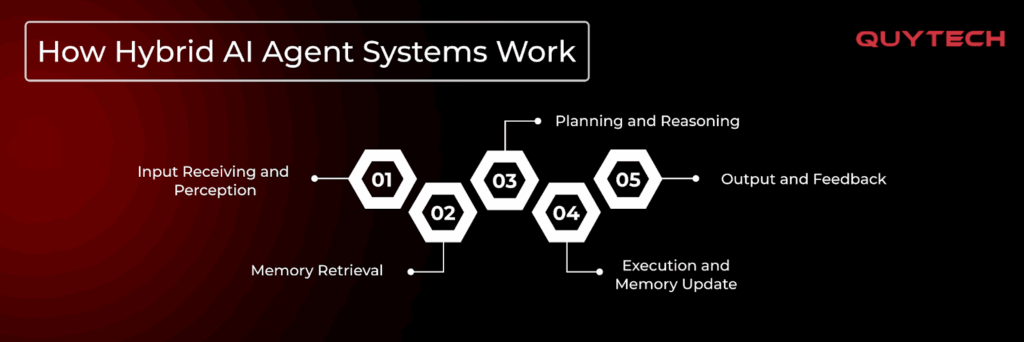
Hybrid AI agents work by receiving and perceiving the input. They retrieve memory, carry out planning, reasoning, execution, and update memory after every action. But the working mechanism doesn’t stop just here. The following steps will help you dive deeper into how hybrid AI agent systems work:
1. Input Receiving and Perception
The working mechanism begins when input is provided by the user. The system reads and interprets the input and derives key information like the user’s intent, context of the input, and so on.
2. Memory Retrieval
Once the input is perceived, the hybrid agent system first looks into the existing memory to see if the recent context matches the past interaction data. If the context does match, then it is derived to help the agents execute the task.
3. Planning and Reasoning
After the task is properly understood, the agents begin planning. Here, the tasks will be divided and distributed based on what suits the agents’ capabilities the best.
4. Execution and Memory Update
Here, all the agents execute their tasks as assigned. As tasks are executed, hybrid agent systems also update their memory for maintaining a log of actions, auditing, and future referencing.
5. Output and Feedback
This step is where the hybrid agent system delivers the output. by compiling the results of every agent’s work to form the final response. The system also takes feedback. It learns from its interactions to enhance its future performance.
How Multi-Agent Systems Work
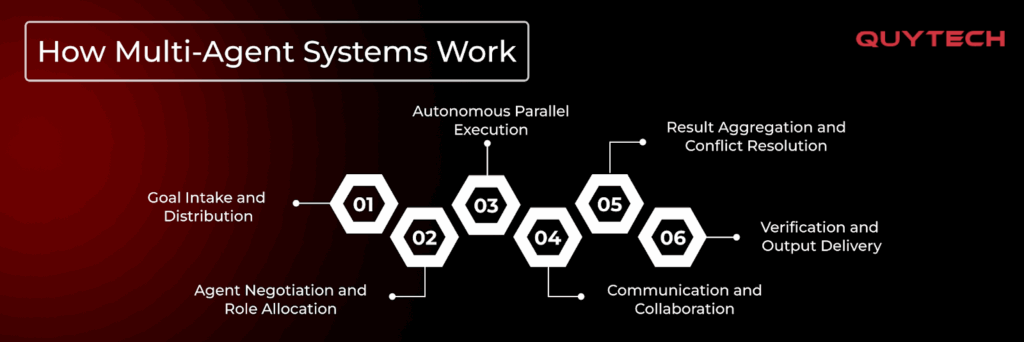
Multi-agent systems function by acquiring goals, negotiating, allocating roles, and autonomously executing them in parallel. They also communicate and collaborate. The agents are capable of sharing knowledge and validating aggregated outputs with the expected one. Here’s a detailed and sequential breakdown of each of these steps:
1. Goal Intake and Distribution
The primary step of the working mechanism of multi-agent systems is goal intake. This happens when the user provides input. Based on the input, the agents themselves identify areas that match their capabilities.
2. Agent Negotiation and Role Allocation
Once the goal is interpreted, multi-agent systems negotiate among themselves to claim small units of the main objective. They align subtasks with their capabilities and allocate roles as well.
3. Autonomous Parallel Execution
After roles are allocated, every agent in the multi-agent system starts executing their share of tasks. This execution happens in parallel.
4. Communication and Collaboration
While the agents do not depend on each other, they do communicate. They share their findings through a common communication layer without disrupting the workflows.
5. Result Aggregation and Conflict Resolution
Once the agents finish their tasks, their outputs are gathered to make sure the combined results meet expectations. Any differences found during this step, such as conflicting outputs or inconsistencies, are resolved as well.
6. Verification and Output Delivery
After the aggregated output is finalized, it is validated against the original objective. Post validation, the result is delivered to the user. This whole process is also logged for learning and future referencing.
People Also Like: AI Agents for Product Management: Driving Smarter Feedback, Insights, and Prioritization
Pros and Cons of Hybrid Agent and Multi-Agent Systems
Now that you are familiar with the distinctions and working mechanisms of hybrid vs multi-agent systems, let’s explore the pros and cons of each:
Pros of Hybrid AI Agent Systems
- Complementary Capability Coverage
Hybrid AI agent systems use diverse AI approaches. This makes them capable of solving even extremely complex problems, as agents of different capabilities come together to not only play their role but to cover the weaknesses of the others.
- Versatile Task Handling
Hybrid agents are connected with different layers of reasoning, like the reactive layer, learning layer, etc. These layers make them capable of handling tasks of different natures and complexities, which naturally adds versatility.
- Gives Reliable Outputs
Since various AI methods examine and confirm an input from different perspectives, the chances of errors or inaccuracies decrease. If one method overlooks something, the others can find it, providing dependable results.
- Faster Response on Time-Sensitive Tasks
Hybrid AI agent systems comprise reactive layers, which make them capable of reacting to situations as they take place. This helps them give a faster response in urgent situations.
Cons of Hybrid AI Agent Systems
- Complex to Design and Maintain
While the multiple approaches of hybrid AI agent systems do bring in benefits, they also add complexity to the design. And naturally, introducing changes or carrying out maintenance also becomes challenging.
- A Failure in One Layer Disrupts the Entire System
As is known already, all the layers of the hybrid AI agents are tightly connected and follow a sequence when carrying out tasks. This creates dependency, and a fault at one layer can disrupt the complete workflow.
- Hard to Scale
Scalability is quite challenging in a hybrid AI agent system. This is because the structure of these systems is fixed, and making changes to them needs reworking the core architecture.
- Higher Computational Cost
Hybrid agent systems require significantly more computational resources. The reason behind this is that they utilize multiple AI approaches, and the costs spent on their work are very high.
Pros of Multi-Agent AI Systems
- Easy Scalability
Multi-agent AI systems are quite easy to scale. This is because the agents in this system are autonomous, so there’s no need to completely restructure the system to add new agents.
- Faults Do Not Disrupt Workflows
Since all the agents in a multi-agent system are autonomous, they are not dependent on each other for functioning. The faults in one agent do not affect the complete workflow. Even if an agent breaks down, other agents divide its tasks among themselves to ensure that the objective is accomplished.
- Faster Execution Through Parallel Processing
As mentioned already, multi-agent AI systems do not follow a dependent approach. All agents in this setting work in parallel. This enables them to complete their tasks faster, as they don’t have to wait for other agents to finish their portions.
- Easy to Improve and Maintain
Since each agent in a multi-agent AI system is an individual component, introducing improvements or performing maintenance is easier. The agents can be updated, enhanced, or replaced without rebuilding the whole system.
Cons of Multi-Agent AI Systems
- Complex Agent Coordination
While multiple agents can solve problems faster, they still require continuous coordination to avoid duplicate work. However, collaboration can become challenging if its mechanism is not properly designed.
- Output Conflict Resolution Overhead
The agents, being autonomous, increase the chances that the decisions they make can conflict with those of other agents. This can delay delivery of the final output, as resolving it requires additional effort.
- Shared Memory Can Become a Bottleneck
Shared memory can become a bottleneck in multi-agent AI systems. This is because when multiple agents share the same source of information, the chances of incorrect information being shared and used also increase.
- Unpredictable System Behavior
Since agents are autonomous, their behavior in a multi-agent system is highly unpredictable. This is because multiple agents are involved in the decision-making process. They perceive and work differently, which can lead to unexpected outcomes.
Read More: AgentKit vs Langchain: Best AI Agent Frameworks 2026
Hybrid vs. Multi-Agents: Enterprise Decision Framework for 2026
Both hybrid and multi-agent systems bring in numerous benefits for organizations. One helps organizations handle workflows without losing control, while the other lets organizations scale without worrying about making architectural changes. But how do you figure out which one suits your organization the best? Well, that’s exactly what this section will guide you through:
Choose Hybrid AI Agent Systems if:
- Your workflow has mixed complexity levels
If your organization’s workflows are a mix of both time-critical and deep reasoning tasks, then you can opt for hybrid agent systems. These systems use different AI approaches, such as reactive, which is helpful for quick responses, and deliberative, which is good for reasoning.
- You need centralized control and governance.
If you prioritize centralized control and governance, hybrid agent systems are well-suited to your enterprise. They comprise an orchestrator that plans, distributes, and governs the AI agent workflows.
- Structured Enterprise Workflows
If your organization follows structured and predictable workflows, then hybrid agent systems are the right option for you. This is because hybrid agent systems operate according to a systematic process.
Choose Multi-Agent AI Systems if:
- Your Workflows Require Parallel Execution
If your organization handles multiple workflows and tasks and requires parallel execution, then you should go with a multi-agent AI system. These systems handle a large number of tasks very quickly because they operate in parallel without depending on other agents.
- Your Organization Prioritizes Decentralization
If you prefer decentralization for workflow management and decision-making, consider multi-agent systems. Such systems comprise autonomous agents that control their portion of the overall tasks without depending on or being disrupted by another agent.
- Your Organization Needs a Highly Scalable Architecture
If your organization needs a highly scalable architecture, a multi-agent AI system is the answer. These systems do not need a complete reworking of the core architecture to scale them to increasing workflow needs.
Interesting Read: AI-Powered SOC Agents: The Future of Automated Threat Detection and Response
From Architecture to Deployment: Building AI Agent Systems with Quytech
When it comes to implementing AI agent systems, merely knowing the system architecture is not enough. Organizations need a partner who understands how these approaches would deliver measurable value in their workflows, align with their existing infrastructure, and connect with the long-term objectives. This is exactly where Quytech comes in.
With over 16 years of experience and expertise in delivering AI-powered solutions across industries, we bring a team of dedicated developers who specialize in end-to-end AI agent implementation. Our team begins by assessing your complete infrastructure, organizational needs, workflows, and determining which agent system aligns with your needs perfectly.
From designing the architecture to deployment and maintenance, we take care of every phase and deliver quality and transparency throughout. We place a special emphasis on customization and scalability, ensuring that the AI agent system, be it hybrid or multi-agent, fits your current and future business needs without fail.
Conclusion
Choosing the right AI agent system is much more than a mere technology decision; it’s a strategic one. It involves a thorough assessment and selection of agent systems that have an architecture that actually supports organizational workflows and objectives. This is exactly where making the right call between hybrid vs multi-agent systems comes in.
Hybrid AI agent systems bring in different AI methodologies that complement each other and help organizations tackle complex problems. They handle tasks of different natures and complexities, give reliable outputs, and offer quick responses in time-sensitive situations.
Multi-agent systems power organizational workflows with their autonomous and independent working capabilities. They help in scaling without changing existing infrastructure. What’s more is that multi-agent AI systems work even if one agent or layer becomes faulty, thanks to their ability to autonomously execute tasks in parallel.
FAQs
Yes, hybrid AI systems and multi-agent systems can be used together. In fact, many organizations do use multiple AI methodologies while multiple agents collaborate within a multi-agent system.
Yes, multi-agent systems are more expensive to build than hybrid AI systems, but the scalability factor they offer justifies the cost.
AI agent systems integrate with existing enterprise software by utilizing APIs, data pipelines, and micro services.
Yes, AI agent systems are secure for enterprise environments when they are implemented with proper security measures like encryption, access control, and authentication.
Yes, many AI agent systems can react and operate in real-time. Such systems use event-driven triggers, fast-decision models, and automated execution capabilities.
Enterprises can ensure reliability in AI agent systems by establishing continuous system monitoring, performance tracking, and fallback mechanisms.
Yes, organizations with limited technical capabilities can also implement AI agent systems. They can do so by partnering with an AI agent development company.
