
Building a competitive and innovative digital product is a very challenging task, but what’s even more challenging is forming the right team to carry out its development. The product engineering life cycle is not a stable and steady process. Instead, it is a process that is as dynamic as it could get. Product engineering brings in different challenges every day, be it about scaling, collaborating, needing specialized engineers, or making real-time product decisions.
What withstands and overcomes these challenges is a capable and strategic product engineering team. But what makes a team truly capable varies from organization to organization. Some organizations may use their in-house engineering teams to have complete control over development, while others may choose offshore teams to access global talent. And many might take the best of both worlds and opt for a hybrid product engineering team.
If you are evaluating offshore vs in-house vs hybrid product engineering teams structure and are unsure which one is right for your organization, you are in the right place. This blog breaks down each model to help you make the right call.
What is an Offshore Product Engineering Team?
An offshore product engineering team refers to the resources outsourced from other countries. In this model, the entire product engineering life cycle, that is, from ideation to deployment and maintenance, is handled by the outsourced team.
Offshore product engineering teams allow organizations to access technically competent human resources without having to full-time hire them. These teams offer a much more cost-effective solution than internal teams.
Similar Read: Offshore Vs. Nearshore Outsourcing: A Detailed Comparison
What is an In-House Product Engineering Team?
As the name suggests, in-house product engineering teams refer to a technical team formed with internal human resources. These teams are a part of the organization and share the same cultural and working methodology.
In-house product engineering teams utilize internal talent to develop digital products. Being a part of the organization, these teams offer better oversight and control over the product engineering life cycle.
Interesting Read: How to Hire an Offshore Development Team? A Complete Guide For Businesses
What is a Hybrid Product Engineering Team?
A hybrid product engineering team is one that brings a blend of both offshore and in-house models. It allows organizations to access the best of both worlds by utilizing in-house talent for core tasks and opting for offshore teams to fill the gaps of the internal teams.
Hybrid teams help organizations establish the right balance of control and flexibility. It lets organizations exercise control over development through internal teams. Meanwhile, partial offshore teams allow companies to access global talent while saving costs.
Similar Read: 9 SaaS Product Engineering Trends to Watch in 2026

Offshore vs In-House vs Hybrid: Key Differences
Now that you are familiar with all three product engineering team types, let’s help you compare them for a deeper understanding. Here’s a table highlighting the key differences of offshore, in-house, and hybrid teams:
| Aspect | Offshore Product Engineering Teams | In-House Product Engineering Teams | Hybrid Product Engineering Teams |
| Team Location | Offshore product engineering teams are generally located in other countries. | In-house product engineering teams are located in the organization itself. | In hybrid product engineering teams, the core team is internal, and the rest of the workforce is offshore. |
| Cost Structure | The cost of managing talent is very low. | High cost of managing talent as they are hired and maintained. | Moderate costs of managing the workforce. |
| Talent Access | Organizations get access to global talent. | Organizations get access to only internal human resources. | Organizations get to utilize both internal and global talent. |
| Scalability | Rapid scalability is possible. | Scalability is possible, but it is comparatively slower than offshore teams. | Being a combination of both models, hybrid teams are moderately scalable. |
| Control & Oversight | Control and oversight are limited in offshore teams. | There is direct control and oversight in in-house teams. | Control and oversight are shared as teams are both internal and offshore. |
| Communication Complexity | Communication complexity is higher as teams are located in different regions and time zones. | Communication complexity is low because teams are located in-house. | Moderate communication complexity. |
| Cultural Alignment | Offshore teams require alignment efforts. | In-house teams are naturally aligned. | Hybrid teams have a managed alignment framework. |
| Infrastructure Investment | Minimal client-side infrastructure. | High infrastructure investment. | Shared infrastructure responsibility. |
| Best Suited For | Cost optimization and rapid build. | Strategic core product ownership. | Long-term scalability with cost efficiency. |
Handpicked For You: Agentic AI in Product Engineering: Guide for Business Leaders
Pros and Cons of Offshore, In-House, and Hybrid Product Engineering Teams
Let’s compare offshore, in-house, and hybrid product engineering teams based on the pros they bring and the cons they possess:
Offshore Product Engineering Teams
| Pros | Cons |
| Offshore product engineering teams are a cost-effective option. They save the cost organizations spend on hiring, onboarding, compensating, and retaining teams. | Being located in a different country and time-zone, offshore teams often fail to connect in terms of culture and work methodology. |
| The offshore model allows organizations to access talent across the globe. | Time zone differences of the offshore teams often create communication gaps, as the working hours may not align. |
| Offshore product engineering teams offer high scalability as compared to other models. | Since offshore teams are not in the organization, they are hard to control and have oversight on. |
| Offshore teams reduce the administrative burden of the organizations as they no longer need to handle hiring, onboarding, payroll, etc tasks. | Offshore teams are across borders and require sharing sensitive information and resources. This increases compliance and security requirements. |
In-House Product Engineering Teams
| Pros | Cons |
| In-house product engineering teams allow organizations to exercise direct and complete control over the product development process. | In-house teams are quite expensive to maintain as they require hiring, salaries, incentives, infrastructure, and so on. |
| Being located in the work premises, in-house teams make communicating easy and effective. | In-house product engineering teams are not easily scalable, as hiring specialized engineers can take months. |
| Having an in-house product engineering team offers higher data security confidence to organizations as they don’t need to share their data resources with external teams. | Organizations’ access to competent and talented engineers is limited to the human resources available internally. |
| In-house teams align perfectly with the organization’s long-term objectives, culture, and work methodology. | There are chances that the internal teams may become technologically stagnant or resistant to new methodologies without external exposure. |

Hybrid Product Engineering Teams
| Pros | Cons |
| Hybrid product engineering teams allow organizations to handle the core and strategy-related areas of product development through internal teams | Since hybrid teams are a combination of both internal and offshore models, it’s comparatively harder to ensure coordination due to distributed teams. |
| Since hybrid teams include a mix of offshore models, it makes scalability easy and cost-effective. | Hybrid product engineering teams often face communication gaps as there’s a difference in their working time zones. |
| With hybrid product engineering, the product development cycle operates on a 24-hour cycle because of the time zone gaps. This means that when the internal teams rest, the offshore ones function. | Hybrid teams often have an unclear sense of ownership during the product engineering process due to unclear boundaries and accountability. |
| Hybrid teams help organizations utilize both internal talents and access external talent pools as well. | Being a mixture of two different models, hybrid teams often have gaps in working styles and culture. |
People Also Like: Generative AI in Product Engineering: Real-World Applications
How to Choose the Right Development Team
The decision of choosing the right product engineering team is not something that can be made based on a single factor. It is a strategic decision that should be made after understanding all the factors affecting it and comparing all the suitable options. Sounds complex, right? But worry no more because in this section, we will help you choose the right product engineering team:
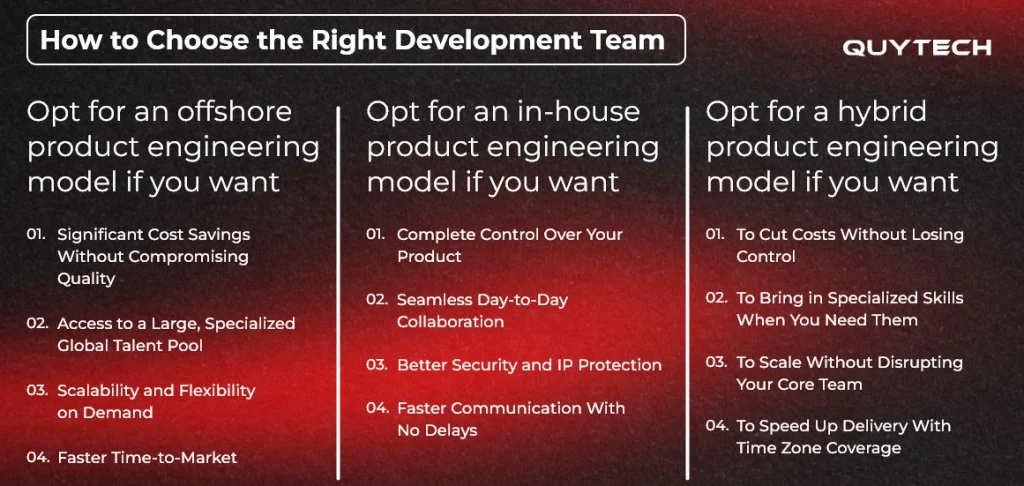
Opt for an offshore product engineering model if you want:
- Significant Cost Savings Without Compromising Quality
If you want a cost-effective development team without compromising on the quality of the product, then you should opt for an offshore engineering team. This model provides competent team members without going through the hustle and bustle of hiring and managing them internally.
- Access to a Large, Specialized Global Talent Pool
If you are looking for a certain expertise in a team, go for offshore engineering teams. These teams comprise specialized global talent pools and let you source niche expertise quickly.
- Scalability and Flexibility on Demand
If your concern is scalability with flexibility on demand, then you should choose an offshore product development team. These teams allow organizations to upscale and downscale human resources without worrying about urgent hiring and sudden layoffs. It offers access to talent based on the phase of product development.
- Faster Time-to-Market
If you want to make your product reach the market faster, then offshore product engineering teams are the answer. Offshore partners come with pre-built teams, established workflows, and domain expertise, which allows organizations to skip the lengthy hiring cycles and get straight to building the digital product.
Opt for an in-house product engineering model if you want:
- Complete Control Over Your Product
If your concern is to have complete control over the product engineering life cycle, then you should opt for an in-house team. Since the members in these teams are part of the organization, it allows better oversight and alignment with objectives as well.
- Seamless Day-to-Day Collaboration
If your digital product requires continuous collaboration during development, then in-house teams are the right choice. In-house product engineering teams reduce the complexity of continuous collaboration as they are in the same work premises.
- Better Security and IP Protection
If your product utilizes sensitive data or is related to regulated industries, then you should opt for in-house development teams. This protects data from external threats and ensures compliance with regulatory requirements during product development.
- Faster Communication With No Delays
In-house product engineering teams are suitable when organizations want faster communication with no delays during product development. It eliminates wait times that are encountered when teams belong to different countries and time zones and makes communication direct, especially when making real-time decisions.
Opt for a hybrid product engineering model if you want:
- To Cut Costs Without Losing Control
If you want cost efficiency without losing control of the product engineering life cycle, then you should opt for a hybrid model. Hybrid product engineering teams ensure that the main control of the product remains with the organization while still benefiting from offshore efficiency.
- To Bring in Specialized Skills When You Need Them
Now, if your internal teams can handle core development areas but require specialized skills for certain areas, then you should consider a hybrid model. It allows you to get access to talent as and when needed instead of utilizing external teams for complete development.
- To Scale Without Disrupting Your Core Team
As is well known, development team requirements vary across product development phases. Hybrid product engineering teams allow organizations to keep the core team internal and scale through offshore teams.
- To Speed Up Delivery With Time Zone Coverage
If you want to speed up the delivery of your product, then hybrid product engineering teams are the answer. This is because these teams work in a continuous 24-hour pattern where internal teams work when external rests and vice versa. This pattern creates a development rhythm that shortens delivery timelines significantly.
Read More: Why Even Well-Funded Product Engineering Initiatives Fail and What CIOs Must Do Early
How Quytech Helps You Build a Product Engineering Team Aligned With Your Vision
Quytech helps organizations build and scale product engineering teams by understanding everything from organizational goals and product vision to constraints and specific requirements. Through this approach, we provide organizations with a skilled offshore team to handle end-to-end product development or combine internal expertise with dedicated global teams to speed up delivery without the stress of recruitment.
With over 16+ years of experience in delivering quality digital products, Quytech stands as a strategic partner. We bring technical expertise, security standards, and cross-industry knowledge needed to build scalable products. Our dedicated developers seamlessly integrate into your workflow, whether they are extending the in-house team or driving the complete development cycle independently. We emphasize clear communication and transparency during the whole development process.
Conclusion
Choosing the right product engineering team is one of the most strategic decisions organizations make. It shapes how fast a product will be delivered, how well it will align with organizational objectives, and whether it will succeed or fall behind in the competitive market.
While all the models bring in their own pros and cons, choosing the right one mainly depends on several factors. For organizations wanting to access global talent, cost-effective scaling, and reduced administrative tasks, offshore product engineering teams are the right option.
Whereas for organizations expecting complete control over product development, seamless communication and collaboration, in-house product engineering teams are suitable. And for those wanting a balance of both internal and global talent, a hybrid product engineering team is the right model.

FAQs
Quality can be ensured by an offshore product management team through regular checkpoints. Along with this, appointing an in-house lead to oversee the product engineering life cycle is also an effective practice.
Yes, businesses can switch from one team model to another as they grow. However, the transition should be made with a proper plan to ensure there are no disruptions and teams are able to adapt to the change.
Offshore product engineering is suitable for both long-term and short-term projects. It’s beneficial in the long term when organizations want a stable development cycle without exceeding budgets. For short-term, offshore teams are ideal for MVPs and specific feature builds.
Traditional outsourcing is more of a task-based approach where external teams are hired only to carry out certain tasks. Whereas offshore product engineering teams handle everything in the development cycle.
Not necessarily. A carefully chosen offshore product engineering team does not affect product quality. Instead, such teams enhance the quality of the product through their experience and expertise in product engineering.
Key factors that should be evaluated before choosing an offshore product engineering partner include technical expertise, industry experience, communication processes, compliance practices, client testimonials, and engagement model flexibility.
Yes, offshore product engineering is a good fit for startups as it allows them to access global technical talent without spending as much as they spend on maintaining an internal team.
Industries that commonly use Offshore product engineering are fintech, healthcare, e-commerce, edtech, logistics, and SaaS. Additionally, any industry that depends on digital products to provide value can gain from this model.
