Building a competitive product in 2026 is no easy feat. By the time an enterprise finishes designing the roadmap, the market may shift, trends may change, or new technologies may emerge.
Every new technology, such as Agentic AI, blockchain, predictive analytics, and digital twin, brings novel opportunities, but the risk of failure also comes along. Not studying the market well and making wrong technology choices are two common reasons that may become a roadblock to modernizing your enterprise tech.
It may also lead to losing significant market share to your competitors who have adopted them early and already have a first-mover advantage. So, whether you are planning to build a new product from zero to one or redefining your current tech strategy, it is crucial to have an in-depth understanding of the technologies global enterprises are actively betting on in 2026.
These technologies contribute to building future-ready products that are harder to compete with. So, without further ado, let’s start!
8 Technologies Enterprises Leverage to Build Competitive Products
Let’s quickly take a look at the technologies that global organizations are utilizing to develop products that stand out:
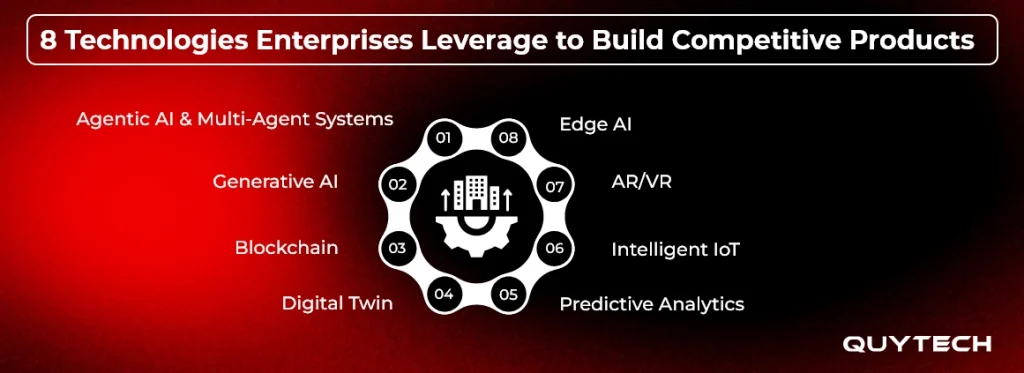
- Agentic AI & Multi-Agent Systems
Agentic AI surpasses traditional AI that can do pre-defined automation and respond to given prompts. It can autonomously plan, make decisions, and even take actions to perform tasks without requiring much involvement. 2026 is not just about Agentic AI but about multi-agent systems involving more than one agent, each performing a specialized function, just like the human workforce.
How it works:
An agent receives a goal or input and breaks it down into small tasks. It performs or executes them all without requiring any further input or human intervention.
How enterprises are using Agentic to build smarter products:
Enterprises across the world are relying on Agentic AI in customer support operations, software development workflows, supply chain management, and financial operations. Agents are not just assistants; they are the team that works and performs tasks.
Why Agentic AI in product development matters in 2026:
In 2026, enterprises not only look for automation, but they need AI that can autonomously act and execute tasks. They need a technology that replaces entire operational workflows with intelligent systems. Integrating agentic AI or multi-agent systems can bring workflow automation. It also ensures faster delivery, lower costs, and an exceptional product experience.
Real-world examples:
Klarna, a Swedish fintech company and digital bank, has implemented AI agents to offer customer support services and handle an equivalent workload to 700+ human agents. These agents provide immediate support services while enhancing the customer satisfaction score.
Explore More: Agentic AI in Product Engineering: Guide for Business Leaders
- Generative AI
Most enterprises think that Generative AI is for content creation. But they really need to broaden their horizon because it is also being widely used in the product development lifecycle. Yes, you read that correctly! Gen AI redefines product design, development, and testing to accelerate innovation.
How it works:
Gen AI learns from the patterns associated with your current data to create new content in the form of text, images, code, audio, and videos. It’s the speed of this technology and seamless integration capability that enterprises can leverage for content creation and in product development workflows.
How enterprises are using Gen AI to build smarter products:
Enterprises are leveraging Generative AI to auto-generate and review code, create hyper-personalized experiences, and create synthetic training data. This data can be used to train AI models for specific business use cases.
Why Gen AI in product development matters in 2026:
For most enterprises, Gen AI is not just a productivity tool; it is a product strategy that companies can utilize in their development lifecycles and workflows. Apart from this, the demand for development speed, personalization, and operational efficiency is more than it used be. Most enterprises are not considering it as a technology to augment human work; they are already running it as a part of their core technical infrastructure.
Real-world examples:
GitHub Copilot utilizes Gen AI to enable developers to speed up coding by 55%. Most developers even rely greatly on AI to generate code; this reduces development costs and also ensures faster time-to-market.
Discover More: Generative AI in Product Engineering: Real-World Applications
- Blockchain
Enterprises across the world are now leveraging blockchain to build transparent and highly secure digital products and ensure verifiable supply chain tracking, fraud-proof, and tamper-proof financial transactions. The technology enables the products to record transactions across networks in a transparent and tamper-proof manner.
How it works:
Blockchain is a decentralized and distributed ledger with shared control. In other words, no single entity that is part of the blockchain network can control it. This improves trustworthiness in an enterprise environment where multiple parties are involved.
How enterprises are using blockchain to build smarter products:
Large organizations are using blockchain to ensure supply chain transparency, improve security in financial transactions, automate smart contracts, and tokenize real-world assets.
Why blockchain in product development matters in 2026:
Blockchain in product development matters because of increasing scrutiny around data integrity and financial transparency. Apart from this, customers are also demanding more accountability from the enterprises, making it a necessity rather than a choice.
Real-world examples:
Walmart utilizes blockchain to improve supply chain tracking and transparency of its food products. The technology enables them to do days of work in seconds, and that too in real-time.
You May Like to Read: Guide to Enterprise Blockchain: Top Use Cases, Features, Trends, and Benefits
- Digital Twin
Digital Twins are one of the emerging technologies that are contributing to building intelligent digital products. Basically, they enable enterprises to create a virtual replica of physical assets, processes, or even entire systems. A digital twin of a process can be used to simulate, monitor, and optimize in real-time, without changing the actual product/process.
How it works:
It is a dynamic virtual model that mirrors a process or system. This model gets live data from connected systems and sensors and can be used to test and iterate changes without making changes to the real systems.
How enterprises are using digital twin technology to build smarter products:
Enterprises are using this technology to create a replica of products and test them for performance and functionality before the final launch. They can even predict equipment failure while making it easy to optimize processes.
Why digital twin in product development matters in 2026:
The cost of product failure is high for any enterprise. Digital twin, in combination with AI and IoT, allows enterprises to test their products in a risk-free environment and build next-generation products.
Real-world examples:
Siemens, a German multinational technology company, uses this technology in its manufacturing operations. Their team can virtually simulate production lines before actually setting them up. This helps them reduce product development time and cost.
Give it a Read: Why Even Well-Funded Product Engineering Initiatives Fail and What CIOs Must Do Early
- Edge AI
It is an emerging technology that makes it possible to process data at the source where it is generated. This saves the time that was required to route that data from the origination to the data processing system.
How it works:
In Edge AI, AI algorithms are deployed directly on the local device. Now, it could be a sensor, camera, or even a smartphone. It eliminates the requirement of taking that data through a remote cloud server. This results in faster processing and lower latency.
How enterprises are using Edge AI to build smarter products:
Large companies are integrating Edge AI into their products to ensure real-time quality controls in various operations on the manufacturing floors. They are also using it for autonomous decision-making for vehicles and instant detection of fraud at the point of sale.
Why Edge AI in product development matters in 2026:
With increasing demand for interconnected devices and real-time experiences, Edge AI is becoming a technology that is becoming an integral part of enterprise product development. With edge-first architecture, products are becoming more scalable and resilient.
Real-world examples:
Tesla, an American multinational automotive and clean energy company, uses Edge AI to process most of its autonomous driving decisions right on the vehicle’s onboard AI chip. It enables the vehicle capable of making split-second decisions.
Learn More: 9 SaaS Product Engineering Trends to Watch in 2026
- AR/VR
Augmented reality and virtual reality have been around for a long time. But they are increasingly being used now to transform customer experiences, customer interactions, and the way customers make buying decisions.
How it works:
AR overlays digital information onto the real world. Virtual reality delivers an immersive experience to users. When used together, they both bridge the gap between the physical and virtual world and help enterprises build products that deliver a lifelike experience.
How enterprises are using AR/VR to build smarter products:
Enterprises are using AR/VR to deliver immersive product demos, create virtual showrooms, deliver remote training, and other use cases. The technology helps to improve user engagement and eliminates the need to physically visit the place/facility.
Why AR/VR in product development matters in 2026:
With customers expecting lifelike experiences, AR/VR is no longer a choice for retailers, real estate, healthcare, and other similar verticals. Many enterprises are already using the technology to set a benchmark for quality and customer satisfaction.
Real-world examples:
IKEA, a leading furniture retailer, uses AR-powered applications to enable its customers to virtually place furniture in their homes before making the actual purchase. This reduces the chances of returns while ensuring quicker and more confident buying decisions.
You May Like to Read: The Difference Between Virtual Reality, Augmented Reality, and Mixed Reality

- Intelligent IoT
The Internet of Things is not a new technology; however, it has undergone a little transformation by joining hands with AI and ML. Using intelligent IoT, enterprises are building products that are not only capable of collecting data but also understanding it and taking action.
How it works:
Intelligent IoT takes data from connected devices and systems and then utilizes embedded AI to automatically analyze, process, and respond to that data. All this happens in real-time. A sensor that can record temperature can predict equipment failure after intelligent IoT integration.
How enterprises are using Intelligent IoT to build smarter products:
Enterprises from manufacturing, energy, real estate, healthcare, retail, and other industries are using AI-powered IoT for predictive maintenance, smart energy management, remote patient monitoring, and retail inventory management.
Why IoT in product development matters in 2026:
Enterprises are now focusing on building smarter and highly efficient products that can predict problems, automate responses, and improve over time. Intelligent IoT enables enterprises to build such products.
Real-world examples:
Rolls-Royce utilizes intelligent IoT for its aircraft engines to enable thousands of sensors to stream data and feed it to AI systems for real-time processing. With this technology, the company can predict maintenance needs and prevent failures.
Take a look at: Enterprise IoT– Benefits, Use Cases, and Real Examples
- Predictive Analytics
Predictive analytics has become a core competitive advantage that enterprises are leveraging by integrating it into their products. It turns ordinary data into intelligent insights, which enterprises can rely on for informed decision-making.
How it works:
Predictive analytics uses statistical algorithms along with machine learning and historical data. These algorithms process the data to identify patterns and predict future outcomes.
How enterprises are using predictive analytics to build smarter products:
Enterprises are leveraging this competitive technology in forecasting demands, predicting customer churn, setting dynamic pricing, and delivering personalized recommendations. Organizations can shift their decision-making approach from reactive to proactive.
Why predictive analytics in product development matters in 2026:
For any organization, data is not just details of their customers or purchases. It is a valuable asset that can be used to extract insights. Based on these insights, companies can make intelligent decisions, which can amplify their revenue and become competitive.
Real-world examples:
Amazon uses predictive analytics in its recommendation engine to understand its customers’ buying behavior and predict their next purchases.
Dig Deeper: How to use AI Predictive Analytics for Forecast Business Performance
Apart from these aforementioned technologies, one more technology that is becoming immensely popular in building competitive products is confidential computing. The main reason behind its popularity is that almost every enterprise today deals in sensitive data. Securing this data requires implementing technologies like confidential computing. The technology ensures that the data is secured even when it is being used, not just when it is stored and transmitted.
Just like confidential computing, serverless computing is also becoming a trend that contributes to building products or software that stand out. This technology enables enterprises to forget the hassle of managing tech infrastructure, as it is done by cloud service providers.
How Quytech Helps Enterprises Build Competitive Products
So, you know which technologies are becoming enterprises’ favorite in building future-ready digital products. Now is the time to understand that to make the most of these technologies, you need a reliable and experienced technology partner. A partner who doesn’t have an in-depth knowledge of Agentic AI, Edge AI, IoT, and other techs, but should have hands-on experience in developing enterprise-grade products using them.
That’s where Quytech enters the scene. With more than 16 years of experience and certified engineers of blockchain, AR/VR, Agentic AI, Edge AI, Predictive Analytics, Gen AI, and other technologies, we offer end-to-end product engineering services. Our experts have delivered high-performance products to global organizations from healthcare, travel, BFSI, manufacturing, and almost every other industry.
We don’t build ordinary products; we build exceptional digital experiences that align with your unique goals and give you a competitive advantage. Our team thoroughly evaluates your existing tech infrastructure to identify gaps and opportunities, and determine which technology would be perfect for your product. In short, from strategy to architecture design to full-scale development deployment- we offer end-to-end product development services.
Take a look at some of our leading products in every technology:
- Gen AI-Powered Entertainment App
- Predictive Tyre Maintenance and Analytics Solution
- AI-powered Car Damage Detection System
- A Fiat Currency and Cryptoexchange App
- Live AR App for a Newspaper
- IoT App for Garden Monitoring
- A Premium Digital NFT Marketplace
Important Read: Product Engineering Governance: Ensuring Security and Compliances
Final Words
One thing that this list makes clear is that for any product to be competitive in 2026, it is not necessarily required to be backed by all emerging technologies. Rather, what’s needed is to make the right technology decision or choice by thoroughly understanding your business challenges and objectives.
Once you define your needs clearly, identify two or three technologies, from Agentic AI, Edge AI, IoT, digital twin, and Gen AI, that you think can make a real impact. If you are unsure at any point, it is the right choice to partner with an experienced and trusted technology company to get their product consulting services.
They can help you determine which technology would be the best meet your product vision and stand out in the market. Not just consulting, companies like Quytech can also build an end-to-end product that is tailored to your business goals and delivers measurable results. All you have to do is reach out to one of its product engineers and share your unique requirements.

FAQs
An enterprise should begin by defining the problem or the challenges it is facing. Then they should evaluate their current tech infrastructure and understand upcoming market trends to decide on the technologies that align with their needs. They can simply partner with a reliable technology company to get consulting services on tech selection.
Whether you want to integrate digital twin, AI/VR, Edge AI, or Gen AI into your enterprise product, the time needed to spend depends on the complexity of your current infrastructure and the scope of integration. It may take a few weeks to up to six months.
Enterprises of all sizes and types can implement these technologies. However, it is recommended to begin with a pilot before scaling.
One of the common mistakes that enterprises make while adopting new technologies is not defining a clear objective. This may lead to fragmented implementations that don’t deliver measurable outcomes. Therefore, they need to define the problem and the outcome they want to achieve.
ROI of the new technology adoption can be measured in various ways, including reduced time-to-market, lower operational costs, improved customer retention, and increased revenue. Make sure these ROIs are defined before you begin implementing any technology.
To ensure a smooth transition of new tech integrations, it is recommended to begin with a focused pilot. We also recommend that you validate outcomes with defined metrics. Once it delivers the desired outcome, scale the product. This will minimize disruption and downtime.
