Key Takeaways:
- AI agents in product management refer to software systems that automate product lifecycle management tasks without human dependence.
- AI agents for product management assist in managing user feedback, product insights, prioritization, and performance tracking.
- They bring in numerous benefits for enterprises. These include enhanced accuracy, decision-making, customer understanding, and efficiency.
- Intelligent agents for product management can be applied to varied use cases like feature request analysis, opportunity identification, routine task automation, and cross-product pattern detection.
Imagine a product management team going through tons of customer data, that too from multiple sources, to make roadmap decisions. What you imagined just now is the reality of numerous product management teams, where disconnected tools, manual coordination, and growing data volumes make even basic product decisions hard.
This is where AI agents bring the wave of transformation. They automate the manual data collection, analysis, prioritization, and insight generation tasks. What’s more is that AI agents for product management operate continuously across systems. They reduce dependency on manual coordination and help teams maintain consistency as products and user data scale.
In this blog, we’ll explore how AI agents are transforming traditional product management by streamlining user feedback, generating actionable insights, supporting prioritization, monitoring product performance, and scaling product operations for enterprise teams.
What are AI Agents in Product Management?
AI agents are autonomous software systems working collectively to automate assigned tasks. In the context of product management, intelligent agents help bridge the gaps that product managers face in acquiring information, user feedback, and insights through fragmented procedures and data management systems.
In enterprise environments, product management requires continuous collection, analysis, and synthesis of product data. As is obvious, manual handling of such tasks is not just time-consuming but also prone to human error. Along with this, it creates dependency on individual judgment, increasing inconsistency across product decisions. Traditional product management systems also make it difficult for teams to sustain accuracy and continuity as product complexity grows.
AI agents in product management take over the routine tasks of managing data across systems. They reduce dependency by making logical decisions for product management stages. AI agents ensure continuity and accuracy by continuously monitoring and updating data across systems.
Why Enterprise Product Teams Need AI Agents
Enterprise environments do not handle one or two, but multiple products. They operate in complex environments, cater to varied user bases and their needs, and on a larger scale.
This makes it challenging for enterprises to understand the expectations of every user, naturally making product management a daunting task. Here are some challenges that give a deeper understanding of why enterprise product teams need AI agents:
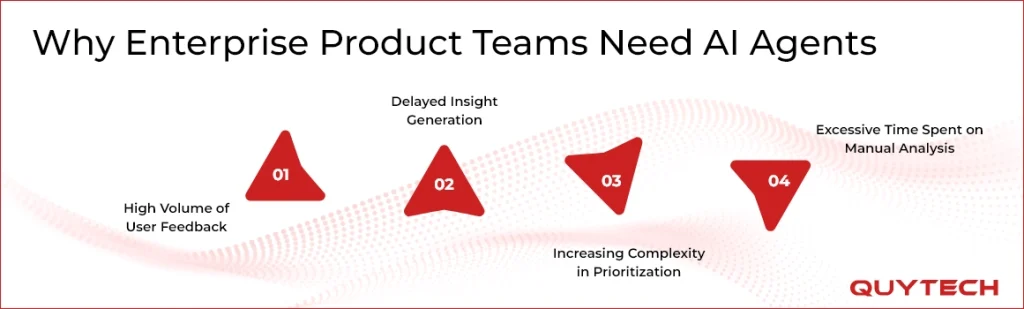
High Volume of User Feedback
Enterprise products receive feedback from multiple channels. These include sales, customer care, social media reviews, online ratings, and surveys. This feedback plays a vital role in understanding users’ perceptions of the products, but since it is fragmented, acquiring useful information becomes complex.
AI agents for product management automate the tasks of collecting, analyzing, and managing feedback from different resources. They maintain context in the data being generated, which reduces the time spent in accumulating information from scattered resources.
Delayed Insight Generation
Since data analysis and insight generation are manual in the traditional scenario, enterprises schedule them periodically. This often leads to delayed insight generation, as by the time the insights are generated, the situation of the product may have changed already. This reactive approach makes it difficult to introduce changes in the products based on ongoing trends.
AI agents in product management do not wait for the periodic analysis dates; they analyze as the data is generated. It collects insights in real-time, allowing enterprises to tap into trends and gain an early mover advantage.
Increasing Complexity in Prioritization
As mentioned already, enterprises cater to a diverse audience base. This diverse user base may have different expectations from a product. And not just the audience, but different departments might also present different views on the product. Varied inputs from varied sources can create chaos, confusion, and impact the quality of decisions.
AI agents for product management introduce systemacity, which helps decision makers picture the right challenges, opportunities, and considerations to implement on the product. It structures product information, which presents varied expectations without creating a chaotic environment.
Excessive Time Spent on Manual Analysis
Traditional product management depends heavily on manual analysis. Being handled manually, not only does the analysis take a lot of time, but it can also be manipulated intentionally or unintentionally. This impacts the quality of analysis, naturally affecting the decisions made through this analysis.
AI agents in product management replace manual analysis by continuously interpreting data as it gets generated. They do not analyze from scratch every time. Instead, they organize information, which makes analysis quick and accurate.

Now that you are familiar with the role intelligent agents play in overcoming different product management challenges, let’s move on to the next section to explore some detailed use cases of the same.
You Might Also Like: The Rise of Voice AI Agents: Revolutionizing Support and IVR Systems
AI Agents for Product Management: Key Areas They Transform
AI agents for product management help enterprises in transforming numerous key areas. It enhances user feedback management, insight generation, and prioritization. But it does not limit its capabilities to just these areas. The following are the key areas where AI agents for product management bring transformation:
User Feedback Management
AI agents for product management assist in systematically and continuously collecting feedback about the product. It accumulates feedback from every resource, be it from user ratings, reviews, surveys, or from sales or customer care. Once accumulated, AI agents organize them at one centralized location.
Product Insight Generation
For product insight generation, intelligent agents contribute to product insight generation, by analyzing data in real-time. Instead of following a proactive approach and waiting for periodic review cycles, AI agents analyze data as it’s generated and derive insights to power informed decision-making.
Product Prioritization and Decision Support
Unlike traditional product management, AI agents are capable of prioritizing inputs for decision-making. They do not get confused with multiple product inputs. AI agents can organize the inputs based on what’s actually important and work on them seamlessly.
Product Performance Monitoring
AI agents for product management monitor the performance of the product in real-time by tracking how it interacts with users. It also gathers the feedback from diverse sources to analyze how well the product is performing and what needs to be corrected. Intelligent agents automate performance monitoring, so it takes a lot less time as compared to manual monitoring.
Scalability of Product Processes
As mentioned already, the product process in traditional management is handled manually. Everything from feedback collection to analysis is manual, which is very slow, prone to error, and costly when it comes to scaling. AI agents flip the tables by automating repetitive tasks like the collection and analysis of data. They can handle a large amount of data as well, which makes scalability achievable.
Interesting Read: Agentic AI System Development 101: Explore Steps, Applications, Architecture, and Real-World Examples
Benefits of Implementing AI Agents in Product Management
Implementing AI agents in product management brings numerous benefits for enterprises. They help enterprises in understanding their customers better, in improving decision-making, and gaining a competitive advantage. Let’s understand these benefits in detail:
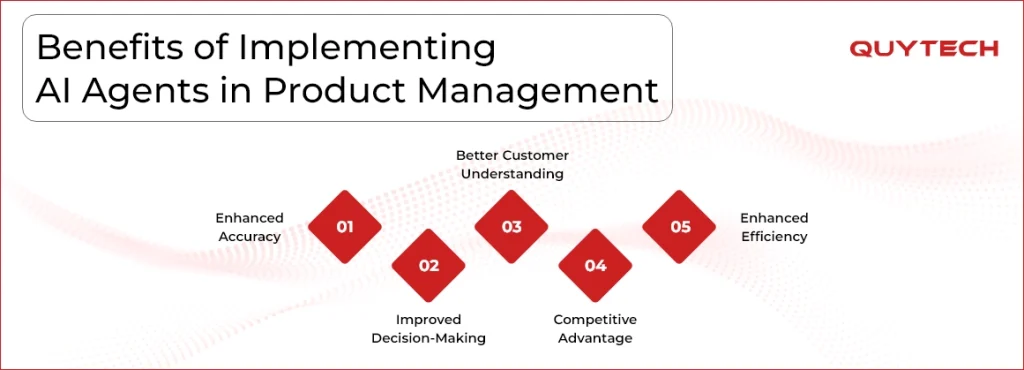
Enhanced Accuracy
Implementing AI agents in product management enhances the accuracy of product-related operations like feedback collection, analysis, and interpretation. Unlike manual analysis, intelligent agents do not work on partial data or assumptions. They gather every bit of information, unaffected by intuitions, mistakes, or bias.
Improved Decision-Making
Intelligent agents are capable of organizing varied inputs from various sources in a structured manner. This benefits enterprises as decision makers can easily evaluate the data, options, and make decisions with a better vision instead of relying on incomplete, scattered information and assumptions.
Better Customer Understanding
Intelligent agents continuously analyze customer data and derive insights from user behavior and feedback. Naturally, they get to understand what the customers want. This helps enterprises and product teams in aligning the product with the needs of the user.
Competitive Advantage
As mentioned already, AI agents for product management help product teams in understanding user behaviour in real-time. This offers clear insights into what the actual need is, and when enterprises tap into them, they naturally become the early mover. And being an early mover helps them stay ahead of competitors.
Enhanced Efficiency
Taking over time and resource-consuming tasks like data collection, analysis, management, organization, etc. AI agents enhance the overall efficiency of product teams. It eliminates the need for manual efforts, naturally directing them to more strategic areas. Not only does the efficiency increase, but resource allocation also enhances.
Read More: The Impact of Agentic AI in Redefining Startup Growth
Enterprise Use Cases of AI Agents in Product Management
Now that you are aware of the areas AI agents in product management transform, it’s high time to understand the other areas where it applies. The following are some use cases of AI agents in product management:
Voice-of-Customer Consolidation
Implementing AI agents helps enterprises in accessing a centralized view of all the varied customer inputs from different sources. They work 24/7 in accumulating feedback, be it from support tickets or from account reviews. AI agents in product management help product teams access all the data at one point, enhancing efficiency.
Feature Request Analysis and Grouping
Enterprises often receive a large number of feature requests, not just from the users of the product but from internal teams and departments as well. AI agents implemented in product management help in analyzing these requests and grouping them according to urgency and priority. Grouping helps product teams in targeting crucial features as a priority, as compared to general requests.
Opportunity Identification
AI agents applied to product management help in identifying opportunities and tapping into them at the right time. They utilize machine learning models to analyze data and derive meaningful insights, which are often overlooked when data is analyzed manually.
Routine Task Automation
Implementing AI agents in product management helps enterprises automate routine tasks. Enterprises manage multiple products, and that too, catering to a very large user base. AI agents applied to product management help in carrying out the routine tasks like input collection, insight generation, and preparing material for discussion. Their ability to handle large amounts of data makes them capable of coping with scaling environments as well.

Cross-Product Pattern Detection
AI agents applied to product management help in detecting patterns across products. As enterprises manage multiple products, they often end up sharing common issues across their products. AI agents can detect common cross-product patterns while monitoring them.
Interesting Read: Agentic AI in Education: The Future of Personalized and Adaptive Learning
Key Considerations for Implementing AI Agents for Product Management
When implementing AI agents in product management, there are some considerations that enterprises should look out for to achieve smooth implementation. But what are those considerations? That’s exactly what this section will walk you through! Here are some key considerations for implementing AI agents for product management:
Data Quality & Bias
Since AI agents depend on data to carry out the tasks of analysis, insight generation, and prioritization, the quality of data plays a very important role. Bias, fragmented, and scattered data can impact the quality of analysis done by product management AI agents.
Enterprises can overcome data quality and bias concerns by ensuring proper management of data. This will add accuracy and enhance the quality of the outputs of AI agents.
Integration Complexity
As enterprises deal with multiple products and large amounts of data, the data is often spread across multiple tools like CRMs and other existing systems. Along with this, outdated existing systems can also challenge integration.
Enterprises can address this challenge by carefully planning integration and following API-based integrations. This will ensure that the AI agents integrate with the legacy systems without impacting performance.
Security Considerations
As mentioned already, product management utilizes user data from multiple sources. And since the data belongs to the users, they may raise security concerns as it may contain sensitive information about both the users as well as about the product.
To address security concerns, enterprises should build AI agents that comply with security standards. Along with this, integrating access controls and encryption practices will also add strictness to security compliance.
People Also Like: Using AI Agents in Code Security: Benefits, Challenges, Types, and More
Bringing AI Agents into Product Management with Quytech
When it comes to bringing the vision of AI agents in product management to life, Quytech stands at the forefront of this transformation. With over 15 years of experience in AI, machine learning, and automation, Quytech specializes in building AI agents designed specifically for product management workflows.
Our special emphasis on practicality, scalability, and customization is what makes us capable of delivering AI agent solutions that are tailored to grow with the enterprise. Our successful projects, like E-Commerce agents, Healthcare agents, and Travel agents, reflect our ability to develop AI agents that align with enterprise-specific needs.

Conclusion
AI agents are changing how enterprise product teams understand users, interpret data, and prioritize product initiatives. They help product teams by automating repetitive and routine tasks. AI agents in product management assist with user feedback management, product insight generation, prioritization, performance monitoring, and scalability.
They apply to numerous phases of product management, ranging from customer feedback consolidation and feature request analysis to opportunity identification to cross-product pattern detection. Bringing in benefits like enhanced accuracy, decision-making, customer understanding, and competitive advantage, AI agents for product management are reshaping how enterprises manage products at scale.
FAQs
AI agents are highly customizable. They work based on the rules, goals, and context defined by enterprises, which makes them work as per the needs of the company.
Yes, AI agents are suitable for large, complex enterprise products as they can easily analyze large amounts of data, which is also a crucial element for accuracy in output.
AI agents are powered by artificial intelligence-based technologies like natural language processing. These technologies can understand the context behind unstructured data.
Yes, AI agents can work across multiple product teams. This capability also powers them in identifying cross-product patterns.
Not necessarily. You can implement AI agents for product management in your enterprise by hiring developers or by partnering with an AI agent development company.
AI agents for product management follow strict data protection regulations. This ensures the safety of sensitive customer and product data in an enterprise environment.
No. AI agents do not disrupt existing team roles. Instead, they assist product teams in enhancing their performance by automating routine tasks, saving the time and effort of team members, and directing them towards strategic tasks.
