Imagine working months on a software, testing for weeks, only for users to uncover bugs on day one that your team never caught. But what led to this? One of the major reasons users encounter software bugs after deployment is the limitations of manual testing. Not only are manual quality assurance processes time-consuming, but they are also prone to human error.
This is where AI for software quality assurance turns the tables. It automates and streamlines the quality assurance process, from test case creation to execution. AI for software testing goes beyond traditional quality assurance. It generates self-healing test cases that adapt to code changes.
This blog digs deep into AI in software quality assurance, covering everything from how AI changes QA and key benefits to the core use cases and implementation challenges.
What is AI in Software Quality Assurance
AI in software quality assurance involves using advanced technologies such as machine learning, natural language processing, and computer vision to automate the software testing process.
In the traditional processes, quality testing is handled manually. Everything from test case creation and execution, to manually editing tests every time code changes are carried out by analysts. While this approach does work, it is very time-consuming. Not only this, but the results of these tests are often inaccurate, and they tend to leave edge cases untested, which are later discovered by users.
AI-powered software quality assurance changes that. AI systems can generate, execute, and update test cases after code changes. Unlike manual testing, AI does not follow a certain testing script. Instead, it understands how a real user would actually interact with the software. Based on this understanding, AI tests different functionalities, features, and combinations. Naturally, the result is a software whose quality is aligned with real-world usage, all while providing higher accuracy, better coverage, and reliability.
Why Traditional QA Processes are No Longer Enough
Traditional QA processes are no longer enough because they are incompatible with agile development environments. They have limited test coverage in complex systems. They are also highly dependent on manual efforts. Let’s understand these reasons in detail:
1. Incompatibility with Agile and Continuous Delivery
Traditional quality assurance processes are incompatible with agile development environments. This is because in agile environments, testing is continuous, whereas in traditional environments it is not.
Here, code changes happen daily, sometimes hourly. This makes it hard for manual testing to keep up, as it is suitable for environments that allot a specific time window for testing.
2. Limited Test Coverage in Complex System
Modern software is very complex. It comprises numerous features, third-party integrations, APIs, databases, and so on. Naturally, all these features and integrations need to be tested in different combinations and contexts, which is difficult with manual testing processes.
Traditional quality testing fails to keep up with the complexity of modern software. This is because it follows pre-defined test cases. Such cases test only the common user flows, leaving countless edge cases untested. As a result, these gaps often surface later in real user interactions.
3. High Dependency on Manual Effor
In traditional software quality testing, there is a high dependency on manual effort. Everything from writing and running test cases to logging results and updating them is performed by human quality analysts. After every code change, human analysts must manually rewrite the test cases, which is time-consuming.
The traditional software quality assurance process is not only human-dependent but also relies on the coordination and availability of team members. If any person is unavailable, the entire process halts.
4. Reactive Instead of Proactive Approac
As is obvious, the traditional approach of software quality assurance is reactive. It waits for the complete software to be built before testing begins. This approach often raises concerns about costs.
This is because bugs in already written code are expensive to fix, as changes must be made in areas that were ready for deployment. What’s more is that apart from this method, manual testing does not have any mechanism to detect bugs earlier or before they occur. They only support reactive error fixings.
5. Lack of Real-World Testing Condition
Another reason traditional testing no longer works is the absence of real-world conditions. The tests here are conducted using structured scripts, specific devices, and stable network conditions. However, if you compare that with the real world, it hardly matches.
Real users use different devices and experience varying network conditions. They utilize different operating systems, browsers, and screens. They do not use software with a script; they explore areas and combinations that quality analysts would never have anticipated.
Handpicked For You: Hybrid Vs. Multi-Agents: What Enterprises Should Choose in 2026
The Role of AI in Software Quality Assurance
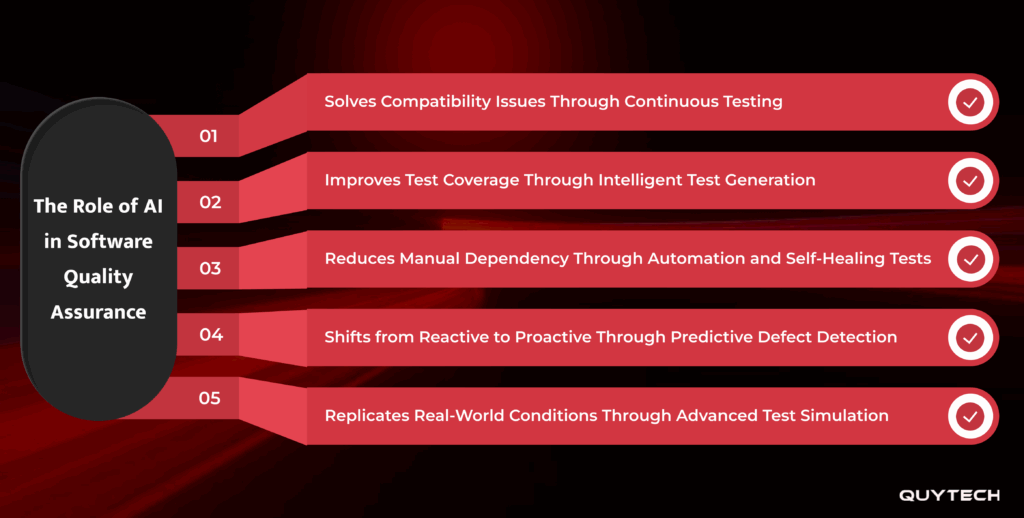
AI in software quality assurance solves compatibility issues, improves testing coverage, reduces manual dependencies, and simulates real-world conditions for test case creation. Here’s a section explaining the role of AI in software quality assurance in detail:
1. Solves Compatibility Issues Through Continuous Testin
AI for software quality assurance solves compatibility issues by seamlessly integrating with agile development environments. It does not wait for a dedicated time window; AI-powered testing runs automatically as code is written or changed.
It does not depend on human intervention for running or updating test cases. Instead, AI ensures that the test cases are run and updated in parallel with code.
2. Improves Test Coverage Through Intelligent Test Generatio
Unlike traditional quality assurance, AI-powered testing can generate and execute test cases. What’s more is that these tests can support numerous feature combinations, integrations, and workflows.
Instead of executing predefined scripted tests, AI for software quality assurance learns from user behavior and historical data. From this, it generates edge cases. This helps it identify bugs that go undetected even after thorough manual testing.
3. Reduces Manual Dependency Through Automation and Self-Healing Tests
As is quite obvious, AI for software testing reduces manual dependency. It does so by automating the testing process. What’s more is that AI can create self-healing tests. Such test cases do not need to be changed for testing after code changes.
AI powers self-healing test cases to adapt to changes. It does not need human intervention to update the affected test case.
4. Shifts from Reactive to Proactive Through Predictive Defect Detectio
AI for software quality assurance helps organizations shift from reactive testing to proactive testing through shift-left testing. This approach incorporates testing into the complete, continuous development cycle rather than waiting for the software to be fully developed.
This helps organizations catch and fix errors and bugs earlier, and even predict them, rather than waiting until later stages, which not only increases costs but also the effort for both developers and testers.
5. Replicates Real-World Conditions Through Advanced Test Simulatio
A prominent limitation of traditional testing approaches is that they follow scripted test cases. AI in software quality assurance flips this script by simulating real-world conditions and scenarios when creating test cases. It understands how users actually think and perceive the software and can mimic unpredictable user behavior.
AI also accounts for realistic factors such as the devices users may use, browsers, and operating systems when creating edge test cases. This bridges the gap between what testing environments simulate and what users actually do, ensuring that no bugs go undetected.
You Might Also Like: 10 High-Impact Use Cases of AI Automation Transforming Industries in 2026
Key Benefits of Using AI for Software Quality Assurance
Now that you are aware of the role AI is playing in software quality assurance, let’s familiarize you with the benefits it brings. The following are the key benefits of using AI for software quality assurance:
Faster Time-to-Market
Using AI for software quality assurance helps organizations accelerate the time-to-market of the software. This is because AI eliminates the need to wait for the entire software development process to complete.
It integrates automated testing into the development pipeline, ensuring that every code change is tested immediately upon completion. This significantly reduces the time analysts spend testing the software and accelerates its deployment.
Reduced Testing Costs
As is well known, software testing requires extensive human resources and continuous effort across tasks such as writing test cases and executing them. Each time the code changes, the test cases must be updated accordingly.
AI in software quality assurance reduces costs by automating repetitive, time-consuming tasks. It also introduces self-healing test cases that automatically update after changes, eliminating the need to rewrite them.
Improved Product Quality
AI for software quality testing helps organizations unlock higher product quality. It does so by automating not only general test case creation but also edge cases. This helps replicate and test areas, environments, and combinations that human analysts may miss.
Apart from this, AI understands user behavior and mimics it to expand test coverage, which is something that cannot be done precisely through manual QA processes.
Scalability Across Projects
Utilizing AI for software quality assurance enhances scalability across projects. When projects grow, their quality testing requirements grow as well. Naturally, the growing scale demands hiring more testers, which not only increases costs but also takes its sweet time.
AI in software quality testing eliminates the need for hiring more people. It scales effortlessly as needed. It can automatically generate and execute tests, allowing organizations to scale QA teams without increasing headcount.
People Also Like: SaaS vs. BYOS (Build Your Own Software): A CTO’s Guide to Choosing the Right Model for Product Engineering
Use Cases of AI in Software Quality Assurance
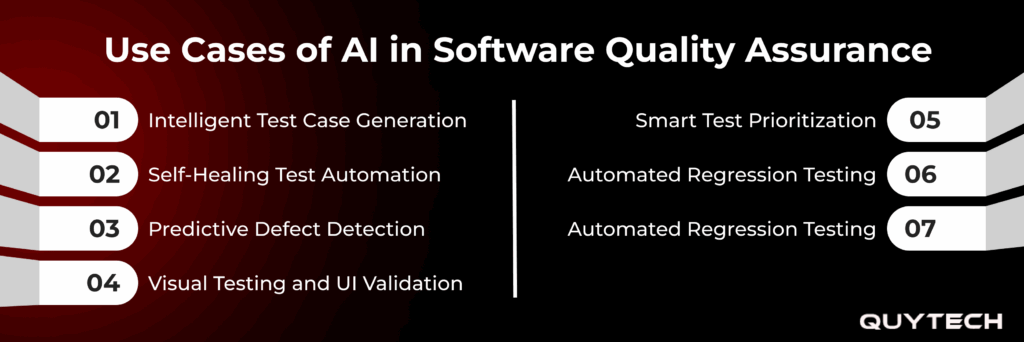
AI-powered software quality assurance applies to intelligent, self-healing test case generation. It also automates regression testing and supports predictive defect detection. But the list doesn’t end here. The following are the key use cases shaping modern software quality assurance:
1. Intelligent Test Case Generation
AI in software quality assurance helps QA teams reduce workload through intelligent test case generation. It uses NLP to read and interpret requirements and existing code. Based on the code’s logic, the AI generates test cases that cover user flows and edge cases.
2. Self-Healing Test Automation
Additionally, AI can automate self-healing tests. It uses machine learning to monitor and interpret changes to code. This understanding helps AI automate the update of the affected area in earlier test runs without human assistance.
3. Predictive Defect Detection
AI in software quality assurance also brings in predictive defect detection. This helps QA teams proactively predict and prepare for errors rather than react to them. Predictive defect detection uses machine learning to analyze historical data and code patterns. These help AI identify areas of the software that are at high risk of failure, before testing even begins.
4. Visual Testing and UI Validation
AI-powered software quality assurance helps organizations automate visual testing and UI validation. It utilizes computer vision to scan the UI and detect inconsistencies that users connecting through different devices might encounter. AI can detect broken layouts, inconsistent screen sizes, etc., across different platforms.
5. Smart Test Prioritization
Beyond automation, AI adds intelligence, enabling smart test prioritization. It can analyze recent code changes, historical defect patterns, and risk levels to identify which areas require faster action based on criticality. This ensures that higher priority tasks are handled first.
6. Automated Regression Testing
AI-powered software quality assurance also includes automation in regression testing. It analyzes changes to the code after a new commit is pushed. AI does so with the help of machine learning models. It can also create and execute regression tests by itself.
7. Continuous Testing in CI/CD Pipelines
As mentioned, AI for software quality assurance enables continuous testing in CI/CD pipelines. It uses technologies such as ML and automation. As a result, AI-driven tests are executed in real time after every code commit.
Interesting Read: Enterprise Product Modernization: Turning Legacy Systems into Future-Ready Products
Challenges and Best Practices of Implementing AI in Software Testing
While AI offers numerous benefits and use cases for software testing, its implementation also presents challenges. But these challenges can be overcome as well. Here are some common challenges along with best practices of implementing AI in software testing:
Poor Data Quality and Availability
A common challenge that organizations face when implementing AI for software testing is poor data quality and availability. AI models perform well only if they are trained on diverse, high-quality data. If the data itself is not available or lacks quality, the outputs that AI would give in the QA process would also lack the same.
Best Practices:
To overcome data quality challenges, organizations should audit their existing data before implementing AI. For availability issues, establishing a structured data management system and using data augmentation techniques would help.

Integration with Existing Pipelines
Many organizations already have a systematic development and testing process. Such organizations often struggle to determine where AI automation fits and whether it will require changes or disrupt existing systems and workflows. Compatibility doubts also surface in integration challenges.
Best Practices:
Organizations can tackle integration challenges by choosing tools that fit their existing workflows. They can also opt for API-based or prebuilt integrations to simplify setup.
High Initial Setup Effort
AI-powered quality assurance requires a high initial setup effort. This effort is not limited to expertise or time; it also includes resources. Implementing AI in software testing requires a long checklist of configurations, model training, workflow integrations, and more. Such factors often overwhelm organizations with limited technical expertise, stalling implementation.
Best Practices:
To overcome the setup effort challenge, organizations should break the implementation into phases rather than a single, complete rollout. They should also consider investing in training QA teams on AI tools to reduce dependency on external expertise.
People Also Like: Offshore vs In-House vs Hybrid: Choosing the Right Team Structure for Product Engineering
The Future of AI in Software Quality Assurance
The future of AI in software quality assurance holds hyper-personalized testing, self-improving tests, and autonomous QA agents. Let’s explore these future trends in detail:
Hyper-Personalized Testing
The future holds AI-powered hyper-personalized software quality assurance. This will transform testing from a one-size-fits-all approach to one in which every test reflects the diversity of real-world usage.
Self-Improving Test Ecosystems
In the future, AI-powered QA processes will have a self-improving test ecosystem. It will enable feedback systems and self-learning mechanisms that help AI systems learn from every test, interaction, and feedback they receive. This ecosystem will help AI testing systems in improving their performance without human intervention.
Autonomous QA Agents in Pipelines
The future holds the integration of autonomous QA agents in testing pipelines. The difference agents would make is that they would perform tasks such as monitoring code changes, assessing risks, and executing tests autonomously. They won’t wait for human input and will make their own decisions.
How Quytech Enables AI-Driven Software Quality Assurance
Quytech helps organizations transform traditional QA practices by implementing AI for quality assurance. We combine expertise in AI technologies such as machine learning, NLP, automation, and more to deliver tailored software testing solutions with AI embedded at every stage.
Beyond our expertise in building AI solutions, Quytech also brings 16+ years of experience in catering to diverse industry verticals. This experience enables us to develop AI-powered QA solutions that not only address traditional QA limitations but also align with long-term organizational objectives.
Final Thoughts
Software quality assurance is no longer a reactive process, and artificial intelligence is the reason why. Unlike traditional testing, it no longer requires teams to create and edit test cases every time code changes. Instead, AI-powered QA automates everything from test case generation to updating through self-healing capabilities.
It fits naturally with agile development requirements and provides wider test coverage by simulating real-world scenarios. AI automates all the repetitive tasks, which naturally reduces dependency on manual effort. Together, these capabilities help QA teams catch edge cases that manual testing often misses.
Apart from its capabilities, AI for software quality assurance also brings in numerous benefits. It accelerates the software’s time to market and reduces testing costs. And since the tests it creates replicate real-world usage patterns, it naturally catches errors at early stages and enhances the overall product quality.

FAQs
Yes. An organization with legacy systems can also utilize AI-based software quality assurance. To do so, they can opt for API-based integration.
Organizations should think about data readiness, team skills, system compatibility, and how it fits with business goals before adopting AI-powered software quality assurance
Yes, AI-powered quality assurance can handle multi-platform testing. It is capable of understanding how users would use the software across different platforms and creating test scenarios accordingly.
Yes, organizations with limited technical skills can use AI for software quality assurance. They can either partner with an AI app development company or hire dedicated developers.
No, AI in software quality assurance is not just for large companies. Startups and mid-sized businesses can also use it based on their needs and scale.
