
In 2024, the Co-operative Group lost approximately £80 million in shoplifting and theft-related incidents across its stores. Another statistic by Capital One Shopping Research highlights that by 2028, stores may lose up to $55 billion in such incidents. Not just retail stores, the internet is inundated with similar statistics that reveal monetary losses caused by theft in manufacturing plants, warehouses, and corporate facilities.
What does this indicate? Clearly, traditional security measures and CCTV surveillance are not enough; it is high time to implement AI theft detection systems or AI-assisted surveillance systems.
Traditional surveillance solutions are effective, but they don’t provide a means to get real-time intelligence, which is needed to prevent theft incidents or at least reduce the loss. AI theft detection systems can help prevent shoplifting, employee theft, asset misplacement, unauthorized access, and inventory shrinkage.
But how do AI or computer vision-based theft systems work? How do they amplify security, or what technologies do they utilize? This comprehensive guide covers everything! Read it till the end to know the use cases, benefits, development process, future trends, and almost everything else about real-time theft detection systems.
What is a Theft Detection System?
Let’s begin with the basics. An anti-theft detection system is a system that identifies and prevents theft in real-time. The system utilizes AI, computer vision, sensors, and video analytics to keep a tab on suspicious individuals, activities, and behavior. The system automatically alerts security teams intervene and investigate any suspicious activity. This enables an enterprise to minimize losses (mostly, financial), improve response time, and protect its assets.
Also read: An Ultimate Guide to Video Analytics: Applications and Opportunities
Key Problems with Legacy Surveillance Systems
Before we move further into AI theft detection system development, let’s take a look at the problems that businesses are currently facing with traditional security and surveillance systems.
Manual Monitoring and Human Dependency
Conventional surveillance systems require manual monitoring. They record the footage and require security professionals to review the same to find out theft incidents by analyzing suspicious activities, behavior, etc. Now, for large facilities equipped with hundreds of cameras, human review may not guarantee accuracy because of fatigue, distractions, and delayed reaction, which may result in theft incidents.
Post-Incident Detection
Traditional monitoring and security systems don’t provide preventive measures; they only enable businesses to detect theft after it happens. Their aim is to find out means for recovery rather than preventing the theft from happening. This reactive approach doesn’t provide any means for immediate loss prevention in enterprise environments.
High False Alarms
With the help of motion detectors, enterprises get alerts every now and then. Sometimes, it is normal customer movement or a lighting change, but the detector considers it suspicious and raises an alarm. These frequent false alarms can cause alert fatigue, and security personnel may delay response in actual theft situations (thinking that it could be a false alarm).
Limited Scalability
Legacy surveillance solutions are not so easy to manage, especially when the surveillance is being done across different warehouses or facilities. Such solutions may not provide centralized monitoring while heavily depending on human security personnel. And in case the facility wants to increase surveillance, visibility & scalability becomes a challenge without increasing the workforce.
Lack of Behavioral or Contextual Intelligence
It is one of the main challenges with the traditional systems. They cannot understand the behavior or intent of the human. Such systems can only record what they see, and patterns like suspicious behavior or concealment may go undetected and may further result in theft incidents in a facility.
To overcome the above said and other similar challenges, the best way is to implement computer vision-based theft detection systems. Continue reading to explore how.
How AI-Powered Theft Detection Systems Work
Intelligent theft detection systems powered by AI, computer vision, and other advanced technologies follow a stepwise process to detect even the slightest activity that seems different from usual. Here is how it works:
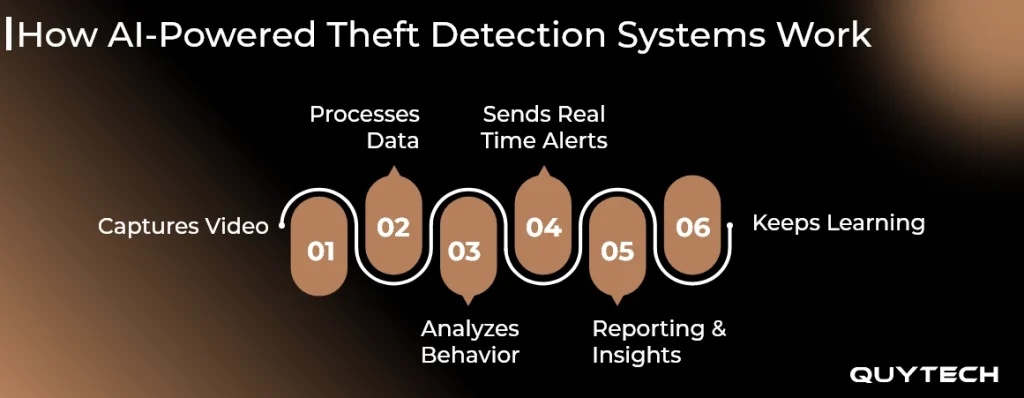
- Captures Video: Like legacy systems, the AI-powered theft detection system continuously records activities in a facility. It ensures that the feeds have high resolution for detailed monitoring and analysis.
- Processes Data: The system then sends the captured video to AI/edge servers, where it is processed to eliminate noise and ensure detection accuracy.
- Analyzes Behavior: The anti-theft detection system relies on computer vision and machine learning models to analyze behavior or unusual patterns, such as concealment, unusual loitering, or repeated access to a restricted area.
- Sends Real-Time Alerts: If the AI theft detection solution detects a potential theft, it sends an immediate alert (via email, message, or dashboard) for security personnel to intervene and take appropriate action.
- Reporting and Insights: The system generates actionable analytics and reports to empower organizations or businesses track incidents and optimize security operations in the future.
- Keeps Learning: The AI system for theft detection and prevention continuously learns from previous interactions to improve detection accuracy and reduce false positives.
Explore More: How Does AI Video Analytics Help Detect Threats in Real Time?
Traditional vs AI-Powered Theft Detection
Take a quick look to understand how a traditional theft detection system differs from an advanced one. For better understanding, we have provided a tabular view of the same:
| Aspect | Traditional Theft Detection Systems | AI-Powered Theft Detection Systems |
| Detection Approach | These systems look for basic motion detection and manual monitoring of CCTV footage. | These advanced systems use AI, computer vision, and machine learning to analyze behavior in real time. |
| Response Time | Mostly reactive; security teams review incidents after they occur. | Proactive; the system detects suspicious activity and sends real-time alerts. |
| Accuracy | The chances of false positives are high due to simple rule-based triggers. | AI theft detection and prevention systems offer higher accuracy with reduced false alarms through intelligent behavior analysis. |
| Human Dependency | Legacy systems need constant human attention to monitor screens. | Such systems don’t require manual monitoring as the detection and sending alert is automated. |
| Scalability | Managing them across multiple locations is challenging. | AI theft detection systems can be scaled seamlessly across stores, warehouses, and enterprise facilities. |
| Behavior Analysis | They cannot understand intent or suspicious patterns. | AI offers immediate behavior detection. It can detect concealment, unusual movement, and repeat actions immediately. |
| Operational Insights | These are restricted only to video playback. | Advanced theft detection solutions offer actionable insights, reports, and analytics. |
| Adaptability | Follow static rules with no self-learning capability. | ML and computer vision models continuously improve through training and learning. |
| Cost Efficiency | Appears cheaper initially, but leads to higher long-term losses. | Higher upfront value with measurable reduction in theft and losses. |
| Enterprise Readiness | Traditional systems offer limited support for modern enterprise security needs. | AI systems for theft detection are designed for large-scale and AI-driven enterprise environments. |

Use Cases of Theft Detection Systems Across Industries
Now that you know enough about anti-theft detection solutions, it is time to understand the applications and use cases of such systems across diverse industries:
Retail
In the retail industry, AI-powered theft detection systems can easily monitor multiple checkout counters, store aisles, and stockrooms, all at the same time. They can even alert security teams as soon as they detect unusual behavior or activity. These systems can detect:
- Shoplifting
- Employee theft
- Inventory shrinkage
Explore More: AI Video Analytics for Retail: Enhancing Retail Store Analytics
Warehousing & Logistics
Warehousing and logistics operations require continuous monitoring, especially in real-time, to stop unauthorized access to restricted areas, theft, and tampering with the products. AI models equipped in anti-theft detection systems can track employee and vehicle movement patterns to serve this purpose. They can prevent theft of:
- Goods
- Pallets
- High-value inventory
Manufacturing and Industrial Facilities
Computer vision-based theft detection systems and AI video analytics solutions for manufacturing can detect unauthorized access to storage areas. They can even monitor production lines to raise an immediate alarm for any irregular behavior. Such AI-powered surveillance systems can help secure the following from internal and external theft:
- Raw materials
- Tools
- Finished products
Corporate Offices & Smart Buildings
AI-powered theft prevention systems and detection systems can track entry and exit points. They can even monitor restricted areas to identify suspicious activities or unauthorized access and send an immediate alert to the security teams. This can level up enterprise security and employee accountability. Anti-theft detection systems can prevent theft of:
- Sensitive equipment
- Documents
- Personal property
Banking and Financial Institutions
Banks and financial institutions can make the most of intelligent theft detection systems to detect unusual movement patterns, loitering, and unauthorized access. They can get real-time alerts to ensure quick security response and minimize losses. Such systems can monitor:
- ATMs
- Vaults
- Branch lobbies
Healthcare & Pharmaceuticals
Intelligent theft detection systems and video analytics systems, when installed with CCTV cameras or surveillance cameras, can prevent both internal and external theft by raising an alarm for suspicious activities and people trying to access restricted areas. They can prevent the theft of:
- Medical supplies
- Drugs
- Sensitive patient equipment
Airports, Railway Stations & Public Transport
Smart theft detection systems are capable of even monitoring high-traffic areas and crowded places. They can accurately track movement patterns and prevent the happening of theft-related incidents. With such a system, airports, railway stations, and transportation management offices can detect:
- Baggage theft
- Unauthorized access
- Suspicious behavior
Hotels and Hospitality
Hotels and hospitality businesses can rely on AI-powered theft prevention systems for the smart monitoring of lobbies, corridors, and storage rooms. With this, they can improve safety and protect assets by preventing:
- Guest property theft
- Hotel assets
- Unauthorized access to property
- False alarms
Educational Institutions
AI-powered theft detection systems can be used to monitor labs, classrooms, and campus areas for detecting if there is any suspicious behavior or activity that may result in theft. Educational institutions can use these systems to prevent theft of:
- Equipment
- Lab materials
- Personal belongings of students, the institution, and teachers
You might be interested in: AI Video Analytics for Infrastructure: Use Cases & Benefits
Benefits of Developing an Anti-Theft Detection System
By implementing an intelligent theft detection system, enterprises, manufacturing plants, warehouses, and other facilities can get the following benefits:
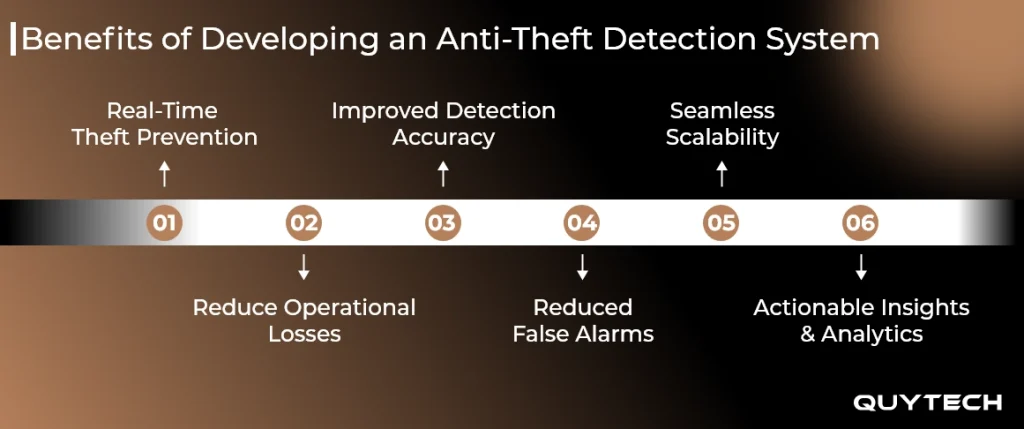
Real-Time Theft Prevention
AI systems designed for theft detection and prevention can help with real-time intelligence on preventing theft, rather than offering a reactive approach that allows security teams to intervene after the loss occurs.
Reduce Operational Losses
By implementing smart theft detection solutions across facilities, enterprises can minimize asset loss and inventory shrinkage.
Improved Detection Accuracy
Manually reviewing footage recorded by traditional CCTV cameras can consume significant time and cost. ML and computer vision-based theft detection systems can automatically analyze behavior in real-time to offer accurate detection insights.
Reduced False Alarms
Automated behavior detection and analysis can reduce false positives that are quite common with legacy systems.
Seamless Scalability
AI-driven theft detection systems can monitor multiple facilities simultaneously without requiring additional cost. These systems can work with the same efficiency no matter the number of cameras they are linked to.
Actionable Insights and Analytics
AI theft detection systems can provide insights related to theft trends, which enables facilities and enterprises to optimize security operations and adopt a proactive approach.

Technical Components and Technology Stack Required to Develop a Theft Detection System
Developing an AI theft detection system requires having expertise in advanced technologies like AI, ML, computer vision, and others. Besides, you have to have a thorough knowledge of core components. This section focuses on both the components and the technology stack.
Core Components
- Video Data Sources: CCTV cameras, IoT devices, and IP Cameras to capture live footage across facilities.
- AI Detection Engine: Computer vision and ML Models to detect deviations and identify suspicious activities.
- Alerting & Dashboard: To provide real-time analytics and notifications for instant response to theft incidents.
- Data Storage & Processing: This component is responsible for storing video and metadata required for quick processing.
- Integration Layer: The layer connects the AI theft detection systems to your existing surveillance infrastructure and other required systems.
Technology Stack
- Programming Languages: Python, C++, JavaScript for AI, backend, and front-end development.
- AI & Machine Learning Frameworks: TensorFlow, PyTorch, OpenCV, and Keras for training models and processing video data.
- Edge & Cloud Platforms: NVIDIA Jetson, AWS, Azure, or GCP for real-time edge processing and scalable cloud deployment.
- Databases & Storage: SQL/NoSQL databases for metadata and cloud storage for video archives.
- APIs & Integration Tools: REST APIs, WebSockets, and custom SDKs for connecting with enterprise applications and dashboards.
You may like to explore: The Role of Computer Vision in Transforming Security
Key Features Enterprises Should Equip in Computer Vision-Based Theft Detection Systems
Below is the list of features that should be in an anti-theft detection system to make it deliver what it intends to.
Please note that these features may vary depending on your facility’s unique requirements.
| Features | Purpose |
| Real-Time Detection and Alerts | To detect suspicious behavior and activities and share real-time alerts for immediate intervention. |
| Multi-Camera and Multi-Location Support | To monitor multiple store aisles, warehouses, and facilities under one centralized dashboard. |
| Advanced Behavior Analysis | To analyze unusual patterns, such as concealment, loitering, and suspicious actions. |
| Scalable Architecture | To make the AI theft systems capable of easily scaling when the facility adds new cameras or its infrastructure grows. |
| Integration with Enterprise Systems | To enable the anti-theft system connect to existing security and surveillance cameras. |
| Data Analytics and Reporting | To generate actionable insights and track incident trends to prevent losses caused by theft. |
Similar Read: How AI is Transforming Fraud Detection in Digital Transactions
Steps to Develop an AI-Powered Theft Detection System for Enterprises
Here is the step-by-step development process for an AI theft detection system.
Requirement Analysis
The first step is to identify the type of theft you want to prevent. It could be shoplifting, asset theft, or an insider threat. Define the monitoring areas, rules to follow, and integration needs.
Data Collection and Annotation
Now, collect video data from cameras and other connected devices across all targeted locations. Define suspicious actions, concealments, and other patterns you want to be marked and get alerts for. You can create a labeled dataset for the same and then train models on it.
AI Model Selection and Training
Select appropriate computer vision models and train them on annotated datasets. You can choose from action recognition, anomaly detection, and object detection models. Fine-tune them based on your custom requirements and specific situations.
Edge and Cloud Infrastructure Setup
Choose edge AI deployment models to ensure real-time on-device processing and cloud-based processing to achieve scalability. Set up servers and storage to store collected video data and secure network pipelines.
Integration with Monitoring and Alert Systems
Create dashboards, mobile notifications, and automated alerts. Also, integrate the achieved AI output with existing enterprise systems and workflows.
Testing and Validation
Once you develop the complete AI theft detection system, perform multiple tests in different locations and scenarios to measure detection accuracy, response time, and false positives. Make required changes.
Deployment and Maintenance
Deploy the system in all targeted areas and continuously monitor its performance. Implement centralized monitoring in case of multi-location monitoring. Update the models on the new databases to improve their accuracy and performance.
Challenges in Theft Detection System Development
While developing a computer vision-based theft detection system, one may experience the following challenges. These challenges can be overcome by partnering with a trusted AI video analytics solution development company. Take a look at some common challenges:
- Detection accuracy challenges in crowded stores, warehouses, and factories.
- Lighting and camera angle variations can impact theft detection efficiency.
- Inability to collect and annotate data from footage.
- Inability to scale across multiple locations.
- Ensuring data privacy and regulatory compliance.
- Difficult in the integration of AI theft detection systems with existing surveillance systems and security infrastructure.
Future Trends in Theft Detection Systems (2026 and Beyond)
In 2026 and the upcoming years, we may witness an increase in the implementation of AI-powered theft detection systems across manufacturing plants, retail stores, warehouses, and other facilities. Here are the future trends associated with such systems:
- Use of edge AI and On-device intelligence to quickly process data right where it generates.
- Implementation of multi-modal sensing and data fusion to combine video with sensors and create richer contexts for detecting theft attempts and reducing false positives.
- Rise of predictive risk scoring and anomaly forecasting to offer predictive insights to identify behavior patterns before theft incidents.
- Use of explainable AI to understand why the theft detection system has marked an incident as theft or behavior as suspicious.
- Integration of AI theft detection systems with smart building management systems and IoT platforms to create centralized security intelligence.
- Integration of adaptive AI models to enable the model automatically learn from previous incidents and feedback to improve accuracy.

How Quytech Can Help
Quytech is a trusted technology company backed by AI, ML, computer vision, video analytics, and top-end frameworks and backend systems. We have delivered over 250+ AI Solutions dedicatedly for CCTV cameras for more than 30 industries. These solutions have been designed for suspicious behavior detection, fall detection, fire detection, shoplifting detection, and more.
The theft detection systems that we create transform CCTV and camera feeds into actionable intelligence using computer vision, anomaly detection, and real-time alerts. These solutions are equipped with multi-location monitoring, actionable analytics, and other top-notch features to enable your enterprise adopt a proactive approach to prevent theft and minimize loss.
Conclusion
One common challenge across retail, manufacturing plants, warehouses, and other similar industries is the increasing number of shoplifting and theft. Traditional surveillance work, but they don’t offer real-time intelligence, so that theft can be stopped or prevented.
AI theft detection systems have transformed this entire scenario by leveraging computer vision, machine learning, edge AI, and cloud computing-like technologies to provide insights. This intelligence and real-time monitoring can detect suspicious behavior, unusual patterns, and even concealments to prevent theft and minimize financial losses.
FAQs
Implementing an AI-powered theft detection system can reduce inventory shrinkage, asset loss, and operational downtime. This way, enterprises can see significant cost savings.
Yes, most AI-powered theft detection solutions are designed to be seamlessly integrated with existing surveillance systems and CCTV setups.
No, advanced theft detection systems have friendly interfaces and dashboards that make them easy to operate by anyone with basic knowledge.
Yes. AI and machine learning models can immediately detect and flag unusual behavior patterns and unauthorized access across warehouses and retail stores. This prevents and detects insider theft.
AI theft detection systems support multi-location monitoring and have centralized dashboards to provide insights and generate theft incident reports.
Yes, they can be customized for retail, manufacturing plants, healthcare and pharmaceutical businesses, and other industries.
