Over the years, security in product engineering has been the task of one single team, which is carried out at a particular point, usually after the product is already developed. But DevSecOps is changing that. It sheds light on the fact that vulnerabilities do not occur after the product is completely developed; they may occur during the mid-development stages.
So logically, shouldn’t security be handled after every sprint? DevSecOps in product engineering does exactly that. It promotes the practice of implementing security throughout development. These practices help teams catch errors and vulnerabilities at their earliest stages, which naturally reduces the costs and effort spent on fixing them post-development.
This blog is a complete guide, exploring everything from what DevSecOps in product engineering actually is to the role it plays in integrating security without slowing development.
What is DevSecOps in Product Engineering?
DevSecOps refers to integrating security practices in the entire product engineering lifecycle. Meaning that security is integrated right from development to deployment and delivery. As the name suggests, it blends development, security, and operations. DevSecOps in product engineering focuses on accelerating the time-to-market of the product without compromising security.
Traditionally, the security aspects of a product are touched only after the complete product is developed. While this approach did work effectively, its effectiveness is at its peak when product updates are launched once or twice a year, which is not the case currently.
Modern products are much more complex and have also adopted continuous and agile development approaches. In such approaches, leaving security considerations for later stages of development creates vulnerabilities that are costly to fix post-development. Still, it can also lead to data breaches, compliance failures, and reputational damage.
Why DevSecOps is no Longer Optional for Modern Product Engineering
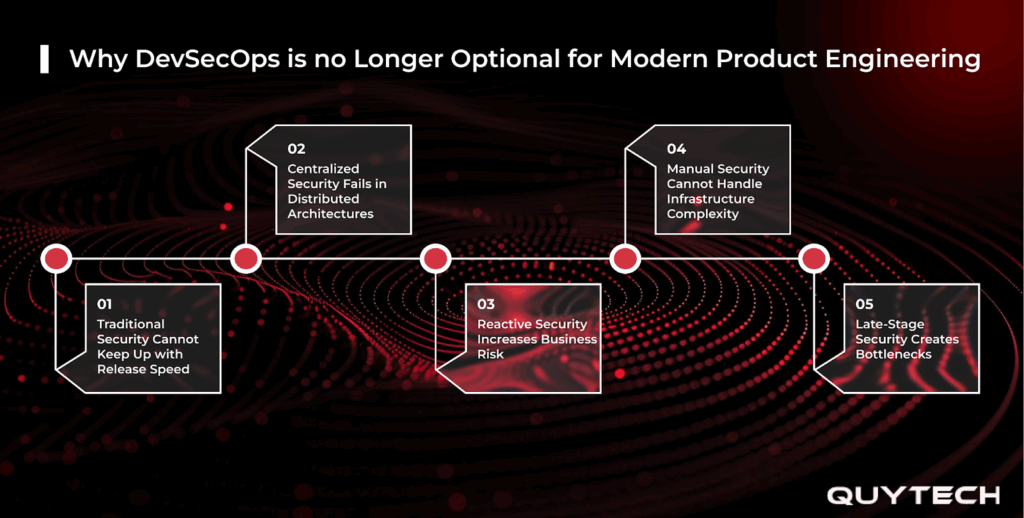
Traditional security practices lack the speed, flexibility, and proactive approach needed to keep up with modern product engineering, and DevSecOps helps in bridging this gap. It keeps development and security running in parallel. Here are some reasons explaining where traditional security falls short and how DecSecOps addresses them:
1. Traditional Security Cannot Keep Up with Release Speed
In the current times, product engineering teams follow continuous development cycles. Everything from development to testing and deployment takes place in sprints, which means that there’s no dedicated window for integration security anymore. Naturally, manual security processes fail to keep up with these development environments.
DevSecOps in product engineering solves this by automating security checks within the development pipelines. It triggers security scans after every code is pushed and tests are conducted, without increasing the workload of teams in pacing up manual security processes. DevSecOps ensures that security fits in perfectly with the development and operations ecosystem.
2. Centralized Security Fails in Distributed Architectures
Modern products are very complex. They have distributed architectures, third-party integrations, offer diverse features, support transactions, and whatnot. Such complexities make security integration difficult. This is because traditional security follows a centralized approach where one team handles everything. Even the processes and rules are pre-decided, which is something that does not fit with modern products.
DevSecOps in product engineering introduces a decentralized approach that distributes security across the entire engineering cycle. It embeds automated security practices and tools at every layer of the architecture. This ensures that everything, be it the points of integration of features and transactional support, has its own security controls.
3. Reactive Security Increases Business Risk
Another reason why DevSecOps is no longer optional for modern product engineering is that manual security reacts to the incidents instead of proactively predicting and preventing them. This is because it conducts periodic audits and reviews to identify problems. Any incidents occurring between the periodic security checks go undetected, reflecting that traditional processes identify incidents after the damage is already done.
DevSecOps in product engineering replaces the reactive security approaches with proactive ones. It monitors the complete product life cycle, flags errors and vulnerabilities, and fixes them in real-time. Naturally, DevSecOps helps security teams cut detection time, respond early, and prevent damage.
4. Manual Security Cannot Handle Infrastructure Complexity
Modern products run on cloud infrastructure that is very dynamic. In such infrastructures, tasks like adding new servers, updating configurations, and modifying cloud environments are routinely carried out by teams. Being manual, traditional security practices make it difficult to handle these tasks, as they are suitable for slower environments, which is not the case with cloud infrastructure.
DevSecOps in product engineering eliminates the need for manual monitoring and configuration of every change. It automates security checks across the entire infrastructure to handle tasks like scanning for vulnerabilities, flagging issues, and fixing them. And guess what? This all happens in real-time. DevSecOps ensures that every time the infrastructure changes, security checks adapt to it as well.
5. Late-Stage Security Creates Bottlenecks
Late-stage security approach is another reason why DevSecOps in product engineering is becoming a necessity. This is because such approaches are manual and need a dedicated time window after product development to integrate security. But the problem here is that later-stage changes often delay the time-to-market and also increase costs if heavy changes need to be made.
DevSecOps in product engineering removes this bottleneck by integrating security checks across the entire product lifecycle rather than allotting a separate phase post-development. It automates and distributes checks throughout the process. This ensures that every sprint that clears is secure as well.
Handpicked For You: SaaS vs. BYOS (Build Your Own Software): A CTO’s Guide to Choosing the Right Model for Product Engineering
How DevSecOps is Different from Traditional DevOps
Now that you are familiar with the reasons why DevSecOps is no longer optional, let’s walk you through how it is different from traditional DevOps. Here’s a table highlighting the differences between traditional DevOps and DevSecOps:
| Aspect | Traditional DevOps | DevSecOps |
| Primary Goal | The primary goal of traditional DevOps is to ensure smooth collaboration between development and operations to deliver products faster. | The primary goal of DevSecOps is to combine development with security and operations to ensure faster yet secure product delivery. |
| Security Integration | Security is integrated after the product is developed. | Security is integrated throughout the product development pipeline. |
| Security Approach | The security approach is reactive; it reacts after incidents happen. | The security approach is proactive; it detects and fixes vulnerabilities continuously. |
| Testing Method | Security tests are manual and periodic. | Security checks are automated and continuous. |
| Speed Impact | Later-stage security reviews slow down release cycles. | Release speed doesn’t get impacted as security runs in parallel. |
| Vulnerability Detection | Vulnerabilities are detected late. | Vulnerabilities are caught early. |
| Cost of Fixing Issues | The cost of fixing issues is high as the product is already developed at these stages. | Low cost of fixing issues through early detection. |
| Compliance | Addressed periodically at audit time. | Addressed continuously throughout development. |
| Scalability | Scalability becomes harder to maintain as the product grows. | Scales naturally as automated security checks adapt to growing complexity. |
The Core Principles of DevSecOps
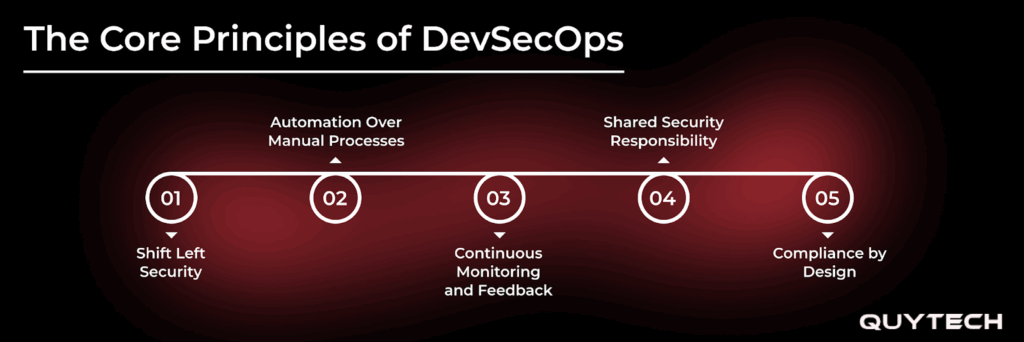
The core principles of DevSecOps include shift left security, automation, continuous monitoring and feedback, compliance by design, and shared security responsibility. Let’s break each of these principles down in detail:
Shift Left Security
Shift-left security is the principle of integrating security into the product engineering cycle from the outset, rather than deferring it to post-development stages.
When security is integrated earlier, any error found is quicker and cheaper to fix than one found post-development. When implemented in practice, security checks begin immediately after code is pushed, rather than waiting for the product to be fully developed.
Automation Over Manual Processes
Another core principle of DevSecOps in product engineering is automation over manual processes. As is known already, security checks conducted throughout the product life cycle are of significant volume.
There’s a lot of code scanning, configuration reviewing, infrastructure validating, and more. Tasks of such volume cannot be handled manually, so automation naturally fits in. It eases the burden of security teams by taking command of repetitive tasks.
Continuous Monitoring and Feedback
This principle of DevSecOps reflects that security is not a one-time event. It is implemented throughout the product lifecycle, even after deployment. Modern products are hosted on different platforms. They integrate with multiple third-party services and also require regular updates to match the dynamic market environment.
These changes often create vulnerabilities that, if not addressed promptly, can negatively impact security. Continuous monitoring and feedback eliminate such risks as it does not check security periodically; instead, it monitors the product continuously and provides feedback without waiting for vulnerabilities to turn into damage.
Shared Security Responsibility
Shared security responsibility is the principle that highlights that security, unlike the traditional methods, is not a sole responsibility of a single team. Instead, it is the responsibility of every team involved in the product development process. How so?
Well, DevSecOps integrates security throughout. If the development team is writing code, every line of the code should be secure. Operation teams should ensure that the infrastructure of the product is secure. This principle ensures that every team, from development to operations, contributes to making the product secure.

Compliance by Design
Traditionally, compliance requirements were always treated as an afterthought. But with DevSecOps, compliance is implemented by design. It emphasizes building regulatory requirements directly into the product life cycle.
DevSecOps blends security controls with compliance standards and incorporates them throughout product development. This principle ensures that, similar to security checks, compliance checks are continuously monitored and automatically executed. It does not wait for periodic audit cycles; instead, it keeps the compliance in check along with security.
You Might Also Like: Offshore vs In-House vs Hybrid: Choosing the Right Team Structure for Product Engineering
Benefits of DevSecOps in Product Engineering
DevSecOps in product engineering helps teams in detecting vulnerabilities at early stages. It improves product stability and reliability and ensures compliance with regulatory requirements. Here’s a section explaining the benefits of DevSecOps in product engineering:
Early Detection of Vulnerabilities
DevSecOps in product engineering helps teams in detecting vulnerabilities at an early stage. This is because it continuously monitors and runs security checks throughout the product development process. These checks help it catch errors and fix them before they reach production. Early detection takes very little time to fix errors and also costs significantly less.
Improved Product Stability and Reliability
Integrating DevSecOps in product development helps improve the stability and reliability of the digital product. This is because it automates security checks all along the product life cycle. It catches errors and also highlights the areas that may not function properly under certain circumstances. This continuous checking and rectification naturally enhances product stability. The chances of the product breaking down post-deployment reduce significantly
Continuous Compliance and Audit Readiness
For enterprise product teams, maintaining compliance with regulatory requirements is both mandatory and an ongoing requirement. Similar to what’s implemented in security, DevSecOps ensures compliance and audit readiness by blending it in with the product life cycle. This ensures that every release is automatically validated against regulatory standards. It also establishes audit readiness.
Better Collaboration Across Teams
As mentioned already, DevSecOps in product engineering goes beyond traditional security practices. It does not tag security practices as the task of a certain team; it distributes them to every team involved in product development. From development to operations teams, each implements security practices in their tasks. Naturally, DevSecOps brings in better collaboration across teams.
Scalable Security for Growing Systems
As digital products grow, their infrastructure, integrations, and codebase grow with them. Naturally, security requirements also grow, which, when handled manually, cannot scale at the same pace. DevSecOps in product development solves this by integrating automated security into the development process. This ensures that scaling does not require additional effort. DevSecOps can adapt security to the scale of the product.
Interesting Read: Generative AI in Product Engineering: Real-World Applications

DevSecOps Adoption: Common Challenges and Best Practices
As easy as it may sound, DevSecOps implementation brings in its fair share of challenges and roadblocks. If not paired with the right practices, they often impact DevSecOps adoption in product engineering. Here are some of them, along with the best practices:
Cultural Resistance and Ownership Gaps
A very common challenge in implementing DevSecOps in product engineering is cultural resistance. Organizations face this because it requires developers to integrate security into their code, which is something they are not used to. The security teams might also not trust developers to handle security properly. This naturally creates ownership gaps.
Best Practices
Organizations can overcome cultural resistance and ownership gaps by:
- Making security a shared responsibility among all the teams involved in product engineering.
- Training developers on secure code writing to build confidence for handling security from their end.
- Integrating security in development workflows through automated checks at different points.
Toolchain Complexity and Poor Integration
Implementing DevSecOps in product engineering requires integrating different tools. However, these tools often fail to integrate as they are of different types and complexities. This incompatibility creates complexity in managing them. Why so? Because each tool brings its own dashboards, reports, and alerts, which can often conflict with the others.
Best Practices
Organizations can address the toolchain complexity and poor integration challenges by:
- Utilizing tools that easily connect with existing CI/CD pipelines.
- Unifying the dashboards, all the tools, and systems to avoid conflicting outcomes.
- Introducing filters to avoid lower priority alerts and focus better on high priority ones.
Lack of Compatibility with Legacy Systems
Lack of compatibility with legacy systems is a very commonly faced challenge among enterprises wanting to implement DevSecOps in product engineering. This is because the existing systems that they have are often outdated, which is the opposite of DevSecOps. Naturally, integrating those systems with DevSecOps brings in challenges that may stagnate automation and disrupt the workflows as well. These incompatibilities ask for additional effort and workarounds, which is something organizations may not want.
Best Practices
To overcome compatibility issues with legacy systems, organizations can:
- Opt for upgrading their legacy systems gradually to support sophisticated DevSecOps workflows.
- Utilize APIs to connect their existing systems with DevSecOps systems.
- Plan a phased migration approach to implement DevSecOps without disrupting existing workflows.
Conclusion
The security factor that was seen as the job of a certain team is now handled at every stage of product engineering, and that too with collaboration, and the credit for this change goes to DevSecOps. It has changed the way teams deal with vulnerabilities by integrating security throughout the entire product lifecycle. DevSecOps blends in precisely with modern product engineering practices. It turns the traditional reactive approach of fixing errors into a proactive one by detecting and fixing vulnerabilities in real-time.
Beyond pipeline security, DevSecOps benefits organizations by detecting vulnerabilities at the earliest. Naturally, this improves the stability and reliability of the product and also ensures compliance with regulatory requirements. DevSecOps doesn’t just deliver software that is fast and secure; it also promotes stronger collaboration across teams, making it a truly transformative approach to modern product engineering.

FAQs
Product teams using DevSecOps can balance speed and security scanning by automating security in the CI/CD pipelines. It removes the need for manual involvement. This means security is managed without the delay caused by manual tasks.
No. Small and mid-sized companies can also adopt DevSecOps for product engineering. It is not limited to large organizations only.
A very common error is treating DevSecOps as a tooling upgrade, which it clearly is not. Organisations should understand that DevSecOps requires a cultural change. It incorporates security at every level. So obviously, it’s not just changing tools but also how teams operate.
Yes, it does. DevSecOps integrates faster in cloud environments. This is because it doesn’t require a lot of infrastructure support. And since on-premise environments require more manual controls, they take longer.
Organizations can use these metrics to measure DevSecOps success:
1. Time to detect and fix vulnerabilities
2. Number of vulnerabilities in production
3. Deployment frequency without security issues
