Many businesses confuse product engineering and custom software development. But they’re two very different things. These terms have long been used interchangeably, which can be very misleading because, in terms of developing digital solutions, they bring opposite approaches.
While both develop software, the intent and execution they carry make them different from each other. Custom software development is the approach that helps organizations develop digital solutions catering to specific business needs. Whereas product engineering delivers digital products that cater to a wide audience, are easily scalable, and can adapt to changing environments. But the list of differences doesn’t end just here.
This blog will unpack different aspects and highlight the key differences between product engineering and software development. Read till the end and choose the right approach for your digital product vision.
What is Product Engineering
Product engineering can be defined as a comprehensive, life-cycle-based approach that encompasses stages ranging from conceptualization to the evolution of a digital product. It does not merely focus on bringing a product idea to life. Instead, it focuses on developing digital products that grow with long-term organizational objectives.
What is Custom Software Development
Custom software development can be defined as an approach where software is developed to address particular organizational needs. As the word ‘custom’ makes it obvious, the software developed through this approach is built with consideration of the organization’s processes, workflows, and requirements. While maintenance and updates can be issued, the core purpose is to solve the problem or need highlighted.
Custom Software Development vs Product Engineering: A Detailed Comparison Guide
Let’s help you go beyond definitions to differentiate between custom software development and product engineering. Here’s a table that breaks down the difference in detail:
| Aspect | Custom Software Development | Product Engineering |
| Core Focus | The core focus is on developing software that addresses particular organizational needs. | Core focus is on developing a digital product that adapts to and grows with long-term organizational needs. |
| Target Audience | A single client or organization with workflows. | A very wide audience, multiple clients, and market segments. |
| Approach | Custom software development follows a requirement-driven approach. | Product engineering follows an exploratory approach. |
| Life Cycle | The life cycle is fixed. It ends after organizational requirements are addressed. | The life cycle is continuous. The product developed is for long-term organizational needs, so it evolves throughout. |
| Flexibilty | Flexibility is low, and making changes post-development can be costly. | Highly flexible, as the product is made to adapt to evolving environments and needs. |
| Scalability | Scalability is defined before development. Additional changes often require rework. | Highly scalable as it is built to cater to a very wide audience base and is expected to grow further. |
| Best Suited for | Internal tools, legacy system replacements, and specific workflow needs. | SaaS platforms, consumer apps, etc. |
Interesting Read: How to Choose the Right Product Engineering Partner
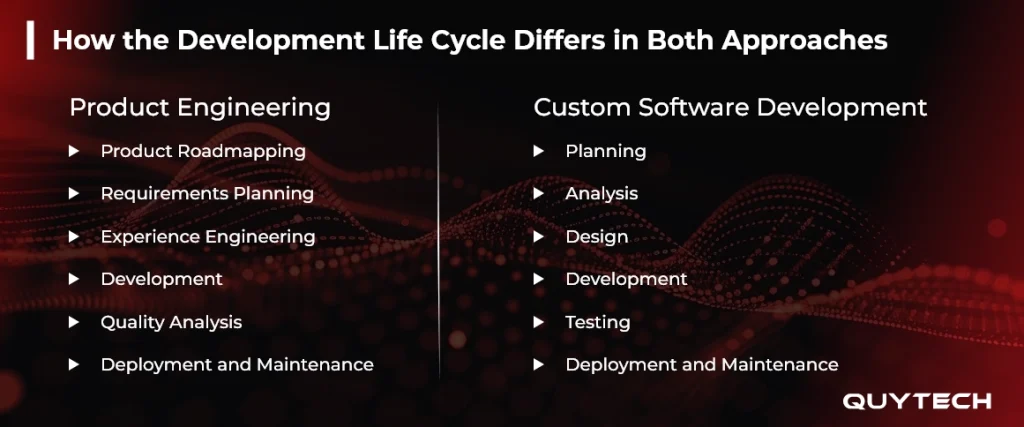
How the Development Life Cycle Differs in Both Approaches
The applications and audience contribute highly to differentiating software development and product engineering approaches. However, the real distinction lies in the development life cycle. Here’s a quick explanation of the development life cycle of both approaches:
Custom Software Development
Here’s a step-by-step breakdown of the custom software development life cycle:
- Planning
Custom software development begins with identifying the core business problem, how the software will address it, and the resources needed to build it.
- Analysis
The analysis stage covers the assessment of resources, requirements, constraints, etc. It also explains how the software being developed will solve the problem faced.
- Design
Post planning and analysis, the design process begins. Here, the user interface, platform framework, and database structure are designed.
- Development
Based on the design, the developers begin the coding and actual development process. They develop the frontend and backend while integrating third-party platforms to ensure seamless functionality.
- Testing
Once the development process is in place, testing begins. Teams test the platform thoroughly to ensure that everything functions well and any bugs encountered are fixed.
- Deployment and Maintenance
Post testing, the platform is deployed and made available to the users. Regular maintenance and updates are also taken care of once the software gets deployed.
Product Engineering
Here’s a step-by-step breakdown of the product engineering life cycle:
- Product Roadmapping
Product engineering begins by initiating consultative discussions with the right product engineering partner. Decisions regarding development strategies, phases, organizational goal alignment, and milestones fall in this phase.
- Requirements Planning
After forming a clear roadmap, requirement planning begins. It decides on resource requirements, technical feasibility evaluation, and compliance needs.
- Experience Engineering
After planning requirements, experience engineering begins. It defines the user journey, designs it, builds prototypes, and is tested to see if it meets the expectations.
- Development
Once the user experience is in place, the actual development starts. It involves creating system architecture, building the core product, and integrating third-party systems and APIs.
- Quality Analysis
Quality analysis phase tests the final product to ensure that everything functions as planned. Here, the performance and security of the product are thoroughly evaluated by teams, and refinements are made.
- Deployment and Maintenance
Once the product goes live, the team monitors performance, fixes issues, and introduces further improvements.
Recommended For You: Product Engineering Life Cycle: A Complete Overview
Pros and Cons of Product Engineering and Custom Software Development
Now that you are familiar with the life cycle differences of product engineering and custom software development, this section will walk you through their pros and cons. Let’s begin with custom software development first:
| Custom Software Development | |
| Pros | Cons |
| Custom software development helps organizations in addressing specific problems easily. | If scaling is required after the software is already developed, it can be challenging. |
| It helps in developing tailored software to address business needs | The product caters to specific organizational requirements and is not aligned with long-term goals. |
| Development and deployment are faster | Significant post-deployment changes often end up hiking the costs. |
| Software development provides a clear point of completion. | Adaptability in custom software development is limited. |
Let’s take a glance at the pros and cons of product engineering:
| Product Engineering | |
| Pros | Cons |
| Product engineering develops digital products that are aligned with long-term organizational objectives | It is hard to describe an end point ot the development process in product engineering because the product is continuously monitored and improved even after being deployed. |
| The product developed is highly flexible and is made with consideration of the dynamic environments | Product engineering requires long-term commitment when it comes to developing a digital product. |
| Post-deployment changes can be made easily without having to introduce more workflows | The investment in product engineering is quite high. |
| Product engineering focuses on developing products that scale as it caters to a wide audience base. | Since it focuses on addressing long-term objectives, it does not provide quick solutions as needed to handle short-term objectives. |
You Might Also Like: Agentic Analytics: When AI Manages the Entire Data Lifecycle
When to Choose Product Engineering vs Custom Software Development
Knowing the pros and cons of custom software development and product engineering certainly helps. However, deciding on which approach should be chosen in different scenarios can be quite challenging, right? But not anymore! Here’s a section that will help you choose the right approach:
Choose Product Engineering When:
- You are targeting a broad or multi-segment market
If the digital product you want to build has a wide audience base or is targeted to a multi-segment market, then you should opt for product engineering. It can easily cater to different user needs.
- You have long-term scalability and growth objectives
If you want to build a digital product that aligns with your organizational goals, then product engineering is the answer. It aligns the product roadmap in a way that makes scalability easy without losing track of long-term goals.
- You are building a customer-facing digital product
When building a customer-facing digital product, opt for product engineering. It develops user experience after understanding and mapping the complete journey.
- Launching digital platforms that require fast feedback loops
Opt for product engineering when you want to develop a user-facing platform. It helps you adapt to user expectations, deliver personalized experiences, and continuously improve through user feedback.
Choose Custom Software Development When:
- You are modernizing or upgrading legacy systems
Opt for custom software development if your goal is to modernize your existing software or systems. Custom software development can target specific organizational needs, like slower legacy systems and address them with modern digital software.
- The software is intended for internal use only
Now, if your objective of developing software is internal usage, then custom software development is the answer. This is because it is capable of developing tailored solutions that can improve efficiency faster.
- You need to solve a business-specific operational problem
When solving a business-specific operational problem is the goal, opt for custom software development. It helps you build a solution that fits perfectly with your business requirements.
- Your requirements are clearly defined from the start
In situations where you already have all your requirements mapped out, choosing custom software development is the right option for you. It eliminates the need for additional research steps and lets you begin development without delays.
People Also Like: Use Cases of Agentic AI in Enterprise Businesses
Custom Software Development vs Product Engineering: Which Brings Better ROI
It is well known to everyone that calculating ROI is not limited to monetary returns. It includes factors like revenue potential, scalability, lifecycle value, maintenance overhead, and long-term business impact. And since the priorities in both product development approaches are different, ROI is also calculated differently. Here’s how:
ROI in Custom Software Development
Custom software development drives better return on investment when:
- The goal of developing the product is to maximize internal operational efficiency and save costs.
- The digital product is expected to give outcomes other than monetary value, like supporting compliance, quicker responses, etc.
- The ownership is expected to remain within the organization for internal operations.
ROI in Product Engineering
Product engineering drives better return on investment when:
- Your expectations from the digital product are to generate recurring revenue.
- The digital product is expected to serve multiple segments and a very large number of users.
- The core focus of the digital product is user experience, long-term engagement, and alignment with future organizational goals.
How Quytech Helps You Choose the Right Development Approach
Quytech helps organizations choose the right development approach. We do so by understanding organizational needs, operational challenges, and long-term goals. Whether you need a digital solution to transform your legacy system or a customer-facing scalable product, our dedicated development team helps you right from the ground up.
With over 16 years of experience in developing custom software solutions like ERPs, CRMs, etc., we help organizations unlock efficiency outcomes faster. We also help teams with a product vision bring their ideas to life with our end-to-end product engineering services. Our successful products, like PepUp Sales, reflect our commitment to delivering real impact aligned with long term businesss goals.

Conclusion
Choosing the right process for developing digital solutions can be quite challenging. And, when this decision is combined with two opposite models, like custom software development and product engineering used interchangeably, the challenge intensifies.
Both these models might resemble each other because of their core focus on developing digital solutions. However, choosing the wrong approach can significantly impact the outcomes and the development process.
Custom software development is the right approach when the core focus is on specific business challenges. It can help organizations improve their operations and derive ROI faster. Product engineering presents solutions that cater to a wide audience. They help in developing easily scalable solutions, all while keeping them adaptable and aligned with organizational goals.
FAQs
In custom software development, the budget is pre-defined as the process ends post-deployment. Product engineering requires ongoing investment because the product continuously evolves.
Product engineering requires more long-term resource commitment because the product developed continuously evolves even after it is developed.
Yes, product development is suitable for startups with limited budgets if they want to tap into recurring revenue markets.
The time-to-market in custom software development is shorter than what is required for product engineering.
Yes, custom software development projects can be evolved into commercial products. However, to do that, additional work such as improving user experience, enhancing scalability, etc., would be required.
Yes, organizations can use both product engineering and custom software development simultaneously.
Custom software development is comparatively less risky for a first-time digital investment because of its defined scope and predictable outcomes.
