
The world of SaaS has always evolved, but 2026 feels different. Engineering teams are no longer just asking how to ship faster or scale cleaner. The questions have gotten bigger.
How do you build a product that works intelligently, acts autonomously, and keeps enterprise-grade data secure- all at the same time?
Because that’s exactly what most companies expect now. And meeting that bar requires more than tweaking what already exists. It means rethinking how SaaS products are engineered from the ground up.
This rethinking requires knowing what exactly is changing, what’s in demand, and what most enterprises are already adding to their real SaaS product engineering roadmaps. And this is what the blog is about.
We have put together the top SaaS product engineering trends of 2026 that are redefining the future of SaaS products. Without further ado, let’s start:
Current State of the SaaS Market
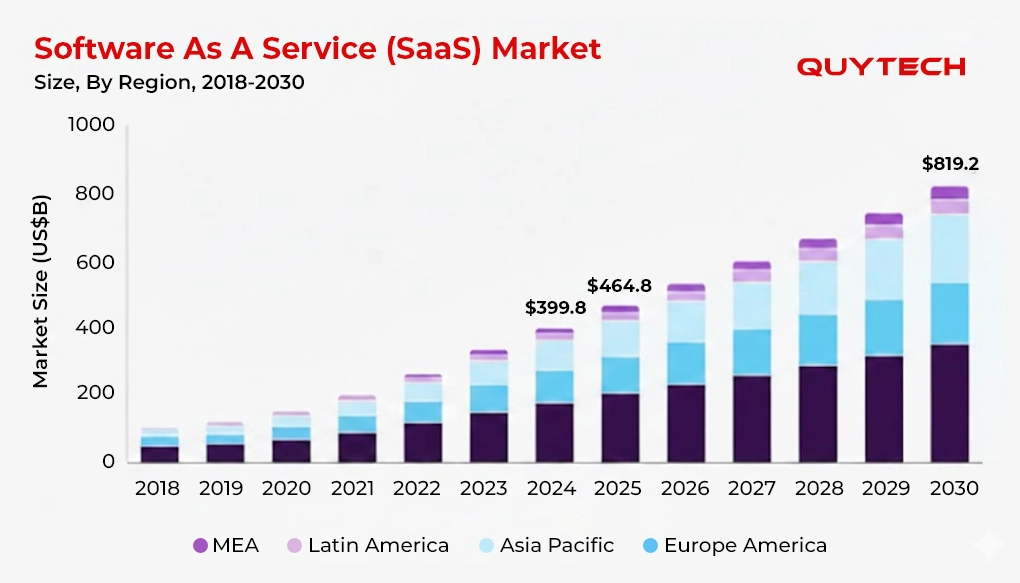
As aforementioned, the SaaS industry is growing at an unprecedented rate; let’s take a look at these statistics to know the industry’s market size, revenue, and more:
- The global SaaS market size is estimated to reach USD 819.23 billion by 2030.
- The market is expected to witness a compound annual growth rate of 12.0% from 2025 to 2030.
- The USA is expected to generate the highest revenue of USD 260.04 billion in 2026.
- Integration of technologies like AI and Agentic AI, and the rise of micro SaaS and mobile SaaS are among the growth drivers of this industry.
You may like to read: Top SaaS Application Ideas to Build in 2026
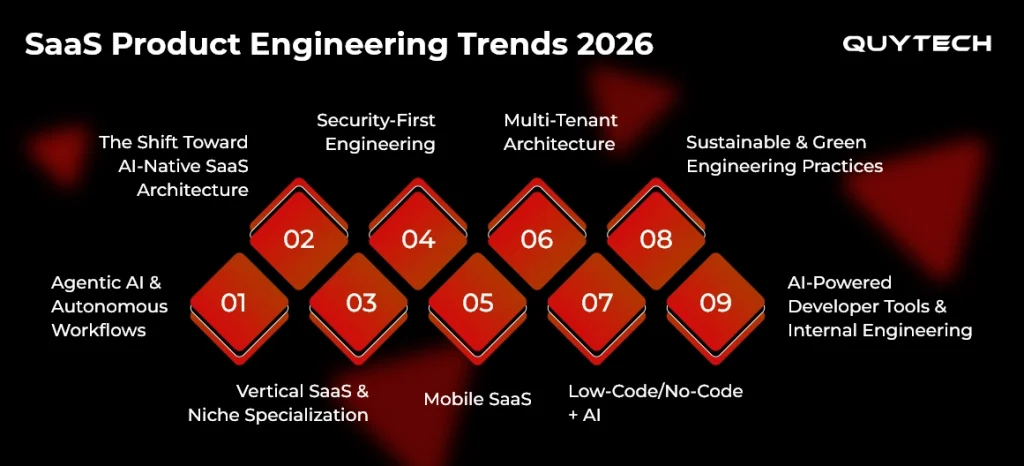
SaaS Product Engineering Trends 2026
Whether you are building a new SaaS product or modifying an existing one from scratch, these SaaS trends 2026 are a must to consider:
1. Agentic AI & Autonomous Workflows
Traditional SaaS products provide a response or take action when a user tells them to. However, Agentic AI changes this scenario; it enables SaaS products to take initiatives, make decisions, and perform multiple tasks without manual intervention.
Agentic AI in SaaS means making the product actively participate in the workflow, just like a human professional. This is one of the biggest SaaS product engineering trends of 2026.
In fact, companies like Salesforce, ServiceNow, and HubSpot are already utilizing Agentic AI in production environments.
Agentic AI in Software-as-a-service combines AI agent frameworks to define planning and execution capabilities of agents and embed tool-calling capabilities to enable the agent interact seamlessly with external APIs, databases, and services. It also includes adding memory layers that make the agent stick to the context while working in multi-step workflows.
Dig Deeper: How to Build an Agentic SaaS Platform
2. The Shift Toward AI-Native SaaS Architecture
Adding AI to a SaaS product doesn’t mean integrating an AI-powered recommendation system or a chatbot. Today, it means ensuring an AI-native SaaS architecture from day one. It means the data pipelines, infrastructure, and product logic that work together to support AI at the core.
Having an AI-native architecture means the products are capable of learning, adapting, and making decisions continuously. Basically, it improves product intelligence while ensuring faster and more personalized user experiences.
A perfect example of a SaaS product with AI-native architecture is GitHub’s Copilot, which is not just a code editor with AI added; rather, the entire product experience is engineered around an artificial intelligence interface.
AI-native SaaS products are mainly built on a combination of vector databases that can store and retrieve context-rich data and LLM orchestration layers responsible for managing how AI models interact with your product logic. It also includes real-time inference pipelines that process data and deliver AI-driven outputs without latency.
Explore More: How To Build an AI-Based SaaS Platform
3. Vertical SaaS and Niche Specialization
We have all used products like Google Workspace, Slack, or Zoom, which are built for everyone and work for every industry. These tools are indeed powerful and have excellent adoption rates globally, but most companies have started looking for industry-specific SaaS products, making vertical SaaS and niche specialization a big trend of 2026.
Vertical SaaS doesn’t follow a one-size-fits-all approach; it focuses on custom workflows, compliance requirements, and data structures unique to a specific domain. So, whether it is healthcare, legal, logistics, or retail, companies are now shifting their focus towards vertical SaaS.
Vertical SaaS products rely on industry-specific data models and have pre-built compliance frameworks. Unlike horizontal SaaS platforms, they involve deep third-party integrations and ensure faster deployment and seamless adoption.
Also Read: Top 25+ Micro SaaS Ideas to Build in 2026
4. Security-First Engineering
Security has always been a key consideration when it comes to SaaS product development. In 2026 and beyond, we may see more and more organizations opting for security-first engineering.
It means embedding and ensuring security into every stage of the product development, rather than making it a part of quality assurance that is conducted after the development.
Security-first engineering is the need of the hour, considering that SaaS products handle sensitive enterprise data across multiple tenants, geographies, and compliance environments simultaneously. Even a minor vulnerability can expose the entire platform.

The 2024 high-profile breaches at companies like Okta and Snowflake happened mainly due to poor security posture. Having a secure and trusted SaaS product can not only avoid breaches but also build buyer trust and accelerate compliance certifications like SOC 2 and ISO 27001.
Ensuring security-first SaaS engineering involves adopting a zero-trust architecture and combining it with DevSecOps practices. It also involves integrating code vulnerability scanning tools and secrets management tools while using modern testing frameworks like SAST/DAST.
Interesting Read: How to Build a SaaS Product: Complete Step-by-Step Guide
5. Mobile SaaS
Mobile SaaS products are designed or engineered for mobile interfaces. It is becoming a fast-growing trend in 2026 because companies no longer want their employees to be desk-bound. In fact, for some jobs like field work or remote work, having a mobile SaaS product is very convenient.
Even companies like ServiceNow and Workday have made significant investments in their mobile experiences in recent years. Having a mobile SaaS product means higher production adoption and improved workforce productivity. It also means users can make faster decisions.
Building a mobile SaaS product doesn’t only need to ensure responsive design, but it also includes engineering the product for offline-first functionality, creating lightweight API layers, and adopting cross-platform development frameworks.
6. Multi-Tenant Architecture
A multi-tenant architecture makes SaaS economically viable and enables multiple customers and tenants to utilize the same underlying infrastructure. In 2026, the multi-tenant architecture may further evolve to offer per-tenant customization and dedicated performance guarantees.
Apart from these two benefits, it will also ensure regional data residency and compliance controls, completely different from one tenant to another. For instance, a global enterprise with its operations across Europe, the US, and Asia may have different compliance requirements for all geographies. This can be achieved by moving towards hybrid tenancy models for all geographies.
Multi-tenant SaaS engineering combines shared infrastructure to accommodate smaller tenants. Each tenant has dedicated compute and storage layers. Doing this requires using tenant-aware microservices and databases ike PostgreSQL.
7. Low-Code/No-Code + AI
Another big trend in SaaS product engineering in 2026 is relying on low-code and no-code platforms along with artificial intelligence. Adding AI to this automates workflows, gives integration suggestions, and automatically generates logics in the visual and drag-and-drop development environments. What you actually get is a powerful SaaS product.
Two examples of using low-code/no-code are Microsoft Power Platform and Bubble. However, if you add AI to these development tools or platforms, the development gets fast and easy.
Even non-technical users can build functional and production-ready applications by giving commands in plain language. Salesforce Einstein Studio is a perfect example of it. The adoption of this trend will bring faster time to value, reduce dependency on engineering backlogs, and minimize the overall development costs.

Modern low-code/no-code SaaS platforms require pre-built integration connectors, event-driven architectures, and AI-assisted code generation engines.
8. Sustainable and Green Engineering Practices
SaaS product engineering trends 2026 also include adopting sustainable and green engineering practices. That’s because SaaS products require cloud infrastructure to run, and this infrastructure consumes enormous amounts of energy. With regulators, government policies, and customers making the demonstration of ESG commitments mandatory, the carbon footprint of SaaS product development also needs to be controlled.
Green product engineering of SaaS solutions is about making engineering decisions that minimize the amount of compute consumption required, optimizing algorithms, choosing the right-sized cloud resources, and reducing redundant data storage. This will build more efficient data pipelines that utilize less computational power.
Big companies like Microsoft and Google have even made commitments towards carbon-neutral cloud infrastructure. Sustainable SaaS engineering includes implementing carbon-aware computing by scheduling workloads. It also focuses on adapting FinOps practices that eliminate wasteful cloud spending by leveraging serverless architectures.
Know More About: What is Consumer SaaS? A Detailed Guide
9. AI-Powered Developer Tools and Internal Engineering
SaaS product engineering or development is getting a major transformation this year. Not just what gets built, but how it gets built. AI-powered tools are being used to accelerate development during code writing, pull requests reviewing, finding and fixing bugs, generating tests, and even documenting systems.
This is one of the most promising trends of SaaS product engineering in 2026. Tools like Cursor, Tabnine, and Amazon CodeWhisperer can help automate workflows, monitor system health, and predict deployment failures. This accelerates development, saves manual effort, and ensures fewer production incidents.
AI-powered engineering tooling utilizes LLms fine-tuned on code. It can integrate directly into CI/CD pipelines to automate critical operations.
Read More: AI in SaaS Software and Applications: Use Cases Automation, and the Future
Want to Build a Future-Ready Product?
Now that you know the top SaaS product engineering trends or SaaS trends of 2026, the next step is to build your Saas product according to them. That’s where Quytech can help. We are a leading SaaS development company with a hands-n experience in building SaaS products powered by AI, Agentic AI, Blockchain, and other similar technologies.
Moreover, we follow a security-first architecture to ensure every product that is designed and developed is highly secure and can also be scaled seamlessly. Whether you want to build a micro SaaS product, a vertical SaaS solution, or AI-powered SaaS software, we have expertise in building any type of SaaS.
Similar Read: How to Start a SaaS Business in 2026: Startup Guide
Conclusion
The SaaS landscape is changing rapidly, with companies now shifting their focus to AI native architectures, agentic AI-powered autonomous workflows, and sustainable development practices. Besides AI, security-first and native-AI architectures, blockchain integration, and mobile SaaS are among the top SaaS trends of 2026.
Companies need to ensure that their SaaS products align with these trends to achieve scalability, speed, security, and trust. Partner with a reputed SaaS development company or hire SaaS developers to build a future-ready SaaS product or modify the existing one.
Frequently Asked Questions
The upcoming SaaS product engineering trends for 2026 include AI-native architecture, agentic AI and autonomous workflows, vertical SaaS specialization, security-first engineering, and mobile SaaS.
AI is gradually becoming the foundation of SaaS products, with agentic AI making them autonomous to independently think, plan, and execute. Apart from this, AI-native architectures are also becoming a key trend to redefine how the products are designed, built, and scaled.
Horizontal SaaS serves all industries with a general-purpose solution; on the other hand, vertical SaaS is built specifically for a specific industry with workflows, compliance requirements, and integrations tailored to that domain.
Security has become prominent in every SaaS product development. Therefore, SaaS products are being embedded with top security techniques throughout the development lifecycle, rather than just making it a final checkpoint. Security-first engineering improves security while building trust in users and adhering to compliance.
