There was a time when purchasing a software license was the standard answer to every organizational need. If a company needed a platform, they used to simply opt for an existing SaaS solution and put it to use. But slowly, a shift began to occur when complexities in workflows started rising, and limitations of SaaS platforms like vendor dependencies, data ownership, and lack of customization started surfacing.
This shift brought two different approaches of product engineering to the table: SaaS and BYOS. For areas where SaaS products fail to bring the change, enterprises have the option of building their own software. Where SaaS targets smaller user bases and straightforward requirements, BYOS gives organizations tailored solutions without recurring costs and integration limitations. Both product engineering models deliver real value when applied to the right context.
But how do you decide which model is right for your engineering strategy? In this blog, we will walk you through the key differences between SaaS and BYOS, their pros and cons, and the key factors that should guide your decision.
What is SaaS (Software as a Service)
Software as a service (SaaS) is a cloud-based platform accessed via the web. Such software does not require infrastructure installations and can be accessed from anywhere, through any device. They are cost-effective in the short run, as organizations don’t need to invest in building them.
SaaS platforms are also quicker to implement, as all they need is a device and an internet connection. They use a licensing model in which plans offer different features, allowing organizations to choose the options that suit them. It allows organizations to handle standard workflows instead of building the complete product from scratch.
Similar Read: How to Build an AI-Based SaaS Platform
What is BYOS (Build Your Own Software)
As the name suggests, BYOS (build your own software) refers to the option in which organizations choose to build their own software rather than use existing software. The primary reason companies opt for BYOS is that the product is tailored and fully under the organization’s control.
Teams move to BYOS when existing off-the-shelf products no longer address the needs. In such situations, opting for existing products merely to reduce costs ends up increasing costs due to recurring licensing fees and gaps between what is offered and what is actually needed.
BYOS fills this gap by enabling organizations to manage every step, from ideation through deployment and maintenance, in-house. This gives organizations the flexibility to build, scale, and control their product as needed. It helps organizations with large user bases direct their funds to more impactful areas, rather than draining them slowly through recurring expenses.
You Might Also Like: Product Engineering vs Custom Software Development: Key Differences
SaaS vs BYOS: Key Differences
Now that you are familiar with both SaaS and BYOS, let’s help you understand the core areas that make them different from each other. Here’s a detailed table comparison of SaaS vs BYOS:
| Aspect | Software as a Service | Build Your Own Software |
| Ownership | Ownership of a SaaS platform rests with the vendor. | Ownership and control of BYOS rest with the organization. |
| Customization | In SaaS platforms, customization is limited. | BYOS is fully customizable and can be tailored to meet organizational requirements. |
| Cost Structure | The cost structure in SaaS platforms is recurring and subscription-based. | The cost structure in BYOS is high initially, but it is justified in the long run. |
| Maintenance | The vendor handles maintenance of the SaaS platform. | In BYOS, the organization is responsible for handling the maintenance. |
| Vendor Lock-in risk | High vendor lock-in risk. | There’s no vendor lock-in risk. |
| Engineering team requirements | Minimal technical expertise is needed as the vendor manages most of the product. | Requires capable engineers as the complete product is built by the organization. |
| Scalability | Scalability in SaaS platforms depends on the subscription plans. | Scalability in BYOS depends on the product’s architecture and design. |
| Licensing | SaaS platforms come with recurring license agreements. | In BYOS, organizations do not need licenses because they own the product they develop. |
| Integration | Integrations in a SaaS platform are limited to what the vendor provides. | Since BYOS means the platform will be developed within the organization, its integration capabilities are not limited. |
| Control | The vendor controls the platform’s roadmap and features. | The organization has complete control over the product, including the roadmap and features. |
| Time-to-Market | Faster time-to-market as the platform is already built. | Steadier time-to-market as the product needs to be built from scratch. |
| Ideal For | SaaS platforms are ideal for organizations with limited budgets and small user bases. | BYOS is ideal for organizations with complex workflows, unique processes, and a broad user base. |
People Also Like: 9 SaaS Product Engineering Trends to Watch in 2026
Advantages of SaaS and BYOS Model
The SaaS and BYOS models both benefit organizations in different ways. SaaS offers lower upfront costs and reduces maintenance burden. Whereas BYOS brings in customization, ownership, and a competitive advantage. Let’s explore these benefits in detail:
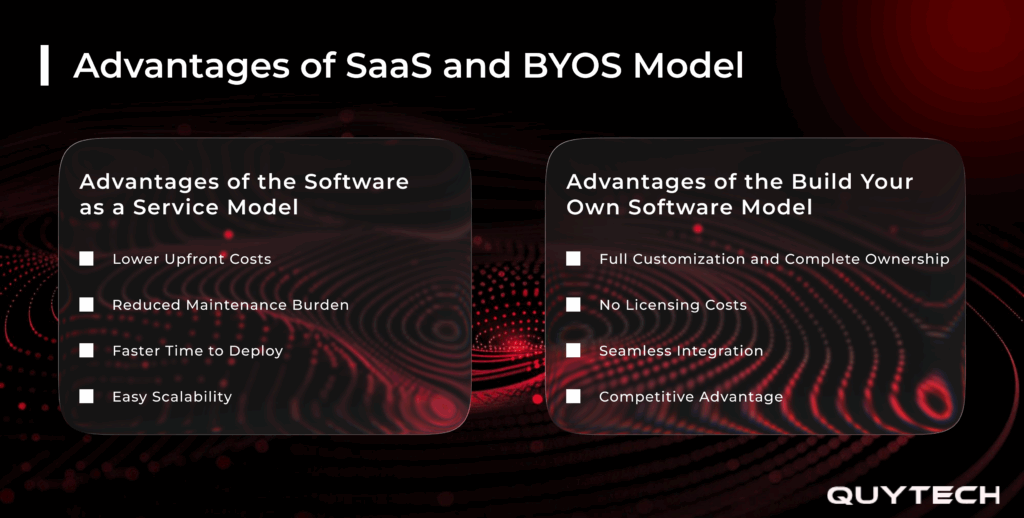
Advantages of the Software as a Service Model
- Lower Upfront Costs
SaaS platforms run on subscription models, which are a cost-effective option in the short run. This is because it does not require upfront investment for its development, installation, or implementation. SaaS can be used by teams for standard workflows of their product.
- Reduced Maintenance Burden
Another significant benefit of SaaS is that it reduces maintenance burden. Platforms require ongoing maintenance by teams, including bug fixes, system upgrades, and related tasks. But with SaaS, the vendor handles everything. This reduces the need for internal teams to perform these tasks and frees them to focus on core product development.
- Faster Time to Deploy
As is well known, developing a platform requires dedicated effort over several months. But with SaaS platforms, organizations can skip the deployment phase, as the platforms are already built. They are also hosted in the cloud, so they don’t require installation or implementation, allowing companies to get them up and running faster.
- Easy Scalability
As organizations grow, their requirements and expectations from platforms also increase. SaaS products support those needs by scaling easily, as they run on cloud infrastructure. This means that, to scale, all organizations would need to upgrade their plans and access the platform’s resources as needed.

Advantages of the Build Your Own Software Model
- Full Customization and Complete Ownership
When organizations build their own software, they can control every aspect of it. Whether it is the product’s design, features, or interface. BYOS also allows them to customize the software to match their needs and expectations. This eliminates the need to use existing software that does not fit the organization’s workflows.
- No Licensing Costs
BYOS brings in cost efficiency for organizations by eliminating recurring licensing costs. When a product is developed in the organization, the funds are allocated to the product instead of the recurring subscription plans. Even when workflows scale, there’s no stress about high licensing costs because the product belongs to the company and can be scaled or downsized as needed.
- Seamless Integration
BYOS powers seamlessly integrate the platform with existing systems and tools. Built by the organization, the software is not limited to a specific integration limit; it supports collaboration as designed. This helps organizations maintain a unified view of all tools, rather than workarounds to bridge gaps caused by disconnected systems.
- Competitive Advantage
Building your own software can help organizations get a competitive advantage, as it cannot be replicated by competitors. This is because such software is tailored to the company’s workflows, processes, and other requirements. It fits around how the organization actually works, keeping workflows efficient and outcomes focused.
Handpicked For You: Top Software Development Companies in India for 2026
Disadvantages of SaaS and BYOS Models
While both SaaS and BYOS models offer numerous benefits, they also have drawbacks. SaaS platforms offer limited customization and recurring costs, whereas BYOS requires significant upfront investment and longer development time. The following points give a deeper dive into the disadvantages of SaaS and BYOS:
Disadvantages of the Software as a Service Model
- Limited Customization and Control
A clear disadvantage of SaaS platforms is their limited customization. They are built to serve a large number of customers, so their features are standardized and do not fit unique organizational workflow needs. If organizations need specific features, they will have to wait for the vendor to incorporate them, as the control also lies with the vendor.
- Recurring Licensing Costs
SaaS platforms present recurring licensing costs, which are cost-effective in the short run. However, from a long-run perspective, the picture shifts, especially when the organization needs to scale. Over time, accumulated subscription costs can become a significant operating expense.
- Integration Limitations
As is well known, organizations rely on multiple tools and systems to manage their day-to-day operations. However, the integrations offered by SaaS platforms are limited to the tools the vendor supports. This lack of integration can limit the platform’s connectivity to existing tools.
Disadvantages of the Build Your Own Software Model
- High Initial Development Costs
When building software, an organization needs to allocate funds across multiple areas, including ideation and deployment, infrastructure, and human resources. This naturally results in high initial development costs. High costs are often a deal-breaker for organizations with limited budgets.
- Longer Development Time
When organizations build their own software, development time often stretches out. This is mainly because building software requires deep analysis, ideation, and planning. And not just that, but the actual development also takes months, sometimes even a year, depending on the product’s complexity.
- Ongoing Maintenance Responsibility
Building your own software does not end at deployment. Like any other software, it also requires ongoing support, maintenance, and updates. The regular analysis, bug fixing, and feature updating tasks require continuous resources. And these resources are not just monetary, but also the people and time invested to keep the software running.
Interesting Read: AI in SaaS Software and Applications: Use Cases, Automation, and the Future

SaaS or BYOS: Which Should Organizations Choose?
Now that you are familiar with both advantages and disadvantages of SaaS and BYOS, which model would work best for your organization? Well, you can stop wondering now because this section will guide you in choosing between SaaS vs BYOS:
Choose Saas If:
- The Organization is in Its Early Stage
If the organization is in its early stages, the right option is to adopt SaaS. This is because it eliminates the need to develop the platform end-to-end, allowing teams to focus on product engineering rather than building the software from scratch.
- The Functionality Required is Not Unique to the Organization
If the product that your organization needs for its processes is already available and meets your expectations, then SaaS is the right choice. For example, if your concern is authentication, payment processing, or similar capabilities, opting for reliable off-the-shelf software is preferable to developing it internally.
- The User Base is Small
If the product you want to build has a small user base, opting for SaaS is the right choice. This is because licensing pricing is more favourable to organizations with a predictable, compact user base.
- The Budget Requires a Predictable Cost Structure
If supporting the product engineering process of a new software is not feasible, then organizations should consider SaaS. Their subscription plans are predictable and cost-effective compared to BYOS when budget constraints apply.
Choose BYOS If:
- Off-the-Shelf Solutions Do Not Meet the Requirements
If existing products in the market cannot address organizations’ unique needs, BYOS is the right solution. The product will be built from scratch and can be controlled and tailored as needed. Also, the organization doesn’t need to worry about vendor restrictions.
- The Cost of Scaling Justifies an Internal Build
If the costs of scaling your workflows and organizations while using SaaS are high, then you should go for BYOS. SaaS licensing costs scale with the user base, and at a certain level, the accumulated spend can exceed the cost of building the product internally.
- Data Ownership and Security Requirements Are Non-Negotiable
If compliance requirements are your concern, then BYOS is the right option. This is because the product developed would be under the organization’s complete control. The data stored and managed would not be shared with external parties, and accountability will be clearly defined, which is not so in the case of existing software.
Similar Read: Why Even Well-Funded Product Engineering Initiatives Fail and What CIOs Must Do Early
How Quytech Helps Organizations Build the Right Software
When BYOS emerges as the right product engineering solution, Quytech is the partner that takes you through the entire journey. Backed with over 16 years of experience in product engineering, we help organizations build their software by understanding their goals, workflows, and product vision.
Based on that understanding, we plan the product roadmap, followed by requirement gathering and development. Our end-to-end development and support approach ensures the software is built, maintained, and evolved with the same level of care at every stage.
We place special emphasis on delivering a scalable product that grows with organizational workflows and processes. The software is designed to seamlessly address integration requirements and fit naturally within your existing technology ecosystem.
Conclusion
Choosing the right product engineering model is not an easy decision to make. There are multiple factors that CTOs have to consider, be it costs, infrastructure requirements, scalability, or customization. While the list of organizational software needs is ever evolving, two models stand out in addressing them: SaaS and BYOS.
SaaS is the right option when it comes to choosing a cost-effective product engineering model for catering to a smaller user base. It has lower upfront costs, reduces maintenance burden, and has faster deployment.
BYOS is suitable when the costs of scaling existing platforms are outweighed by the cost of developing software from scratch. It allows organizations to have complete control over the product and customize it to their expectations. BYOS eliminates licensing costs and also gives organizations a competitive advantage.
FAQs
Yes, organizations can migrate from SaaS to a customized product later. Many organizations do opt for migration when SaaS fails to keep up with growing needs.
For early-stage product engineering, SaaS platforms are suitable as they allow teams to focus on the core product without getting tied to maintenance.
For complex workflows, organizations should choose BYOS product engineering models as they are under complete control of the company and can be customized to fit in with complex and unique workflows.
The risks of relying entirely on SaaS for product engineering are vendor dependency, customization and integration restrictions, and reduced control over data and security.
Yes, organizations can combine SaaS and BYOS in product engineering. They can utilize SaaS for standard workflows while using BYOS to handle the core functionalities of the product.
Yes, an organization with a small technical team can choose BYOS for product engineering by partnering with the right product engineering partner. This will help them seek expertise while maintaining ownership of the product.
