As per Fortune Business Insights, the agentic AI market was dominated by the enterprise segment with 45.7% share in 2025. This makes it quite obvious that enterprises are no longer wondering if agentic AI is useful for them; they are actually implementing it.
The reason why many still haven’t made a move is very simple: Uncertainty. There are doubts about implementing agentic AI. Some do not know where to start, while some wonder if agentic AI will deliver real value in enterprise environments.
So, if you have the same doubts, you’re at the right place. In this blog, we will walk you through everything, be it the basic definition, key use case, or the future trends of agentic AI in enterprise.
Understanding the Market Pulse of Agentic AI
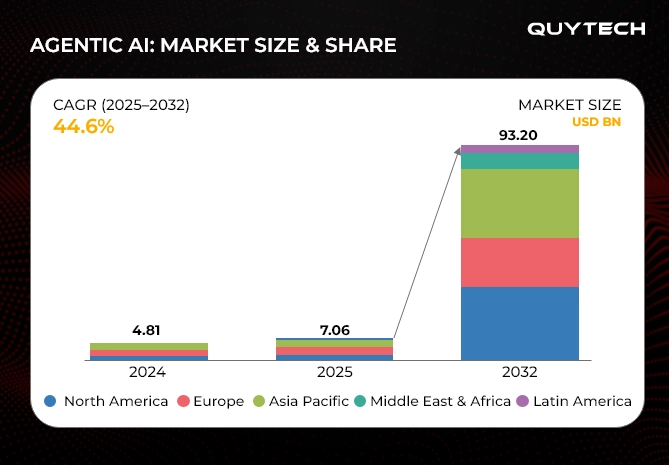
- Research by Markets and Markets reveals that the global agentic AI market is expected to reach USD 93.20 billion by 2032.
- It also highlights that the estimated yearly growth is about 44.6%.
- North America emerged as the largest adopter of agentic AI in 2025. The share it captured was about USD 2.45 billion.
What is Agentic AI
Agentic AI is an intelligent software system that is capable of autonomously making decisions. It does not follow a rule book when it comes to making decisions, which is what makes it different from traditional AI automation. It is context-aware, which enables it to understand what’s happening, plan how to respond, and execute effectively.
Simply, agentic AI can be defined as intelligent systems that can think, decide, and act with the least human intervention. The characteristics that define Agentic AI are:
- Goal-Oriented Behavior
Agentic AI focuses on its assigned tasks. If it’s assigned a task of resolving urgent customer queries, it will analyze all the queries, prioritize urgent ones, and resolve them. In case it encounters any hurdle, it can change its method; the goal does not change.
- Autonomy
Agentic AI is autonomous and can make its own decisions. For example, if it is given a task of analyzing and prioritizing customer queries. It would not wait for human validation to resolve them.
- Adaptivity
Agentic AI learns from every response it gives, feedback it receives, and interaction it has. This means that if it’s given a task of resolving customer queries and the customer gives feedback over the interaction, agentic AI can actually understand and adapt to it.
- Intelligent Reasoning
Agentic AI is powered by intelligent reasoning models. They enable them to think critically, like a human, while executing assigned tasks.
- Context Awareness
Context awareness is yet another characteristic of agentic AI, which adds the human touch to automation. Context awareness helps agentic AI remember past interactions and give responses that feel natural.
Why do Enterprises Need Agentic AI
The reason why enterprises need agentic AI is that they operate in complex and dynamic environments. In such environments, decision-making becomes difficult and may cause delay when challenges occur. Let’s understand these reasons in detail:
- Enterprise Workflows are No Longer Linear
In traditional enterprise workflows, tasks are performed in a sequence. This is because tools and teams are limited, but that’s not the case in the current scenario. Enterprises have multiple teams. The workflows are not sequential, and multiple tools are also involved to handle tasks.
Agentic AI does not follow a fixed script. Instead, it adjusts its action plan based on the situation’s requirements. This makes it easy for enterprises to connect multiple tools and teams. And what’s more is that this does not disrupt workflows.
- Manual Decision Bottlenecks Limit Speed
There is a huge dependency on human intervention in traditional automation. Each automated task must require human review at every step. This slows down operations, naturally delaying decision-making.
Agentic AI is intelligent and autonomous. It takes its own decisions while keeping them aligned with the defined goals. This speeds up both operations and decision-making.
- Scale Operations without Increasing Headcount
Scaling is another reason why enterprises are shifting towards agentic AI. Traditional environments do not really make scaling operations easy. This is because most of the operations are manual, and scaling them would require increasing headcount, which obviously is not a very cost-effective option.
Agentic AI in enterprises makes scaling achievable. How? Well, agentic AI can easily handle multiple tasks at the same time without chaos. And since it needs minimal human intervention, scaling does not require hiring more people.
- Static Automation Can’t Keep Up with Dynamic Enterprise Environments
By now, you can already tell that traditional automation is very rigid. It has action plans to deal with challenges, but these plans target only predictable situations. Which, clearly, is not enough to tackle the dynamic environment in which enterprises operate.
Agentic AI turns the tables by handling dynamic environment changes with its adaptivity. While it can tackle predictable challenges, it can also mold its plans to handle the unpredictable ones. What’s more is that all this does not disrupt workflows.
- Data Doesn’t Automatically Lead to Action
Every operation that’s carried out in an enterprise generates massive amounts of data, which, if analyzed, can help in improving efficiency. But traditional automation waits for human reviews. Naturally, the data remains unused. And by the time data-based insights are accessed, other issues may grow, making enterprises fall behind.
Agentic AI in enterprise bridges the gap between data and execution. It does not wait for human intervention to generate action-oriented insights. Agentic AI analyzes data as generated to help enterprises tackle challenges and tap into opportunities at the earliest.
- Risks are Often Found After the Damage Is Done
Enterprises often follow a reactive approach when managing risks. For example, a compliance violation is noticed during annual audits. Here, enterprises notice this compliance risk after it happens, when it could have been addressed beforehand. In such situations, enterprises react to the situation. There’s no preparedness to handle these challenges.
Agentic AI overcomes these challenges by adapting a proactive approach. It does not wait for risks to cause damage. Instead, it monitors every activity, looks for abnormalities, and takes corrective action immediately.
You Might Also Like: AI Agents for Intent Recognition: How They Understand What Users Really Want
Key Use Cases of Agentic AI in Enterprise Environments
Now that you are familiar with the basics of agentic AI in enterprise environments, you might be wondering how it actually works, like in real life. Well, this section addresses exactly that. Here are some core use cases of agentic AI in enterprise environments:
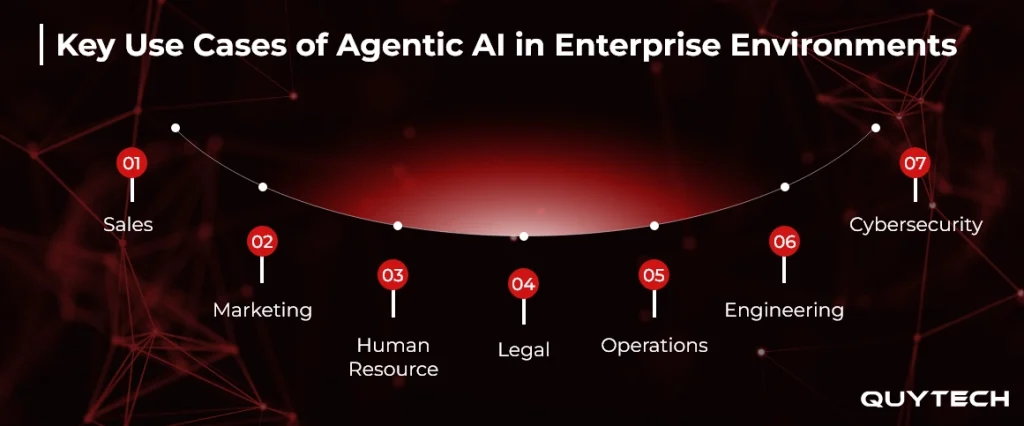
- Sales
- Lead Generation
In the field of sales, agentic AI assists in analyzing, classifying, and prioritizing leads by judging the behavior of potential customers across platforms.
- Automated Robotic Calls
Agentic AI initiates robotic first and follow-up calls. These calls connect with potential customers, understand their intent, and respond to them naturally.
- Customer Service
Agentic AI interacts with customers, captures their input, and understands their concerns. This understanding helps it provide resolution to customers or transfer calls to human agents if needed.
- Marketing
- Content Generation
In marketing, agentic AI helps enterprises in generating content for blogs, social media posts, websites, etc. It can also assist in understanding user engagement metrics and creating content plans accordingly.
- Graphic Support
Just like how agentic AI generates written content, it also helps enterprises generate visual content. It helps in creating images, videos, banners, etc. for various platforms.
- Post Generations and Publishing
So agentic AI does not stop at generating content and graphics. It can also help an enterprise publish the content generated. Agentic AI helps in scheduling content and monitors its performance as well.
- Human Resource
- Candidate Screening
In HR, agentic AI assists the recruitment process by automating the candidate screening process. It analyzes resumes, matches the skillset of candidates with the job descriptions, and shortlists candidates.
- Agentic Interviews
Apart from screening, agentic AI helps in conducting interviews. It can schedule and conduct the first round of interviews, analyze responses, and give insights on whether the candidate is suitable for the position or not.
- Onboarding Processes
Onboarding processes are yet another area where agentic AI can assist enterprises. It carries out tasks like document collection, review, and policy walkthroughs with minimal human assistance.
- Legal
- Contract Reviews
In the legal segment, agentic AI helps in easing the burden of legal professionals by automating repetitive tasks like contract reviews.
- Automating Compliance
Agentic AI also assists enterprises in automating legal compliance. It does so by continuously monitoring processes and alerting when compliance gaps are noticed.
- Legal Research & Documentation
Implementing agentic AI helps in conducting legal research more efficiently. It eliminates the need for legal professionals to manually carry out research by finding relevant laws, past cases, and internal documents.
- Operations
- Automated Invoicing
In operations, agentic AI helps in automating the repetitive processes of creating, verifying, and processing invoices.
- Supply Chain
Along with this, agentic AI enhances the supply chain operations by managing inventory levels, supplier performances, and demand changes. It continuously monitors these areas to predict shortages, trigger reorders, and maintain optimal stock levels.
- Production Assistance
In the production line, agentic AI plays its role by monitoring equipment conditions, maintenance schedules, and output quality. It creates continuity in the production cycle without manual intervention.
- Engineering
- Design & Planning Support
In design and planning, agentic AI analyzes requirements, previous projects, and possible limitations of the project. And it does not stop at analysis; it provides insights to enhance the efficiency of the development process.
- Code Assistance
Along with this, agentic AI also offers code assistance. It analyzes written code, finds errors, and offers improvement suggestions. This saves the time and effort that engineers otherwise spend on finding the error.
- Testing
Now, agentic AI does not stop at code assistance; it is capable of analyzing the quality of the project as well. It can run tests, flag failures, and offer insights on how engineers can fix the encountered problems.
- Cybersecurity
- Threat Detection
Implementing agentic AI in enterprise environments helps in detecting cyber threats from both internal and external factors. It continuously monitors every device and user connected and flags them when they carry out abnormal activities.
- Incident Response
Now, agentic AI does not stop at detecting threats; it can also respond to the incident. How? Well, agentic AI can trigger alerts and safety measures like isolating the device, restricting its access to resources, etc.
- Security Operations Support
In security operations, agentic AI assists by analyzing alerts, prioritizing them, and addressing them. It does all this in real-time, so not only are the alerts addressed timely, but they are also documented for future reference.
Interesting Read: The Rise of Voice AI Agents: Revolutionizing Support and IVR Systems
What are the Benefits of Implementing Agentic AI in Enterprises
Implementing agentic AI in enterprises brings numerous benefits. It unlocks cost and operational efficiencies and also enhances decision-making. But the list doesn’t end just here. Here are some core benefits of implementing agentic AI in enterprises:
Cost and Operational Efficiency
Implementing agentic AI in enterprise environments helps in saving costs while improving operational efficiency. It saves costs because it automates repetitive tasks, which allows organizations to deploy their resources to other strategic tasks. And since tasks are automated, operations are carried out faster and more productively.
Enhanced Decision-Making
Agentic AI for enterprise automation enhances decision-making. This is because agentic AI monitors everything, every data generated, movement, and incident. It generates insights from them. When utilized, these insights help enterprises make quicker and more informed decisions.
Uninterrupted Productivity
Implementing agentic AI for enterprise automation helps in achieving uninterrupted productivity. The reason behind this is that traditional workflows start, pause, and end as per human operators. But since agentic AI does not depend on human assistance, they function even when humans are off shift or on a break.
Scalable Operations
Agentic AI helps enterprises scale their operations easily. This is because agentic AI can handle large amounts of data and work on multiple tasks simultaneously. Meaning, if enterprises plan to scale their operations, which is very common since they operate on a large scale, they would not need to hire more human resources to handle more tasks.
People Also Like: Agentic AI System Development 101: Explore Steps, Applications, Architecture, and Real-World Examples
What are the Challenges of Agentic AI Implementation in Enterprise
Some common challenges faced by enterprises when implementing agentic AI are defining responsibility and securing enterprise data. Not just these, but ensuring ethical behavior and integration with systems also creates hurdles. Let’s take a deeper dive into these challenges:
- Defining Responsibility in Autonomous Decisions
Agentic AI takes decisions autonomously is something we all know. But what happens when it takes the wrong decision? Defining the responsibility of these decisions and who would take accountability for them is a core challenge in the implementation process. This often creates confusion and may even lead to governance gaps.
- Securing Enterprise Data Used by Agentic AI
Agentic AI utilizes enterprise data to interpret, decide, and act on the assigned tasks. And since it connects with multiple tools and teams, shares and accesses data, security concerns naturally arise. They create uncertainty for agentic AI implementation as the chances of data being accessed by an unauthorized party increase.
- Ensuring Ethical and Transparent Agentic AI Behavior
Agentic AI can make decisions without human intervention. But this also raises ethical and transparency concerns because there is no explanation about why agentic AI made a certain decision. The Lack of transparency makes it hard to implement ethical standards or detect bias.
- Integrating Agentic AI with Existing Systems
Since enterprises operate on a very large scale, they utilize numerous tools to handle varied operations. The challenge here is that these systems are often outdated and may not support integration with sophisticated agentic AI technologies. If not addressed properly, agentic AI implementation can be inefficient and not give results.
Interesting Read: Agentic AI in Education: The Future of Personalized and Adaptive Learning
Best Practices for Implementing Agentic AI in Enterprises
While the above-mentioned challenges do make agentic AI implementation a bit tricky, we’ve got you covered. This section will walk you through the best practices for implementing agentic AI in enterprises:
- Establish Clear Accountability and Decision Boundaries
Agentic AI makes its own decisions; enterprises should establish responsibility and accountability for them from the initial phases. This is for the cure; the prevention should be to restrict agentic AI from making decisions beyond its boundaries.
Setting clear boundaries is a way through which it can be taught which areas need human assistance and which do not.
- Enforce Strong Data Access and Security Controls
To protect enterprise data from foreign access and misuse, organizations should restrict data access controls. Agentic AI should also be given access to only that data that it needs for working.
This ensures that nobody except authorized personnel gets access to enterprise data. Also, opting for encryption will protect data even if it does get exposed to unauthorized access.
- Embed Ethical Guardrails and Transparency Mechanisms
Agentic AI makes its own decisions, but on what basis it does so is not revealed, resulting in a lack of trust in its decisions. Enterprises can overcome this black box effect by implementing explainability and ethical guardrails.
This will reveal the reasons that made agentic AI arrive at a decision and can also assist in analyzing if it contains bias or other ethical concerns.
- Design for Incremental and Modular Integration
To tackle integration challenges like incompatibility with existing systems, enterprises can opt for API-based implementation methods. This will help agentic AI connect with existing systems and work in parallel.
Phase-based integration can also be opted for, as it starts by integrating agentic AI in core areas first. After gaining clarity on agentic AI, enterprises can then scale gradually.
Recommended For You: Revolutionizing Insurance Underwriting with Agentic AI
What is the Future of Agentic AI in Enterprise
The future trends of agentic AI in enterprise include cross-functional ecosystems, ambient intelligence, and hyper-personalized systems. These trends would give the current agentic AI systems an intelligent update. Sounds fascinating, right? Let’s dive deeper into these trends:
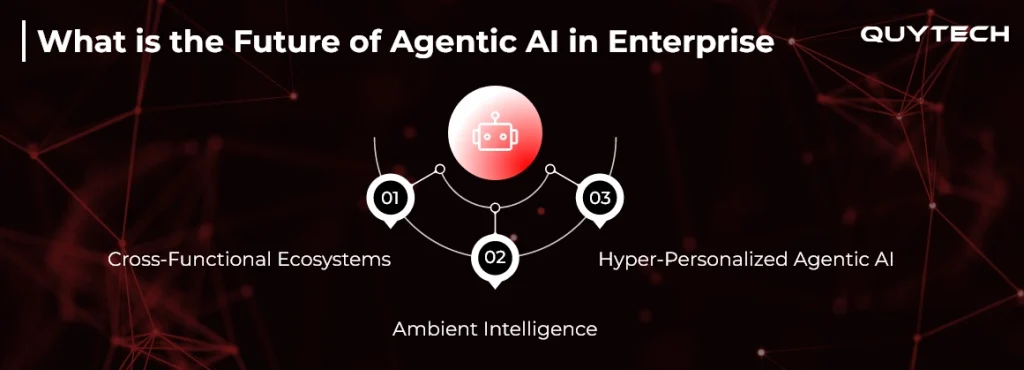
Cross-Functional Ecosystems
In the future, agentic AI systems across departments will collaborate in a centralized ecosystem. This will allow teams from different departments to connect without disrupting workflows.
Ambient Intelligence
The future holds ambient intelligence integration for Agentic AI in enterprises. This means that agentic AI in enterprise would work behind the scenes and provide assistance as and when needed.
Hyper-Personalized Agentic AI
Enterprises will utilize hyper-personalized agent AI systems. These systems would provide tailored assistance to individual users. They would adapt to users’ preferences and working methods and provide assistance accordingly.
Conclusion
There is no denying that enterprises have a lot on their plate when it comes to managing workflows, which is why they are now shifting to agentic AI adoption. It brings in intelligent automation powered by AI agents. Meaning, not just the tasks are automated, but are done with context awareness and smart decision-making.
Implementing agentic AI in enterprises helps in saving costs while enhancing operational efficiency. It enables enterprises to scale their operations without increasing the headcount. The best part is that it matches the enterprise-level workload because agentic AI can operate 24/7 uninterrupted.
Its wide applicability across departments like sales, marketing, HR, legal, and so on makes agentic AI relevant across the entire enterprise. Hence, it is quite clear that tapping into agentic AI for enterprise automation is not just a tech advancement but a step towards gaining the competitive edge.
FAQs
While there are many differences between traditional AI automation and agentic AI, the most significant one is that agentic AI is adaptive. It can go beyond pre-defined rules when it comes to responding. This is something traditional automation can’t do.
No. Enterprises do not need to replace the existing systems to adopt agentic AI. They can blend agentic AI with their existing systems through API-based integration.
The time duration for agentic AI implementation depends on the complexity and customization factors. A single-use agentic AI system takes less time than a cross-department one.
Yes. Agentic AI can work with legacy enterprise software when it is designed with those systems in mind.
While agentic AI does not depend completely on human assistance, establishing a balance is necessary to ensure nothing goes wrong.
Yes, agentic AI is suitable for highly regulated industries. Integrating regulatory conditions and boundaries throughout the development process helps agentic AI operate within regulatory limits.
Yes. Small and mid-sized enterprises do benefit from agentic AI. It allows them to save costs while improving operational efficiency and scale without increasing headcount.
