Key Takeaways:
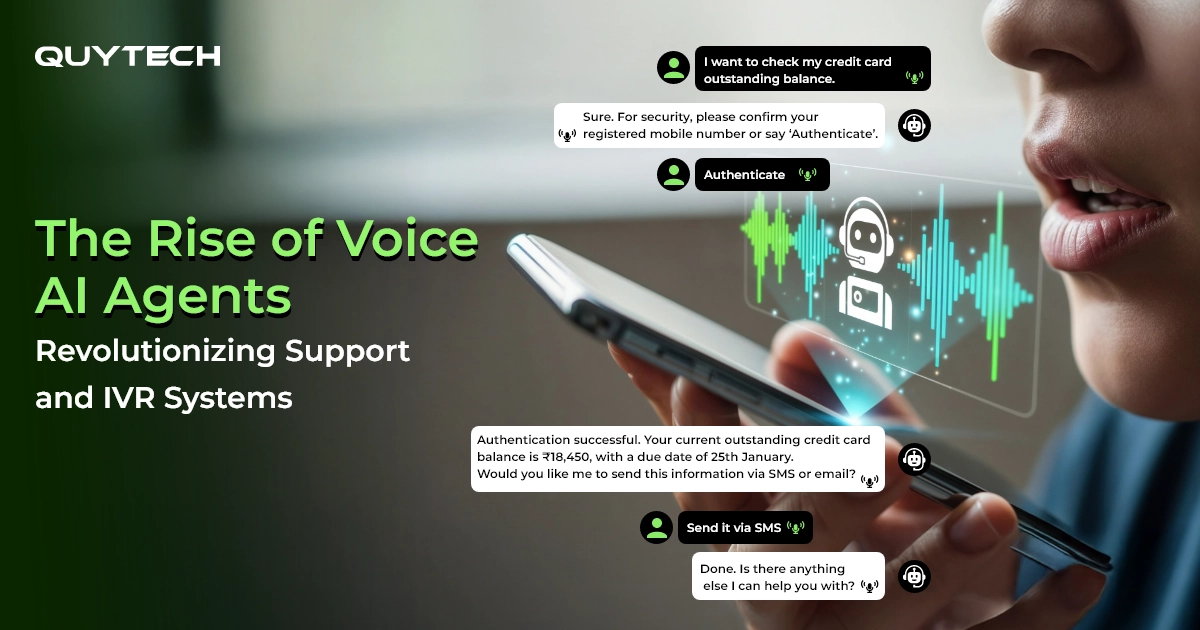
- Voice AI agents are intelligent systems that capture and process natural human speech and respond with a human touch.
- The interactions of AI voice agents are not bound to limitations like those of an IVR system. They conduct interactions with a natural flow.
- Voice AI agents are flexible and adaptable. They can respond as per the requirements of the situation.
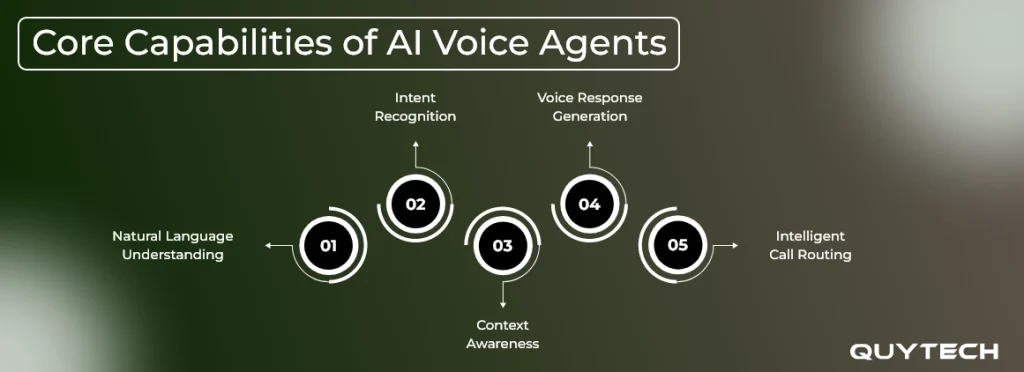
- AI voice agents can understand natural language, recognize intent, have context awareness, and respond with a human voice.
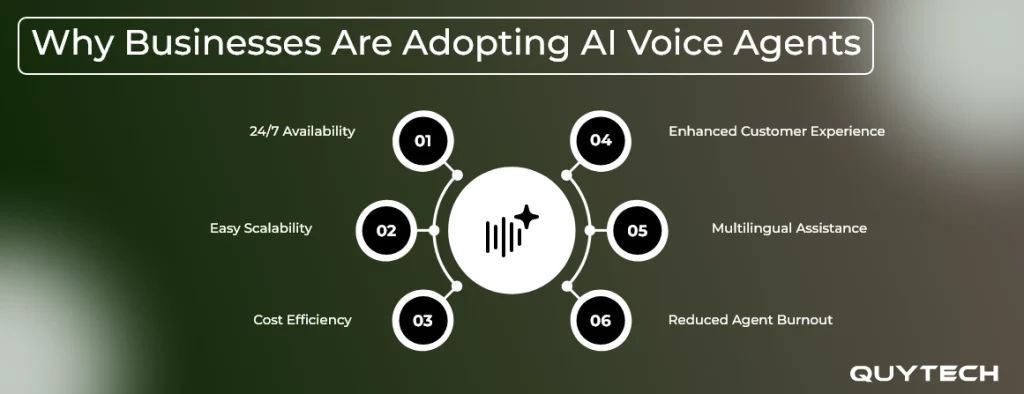
- The benefits of implementing voice AI agents include 24/7 availability, easy scalability, cost efficiency, enhanced customer experience, and multilingual assistance.
If you’ve ever interacted with a traditional IVR system, you may be well aware of how frustrating it can be. The constant beeps, repetitive scripts, and instructions to press 1 for this, 2 for that. The problem intensifies when these systems fail to recognize or address the customer’s actual concern.
This is where voice AI agents play their role. Unlike IVRs, their interaction ability is not limited to instructions. Voice AI agents not only provide basic assistance but also go as far as understanding the intent and personalizing the experience accordingly for every customer. Made with human-centric design and artificial intelligence, voice AI agents are capable of transferring calls to human agents in special situations.
Sounds fascinating, right? But there’s a lot more to voice AI agents. Which is exactly why we have curated this blog to help you know everything about voice AI agents, be it the capabilities they possess or the benefits they bring.
What are Voice AI Agents?
Voice AI agents are software-based systems that can process natural human speech, derive meaning and intent in it, and respond naturally. These agents redefine the way IVRs function. Voice AI agents do not function in a pre-defined and rigid way; they are flexible and intelligent. Their intelligence is what enables them to go beyond scripts.
But why are AI voice agents suddenly so hyped? Well, the answer lies in the fact that 69% of consumers still turn to phone support for complex issues. The reason behind this is that customers value human assistance as they might not always find their concerns addressed in the script that IVRs follow.
Voice AI agents bridge the gap between automation and human touch. They deliver conversations that feel human, without the delays, limitations, or rigidity of traditional support models. Technologies like NLP, automatic speech recognition, and text-to-speech models power AI voice agents. These technologies support everything from the listening and understanding ability of the agents to response decision and execution.
How are AI Voice Agents Different from Traditional IVR Systems?
Don’t AI voice agents and IVRs both interact with customers, so what’s the difference between them? The difference is quite significant. Here’s a table that will help you understand the difference between traditional IVR systems and AI voice agents:
| Aspect | Traditional IVR Systems | Voice AI Agents |
| Interaction Style | Traditional IVR systems interact based on pre-defined scripts. Their outputs are limited to providing instructional support, for example, press one to know about order status. | The interaction style followed by voice AI agents is conversational and human-like. |
| User Input | The user input is also limited to the predefined options provided. | The user input is not bound to any limitations. The user may present any query; there are no predefined options in the interactions with voice AI agents. |
| Understanding Capability | Traditional IVR systems understand inputs that they are trained with. They cannot understand input that exceeds the script or keywords. | Voice AI agents can understand the intent behind an input, which enables them to provide optimal resolutions for varied queries. |
| Conversation Flow | The conversation flow with a traditional IVR system is linear and step-based. It often requires customers to repeat inputs as it treats every step as an isolated action. | The conversation flow with a voice AI agent is very continuous, as they have context awareness. Smooth conversation is what makes voice AI agents feel natural and human-like. |
| Flexibility and Adaptability | Traditional IVR systems are not flexible or adaptable. To add flexibility, manual updates, new flows, or scenarios are needed. | Voice AI agents are highly flexible and adaptable. They don’t rely on manual updates; they learn from every interaction they have with customers. |
| User Experience | Traditional IVRs are functional, but their rigidity makes them feel too mechanical in terms of user experience. | AI voice agents provide a highly intuitive and human-like experience to users. |
You Might Also like: Assistive Search in Learning: AI That Understands Students with Learning Disabilities
Core Capabilities of Voice AI Agents
Now that you know how an AI voice agent is different from traditional IVRs, let’s get you a deeper dive into the core capabilities of AI voice agents:
Natural Language Understanding
Voice AI agents are powered by natural language processing models, making them capable of understanding what a user at the other end is trying to convey. This gives voice AI agents the ability to understand the vocabulary, meaning, and structure in the natural inputs users give. In simple words, NLU defines the capability of voice AI agents in registering the input accurately, even if it’s in everyday language.
Intent Recognition
Intent recognition defines the ability of AI voice agents to identify the intent behind inputs given by customers. As NLU registers and understands the words and their meaning, intent recognition focuses on deriving the actual intent behind them. Intent recognition plays a vital role, as the interpretation it gives will help the AI agents in deciding the next course of action.
Context Awareness
AI voice agents have context awareness. This means that they can remember information from different conversations, which helps them proactively resolve user queries instead of making the user fill in basic information again and again. Context awareness helps voice AI agents in maintaining a natural flow across conversations.
Voice Response Generation
Voice response generation is the feature that makes the voice AI agents capable of delivering spoken responses. It ensures that the responses generated are contextually relevant, clear, and conversational. Voice response generation ensures that the AI agents do not sound rushed and robotic.
Intelligent Call Routing
Intelligent call routing is the capability of voice AI agents that allows them to transfer calls to human agents when required. Unlike traditional IVRs that transfer calls after a certain step, voice AI agents are intelligence-driven. This makes them capable of evaluating the situation in real-time and transferring calls when needed.
Interesting Read: How AI is Transforming the CSR Outcomes
Why Businesses Are Adopting Voice AI Agents
After understanding the core capabilities of AI voice agents, the next question that pops up must be about how these agents are beneficial for organizations, right? Here’s a dedicated section that will help you understand why businesses are adopting AI voice agents:
24/7 Availability
Unlike traditional customer support systems whose availability depends on agents’ working hours, voice AI agents offer 24/7 availability. Being software-driven, AI voice agents do not get tired or take time off work. This helps customers get access to assistance anytime and anywhere.
Easy Scalability
In the traditional system, scaling customer support meant hiring more agents. Even after hiring in bulk, organizations often dealt with unavailability due to clashing calls. But with AI voice agents, scalability becomes easy. They can manage multiple calls without affecting the conversation quality.
Cost Efficiency
As mentioned already, AI voice agents can handle multiple calls at the same time, without human intervention. This naturally saves costs that organizations would otherwise spend on hiring more people. Voice AI agents reduce reliance on large teams by automating routine and repetitive query handling.
Enhanced Customer Experience
Unlike traditional support systems, voice AI agents do not follow instruction-based or repetitive approaches to handle customer queries. They focus on resolving customer queries in the best possible way and in the least amount of time. Along with this, voice AI agents’ natural conversational capability helps them provide a human-like and personalized conversation.
Multilingual Assistance
Voice AI agents utilize multilingual speech recognition and language models. These make them capable of handling customer queries in multiple languages. They eliminate the need for setting up separate teams. Also, it reduces the need for hiring more people to offer support in different languages and dialects.
Reduced Agent Burnout
In the traditional systems, agents needed to address every minute to a crucial query, which drained their energy and affected their productivity. But with voice AI agents, the workload of human agents reduces significantly. This is because AI voice agents handle repetitive and routine customer queries and transfer calls only when needed.
You Might Also Like: How Technology Can Amplify Your CSR Initiatives
Real-World Industry Use Cases of Voice AI Agents
Now that you are familiar with the capabilities and benefits that voice AI agents bring for businesses, let’s help you understand how they actually apply to different industries. The following are some real-world industry use cases of voice AI agents:
Sales & Customer Service
In sales and customer service, voice AI agents assist in automating inbound and outbound call handling. They help in qualifying leads by conducting first calls and follow-ups in sales. In a customer service scenario, they can take up product, order, and help ticket-related queries.
Healthcare
In the healthcare sector, voice AI agents help manage routine interactions. They assist in handling appointment scheduling and rescheduling, sending reminders, and addressing basic patient queries by connecting with them. The automation of administrative tasks will help to ease the burden on staff.
Finance & Banking
Implementing voice AI agents in the Finance and Banking sector can help organizations automate routine tasks like balance inquiries and deliver regular fraud alerts. It can help in conducting transaction verification calls, allowing staff to focus on strategic areas instead of routine ones.
Retail & E-Commerce
In the Retail and E-Commerce sector, AI voice agents help in verifying orders and taking over follow-up calls. They handle queries like returns, replacements, or product enquiries. This helps in reducing the burnout that employees may otherwise experience when handling such calls manually.
Interesting Read: Guide to Multimodal AI: Core Modalities, Working, Applications & Use Cases
Challenges and Best Practices for Adopting AI Voice Agents
Every technology has its pros and cons. While voice AI agents bring a heavier share of pros, their implementation processes hold some challenges. But like any other challenge, these can be overcome by following some best implementation practices. Here are some challenges and best practices for adopting AI voice agents:
Data Privacy Concerns
A very common challenge that impacts the implementation of voice AI agents is data privacy concerns. Many organizations may feel skeptical about implementing voice AI agents as they operate digitally, which makes the data accessed by them vulnerable to cyber threats.
Organizations can overcome their data privacy challenges by following data security practices. These practices utilize encryption to conceal the original information. This ensures that even if any unauthorized personnel do get access to the data, they won’t be able to access the original data.
Lingual Accuracy
While voice AI agents do possess multiple languages, dialects, accents, etc., to address queries of diverse languages, the accuracy is often not guaranteed. This can be because of noise, latency, etc. Lingual accuracy challenges can make organizations feel hesitant towards adopting AI voice agents.
Lingual accuracy challenges can be addressed by training voice AI agents on real call data. This will help them in getting a better understanding of various languages, accents, and dialects, naturally enabling them to accurately understand and address concerns.
Integration Complexity
Integration complexity is a very common challenge that organizations with existing CRM and ERP systems face. This challenge usually arises when existing systems are not compatible with sophisticated modern technology.
Integration challenges can be addressed by developing modular architectures. In case of outdated systems, standard APIs can be used to integrate voice AI agents with existing systems.
Resistance Towards Change
When introducing new technologies, organizations often face resistance from employees. The implementation of technologies like voice AI agents may instill a feeling of uncertainty in the minds of employees. They may take the technology as a replacement for themselves.
Organizations can address resistance-related challenges by spreading awareness and training employees to work together with technology. They should be made aware of the fact that voice AI agents are there to ease their workloads, not to replace them.
How Quytech Helps Businesses Build Scalable Voice AI Agents
When it comes to building voice AI agent solutions, Quytech brings in the right blend of technology and expertise. With over 15 years of experience in building solutions with AI, conversational systems, and emerging technologies, Quytech powers your vision with a team of dedicated developers capable of bringing it to life.
By combining technical expertise with wide industry experience, we specialize in not just building scalable voice AI agents but also tailoring them to fit perfectly with your organizational objectives. With end-to-end development, deployment, and maintenance, Quytech reflects its commitment to developing reliable voice AI agents.
Conclusion
A report by Pylon states that about 64% of customers conveyed that they are likely to trust AI-driven customer services if they offer a human touch during interactions. The human touch in AI interaction is what defines voice AI agents perfectly. Unlike traditional IVR systems, AI voice agents do not have a predefined list of queries. They offer real-time assistance to users, ensuring that their queries are resolved in their best interest.
AI voice agents utilize technologies like NLP, intent recognition, context awareness, voice response generation, and intelligent call routing. These help them in understanding user queries, resolving them, and reaching out to human agents when required. All these capabilities bring in numerous benefits, like 24/7 availability, easy scalability, cost efficiency, and much more, for organizations utilizing voice AI agents. In conclusion, we can say that voice AI agents are no longer a concept of the future, but a practical solution in the present times.

FAQs
Voice AI agents improve the efficiency of handling customer support calls by handling routine queries, reducing wait times, and freeing up human agents to work on complex tasks.
Voice AI agents make use of advanced speech recognition and language models, which make them capable of understanding and interacting in different languages and accents.
Yes, voice AI agents can be configured to meet industry-specific compliance requirements. This can be done by incorporating industry rules and regulations during the process of development.
Not necessarily. You can implement voice AI agents without a technical team by hiring developers or partnering with a voice AI agent development company.
Voice AI agents maintain compliance with data privacy regulations by storing and processing data securely, following encryption practices, and enforcing access controls.
Yes, modern voice AI agents can handle multiple languages. This allows the same system to understand and respond in several languages without needing separate setups.
Yes, voice AI agents adapt to new products, services, and changes. This can be done by updating them with new information and training with new phrases. Along with this, their interactions with customers also improve their response quality.
