Like other industries, the healthcare sector has been growing exponentially with the adoption of new and advanced technologies, including AI, Gen AI, Agentic AI, blockchain, and more. While most healthcare institutions now use next-gen electronic health records, telehealth platforms, and dedicated patient portals, what still remains a matter of concern is their voice channel.
The way they interact with patients to provide information, send appointment reminders, or take post-discharge follow-ups is not good enough to deliver the experience patients expect and deserve. Here is when AI voice analytics comes into the picture. The technology works straight to the core problem, i.e., not being able to extract quality intelligence from healthcare interactions.
AI voice analytics improves patient experience in healthcare interactions by thoroughly analyzing every call to detect sentiments rather than merely providing a response to the queries. Curious to know how? Dig deeper into this blog to understand what healthcare AI voice analytics is, how it works, what its use cases are, and answer everything else about this transformative technology.
What is AI Voice Analytics?
AI voice analytics leverages NLP, sentiment analysis, acoustic intelligence, LLMs, and other similar technologies to analyze patient interactions and extract quality intelligence from them. The technology goes beyond basic, which was converting speech into text, and understands context, emotion, and intent of the conversation.
Based on the analysis, voice analytics AI can flag compliance risks, give scores to the support agent’s performance, and even detect distress in a patient’s voice in real-time or post-call. AI voice analytics might seem similar to speech analytics or voice AI agents. However, there are differences between them.
AI Voice Analytics vs. Speech Analytics vs. Voice AI Agents
| AI Voice Analytics | Speech Analytics | Voice AI Agents |
| It analyzes the conversation during patient calls to extract sentiments, intent, behavior patterns, and compliance signals. | It is ideal for structured reporting as the technology can transcribe a conversation and enables searching for particular keywords. Doesn’t include contextual understanding or emotion detection. | Voice AI agents are the conversational AI bots capable of interacting with patients without human intervention. Ideal for scheduling appointments, sending medication/appointment reminders, and answering FAQs. |
You might be interested in: An Ultimate Guide to Video Analytics: Applications and Opportunities
How AI Voice Analytics Works in Healthcare Interactions
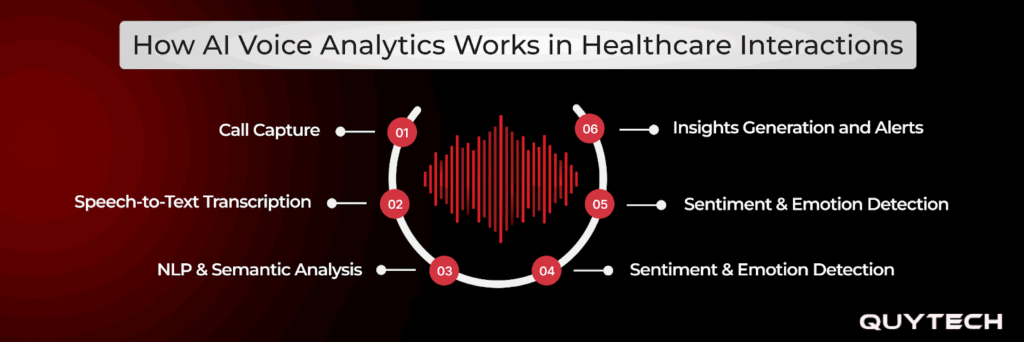
For a better understanding of AI voice analytics in healthcare interactions, let’s take a look at its working:
- Call Capture: The technology captures every patient interaction across different voice channels. It could be in real-time or after the interaction finishes.
- Speech-to-Text Transcription: AI converts speech into well-structured transcripts with every speaker’s (patient, support agent, and clinician) voice recognized and mentioned separately.
- NLP & Semantic Analysis: In this step, the AI voice analytics system analyzes the text to understand context, medical terms, intent, and more in the conversation.
- Sentiment & Emotion Detection: The technology then looks for the tone, pitch, pace, pauses, and other signals to detect emotions, such as anxiety, confusion, and others.
- Compliance and Risk Flagging: Healthcare voice analytics ensures automated monitoring that checks every call for compliance and regulation adherence.
- Insights Generation and Alerts: Healthcare management systems with voice analytics auto-generate insights as well as alerts to supervisors. It leans automatically with every interaction.
Take a look at: AI in Remote Patient Monitoring: Improving Healthcare Accessibility and Convenience
How AI Voice Analytics Directly Improves Patient Experience- 7 Unique Ways
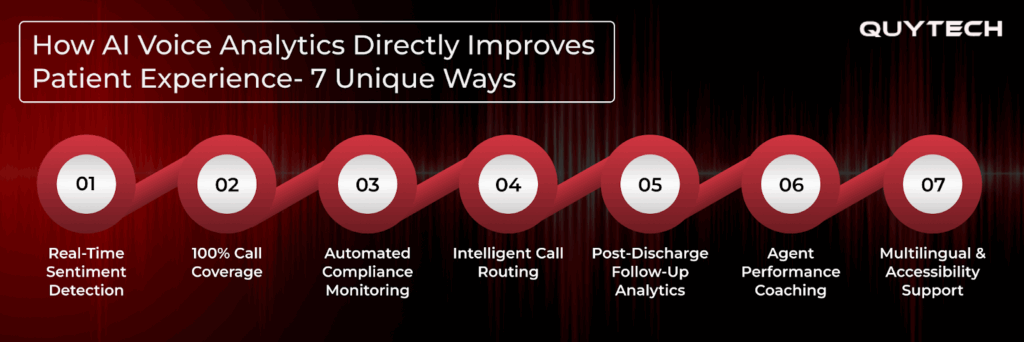
An AI voice analytics system for healthcare improves patient experience by understanding the intent of queries, rather than just being a chatbot that can answer their questions. Here are seven unique ways the technology directly enhances patient experiences by smartly monitoring healthcare interactions:
1. Real-Time Sentiment Detection
With AI voice intelligence, healthcare providers can ensure continuous and precise monitoring of the tone, pace, and language of patients during calls. As soon as the voice intelligence-powered system detects any change in the patient’s sentiment, it raises an immediate alert so that supervisors can intervene before the interaction deteriorates.
For instance, A patient calling after surgery to discuss how to manage pain suddenly begins speaking in clipped sentences with an elevated tone of voice. The voice analytics system immediately considers it as an emotional stress and requires the intervention of a senior healthcare professional during the call.
Insightful: Personalized Treatment Plans: Enhancing Patient Care with AI-driven Consultation
2. 100% Call Coverage
Healthcare institutions, including clinics, hospitals, and post-surgery care service providers, receive hundreds of calls every day. While answering all calls is possible by adding headcounts, it is not necessary for the professionals to analyze every call with the utmost accuracy. AI voice analytics overcome this challenge; the systems powered by this technology automatically process every single call to identify risks, patterns, and other factors that shouldn’t be missed.
For example, a support center of a hospital that receives over 10,000 calls monthly has resources to review only 500 of them. However, when they implemented AI voice analytics, they were able to review each call to get an accurate analysis.
You may like to read: How IoT is Transforming Patient Care: The Future of Smart Hospitals
3. Automated Compliance Monitoring
Ensuring compliance adherence is mandatory not only in healthcare operations management but also in patient calls. Audio intelligence, powered by AI, ensures each regulatory requirement, including consent disclosures, data privacy protocols, and script adherence, is fulfilled. With automated and real-time monitoring, the technology also helps in generating audit-ready documentation.
4. Intelligent Call Routing
Conversational analytics is capable of understanding the intent of patient interactions. It can even analyze the emotional state and previous interaction data, right when the call begins. Based on the analysis, the technology automatically routes calls to the most appropriate support agent or department. This prevents patients from waiting in long queues only to get connected to the right support professional.
For example, a patient calls a multi-speciality hospital and mentions following up on his blood test reports. AI voice analytics automatically detects the keyword and tone, and routes the call to the pathology department. This improves patient experience while reducing the call handling time significantly.
Take a look at: How Mobile Health Apps Improve Patient Engagement
5. Post-Discharge Follow-Up Analytics
Almost every patient is given post-discharge instructions for speedy recovery and care. Sometimes, these are communicated via discharge calls. Now, any misunderstood instructions or missed medication may result in readmissions. AI voice analytics analyzes every follow-up call made by care providers to identify if there is any gap or if the patient has any confusion in understanding what’s being instructed.
Explore More: AI in Healthcare Data Analytics: Cutting Readmission Rates
6. Agent Performance Coaching
With AI-powered voice analytics, healthcare supervisors can provide data-driven coaching to train support agents. The technology can identify where exactly the human agents need training, use ineffective language, or fail to understand patients’ concerns.
For example, AI Voice Analytics for healthcare can analyze new agents’ calls to identify the agents that repeatedly use technical medical terms or jargon when delivering care instructions or explaining billing issues. This can lead to patient dissatisfaction as they might not fully understand.
Also Explore: How IoMT is Revolutionizing Patient Care and Hospital Efficiency
7. Multilingual & Accessibility Support
An AI voice analytics system for healthcare can understand multiple languages, including non-English conversations, without impacting the quality of monitoring. It can analyze multiple languages to ensure compliance and responsive care.
For example, a community healthcare facility providing healthcare services to the Spanish-speaking population can deploy a voice analytics system to ensure real-time monitoring of calls.
Key Use Cases of AI Voice Analytics Across Healthcare Institutions
Now that you know enough about AI-powered voice analytics, let’s take a closer look at its use cases across different healthcare settings:
1. Hospital Contact Centres & Scheduling Desks
Hospital contact centers are facilities that directly interact with patients. They have to deal with high call volumes, long hold times, and sometimes repetitive scheduling queries. This can impact staff bandwidth and also lead to frustration in patients if they don’t get entertained or answers to their queries immediately.
With AI voice analytics, support centers can focus on appointment management and contextual call transfers. This not only improves patient experience but also gives the healthcare organization an intelligent layer capable of handling routine queries.
Explore Similar Read: How AI Is Transforming the Healthcare Industry: Discover the Top Ways
2. Telehealth and Virtual Consultation Platforms
Voice analytics technology has the capability to transcribe conversations in real time. This makes it easier to note down what exactly patients expect. The technology ensures documentation accuracy while listing thorough comprehension of patient interaction.
Telehealth and virtual consultation platforms, when equipped with AI-enabled voice analytics, can extract the meaning as well as context from ordinary conversations. The technology can even analyze if the patient understood their care instructions or has some confusion about them.
Dig Deeper: The Future of Telehealth- How Will It Reshape the Healthcare Industry?
3. Chronic Disease Management & Remote Patient Monitoring
Patients dealing with chronic diseases sometimes require clear and consistent communication with care providers. Most patients choose to do this communication via calls. With a voice analytics-powered system for healthcare, care providers can easily analyze such calls to catch early warning signs of distress or patterns before escalation.
4. Mental Health Services & Crisis Intervention Support
Voice analytics AI for healthcare also helps mental health services providers to manage patient intake processes. Such systems can monitor the emotional element in patient calls made to mental health helplines and crisis support centers. It makes the systems capable of analyzing calls to detect distress and flag high-risk conversations in real-time.
5. Revenue Cycle & Billing Interaction Optimization
Not just patient interactions, billing calls also need to be analyzed, especially when they are compliance-sensitive interactions. For example, a patient who is confused about an unexpected bill and doesn’t even receive a thorough explanation may move to some other healthcare service provider. AI voice analytics solutions empower healthcare providers to manage revenue cycles and billing interactions.
Also Read: How Predictive Analytics is Transforming the Healthcare Industry
Implementing AI Voice Analytics to Improve Patient Experience- A Successful Roadmap
The successful implementation of healthcare AI voice analytics requires following a stepwise process after ensuring a pre-deployment readiness assessment. So, let’s first understand that, and then we will cover the step-by-step process:
Pre-Deployment: Readiness Assessment
- Do you have a centralized data repository where all the voice data is stored and can be processed?
- Are your existing telehealth systems cloud-based, on-premises, or hybrid?
- Does the data storage and transmission layer at your company comply with HIPAA?
- Have you defined a data retention and deletion policy for recorded patient calls?
- Do your support agents, as well as patients, know that all patient interactions are being monitored and analyzed?
- Does your EHR, CRM, or telephony platform support native or third-party AI integrations?
Once you define all these points, here are the steps to follow to implement AI voice analytics in healthcare:
Step 1: Define the Scope and Use Case
Firstly, define the use case of AI voice analytics. You can implement the technology in contact or support centers, quality assurance departments, telehealth documentation, and discharge follow-ups.
Another key area where voice analytics can do wonders is ensuring billing compliance. Choose the right AI development company that can custom-build and train an AI model on your healthcare-specific language and also comply with HIPAA guidelines.
Step 2: Pilot on a Contained Channel
Deploy the use case on one call queue or within a single department, instead of deploying it across multiple departments. Identify if there are any integration gaps, agent resistance, data quality issues, or any other challenges.
Step 3: Integrate with Core Systems
Once the pilot gets successfully deployed, connect the voice analytics layer to your core healthcare systems, including EHR, CRM, and telephony stack. Thoroughly define automated data flows to ensure no call, sentiment, or compliance is missed.
Step 4: Define Baseline Metrics
Since you have planned to add AI voice analytics in multiple processes and departments, don’t forget to establish baseline metrics. The metrics could be call handling time improvement, CSAT scores, first-call resolution rate, QA pass rate, or no-show rate.
With this, you will be able to easily evaluate the ROI of AI voice analytics implementation in healthcare interactions.
Step 5: Train and Coach
Use the first 2 to 3 months of live data to run targeted coaching sessions with agents. These sessions must be grounded in real call evidence rather than just providing generalized feedback about the implementation.
Based on the result, retrain the AI model considering your healthcare setting’s specific needs, terminologies, and patient demographics. Once everything is on track, you can expand the conversational intelligence into other departments, voice channels, and languages.
Interesting Read: How to Monetize a Healthcare Mobile App? Latest Strategies
Measuring ROI: Metrics That Matter to Healthcare Leaders
Whether you are implementing AI voice analytics in one dedicated voice channel or across all healthcare interactions, it is crucial to clearly define metrics to measure ROI. Here are the metrics you can establish:
1. Patient Experience KPIs
Patient experience means how patients feel after they interact with your organization. The metrics you can establish are:
| CSAT (Customer Satisfaction Score) | Measures post-interaction patient satisfaction |
| NPS (Net Promoter Score) | Tells the likelihood of recommending a healthcare facility to others |
| FCR (First Call Resolution Rate) | The percentage of issues resolved in the first call only |
| Average Handle Time (AHT) | Duration of patient interactions |
2. Operational Efficiency Metrics
By considering this as a key metric, you can focus on translating better patient conversations into measurable cost and resource impact. You can establish:
| Call Deflection Rate | Measures the percentage of calls resolved via AI or self-service |
| Agent Utilisation Rate | Compares productive agent time with idle or wrap time |
| QA Coverage Rate | Measures the percentage of calls formally reviewed for quality |
| Supervisor Escalation Rate | This includes calls requiring escalation to senior staff |
Also Read: The Importance of Data Privacy and Security in Healthcare Apps
3. Clinical Impact Indicators
Considering clinical impact indicators as measuring metrics means establishing one or all of these:
| 30-Day Readmission Rate | Measures the patients readmitted within 30 days of discharge |
| Medication Adherence Rate | It measures the percentage of patients following prescribed regimens |
| Appointment No-Show Rate | It means the percentage of scheduled appointments missed |
| Care Plan Comprehension Rate | The metric focuses on the patient’s understanding of their own care instructions |
4. Compliance and Risk Metrics
Healthcare organizations, such as hospitals, clinics, care centers, and support centers, cannot afford to ignore compliance, such as HIPAA, CMS, GDPR, and others. Establishing this metric as an outcome of your healthcare AI voice analytics implementation is an excellent decision.
| HIPAA Violation Rate | It measures the frequency of non-compliant disclosures or data handling |
| Consent Script Adherence Rate | Measures the percentage of calls where mandatory disclosures were completed |
| Audit Readiness Score | It is about the speed and completeness of compliance documentation |
| Complaint & Grievance Rate | It compares the formal patient complaints filed before and after voice analytics implementation |
You may like to read: Latest Healthcare Tech Trends in 2026
How Quytech Can Help
Implementing AI voice analytics is no easy feat. You need to check your organization and infrastructure’s readiness, then define the right use case, establish the right metrics, and also know the path to scale. And for the successful implementation, it is important to partner with an experienced AI development company with hands-on experience in AI voice analytics and that has previously built enterprise-grade AI solutions for healthcare.
Here is when Quytech enters the scene. We have dedicated AI engineers who have deep industry knowledge and understand clinical workflows, compliance boundaries, and the human sensitivity of patient communication.
Our experts have in-depth knowledge of artificial intelligence, machine learning, LLMs, AI agents, voice analytics technology, and regulatory compliance. From building end-to-end AI healthcare solutions, healthcare video analytics systems, and apps to integrating AI, voice analytics, and other technologies into your current infrastructure, our team can do everything.
We have built and delivered AI patent research software, meditation apps, swim workout apps, and other healthcare apps and solutions with top-notch features and functionality.
Final Thoughts
AI voice analytics is gradually becoming an integral part of almost every healthcare organization looking to improve patient experience by analyzing interactions across different channels. The technology ensures that no call is missed, the intent of every interaction is clear for better response, and an exceptional experience.
An AI voice analytics system for healthcare derives actionable intelligence from every call. It can understand the tone, intent, and emotions of patients and even send immediate alerts to enable senior medical professionals to intervene. Just make sure you choose the right technology partner to implement the technology.
FAQs
Healthcare AI voice analytics analyzes patient conversations in real time to detect sentiment, intent, and key concerns. This enables faster and more empathetic responses. This leads to better communication and higher patient satisfaction.
Yes, an AI voice analytics system for healthcare can be integrated with EHRs, telehealth platforms, and call center systems using APIs. This ensures seamless data flow without disrupting existing workflows.
The cost of implementing AI voice analytics varies based on features, scale, and integration complexity, typically ranging from pilot-level investments to enterprise deployments.
A basic implementation in limited voice channels can take a few weeks. On the other hand, full-scale deployment with integrations may take a few months. Timelines also depend on customization and data readiness.
Yes, when built correctly, it follows strict data security and compliance standards like HIPAA. Encryption and access controls ensure patient data remains protected.
