Summary:
An intelligent AI model is a system developed to automate tasks autonomously. These models are not rule-based; they can learn, understand, respond, and resolve. This is a comprehensive guide to intelligent AI model development. Along with the step-by-step development process, it also explains the intelligent AI model and its working, AI model development examples, why to build an AI model, the AI model lifecycle, and other crucial aspects associated with the same.
Have you ever wondered how Siri, Alexa, or Google Assistant understands our commands and provides an immediate response or performs the given task? How can a driverless vehicle automatically perceive its surroundings to navigate or commute from one place to another? How can Netflix or Spotify already know our choices and suggest similar content?
AI models or artificial intelligence models are the ones that take credit for all these innovations happening across industries. Intelligent AI models can be considered sophisticated programs with exceptional cognitive capabilities to mimic human intelligence and perform complex tasks.
Writing a one-liner description for AI models would not be able to justify their immense potential and advantages. Therefore, we have provided this AI model guide that talks about how to build AI models with a stepwise development process, examples, five layers, and more.
Let’s get started!
The AI Market by the Numbers: Key Stats and Trends
- According to Market and Markets, the global AI market is anticipated to unlock a value of about $601.93 billion by the end of 2026.
- Forbes reported that the AI market is expected to reach a value of around $1,811.8 billion by 2030.
- For the year 2025, the market stood at a value of $390.9 billion, as stated by Grand View Research.
- The report also highlighted North America as the region with the highest share captured, quoted to be 35.5%.
- Component-wise, services took a share of around 36.3% in 2025.
What is an Intelligent AI Model?
It is a system that can perform simple to complex tasks with human-like cognitive capabilities, such as learning, understanding, responding, and resolving. Custom AI development produces intelligent models built for a specific task, which are trained on specific datasets to make them identify and analyze patterns for making decisions or providing responses without human intervention.
Once trained, artificial intelligence models keep learning from the latest data to make sure it is updated and provide accurate information. To be able to serve expected performance, AI models rely on technologies like machine learning models, natural language processing (NLP), large language models (LLMs), Neural networks, and more.
Here are the two most common types of intelligent AI models:
What are the different types of AI models?
Below are the types of AI models:
Statistical AI Models:
These models bring data assessment and prediction capabilities. Some examples include:
- Linear Regression
- Logistics Regression
- Decision Trees
- Naive Bayes
Deep Learning Models:
The human brain is the main inspiration for deep learning models. Implementing these models brings capabilities like processing enormous amounts of data to identify patterns. Some examples include:
- Artificial Neural Networks (ANNs)
- Recurrent Neural Networks (RNNs)
- Generative Adversarial Networks (GANs)
- Convolutional Neural Networks (CNNs)
Besides, Artificial Narrow Intelligence (ANI), Artificial General Intelligence (AGI), and Artificial Superintelligence (ASI) are also some fundamental types of AI models.
Traditional Software vs Intelligent AI Models
While many people find traditional software to be the same concept as intelligent AI models, the difference between them is quite vivid when broken down in detail. Understanding this distinction is useful before developing AI models of your own. Here’s a table explaining the difference between traditional software and an intelligent AI model:
| Feature | Traditional Software | Intelligent AI Models |
| Working Mechanism | Operates on predefined rules and instructions written by developers. | Learns from data patterns and improves decision-making through training. |
| Adaptability | Requires manual updates whenever business requirements or conditions change. | Continuously learns from new data and adapts to changing environments. |
| Decision-Making | Follows fixed logic and produces predictable outputs. | Analyzes data, identifies patterns, and makes data-driven decisions. |
| Data Dependency | Uses data primarily as input to execute programmed tasks. | Relies heavily on large datasets for training, learning, and optimization. |
| Handling Complexity | Effective for structured and repetitive tasks with clear rules. | Capable of managing complex, dynamic, and unstructured problems. |
| Accuracy Improvement | Performance remains largely unchanged unless developers modify the code. | Improves accuracy and performance through retraining and continuous learning. |
| Automation Level | Automates predefined workflows and processes. | Enables intelligent automation with minimal human intervention. |
| Predictive Capabilities | Limited ability to forecast outcomes or trends. | Can predict future outcomes, behaviors, and trends based on historical data. |
| Real-Time Learning | Cannot learn from interactions or experiences on its own. | Can learn from new data and refine responses over time. |
| Common Examples | Payroll software, inventory management systems, and accounting applications. | Virtual assistants, recommendation engines, fraud detection systems, and autonomous vehicles. |
Intelligent AI Model Development: Exploring its Layered Architecture
The layered architecture, or the set of AI architecture layers, of an intelligent AI model helps understand its functionality at each level. Here are the layers it has:
Infrastructure Layer
This layer adds up the computational capabilities into an AI model to make it ready for processing and evaluating data. The layer comprises servers, graphics processing units, and other exceptional tools.
Data Layer
The data layer includes the collected and preprocessed data that is further refined to be categorized into different datasets. This AI data pipeline architecture feeds clean, categorized datasets that are further used to perform different tasks or functions.
Service Layer
Servicing and launching AI models to various apps or end users is what happens in this layer. It includes creating APIs to facilitate communication among various applications or systems and AI models.
Model Layer
This layer is where the actual AI model development happens. It involves selecting relevant algorithms, designing neural networks, refining hyperparameters, and training AI models with processed data. The two most common models that are used during this layer are TensorFlow and PyTorch.
Application Layer
This layer involves integrating the developed and well-trained artificial intelligence models into applications for forecasting demands, recommending personalized products/content, helping with decision-making, and other purposes.
A Step-by-Step Guide to AI Model Development
How do you build an AI model from scratch? If that’s what you’re thinking, then the steps below will guide you on how to create an AI model that can be used for various purposes in your organization:
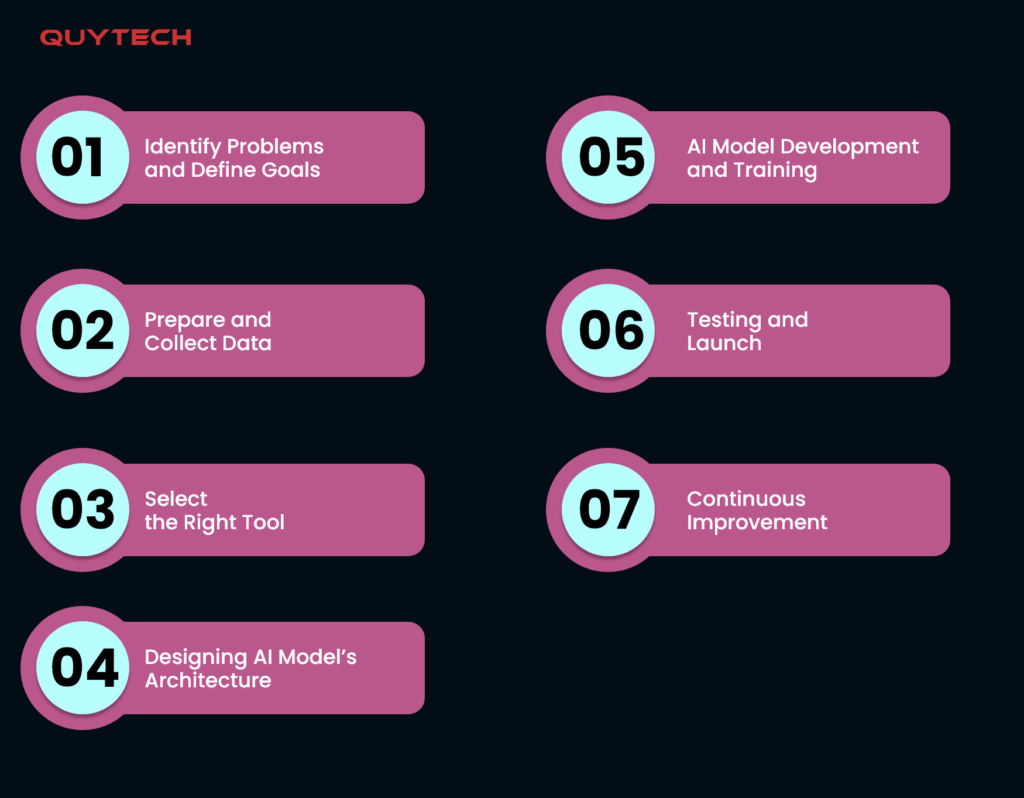
Step 1: Identify Problems and Define Goals
The first step in the AI model creation process is to outline the issues you want to address with the AI model. Once you have clearly outlined the problems and defined your goals, you create a strong foundation for seamless development.
Step 2: Prepare and Collect Data
AI models solely work on data; therefore, it is crucial to collect relevant datasets and refine them to remove inconsistencies that may impact the results or understanding capabilities of the AI models.
Step 3: Select the Right Tool
AI models not only leverage artificial intelligence but also its subsets like deep learning, LLMs, ML, and more. Each tool or framework has its own advantages and strengths. Pay attention to each tool’s capabilities and pick the one that is perfect for the specific use case you want to build AI models for.
Step 4: Designing AI Model’s Architecture
While all the steps of the intelligent AI model development process are crucial, designing the architecture requires a little extra attention. This is where AI workflow design matters; It requires including the components that make a neural network. Try your hand at building the best configuration to make your smart AI model deliver expected outcomes.
Step 5: AI Model Development and Training
We have emphasized the importance of datasets before, and we are saying it again. Split data into three categories: Training data, Validation Data, and Testing Data. To prepare different datasets for developing and training the AI model, optimize the hyperparameters, and verify the efficacy or functioning of the AI models when implemented on data that has not been tested. This stage shows how AI models are built in practice.
- Testing or evaluating the smart AI model focuses on its accuracy, F1 score, and other critical parameters responsible for its effectiveness.
- Training AI models uses computational resources and different AI frameworks.
- Hyperparameter tuning improves AI models’ performance by optimizing factors, including batch size and learning rate.
Step 6: Testing and Launch
Once the model is optimized and validated for its performance and efficacy, the next step in the AI model development lifecycle is to deploy it in the scenarios or applications where it deals with the real world.
Step 7: Continuous Improvement
While intelligent models can self-learn, it is critical to continuously monitor them for performance and precision as the datasets evolve. Support and maintenance are also required to take the required actions based on users’ feedback and keep glitches at bay.

6 Tips to Build AI Models Successfully
When creating an AI model, you may encounter numerous challenges, such as limited data, incomplete data, poor scalability, lack of data security, integration problems, regulatory compliance, and more. However, by following these effective tips, you can prevent or overcome these challenges while ensuring an effortless AI model development.
➡️ Grasp strong domain knowledge to choose the most suitable features and make data-backed decisions during the AI model development process.
➡️ Initially, choose the simple and easy-to-understand and debug AI models. Add on complexity eventually.
➡️ Don’t compromise on data quality, as it is primarily responsible for the accuracy, speed, and consistency of responses by AI models.
➡️ Focus on feature engineering to integrate world-class features or alter the existing ones to enhance your AI model’s performance.
➡️ Ensure zero data bias by continuously analyzing the datasets using the right algorithms.
➡️ Follow a stepwise process while documenting every step to ensure seamless reproducibility.
If you don’t want to develop your own AI model, connect with a reputed and experienced AI development company or hire AI developers from a reliable organization to build AI models for you. While selecting a technology partner, don’t forget to check their AI expertise and the type of AI projects or models they have developed and integrated across industries.
Besides, review their data security practices and adherence to the industry standards and regulations. If you have any doubts, schedule a demo call or opt in for their AI consulting services to get an idea of how the company will build an AI model that aligns with your unique needs.
AI Model Development Examples in the Real World
AI models have become ubiquitous these days; we use them in so many applications and multiple ways. Here are some common AI model examples that you can consider for development:
1. Virtual Assistants
Voice-activated virtual assistants like Siri, Alexa, and Google Assistant are perfect and the most common examples of AI models that anyone can understand easily. These assistants leverage NLP to understand human commands to set alarms, respond to our queries, control devices in smart homes, and perform other tasks.
2. Recommendation Systems
Today, recommendation systems or engines are available in almost every application to personalize our experiences. Netflix, Spotify, Amazon, Facebook, Instagram, and many other applications use AI models to understand users’ choices, preferences, and behavior and show them tailored recommendations.
3. Search Engines
Search engines, such as Google and Bing, also use AI models to understand human queries and offer them relevant information. AI models also contribute to analyzing websites’ relevancy and ranking them in these search engines.
4. Facial Recognition
Dedicated AI models are used to offer facial recognition in smartphones and other devices to enable users to unlock the device or verify payments merely by showing their faces. The technology is even used for surveillance and access control in corporate and other organizations.
5. Spam Filters
Various email and messaging applications like Gmail and WhatsApp also rely on different AI models to identify and filter spam messages to protect users from potentially harmful messages and prevent cyber crimes.
6. Autonomous Vehicles
Self-driving cars also utilize AI models to understand their surroundings, make decisions, and commute from one location to another. Many companies, including Tesla, are offering driverless cars.
7. AI-Powered Chatbots
AI-powered chatbots, often built on generative AI models, are one of the most popular examples of AI models that are in our lives. These chatbots offer customer support in various businesses and industries.

Trending AI Model Development Tools and Frameworks
The selection of the right AI model development tools and frameworks is crucial to its success. Here are the tools that most experienced and skilled AI model developers and top AI development companies use for custom AI model development for different industries:
- TensorFlow: This open-source platform for machine learning is used for building and training various AI models.
- PyTorch: An open-source deep learning framework with high flexibility and a dynamic computational graph.
- NVIDIA (NVCaffe): This framework is recognized for its high-performance GPU computing capabilities.
- Keras: It’s a high-level API that uses TensorFlow or Theano as a base to contribute to developing and training deep learning models
- Theano: Used popularly as a backend for AI model creation, Theano helps in defining, evaluating, and optimizing mathematical expressions.
- SciKit-learn: A Python library for machine learning with built-in algorithms for classification/categorization, regression, and clustering.
- Apache Spark MLlib: It is an ML library that is developed on top of the Apache Spark distributed computing framework.
- Anaconda: Its huge collection of data science and machine learning packages enables developers to set up AI model development environments effortlessly.
- Git: A version control system that helps developers track new changes to the code and work seamlessly with other engineers.
Industry-Wise Use Cases of AI Models
As aforementioned, AI models have entered almost every aspect of our lives through applications and solutions that we use on a daily basis. Here is how industries can benefit from AI models and should invest in custom AI model development:
- Healthcare: To analyze medical imaging, expedite the process of drug discovery, and offer personalized treatment plans.
- Finance: AI models can detect fraud and facilitate algorithm-based trading and credit risk assessment, often using reinforcement learning for adaptive strategies.
- Manufacturing: To predict equipment maintenance and ensure complete quality control through AI product development tailored to the factory floor.
- Transportation: Self-driving cars and seamless traffic management are two popular use cases of AI models in transportation.
- E-commerce: AI models in E-commerce offer personalized product recommendations and forecasting demands.
- Education: These artificial intelligence models in education rely on AI application development to personalize learning experiences and build smart tutoring systems. We put this into practice in our own AI-powered literacy app case study.
Apart from these, AI models have immense potential that different businesses and industries can use to their benefit. To explore the same, it is important to connect with the right AI app development company.

Conclusion
There is no denying that AI models have become an integral part of our lives, from offering personalized recommendations to self-driving cars; they are there in almost all areas. And with the growing use of AI models, the demand for developing AI models is also increasing. To help you build an intelligent AI model, we have provided this comprehensive AI model development guide.
Along with providing step-by-step procedures for AI model development, the guide also includes real-world examples, industry-specific use cases, layered architecture, and more about these models. In case you don’t want to create AI models by yourself, connect with an experienced AI development company.
Key Takeaways:
- An intelligent AI model is a system capable of understanding, learning, and responding like a human. These AI models are built to introduce automation in tasks.
- Intelligent AI models can be divided into two types: statistical models and deep learning AI models.
- The statistical models mainly serve the purpose of analyzing data and making predictions, while deep learning ones are used for pattern recognition and decision-making.
- The intelligent model has multiple layers. These include the infrastructure layer, data layer, service layer, model layer, and application layer.
- The process of developing your own intelligent model begins with identifying the problem statement, preparing and collecting data, selecting the right tool, and designing the AI model’s architecture.
- This is then followed by actual development and training of the AI model, conducting tests, launch, and post-deployment monitoring for smooth performance and continuous improvement.
Frequently Asked Questions About AI Model Development
The duration of training depends on the approach and the dataset size, model complexity, and computing resources. Here are some approaches to training an AI model:
– Small statistical models, minutes to hours
– Fine-tuning a foundation model, hours to days
– Training from scratch, weeks to months
Below are some common challenges you may encounter when building an intelligent AI model:
– Poor data quality
– Overfitting or underfitting
– Ethical considerations
– Data inconsistencies
– Lack of scalability
– Poor data security
– Difficulties with integration
Selecting the most suitable algorithms or AI model development tools for an intelligent AI model depends on the type of data, problem type, required accuracy and interpretability, computational resources, and outcome to achieve.
Consider the following points in mind while choosing the best intelligent AI model development service provider:
– Make sure the company has strong domain knowledge and hands-on experience in building AI models for various use cases.
– Check the company’s portfolio to understand the type of work they have done.
– Review their client feedback to get an idea of their technical expertise, project methodologies, work ethics, and delivery deadlines.
– Verify their data security techniques.
– Make sure the company signs an NDA to ensure the privacy and confidentiality of your information.
– Ensure the company prioritizes ethical AI development.
– Check how they communicate with their clients.
The process of creating and refining machine learning models to work on large datasets and perform specific tasks is known as AI model development.
You must be curious about what the future holds for AI model development in 2026 and beyond. In the upcoming times, we might see the development of Explainable AI models that can explain how they have made a particular decision to display the required information or perform a particular task.
We might also witness AI models being trained on centralized data to ensure privacy. AI models might also show them immense potential in addressing real-world social problems.
The cost of developing an AI model depends on the scope of your AI model. Fine-tuning an existing model can cost less than developing a custom AI model from scratch.