Imagine using an app for the first time. You sign up, you see some options trying to note your preferences, and then you get the same content that every user with similar preferences gets. This is what we call personalization, but on the surface level. It does provide an experience based on your preferences, but does not adapt to them as they change.
Over the years, organizations have implemented different strategies to provide a personalized experience to mobile app users. These included manual practices, which were usually rule-based. They provided minimal personalization, yet failed to address edge cases. The limitations of these strategies gave rise to the need for an intelligent approach to provide hyper-personalization in mobile apps that adapts to dynamic user behavior.
This is where agentic AI comes into the picture. Instead of defining user experience with an ‘if then’ logic, it understands what users like and expect from the mobile app and adapts accordingly, providing a hyper-personalized experience. You can say that it follows an intuitive approach. Agentic AI understands and acts on user preferences by analyzing behavioural and contextual data.
This blog goes into detail, covering everything from what hyper-personalization is in mobile apps to how agentic AI powers it.
What is Hyper-Personalization in Mobile Apps?
Hyper-personalization in mobile apps refers to the ability of the application to tailor experiences for individual users. Unlike traditional personalization, hyper-personalization does not deliver experiences based on static data collected during onboarding. Instead, it goes way beyond this.
Hyper-personalization gathers and analyzes user data in real-time. Through this, it understands things like users’ usage patterns, preferences, behavior when interacting with the app, context, and so on. All this information helps mobile apps in tailoring the experience to match the evolving user needs.
In the current landscape, hyper-personalization in mobile apps is no longer an early move; it’s about keeping up with the evolving expectations users have with digital applications. It reduces user bounce rates by up to 45%, clearly reflecting that hyper-personalization improves user engagement and retention.

Traditional Personalization vs Hyper-Personalization: What’s Changed and Why It Matters
Before going deeper into the role of agentic AI in providing hyper-personalization in mobile apps, let’s first understand how it is different from traditional personalization. Here’s a table giving a glance, followed by a detailed breakdown of the differences between traditional personalization and hyper-personalization:
| Aspect | Traditional Personalization | Agentic AI-Powered Hyper-Personalization |
| Approach | Traditional personalization in mobile apps follows a rule-based approach. Decisions are made on predefined logic. | Hyper-personalization follows an individual-level dynamic approach. Decisions are made autonomously. |
| Data Utilization | Historical and limited data sets are utilized. | Real-time behavior and contextual data are utilized. |
| User Profiles | The user profiles are static. Usually made during onboarding and updated periodically. | The user profiles evolve continuously. They are updated in real-time based on individual user needs. |
| Context Awareness | Minimal context awareness, as only limited areas like time or location are analyzed. | High context awareness includes areas like user behavior, environment, intent, etc., which are analyzed. |
| Experience Delivery | The experience delivered has minimal personalization and is almost the same for every user. | The experience delivered is highly personalized and is different for each user. |
As the table reflects, the difference between traditional and hyper-personalization is not limited to only the experience they deliver. The workflows that they follow are also distinct. Here’s a detailed description of the factors briefed above:
Traditional personalization:
- In traditional personalization, a rule-based approach is followed where teams create a pre-defined workflow that takes all the decisions, be it the content or the recommendations users will get. It falls short when it comes to delivering a handpicked experience as the workflows have bounds.
- Apart from this, the traditional data approach is also limited as it’s mainly historical. The user profiles are static. They change periodically, and those changes are also very minimal, usually involving their past interactions with the application.
- Traditional personalization brings in minimal context awareness, which goes to about the time or location at maximum. The experience it delivers is above the one-size-fits-all ones, but it is not highly personalized.
Agentic AI-Powered Hyper-Personalization:
- Agentic AI-powered hyper-personalization follows an individual-level approach. Meaning that the decisions are dynamic depending on the preferences of the users. This approach helps applications in enhancing individual user experience, naturally resulting in better retention.
- Hyper-personalization uses all sorts of datasets, whether historical or real-time. It analyzes data as it’s generated to make individual experience decisions. And since it supports real-time data analysis, it also enables the continuous evolution of user profiles. Hyper-personalization in mobile applications does not wait for periodic updates. Instead, it updates user profiles in real-time, after every interaction they have.
- The context awareness in agentic-AI-powered hyper-personalization is also very high. This is because it tailors experiences after analyzing every minor to major context related to users. The experience hence delivered is highly personalized and distinct from user to user.
Handpicked For You: How to Develop a Mobile App in 2026: 11 Pitfalls You Should Avoid
How Agentic AI Powers Hyper-Personalization in Mobile Apps
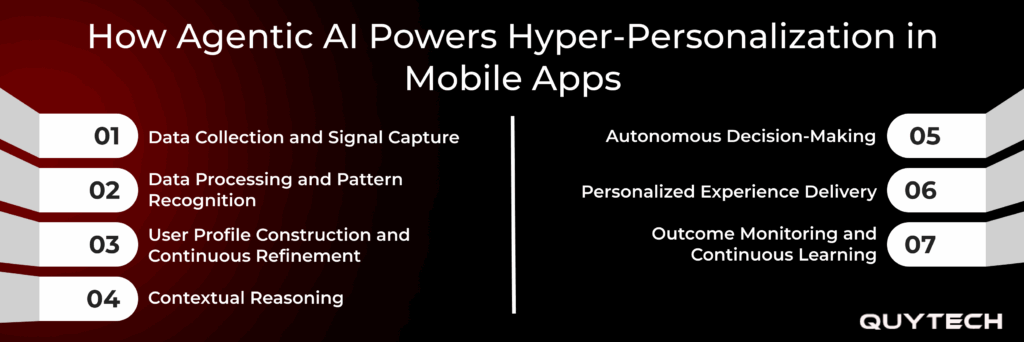
The following are the steps explaining how agentic AI-powered hyper-personalization works in mobile apps:
1. Data Collection and Signal Capture
The core element that brings the hyper-personalization factor in mobile apps is data. So the primary step is data collection. Here, every action a user takes is captured, be it navigation behavior, tap patterns, session timings, bounce rates, etc.
2. Data Processing and Pattern Recognition
Once the data and signals are captured, the collected information is processed. Agentic AI begins by structuring and classifying data and its patterns to understand what areas attract users the most, what can be improved, and what areas should be removed or introduced.
3. User Profile Construction and Continuous Refinement
After processing and pattern recognition, the next step is to construct user profiles. Here, the processed data is utilized to construct dynamic profiles for users that change as their preferences and app usage habits change.
4. Contextual Reasoning
Once user profiles are made, Agentic brings hyper-personalization in action by understanding the present state of the user. It evaluates areas like the time of the day, historical data, what the user is looking for, and so on.
5. Autonomous Decision-Making
After understanding the context and the profile of a user, agentic AI for hyper-personalization in mobile apps starts making autonomous decisions. It decides the type of content the user should be offered, choosing suitable recommendations, notifications, etc.
6. Personalized Experience Delivery
Once the above-mentioned decisions are made, they are executed by agentic AI. This execution brings the hyper-personalization in action. Here, tailored content, recommendations, notifications, and overall experience are delivered to the users based on their distinct profiles.
7. Outcome Monitoring and Continuous Learning
The behavior of a user is not static. Instead, it changes continuously. And to match this behavior, hyper-personalization is also delivered continuously, as the user interacts with the application. This is done by monitoring the outcome by understanding how the user responds to the experience provided to them and learning from the same. This helps agentic AI-powered mobile applications enhance their personalization accuracy.
You Might Also Like: Agentic AI in Product Engineering: Guide for Business Leaders

Benefits of Integrating Agentic AI for Hyper-Personalization in Mobile Apps
Integrating agentic AI for hyper-personalization in mobile apps brings in numerous benefits. Since it understands what users actually want, it delivers exactly that and improves their engagement. It also increases conversion rates and helps in effectively retaining users. Here’s a detailed breakdown of these benefits:
Improved User Engagement
Engagement is the metric that shows whether a mobile app is actually appealing to its users or not. Implementing agentic AI for hyper-personalization in mobile apps helps in improving user engagement. It tailors the experience for every user based on their preferences, which means that users get what they want, naturally enhancing engagement.
Higher User Retention
One of the main reasons why users drop mobile apps after a few uses is that they find the overall experience provided to them to be very general. But with agentic AI, hyper-personalization comes into action. It provides users with an experience tailored to their choices, anticipates their preferences accurately, and makes users feel valued.
Increased Conversion Rates
Apart from retaining users, agentic AI for hyper-personalization in mobile apps also increases the conversion rates. It creates a situation where users get exactly what they were looking for at the right time. This is because agentic AI follows a dynamic user profiling approach where it understands and anticipates the needs of a user in real-time and caters to the same before the user seeks it themself.
Operational Efficiency
Agentic AI mobile apps bring in operational efficiency. They eliminate the need for manual effort to provide a personalized experience to users. Agentic AI autonomously manages the complete personalization picture by learning from user behavior patterns, making decisions, and executing them. This approach helps organizations direct their resources to strategic areas rather than spending them on configuring personalization rules.
Sustainable Competitive Advantage
By now, you can tell how much of an influential factor hyper-personalization is. It goes beyond generic features that every user gets to providing an experience that is distinct for everyone. Agentic AI gives organizations a sustainable competitive advantage that is something that cannot be achieved simply by introducing new features or matching prices. You can also say that it develops a sense of loyalty among users towards the app.
People Also Like: Generative AI in Product Engineering: Real-World Applications
Challenges of Implementing Agentic AI in Mobile Apps for Hyper-Personalization
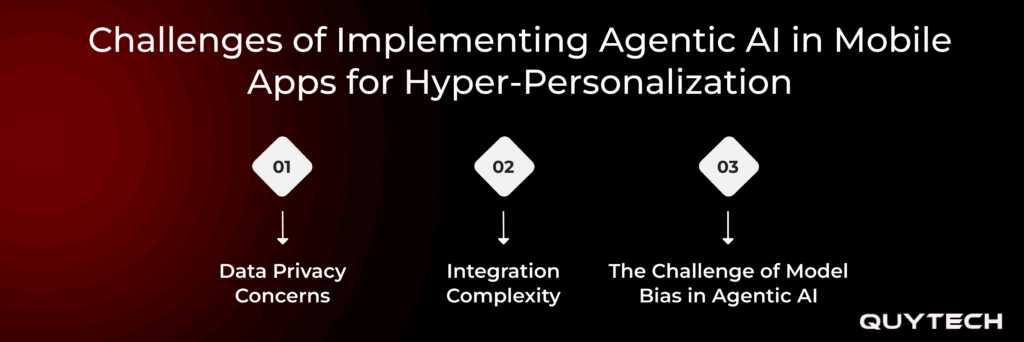
Just like the benefits agentic AI mobile apps bring, they bring their fair share of hurdles as well. But worry no more because we will guide you through them. The following are some common challenges of implementing agentic AI in mobile apps for hyper-personalization, along with the best practices to overcome them:
1. Data Privacy Concerns
A very common challenge organizations face when building hyper-personalized mobile apps is data privacy concerns. The same data that is used to build the personalized experience for users can also create concerns among users about whether their data is safe or not.
Best Practices
Data privacy concerns can be overcome by implementing privacy-first practices. These include encryption, multi-factor authentication, and privacy-enhancing computation. They ensure that no user data gets exposed to external parties, and even if vulnerabilities arise, actual data is not revealed.
2. Integration Complexity
While hyper-personalization in mobile apps with agentic AI does provide organizations with a strong competitive advantage, it brings integration complexities as well. These make it hard to connect existing systems, especially if they are legacy, because they might not support sophisticated technologies.
Best Practices
Integration complexities can be tackled by introducing phase-based integration, where implementation will begin with high-impact areas first. Another option is API-based integrations, which connect AI tools with existing systems and are a good option for legacy systems.
3. The Challenge of Model Bias in Agentic AI
Model bias is yet another challenge that impacts the hyper- personalization factor in mobile apps. Agentic AI tailors experiences based on the user data it is trained on. If the data lacks quality, is inconsistent, or contains bias in any way, the possibilities of the app recommending irrelevant or inferior experiences to users increase.
Best Practices
Model bias challenges can be addressed by using quality datasets. When the data on which the model will be trained is diverse, unbiased, and consistent, the chances of bias are minimized. Apart from this, regular audits and governance frameworks also ensure fairness in the personalization decisions agentic AI takes for the mobile app.
Similar Read: DevSecOps in Product Engineering: Integrating Security Without Slowing Development
How Quytech Enables Hyper-Personalization in Mobile Apps
When it comes to building an agentic AI-powered hyper-personalized mobile app, organizations need a lot more than technical expertise. They need a partner like Quytech, who understands what the end-user actually needs, and how it can be delivered, all while blending agentic AI for intelligence and personalization.
Backed by 16+ years of experience in building hyper-personalized mobile apps for diverse industry verticals, Quytech brings not just the right knowledge, but also the right team. Our developers bring in hands-on experience in agentic AI technologies like AI agent development, LLM integration, and predictive analytics helps in delivering intelligent mobile apps which understand, adapt, and act on user preferences.
And as the saying goes, ‘numbers speak for themselves’, our 1000+ projects delivered reflect the dedication and commitment we put into delivering agentic AI-powered mobile applications. Our successful mobile apps like MySwimPro, AD360, and Kendra G shed light on our ability to actually back our claims of personalized experience delivery.

Final Words
In the current times, hyper-personalization in mobile apps is not a factor that can be ignored, but the factor that saves mobile applications from being ignored. Being powered by agentic AI, hyper-personalization goes way beyond the basic periodic user profile changes. It understands every minor to major change in behavior, preference, and usage patterns of a user, adapts to it, and delivers experience accordingly.
Such experiences make users feel seen and valued, as everything provided to them is exactly what they needed. This results in improved user engagement, enhanced retention, and increased conversion. While the benefits shine immensely, challenges like data privacy concerns, integration complexities, and AI model bias can impact the successful implementation of hyper-personalization in mobile apps with agentic AI.
By adopting practices like encryption for data safety, phase and API-based integration for complexities, and diverse dataset training for model bias, organizations can turn these roadblocks into opportunities and gain a sustainable competitive advantage.
FAQs
Yes. Unlike traditional personalization, agentic AI-powered hyper-personalization is not static. Even if there is not much user data, it personalizes the experience based on the tap patterns, sessions, and usage behavior the user shows.
Yes, agentic AI can do that. As mentioned already, agentic AI creates dynamic user-profiling. Such profiles don’t just collect the latest data but remember the context of every interaction the user has, even if it’s for a short period of time.
Agentic AI-based mobile apps understand the real-time intent of users. They track the patterns like navigation, screens accessed, session times, and clicks. All this is done in real-time as well.
While established ones have a good amount of data for delivering hyper-personalized experiences to users, early-stage ones also have a distinct benefit. Since they are being built from scratch, agentic AI integration for hyper-personalization is easier, as it can be blended with the architecture of the application better.
It is not necessary. Although a larger user base does give the data availability advantage, even with a smaller user base, agentic AI can be effective because it also collects and processes real-time data.
