Summary:
AI in manufacturing gives traditional methods of managing manufacturing activities a long-needed makeover. It solves the challenges of maintaining cost efficiency, reducing machinery downtime, and maintaining quality by automating repetitive processes.
AI is transforming every activity, driving intelligent efficiency across routine tasks and quality assurance to predicting machinery failure and making informed operational decisions. This blog explores how AI for manufacturing works in detail.
Tesla has achieved 95% automated production at Gigafactory Shanghai, with the automation rate of its welding workshop close to 100%.
Leading companies like Tesla, Samsung, BMW, Airbus, and many others have integrated artificial intelligence in their manufacturing units to streamline the process of building products and increasing efficiencies.
Following this blueprint, other companies have also started taking assistance from AI for manufacturing, and this is why the market size of AI inthe manufacturing sector is expected to exceed $8.36 billion in 2026, growing at a CAGR of 44.4%.
AI automates manufacturing, reducing human efforts and errors; however, there is more that AI can offer to manufacturing. In this blog, we have explained AI in manufacturing and how it is proving to be a game-changer.
The State of AI in Manufacturing: Data, Trends, and Market Insights
- A survey done by Deloitte highlights that around 84% of manufacturers have generated measurable value by using AI in manufacturing.
- It also unravels the adoption rate of the manufacturing sector across different segments, where quality stood at 62% and production at 57%.
- According to a report by Research and Markets, AI in manufacturing is anticipated to unlock a value of $34.1 billion by 2030.
- The compound annual growth rate from the base year 2026 to the final year 2030 is estimated to be around 42.1%.
What is AI in Manufacturing and How is it Different from Traditional Manufacturing
AI in manufacturing industry refers to the advanced artificial intelligence technologies for enhancing overall manufacturing operations. It involves automating repetitive processes like assembly, material handling, and quality checks. AI also enables smarter functions such as predicting maintenance, forecasting demand, and making real-time decisions. Here’s a table explaining how manufacturing with AI is different from traditional manufacturing:
| Aspect | Traditional Manufacturing | AI-Powered Manufacturing |
| Production planning | Based on manual forecasts and historical estimates, prone to over- or under-production | AI analyzes demand, resources, and deadlines in real time to optimize schedules |
| Quality control | Manual or sample-based inspection; defects are often caught late | Machine vision inspects every unit and flags defects at the earliest stage |
| Equipment maintenance | Reactive or fixed-schedule servicing, leading to unexpected breakdowns | Predictive maintenance uses sensor data to fix issues before failure occurs |
| Downtime | Higher and harder to anticipate | Significantly reduced through early failure prediction |
| Defect & anomaly detection | Relies on human attention; inconsistencies slip through | Algorithms continuously scan production data for unusual patterns |
| Decision-making | Experience-based and slower to adapt | Data-driven and responsive to real-time market and floor conditions |
| Customization | Costly and time-consuming to adjust for individual needs | Generative AI enables tailored designs without major cost increases |
| Energy use | Often inefficient with limited visibility | Continuously monitored and optimized to cut waste |
| Workforce role | Heavy focus on repetitive manual tasks | Workers shift to higher-value, strategic, and oversight tasks |
| Speed & scalability | Limited by manual processes | Faster output and easier to scale across lines and facilities |
What are the Key AI Components Used in the Manufacturing Industry
Several subsets of artificial intelligence help streamline and enhance productivity in the manufacturing industry. In this section, we have discussed each component’s use case and how it contributes to AI manufacturing.
1. Machine Learning
Machine learning is a subset of AI that allows systems to learn from data and enhance their capabilities and performance over time.
In manufacturing, machine learning is used by the manufacturers to analyze vast data, help improve the efficiency of machines, reduce downtime, and is used during product quality checks.
2. Robotic Process Automation (RPA)
Robotic Process Automation (RPA) is an AI technology that is integrated into software robots, allowing them to mimic human actions and perform repetitive tasks like data entry, processing transactions, and more.
Manufacturers rely heavily on RPA as it plays a key role in improving efficiency, reducing errors, and freeing up the human workforce to focus on other strategic tasks.
3. Big Data Analytics
Big data analytics is a process in which experts analyze large and complex data, also known as big data, to identify new patterns and trends and gain insights that can help in making informed business decisions.
In manufacturing, businesses leverage advanced analytics techniques, such as machine learning, predictive analytics, and data mining, to identify inefficiencies in the machinery or manufacturing processes, predict equipment failures, and make data-driven decisions for better operational outcomes.
4. Machine Vision
Machine vision, the subset of computer vision, is a technology that enables industrial computers to interpret and process visual information from the real world, using cameras and algorithms.
In manufacturing, it is used for various purposes, such as inspecting product quality, detecting defects, and assembling products.
Moreover, it also allows manufacturers to monitor production lines to ensure precision and consistency in the manufacturing process.
5. Generative AI
Generative AI is another subset of AI that is used to design and create new content, such as text, images, audio, or even video, based on input data.
AI models learn by leveraging machine learning on existing data to generate original outputs that mimic the characteristics of that data.
In manufacturing, Generative AI is used to design and create innovative products tailored to specific requirements. Also, the technology helps manufacturers drive innovation, creativity, efficiency, and customization while manufacturing new products.
What are the Use Cases and Benefits of AI in Manufacturing
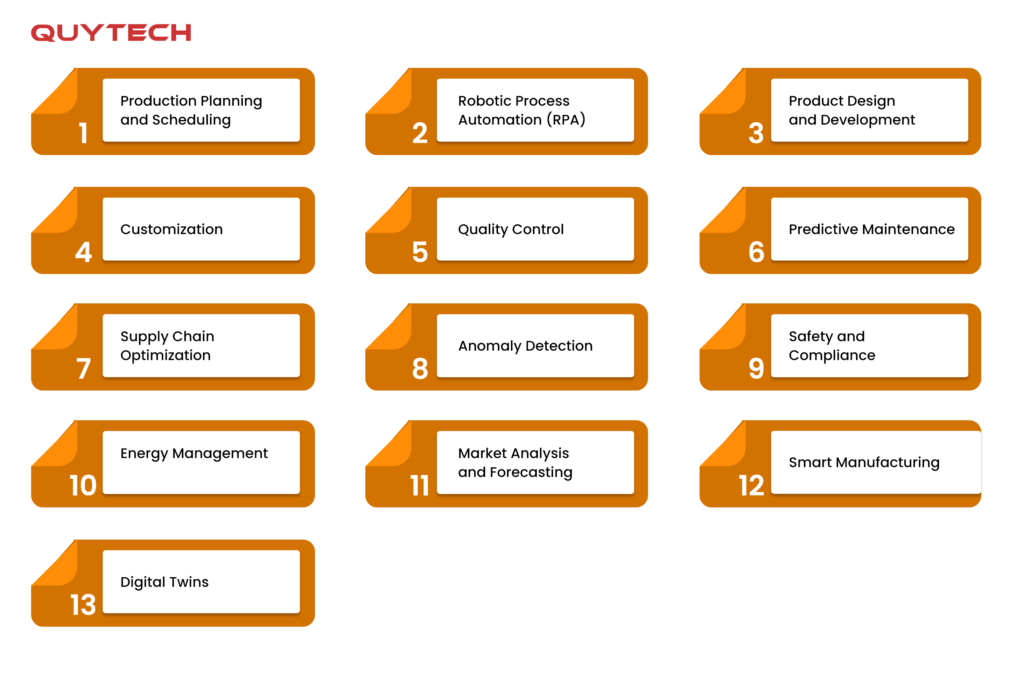
Now, let’s discuss how AI is used in manufacturing and what the benefits of leveraging it are.
1. Production Planning and Scheduling
Many leading manufacturing companies leverage artificial intelligence to optimize production schedules. The AI algorithms analyze data, such as available resources, number of orders, and deadlines, to understand the requirements and plan production accordingly.
For example, a car manufacturer uses AI to analyze the demand for sedan cars, and the raw materials required to build cars and optimize the production line and manpower as per the deadlines.
Benefits of Using AI for Production Planning and Scheduling
By using AI for production planning and scheduling, manufacturers can allocate resources effectively, increase productivity, and reduce lead times. As a result, they can manufacture more products in less time and ship them to the market to meet consumer demands.
2. Robotic Process Automation (RPA)
You have seen machinery in the manufacturing units working automatically and assembling raw materials to create the finished product, packaging finished products and even handling materials. It is called Robotic Process Automation (RPA).
These pieces of machinery are powered by artificial intelligence algorithms. These algorithms empower the machines to perform repetitive and manual tasks as per the set standards.
Benefits of Using AI for Robotic Process Automation (RPA)
Artificial intelligence is used to empower RPA (Robotic Process Automation) to increase operational efficiency in the manufacturing industry. It takes over the repetitive tasks and allows human workers to focus on higher-value tasks, enhancing overall productivity.
3. Product Design and Development
Many products, such as automobiles, electronic hardware and appliances, and others, require design updates frequently.
Hence, manufacturers leverage generative AI to design innovative products and designs based on specific requirements. For example, US Steel is leveraging generative artificial intelligence technology to design new products and change existing ones.
Benefits of Using AI for Product Design and Development
Generative AI in manufacturing accelerates the process of designing products and helps manufacturers bring out creativity, to design and build effective and innovative products.
4. Customization
Artificial intelligence also helps manufacturers understand customer’s preferences and specifications. Based on the requirements, manufacturers make changes in the products and build accordingly to provide customized experiences to the customers.
Benefits of Using AI for Personalized Customer Experiences
By leveraging generative artificial intelligence to redesign products while manufacturing, manufacturers can meet their customers’ specific needs, offer enhanced customer experiences, and increase satisfaction and loyalty without increasing costs significantly.
5. Quality Control
Maintaining quality consistently throughout the products manufactured is a very difficult task. Thus, many manufacturing companies are investing in AI to control the quality of the products they build.
They leverage machine learning, machine vision, and other subsets of AI, to ensure that the product quality is constant. The intelligent AI models are trained on the standard machine learning algorithms to ensure that the product meets the set specifications.
When there are inconsistencies in the quality, it alerts the manufacturers and provides them insights into where the improvement is required.
Benefits of Using AI for Product Quality Control
The major benefit of using artificial intelligence to ensure product quality is that the manufacturers can catch the defects during early stages of manufacturing, and reduce waste.
This helps reduce the returns and overall product recall rates of products and saves significant costs for the manufacturers.
6. Predictive Maintenance
Now, let’s talk about how AI can help in running manufacturing units smoothly. Businesses integrate artificial intelligence, along with IoT-powered sensors to predict machinery downtimes before they occur.
Machinery downtimes can negatively affect the business’s productivity and cause huge losses.
Thus, manufacturers rely on AI to analyze data collected from machinery sensors in real-time, to predict any potential failure of machines. Also, AI helps manufacturers by reminding them to service the machinery at the right time to ensure its smooth functioning.
Benefits of Using AI for Predictive Maintenance
AI is advantageous for the manufacturing industry as it helps in predicting machine failures, reduces downtime, and allows manufacturers to take certain actions to reduce maintenance costs and extend equipment lifespan.
7. Supply Chain Optimization
Another use of AI in manufacturing is optimizing supply chains. Businesses leverage AI to analyze market trends, past data, and consumer behavior to get insights into upcoming demands.
Using these insights, manufacturers optimize the inventory levels accordingly to avoid situations like products being sold out or unsold.
Benefits of Using AI for Supply Chain Optimization in Manufacturing
Leveraging artificial intelligence, manufacturers can improve inventory management and reduce holding costs. The technology also helps in ensuring that the production aligns with the demand, without excess or less stock being manufactured.
8. Anomaly Detection
Anomaly detection is another case of artificial intelligence use in the manufacturing industry. The AI algorithms are used to evaluate production data to identify unusual patterns that indicate inefficiencies in the manufacturing processes.
Using this data, manufacturers can easily identify and fix problems and enhance overall productivity.
Benefits of Using AI for Detecting Anomalies
AI helps manufacturers reduce the risk of defects, find problems in the manufacturing processes, and fix them to increase the productivity and efficiency of the business.
9. Safety and Compliance
Safety is one of the most important concerns in the manufacturing sector. According to reports, the manufacturing sector witnessed 16 fatal injuries in the time period of one year, ie. 2023-24.
However, these industrial accidents can be reduced or fully avoided by leveraging AI in the manufacturing sector. The AI systems can monitor workplace safety conditions and compliance with regulations in real-time.
If the safety protocols are violated, the AI systems alert the safety monitoring team and allow them to take corrective actions.
Benefits of Using AI for Workplace Safety and Compliance
In the manufacturing industry, AI can reduce workplace accidents and ensure adherence to safety standards, resulting in a safer work environment.
10. Energy Management
In manufacturing, artificial intelligence is also used to monitor energy consumption and optimize usage to minimize waste. The trained AI models analyze the amount of energy being utilized by the manufacturing units and help manufacturers use energy efficiently, so the wastage can be reduced.
Benefits of Using AI for Energy Management in Manufacturing
By using AI, manufacturers can reduce energy costs and promote sustainability, contributing to lower operational costs. Moreover, steps taken to use energy efficiently also contribute significantly to the environment.
11. Market Analysis and Forecasting
Another role of AI in manufacturing is helping manufacturers create strategies to grow their business and gain a competitive advantage in the market.
The AI models are used by analysts to evaluate data, such as market trends, consumer behavior and preferences, and more, to get insights for making data-driven decisions in favor of business.
Benefits of Using AI for Market Analysis and Decision-Making
AI can help manufacturers create data-driven strategies and respond quickly to market changes and consumer behavior to gain a competitive advantage in the market.
12. Smart Manufacturing
Manufacturers can opt for smart manufacturing by leveraging AI in the existing manufacturing systems. AI can be integrated along with IoT devices to collect and analyze data from connected machines.
By analyzing these data, manufacturers can optimize the manufacturing processes and opt for smart manufacturing, ie. using advanced technologies to optimize production processes, improve efficiency, and enhance decision-making in real-time.
Benefits of Using AI for Smart Manufacturing
AI allows real-time monitoring and optimization of manufacturing processes, resulting in continuous improvement in products and the business.
13. Digital Twins
Last but not least, AI can also be used to create digital twins. Digital twins are the replicas of real products, based on technologies like machine learning.
These digital twins are used by manufacturing companies to test the products, process changes, machinery, etc., before implementing them in the physical world.
Benefits of Using AI for Creating Digital Twins
AI-powered digital twins can help manufacturers reduce the risk of costly errors, improve operational efficiency, and speed up innovation by enabling data-driven decisions.
Real-World Key Players Leveraging AI for Manufacturing
The following are the top AI manufacturing companies worldwide using artificial intelligence for building products.
1. Tesla and BMW

Source: Tesmanian
Tesla and BMW are the two leading players in the automotive industry. These companies leverage AI-powered robots to perform complex tasks, such as assembling, welding, and painting cars efficiently.
Moreover, these companies use AI for other tasks, such as quality control, supply chain management, product design, and more.
2. Samsung

Source: Samsung Newsroom
Samsung, a well-known appliance and consumer electronics corporation, uses AI to power automated vehicles (AGVs), robots, and mechanical arms to assemble appliances, transport raw materials, and check the quality of the finished products.
3. Airbus
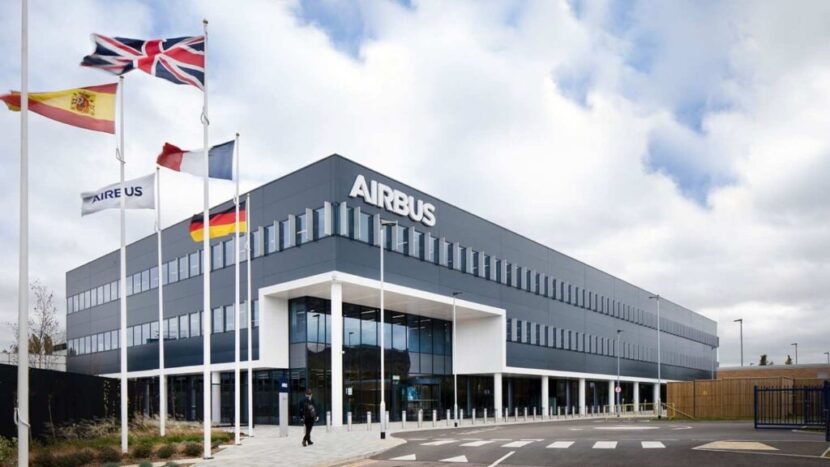
Source: BDP
Airbus leverages AI and machine learning to cut aircraft aerodynamics prediction time. This approach enhances productivity and allows the design team to test other options required while manufacturing airplanes.
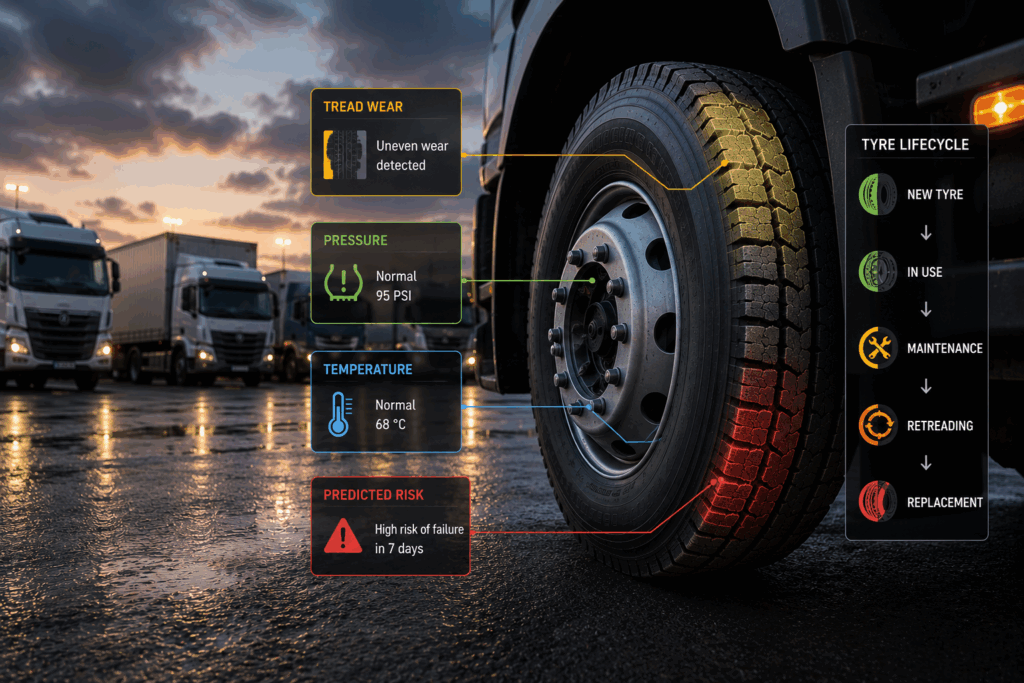
4. Tyre Maintenance Analytics by Quytech
Quytech built an intelligent tyre maintenance and analytics solution for one of India’s top fleet management companies. The company operates over 1,500 trucks. The solution developed utilized machine learning. It helps the solution to predict tyre failures, support real-time alerts, and track each tyre’s lifecycle. The tyre maintenance and analytics solution delivered a measurable impact. It resulted in reduced maintenance costs, minimized downtime, and enhanced fleet safety.
5. NVIDIA

Source: Nvidia News
NVIDIA, a leading GPU manufacturer, uses artificial intelligence to optimize designs with precision, saving time and controlling price and speed.
6. Rolls-Royce

Source: Campaign Asia
Rolls-Royce is one of the top multinational aerospace and defense companies that uses AI for predictive maintenance and digital twins in aerospace manufacturing.
7. Frito-Lay

Source: Savor the Days
Frito-Lay, a US-based chips and snacks manufacturer, uses artificial intelligence for predictive maintenance of its systems and machinery to avoid downtime-like situations.
8. Pfizer

Source: Wall Street Journal
Pfizer, the world’s leading pharmaceutical company, leverages AI to design and manufacture drugs, vaccines, and other supplements, and accelerate the time to market.
Future of AI in Manufacturing
Artificial intelligence is constantly evolving. It is getting better and more accurate as the days pass.
In the near future, we will be witnessing advanced AI manufacturing processes being introduced in the industry to achieve goals like enhanced efficiency, accuracy, and reduced errors and downtimes.
Moreover, robots and cobots (collaborative robots) will be introduced in the manufacturing sector to assist human labor and automate complex processes.
The use of generative AI will also be increased for designing and redesigning products with high precision in various domains, such as automotive, footwear, textiles, electronics, and more.
How Quytech Can Help With Implementing AI?
At Quytech, our experts follow a strategic process to integrate AI into the manufacturing business successfully.
1. Consultation & Needs Assessment
We start with in-depth AI consulting for manufacturing to understand your specific business needs and challenges. Our AI experts analyze your current manufacturing processes to identify pain points and scope where AI can bring maximum value.
2. Strategic AI Planning
Once we understand your business requirements, our team develops a customized AI strategy tailored to your goals.
3. Data Collection & Integration
After planning, we collect and organize relevant data from various sources, such as your existing systems, machines, and external sources like market trends and consumer demands.
After this, we ensure seamless integration of your manufacturing data into AI algorithms.
4. AI Solution Development
Our team then handles AI development for manufacturing, building the actual AI models and algorithms designed to fulfill your specific manufacturing needs, like predictive maintenance, quality control, automating processes, and more.
5. Implementation & Integration
Once the manufacturing AI solutions are developed, we handle the complete implementation process, ensuring seamless system integration with your existing machinery, equipment, and software.
We also conduct pilot testing to ensure that the AI systems are performing as expected before a full-scale deployment.
6. Monitoring & Optimization
After implementation, Quytech offers ongoing support to monitor system performance, fine-tune AI models, and help in scaling your AI software for manufacturing across multiple production lines or facilities.
7. Continuous Support & Upgrades
Quytech remains a long-term partner because we provide regular maintenance and updates to keep your AI systems at the cutting edge.
So, what are you waiting for? Contact us today. For more information, visit www.quytech.com
Conclusion
Artificial intelligence is a key technology for the manufacturing industry. It helps manufacturers to achieve certain goals, such as automation, accuracy, saving time, and costs.
By leveraging AI in manufacturing, manufacturers can automate production processes using robotic process automation (RPA), control quality using machine learning, reduce downtime with the help of predictive analytics, and design new products using generative AI.
However, AI is not just limited to these. It has more potential, and as the technology advances, its potential will also increase. So, if you are not manufacturing with AI, it is the right time to start.
Get in touch with the AI experts of Quytech and equip your manufacturing unit/s with cutting-edge artificial intelligence.
Key Takeaways:
- AI for manufacturing also provides digital twins for product decisions, to simulate products and validate decisions before using physical resources.
- AI in manufacturing is the process of utilizing artificial intelligence for automating different manufacturing processes.
- It helps in efficiently managing tasks like production planning and scheduling, enabling robotic process automation, and assisting with product design and development.
- AI manufacturing helps manufacturers introduce effective customization, enhancing quality control, and machinery predicting maintenance needs.
- Other core AI use cases in manufacturing include supply chain optimization, anomaly detection, and automating safety and compliance.
- Apart from repetitive tasks, AI also assists in providing decision support. It helps with market analysis and forecasting, and also enables smart manufacturing.
Frequently Asked Questions
– AI improves manufacturing efficiency by:
– Automating repetitive tasks
– Optimizing production scheduling
– Predicting machine failures
– Reducing wastage, and
– Boosting manufacturing output.
Core challenges of AI implementation in manufacturing are high setup costs, lack of quality data availability, lack of compatibility with legacy systems, and human resistance to AI adoption.
AI in manufacturing is expected to unlock automation at a completely new level. It is expected to feature smarter cobots, generative AI adoption at scale, fully autonomous factories, and real-time data-based decision-making.
Predictive maintenance in manufacturing refers to analyzing data with predictive analytics technology, which can alert teams in advance to possible machinery breakdowns and the need for maintenance to avoid downtime.
To choose the right AI development company, you should check the following factors:
– Industry experience of the company
– Technical expertise
– Portfolio and relevant case studies
– Reviews on different platforms
– Data-security practices, and
– Post-deployment support
