Key Takeaways:
- Assistive search is an AI-powered technology that provides personalized learning content for students with learning disabilities.
- Assistive search in learning addresses diverse learning challenges like difficulty in framing questions, understanding complex content, processing audio and visual content, etc.
- Its core features include natural language support, multiformat content delivery, personalized search results, and accessibility support tools.
- Implementing assistive search in learning environments benefits by creating equitable learning opportunities, enhancing conceptual understanding, and reducing dependence on external assistance.
Did you know that about 1 in every 7 students has a learning disability? Students with learning disabilities process information differently. This makes some concepts harder to grasp, even with average or above-average intelligence. While many traditional approaches do try to address these challenges, the lack of adaptability to diverse learning needs is what holds them back.
This is where assistive search comes into play. Assistive search in learning helps provide students with disabilities with equal learning opportunities. It targets diverse learner needs and provides personalized content to meet them effectively. Assistive technology makes educational content accessible to all students. But how does assistive search in learning make all this possible?
That’s exactly what we will cover in this blog. We have covered everything from the concept of assistive search and benefits to the common challenges of implementation, along with best practices.
What is Assistive Search in Learning?
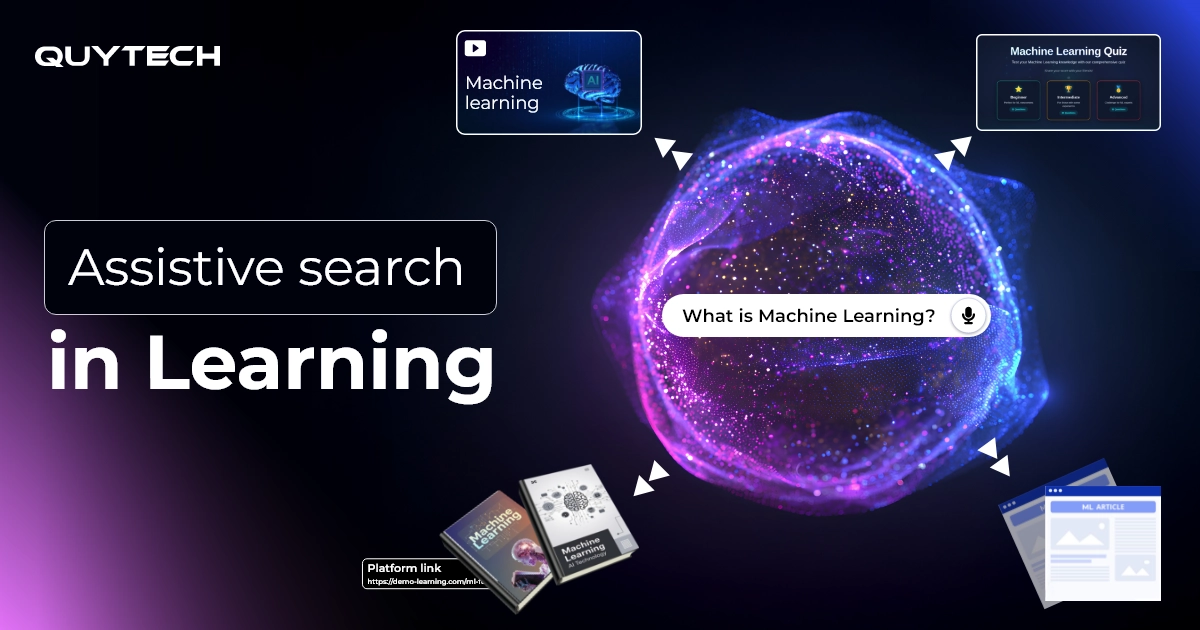
Assistive search is an AI-powered technology that helps students with special needs, like learning disabilities, access educational content easily. It is a bridge that fills the gaps that students with special learning needs face in searching, accessing, and understanding complex study material. It helps students understand concepts in a way that matches their learning needs.
Assistive search technology is not like traditional search systems that give a clear response only when complete questions are asked. It can understand natural, incomplete, and unclear queries of students. Assistive search gives results in short explanations, simple language, and visual content to support a better understanding of concepts.
You can think of assistive search as an AI-powered tutor who can understand the intent behind the incomplete, unclear doubts that students present to it, and give outputs in ways that target their learning needs effectively.
How AI-Powered Assistive Search Supports Students with Learning Disabilities
The needs that a student with dyslexia has are different from those of a student with ADHD. This is where traditional search systems fail, as they lack the understanding of the natural way students ask questions. Assistive search supports students by tailoring help to their special learning needs.
But how does assistive search cope with the challenges that students with learning disabilities face? That’s exactly what this section is all about. Here are some challenges that students with special learning needs face, along with how AI-powered assistive search addresses them:
Difficulty Framing Questions
A very common challenge that students with learning disabilities face is the difficulty in framing questions. While this problem is common for many, students with special needs face it to a greater extent. This challenge affects the ability of students to frame clear questions, as they often end up missing words or using incorrect terms. For example, a student who wants to ask, “What is the process of photosynthesis?” might type, “How plants make food?”, missing key words, affecting clarity.
AI-powered assistive technology addresses this challenge by grasping the intent behind the incomplete and unclear questions. It makes use of natural language processing models and semantic search that go beyond keyword-based search. These technologies power assistive search in finding content based on the actual query.
Trouble in Understanding Complex Content
Another challenge that students with learning disabilities like dyslexia, ADHD, etc. face is the trouble in understanding complex content. They may find it hard to understand technical terms, long sentences, and comprehensive study material.
To address this challenge, AI for learning disabilities simplifies study material by breaking it down into easy-to-understand mind maps, small paragraphs, and simple terms. It makes use of multimodal technologies to support such responses.
Information Overload During Search
Information overload during search is the challenge that affects the ability of students to focus on results. The reason behind this is that traditional search provides tons of information and content, which may not retain the attention of students with special learning needs. It can also make them feel overwhelmed, making students unable to concentrate.
AI-powered assistive search addresses this problem by filtering information based on its relevance to the doubts of the students. It uses user-adaptive filters to eliminate redundant information to enhance the concentration of students.
Different Learning Paces and Needs
As is obvious, different students have different needs, paces, and styles of learning. An educational approach for a student with dyscalculia might not work for a student with dyslexia. This challenge is often overlooked in the case of traditional teaching methods, as they focus on creating educational content with a one-size-fits-all approach.
Assistive search in learning provides students with content that is tailored to their needs. It understands the unique needs, styles, and pace of each student and offers personalized study material. AI for learning uses adaptive algorithms and personalization AI to address this challenge.
Difficulty in Processing Audio and Visual Content
Students with auditory or visual impairments are not able to understand spoken, visual, or graphical data. This makes it difficult for them to access study materials that do not cater to their needs.
Assistive technology in learning addresses the challenges of students with auditory and visual processing disorders. It does so by offering alternative input or output processing options like text-to-speech, captions for understanding audio educational content, etc. Technologies like computer vision, multimodal algorithms, etc., support assistive search in addressing these challenges.
Interesting Read: Agentic AI in Education: The Future of Personalized and Adaptive Learning
Core Features of Assistive Search
Now that you are familiar with the challenges that AI-powered assistive search in learning solves, let’s walk you through the core capabilities that support it:
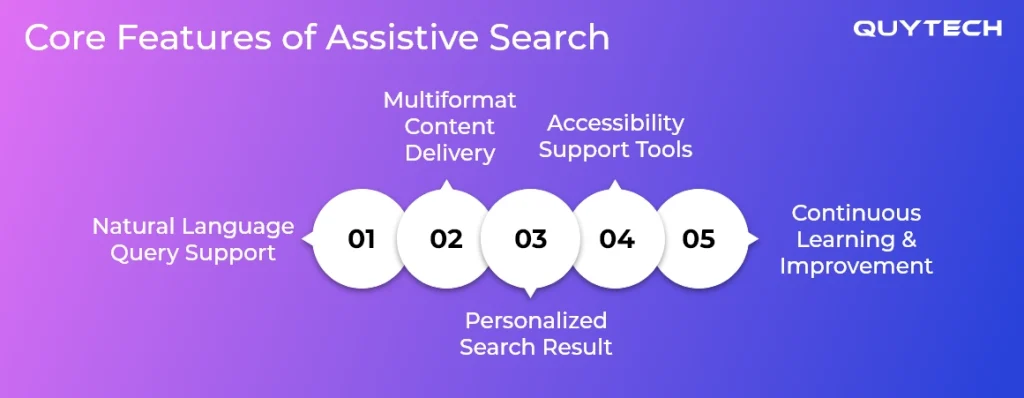
Natural Language Query Support
Assistive search in learning supports natural language queries. This means that students do not need to input correct terms, punctuation, or grammar to get search results. They can get their doubts cleared in a way that’s as simple as having a conversation; the only difference is that the tutor is artificial intelligence.
Multiformat Content Delivery
The content delivery of assistive technology is not limited to a certain format; it can deliver educational content in multiple formats. This means that it can deliver study material in texts, visuals like images, charts, diagrams, video content, or audio explanations.
Personalized Search Result
Implementing assistive search in learning provides students with content that’s tailored to their preferences. It provides varied outputs to students and understands which ones suit their learning styles. Assistive technology also takes time-to-time feedback to ensure that the content given is up to the mark, and if not, it adjusts it accordingly.
Accessibility Support Tools
Assistive search in learning offers accessibility support tools. These tools enable students with different learning needs to access the same content, but in the format they prefer. It makes content accessible to all students with support tools like text-to-speech, speech-to-text, captions, and simplified visuals.
Continuous Learning and Improvement
Assistive technology is powered by artificial intelligence, and it is not static in terms of interactions and responses. It learns from every interaction it has with students and improves its content delivery each time.
You Might Also Like: Metaverse In Education: Top Use Cases, Development Process
Benefits of Implementing AI-Powered Assistive Search in Learning
Implementing AI-powered assistive search in learning brings in equitable learning opportunities for students with special needs. It provides them with a personalized learning experience, enhances their conceptual understanding, and reduces their dependence on external support. Let’s understand these benefits in detail:
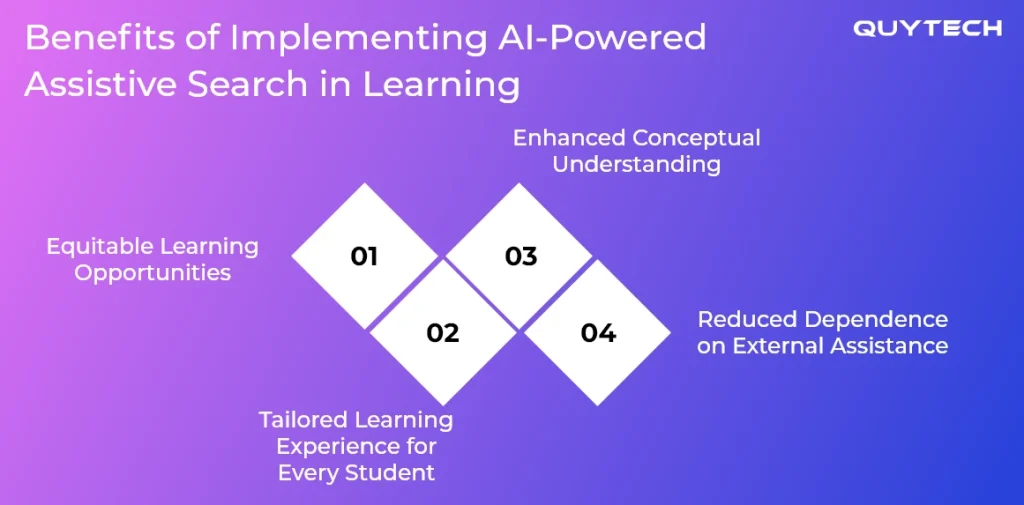
Equitable Learning Opportunities
Implementing AI-powered assistive search in learning creates equitable learning opportunities for all students. Unlike traditional learning environments, assistive search does not provide a common learning environment to students. It understands the distinctiveness that every student has in terms of learning and provides the same content but in formats that every student requires.
Tailored Learning Experience for Every Student
In traditional learning environments, educators follow common teaching practices, which they assume will fit all students. Assistive search brought in changes and introduced tailored study material for students. This addresses different needs of students, be it audio-based lectures for students with visual disabilities, or concept breakdowns for students with dyslexia.
Enhanced Conceptual Understanding
As mentioned already, AI-powered assistive search provides students with learning disabilities with tailored content. This personalization ensures that the study material being accessed by every student caters to their needs, which naturally helps them understand concepts better.
Reduced Dependence on External Assistance
Traditional learning practices make students with special needs dependent on their parents or educators. However, assistive learning enables students to access and understand educational content independently. It eliminated the need for external support by providing easy-to-use platforms for students with special needs.
Interesting Read: How EdTech Companies Use AI to Drive Better Learning?
Challenges and Best Practices for Implementing Assistive Search in Learning
Implementing assistive technology in learning is not just about the sparkles it brings. Like every other technology, implementing assistive technology brings its own set of challenges. Let’s walk you through the challenges the implementation process brings:
Limited Availability of Learning Content
Implementing assistive technology in learning is primarily to help students access learning content with ease. But if the content itself is limited, it will be hard to provide diverse content to students with diverse needs.
This challenge can be overcome by auditing existing content and then gradually converting it into formats as per student needs.
Integration With Existing Learning Systems
Another challenge in implementing assistive search in learning is the integration with existing systems. Many educational institutions already make use of digital tools and learning systems. They may not feel positive about the assistive search implementation, as they may feel it would disrupt the current workflow.
Integration challenges can be addressed by building easily integrable systems. This will ensure that both assistive search and existing workflows work together without interrupting workflows.
Data Privacy and Student Safety
Assistive technology makes use of data, like the credentials of a student, their interactions, learning styles, etc. And where data is being utilized, data privacy and student safety concerns arise naturally.
Data privacy and student safety concerns can be addressed by following data encryption practices. Along with this, compliance with data protection regulations also contributes to maintaining transparency.
Scaling Across Large and Diverse User Bases
Since edtech platforms blended with assistive technology are naturally expected to serve large user bases, scaling them can be quite challenging. This is because serving a diverse user base means that the content would need to cater to varied learning challenges and disabilities, which can be very complex when done at a scale.
Educational institutions implementing assistive search in learning can opt for a scalable and adaptive platform. This will ensure that the platform provides a personalized experience to users without being affected by the number of users it needs to cater to.
You Might Also Like: How to Develop an eLearning App? Empowering the Education Sector
Future Trends of Assistive Search in Learning
As technologies evolve, assistive search will also become more inclusive, adaptive, and learner-centric. It will adopt deeper model interactions, multilingual adaptability, and provide predictive support. Let’s dive deeper into these future trends of assistive search in learning:
Deeper Multimodal Interaction
In the future, assistive technologies will support deeper multimodal interactions. These will enhance interactions by supporting voice conversations, gesture recognition, touch input, etc. This means that accessing content will be made easier through spoken interaction, gestures, etc.
Predictive Support and Guidance
The future holds proactive support and guidance for assistive search in learning. This will allow assistive technologies in learning the areas where a student might feel stuck and proactively provide solutions. It will offer personalized explanations, relevant resources, and formats for students to grasp complex concepts with ease.
Multilingual Adaptability
As assistive technology platforms will cater to a diverse range of users, they will further adopt multilingual adaptability. This will allow assistive technology to cater to a wider user base in their native languages, dialects, etc., enhancing the overall learning experience of the students.
How Quytech Builds Assistive Search Solutions That Adapt to Learning Disabilities
When it comes to building assistive search systems in education, Quytech brings in both expertise and experience. With strong expertise in AI, ML, and emerging technologies, Quytech has delivered diverse education projects, building tailored and scalable solutions.
Backed with success from projects like AI-powered Literacy Coach Pro and Dettol Accessibility Curriculum, we reflect our ability in building custom solutions targeting diverse needs in the field of education. Quytech pairs proven expertise with a hands-on team to deliver inclusive and transparent assistive search solutions designed for students with diverse learning needs.
Conclusion
As the awareness for equitable learning becomes widely preached, so does the need for tools that make it a reality. This is where assistive search in learning surfaces as a practical solution by targeting diverse learning challenges. It addresses every hurdle that students face, be it difficulty in framing questions and understanding complex content, or processing audio and visual content.
Assistive search in learning brings in the perfect blend of technology and accessibility. It tailors learning experiences for each student, enhances their conceptual understanding, and reduces their dependence on external assistance. In conclusion, we can say that implementing assistive search in learning makes it more inclusive, intuitive, and genuinely supportive for students with learning disabilities.
FAQs
No. Assistive search is not meant only for students with special needs. It is a technology that adapts based on user needs, so anybody can use it.
No. Assistive search technology does not replace teachers or tutors. Instead, it complements them by assisting in exploring concepts independently and resolving doubts by offering diverse, learning need-based content.
Assistive search can be configured to align with institutional learning objectives. It supports institutional objectives by enhancing learning accessibility, improving comprehension, and promoting equitable education outcomes.
Before implementing assistive search in learning environments, institutions should have structured curriculum-based learning resources. This will ensure accurate content delivery by the system.
Academic accuracy is maintained in assistive search by training the system on verified and institution-approved content.
Not necessarily. You can implement AI-powered assistive search without a dedicated technical team by partnering with an AI solutions development company. You can also hire developers for the same.
Yes, assistive technology is suitable for institutions with limited digital infrastructure, but it will require basic digital resources, like learning management systems, internet access, and devices to function.
Implementation timelines depend on factors like content readiness, digital resources, system integrations, etc. Many institutions can launch a pilot phase within a few weeks, while full-scale deployment may take a few months.
