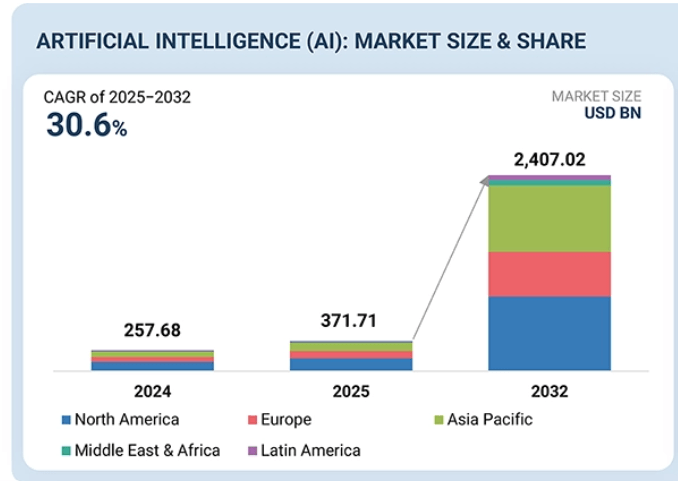
Once in every few decades, a technology arrives that transforms how industries operate. AI automation is that technology. The speed at which industries worldwide are adopting AI automation is remarkable. In fact, research by Markets and Markets shows that the global AI market size is expected to reach USD 2407.02 billion by 2032. This number was USD 371.71 billion in 2025.
Another study by PWC highlights that industries that have adopted AI have experienced 3X growth in revenue/employee. Considering these numbers, it is clear that AI is not just a technology that every organization should adopt; it should be the foundation of every process or industrial operation.
While most organizations are aware of the significant benefits AI adoption brings, many are still unclear about identifying the areas where AI can deliver maximum ROI. That’s what this blog does. It covers high-impact use cases of AI automation across industries, including healthcare, travel, e-commerce, and manufacturing.
Interesting Stat About AI Automation
Before taking a look at the AI automation use cases for industries, let’s check out these statistics to understand how AI automation is transforming industrial operations:
- 42% leaders across six industries and 24 countries have a strategy ready for AI adoption.
- 63% of enterprises across the world plan to adopt AI in the next three years.
- The manufacturing industry is projected to reap maximum benefits from AI automation and adoption. It is expected to gain $3.8 trillion by 2035.
- 47% of organizations believe that AI will help in improving their credibility.
- 88% of organizations are using AI in at least one of their business functions.
- 60% of enterprises across the globe said they have achieved ROI within just a year of AI implementation.
- The global AI market size is expected to grow at a whopping CAGR of 30.6% between 2025 and 2032 to reach USD 2407.02 billion by 2032.
Why AI Adoption Matters in 2026
The aforementioned stats are enough to depict that artificial intelligence is being increasingly used across different industries to achieve productivity, revenue, operational efficiency, and other amazing benefits. The only thing an industry needs to focus on is implementing the right AI technology at the right place. Let’s understand a few compelling reasons to understand the urgency of AI automation in your enterprise.
- No Time for Evaluation is Left
AI automation is not a new thing; we have been living in an AI era for a decade now. With almost every organization already using AI for automation and other benefits, it is time to quickly make it an operational reality for your enterprise to ensure faster decision-making, lower error rates, and reduced operational costs. In short, it is the time for AI execution.
- AI Automation is a Must for Competitive Advantage
AI automation not only makes processes faster or improves operational efficiency, but it also enables an enterprise to deliver exceptional experiences, which is what customers prefer these days. Besides, it also empowers brands with capabilities that didn’t exist before. With AI-automated operations, enterprises are generating proprietary data, refining AI models to understand customers, patterns, and future trends to be competitive and future-ready.
- AI Automation Now Applies Across Every Industry and Function
A decade ago, organizations were in an experimental or planning phase about whether to adopt AI automation or not. But the time has changed now. Today, AI automation is a part of almost every industry and business function. Whether it is healthcare, manufacturing, legal, logistics, or retail, there is no industry that AI automation hasn’t touched or transformed. Now, the question left is whether your organization is among the ones taking advantage of artificial intelligence?
- The Regulatory and Compliance Landscape is Getting More Complex
Regulatory frameworks, data privacy laws, and environmental mandates across industries are different and evolving faster. Ensuring adherence to each regulation manually is not feasible. AI automation enters the scene and plays a pivotal role in risk and regulation management. The technology builds a defensible operational foundation to make sure every process or function adheres to compliance.
Explore More: AI Agents Vs. Traditional Automation: A Detailed Comparison
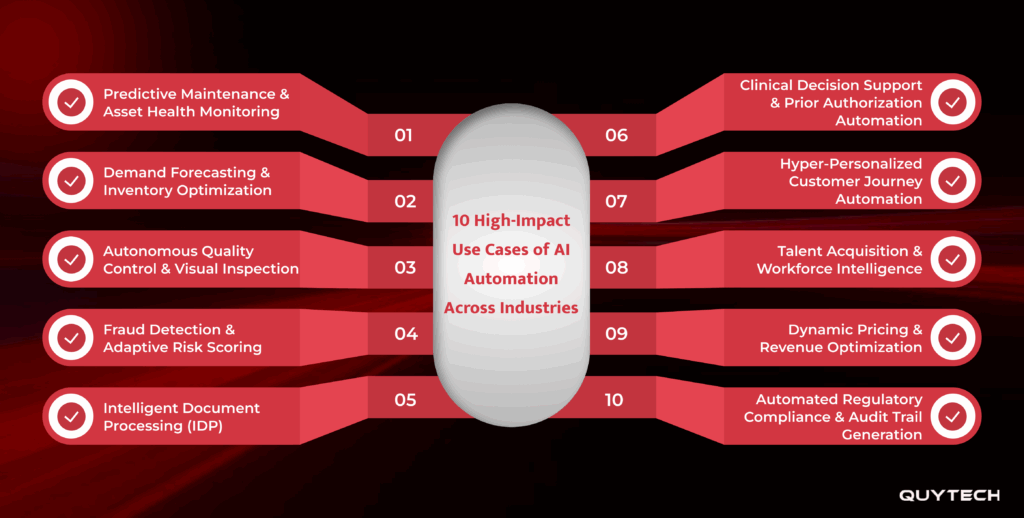
10 High-Impact Use Cases of AI Automation Across Industries
AI automation is now a foundation of healthcare, retail, logistics, supply chain, manufacturing, travel, sports, and almost every other industry. Let’s take a closer look at these high-impact AI use cases by industry:
Use Case 1: Predictive Maintenance & Asset Health Monitoring
Industries: Manufacturing, Energy, Aviation, and Logistics
Predictive maintenance empowers companies from these industries to monitor their equipment by automatically collecting and analyzing sensor data, operational patterns, and environmental factors. Based on the data analysis, AI-powered systems and predictive maintenance offer real-time intelligence and automatically identify failure signals to ensure preventive maintenance and prevent equipment breakdown.
Why It is High-Impact: Unplanned equipment failure can lead to downtime, which can be costly for the industries that are heavily dependent on machines and equipment. It not only stops production but also triggers emergency procurement, idle labor costs, delivery delays, and sometimes, non-adherence to compliance.
| Manufacturing | Energy | Aviation | Logistics |
| Assembly line machinery monitoring | Auto-analyze pressure readings and flow rates | Auto-track in-flight engine temperatures and hydraulic pressure | Monitor vehicle engine health across the entire fleet |
| Auto-detect equipment temperature irregularities | Auto-identify infrastructure stress points in real-time | Auto-generates pre-landing maintenance work orders | Predict vehicle breakdowns before delivery delays |
| Auto-schedule maintenance during planned downtime | Monitor wind turbines and solar installations | Converts reactive maintenance to scheduled interventions | Auto-Prioritize maintenance against delivery commitments |
| Automated tracking of tool and die wear | Auto-flag early equipment deterioration in refineries | Condition-based replacement over fixed schedules | Optimize fleet utilization without disrupting operations |
Take a look at: AI in Healthcare Data Analytics: Cutting Readmission Rates
Use Case 2: Demand Forecasting & Inventory Optimization
Industries: Retail, Pharma, FMCG, E-commerce, Supply Chain
With AI-powered demand forecasting, industries such as retail, pharma, FMCG, and others can gain real-time insights into market trends, future demand, weather forecasts, and user sentiment for dynamic pricing, inventory management, and other use cases.
Why It is High-Impact: Inventory overstocking or understocking, both issues can be costly and impact customer experience. Demand forecasting helps in understanding future demands for optimal inventory optimization, better cash flow, enhanced service levels, and improved supplier relationships.
| Retail | Pharma | FMCG | E-commerce | Supply Chain |
| Analyzes POS data and foot traffic patterns | Predicts medication demand based on disease prevalence trends | Integrates weather and promotional calendar signals | Predicts purchase intent from browsing behavior | Aggregates signals across the supplier-to-delivery network |
| Auto-triggers replenishment at inventory thresholds | Optimizes cold-chain biologics and vaccines inventory | Adjusts production schedules against demand shifts | Dynamically reallocates inventory across fulfillment centers | Identifies supplier bottlenecks before they materialize |
| Identifies slow-moving SKUs for early intervention | Syncs manufacturing output with prescription demand | Coordinates with retailer POS data in real-time | Prevents stockouts during peak sales events | Reduces excess safety stock across warehouses |
| Incorporates competitor pricing into demand models | Ensures regulatory-compliant automated batch tracking | Aligns trade promotion with predictive demand data | Personalizes availability messaging per customer demand | Dynamically reroutes shipments under disruption conditions |
Use Case 3: Autonomous Quality Control & Visual Inspection
Industries: Manufacturing, Pharmaceuticals, Food & Beverage
One of the best use cases of AI automation is autonomous quality control and visual inspection. In this, companies like manufacturing, pharmaceuticals, and food & beverage can make the most of AI automation by using computer vision-powered models that can be trained on thousands of defect variations and automate quality inspection. The technology can automate the identification of surface defects, dimensional inconsistencies, contamination, and others.
Why It is High-Impact: Quality failures can cost a lot and also impact a brand’s reputation. It can also lead to the imposition of regulatory actions or penalties. AI visual inspection not only catches more defects but also ensures capturing the right defect before they turn into a massive failure.
| Manufacturing | Pharmaceuticals | Food & Beverage |
| Inspects components, welds, and surface finishes | Verifies tablet coating and capsule uniformity | Detects contamination and foreign object presence |
| Identifies misaligned or missing assembly parts | Inspects vials for the presence of particulate contamination | Verifies label accuracy and packaging seal integrity |
| Monitors the tool and die condition continuously | Detects microscopic cracks in solid-dose manufacturing | Monitors portion consistency and fill weight accuracy |
| Logs defect patterns for calibration intelligence | Maintains auditable inspection records per batch | Identifies recurring contamination patterns across shifts |
Read More: AI in Manufacturing: A Comprehensive Guide
Use Case 4: AI-Powered Fraud Detection & Adaptive Risk Scoring
Industries: Banking, Insurance, E-commerce, Telecom, Fintech
Fraud detection and risk scoring with traditional fraud detection techniques don’t really provide accurate output. It can flag anomalies or suspicious transactions to a limit only. AI automation transforms this by continuously and autonomously learning and evolving as per the new fraud patterns and behavior.
Why It is High-Impact: AI-powered fraud detection techniques monitor financial transactions in real-time. Systems with this capability empower banking, insurance, e-commerce, and all other industries that deal with confidential and sensitive customer information to automatically flag suspicious patterns with fewer false positives. This reduces the operational cost of fraud investigators while keeping the data secure.
| Banking | Insurance | E-commerce | Telecom | Fintech |
| Monitors transactions against behavioral baselines continuously | Detects staged accidents and coordinated rings | Evaluates every checkout transaction in milliseconds | Identifies SIM swap and account takeover fraud | Monitors payment flows for money laundering patterns |
| Adapts fraud models against emerging vectors | Flags claim documentation inconsistencies at scale | Reduces false positive transaction declines significantly | Detects unusual call forwarding and roaming anomalies | Scores onboarding applications for synthetic identity fraud |
| Correlates signals across multiple accounts simultaneously | Streamlines claims by prioritizing high-risk reviews | Identifies account takeovers before checkout completion | Monitors prepaid top-up and international call patterns | Monitors transaction velocity and geographic inconsistencies |
| Generates real-time risk scores per transaction | Builds continuously improving claimant fraud profiles | Adjusts risk thresholds during high-volume events | Flags bulk SMS and data consumption spikes | Provides real-time audit trails for compliance teams |
Delve Deeper: How AI is Transforming Fraud Detection in Digital Transactions
Use Case 5: Intelligent Document Processing (IDP)
Industries: Legal, banking, insurance, healthcare, government
Intelligent document processing is one of the amazing use cases of AI automation. It goes beyond basic OCR and uses computer vision, NLP, LLM, and ML to read, classify, extract, and validate information, even from unstructured documents. AI systems with IDP have contextual understanding.
Why It is High-Impact: Enterprises from legal, banking, insurance, government, and healthcare industries may have data in different or unstructured formats, such as PDFs, scanned forms, handwritten notes, and emails. IDP, when deployed correctly, can ensure high accuracy in data extraction from different documents and formats.
| Legal | Banking | Insurance | Healthcare | Government |
| Extracts key clauses and obligations automatically | Extracts and validates loan application data | Extracts patient and policy data automatically | Classifies unstructured patient records into structured data | Digitizes and classifies citizen-facing forms automatically |
| Reviews multiple contract versions simultaneously | Automates KYC documentation and watchlist cross-referencing | Auto-approves straightforward claims for faster settlement | Automates prior authorization documentation and matching | Processes licensing and permit applications automatically |
| Scans discovery documents for relevant evidence | Reconciles data from financial and regulatory filings | Identifies fraudulent claims against historical patterns | Auto-populates EHR fields from scanned referrals | Routes information securely across departments automatically |
| Generates audit-ready contract summaries automatically | Processes trade finance documents, reducing settlement time | Monitors and prioritizes high-value incoming claims | Validates clinical records against regulatory requirements | Generates timestamped audit trails from processed documents |
Read in Detail: AI in Intelligent Document Processing: A Comprehensive Guide

Use Case 6: Clinical Decision Support & Prior Authorization Automation
Industries: Healthcare, Insurance, MedTech
Clinical decision support and prior authorization automation are AI automation use cases that healthcare, insurance, and MedTech industries can make the most of. Healthcare organizations can get a clear and complete picture of patients’ disease symptoms, medical histories, lab reports, imaging data, and more. AI can help process this data by matching it against defined criteria to offer real-time insights.
Why It is High-Impact: Prior authorization and validation of enormous patient data can help save admin time, allowing them to focus on other strategic tasks and patient care. AI ensures no relevant data point is missed, no matter how complex the dataset is.
| Healthcare | Insurance | MedTech |
| Cross-references patient history and clinical guidelines | Extracts clinical justification for authorization decisions | Integrates AI into diagnostic equipment directly |
| Flags drug interactions and dosage anomalies | Auto-approves straightforward prior authorization requests | Analyzes connected device data for deterioration |
| Reduces prior authorization delays for treatments | Identifies documentation gaps in authorization requests | Enables remote diagnostic support without physical presence |
| Redirects clinical staff toward direct patient care | Detects fraudulent or inflated authorization requests | Compiles clinical evidence for regulatory submissions |
Also Read: The Role of Generative AI in Enhancing Clinical Documentation
Use Case 7: Hyper-Personalized Customer Journey Automation
Industries: Retail, Fintech, Edtech, Healthcare, Hospitality
Hyper-personalization is one of the biggest trends of 2026. Customers, irrespective of the industry, want every organization to deliver hyper-personalized experiences. AI automation helps with this by orchestrating the entire experience across every touchpoint. Whether it is a website, app, email, or in-store, AI ensures that customers get a consistent and personalized experience based on their preferences and lifecycle stage.
Why It is High-Impact: Customer experience directly impacts revenue. Moreover, users who receive a personalized experience have higher chances of converting into customers and staying with the company. AI automates the entire lifecycle of the customer journey to create a win-win situation for both customers and the company.
| Retail | Fintech | Edtech | Healthcare | Hospitality |
| Adjusts recommendations across all touchpoints dynamically | Detects intent signals for financial journeys | Adapts learning paths from performance patterns | Delivers personalized health management journeys continuously | Personalizes pre-arrival communication from booking history |
| Triggers abandoned cart recovery sequences automatically | Orchestrates personalized onboarding based on profile | Adjusts content difficulty and pacing automatically | Sends personalized medication reminders and follow-ups | Auto-Adjusts in-stay recommendations based on behavior |
| Coordinates promotions across online and offline | Identifies cross-sell opportunities at the right moment | Flags at-risk learners for re-engagement interventions | Personalizes post-discharge care instructions per patient | Dynamically prices upgrades per willingness-to-pay signals |
| Predicts churn and initiates retention journeys | Automates contextually relevant fraud alert communications | Generates personalized learning progress and milestones | Segments patients by engagement and health literacy | Pre-configures room settings from historical stay data |
You may like to read: Artificial Intelligence in Customer Experience – Quytech Insight
Use Case 8: Talent Acquisition & Workforce Intelligence
Industries: All Enterprises
This AI automation use case applies to almost every industry, including manufacturing, e-commerce, travel, and others. Manually performing talent acquisition tasks takes significant time. AI automation can help with both talent acquisition and workforce intelligence by predicting attrition beforehand. It can even identify internal mobility opportunities while mapping employee skills against strategic business direction.
Why It is High-Impact: Talent acquisition, if not optimized properly, can be costly. AI automation helps organizations predict which employees have a higher chance of leaving the company or identify candidates that can take up new roles in the company, and more. The technology can also help with automating talent acquisition, workforce planning, and management tasks with high efficiency.
| All Enterprises |
| Predicts employee attrition risk months in advance |
| Identifies internal mobility against open roles |
| Detects emerging skills gaps strategically early |
| Automates high-volume recruitment workflows entirely |
Explore in Detail: AI-Powered Talent Acquisition for Enterprises: Using AI for Smart Recruitment
Use Case 9: Dynamic Pricing & Revenue Optimization
Industries: Airlines, Hospitality, SaaS, Retail, Transportation
Traditional pricing and revenue optimization techniques don’t provide real-time insights. But with AI-powered dynamic pricing, systems can continuously adjust prices in real-time. It automatically considers current demand levels, prices that competitors are offering, and other factors to dynamically adjust prices to maximize revenue.
Why It is High-Impact: Many studies reveal that even 1% improvement in price realization can maximize revenue. In 2026, it is highly crucial as market dynamics are not consistent and keep changing. Therefore, organizations from airlines, hospitality, retail, transportation, and other industries need to opt for AI-powered dynamic pricing that doesn’t depend on human resources.
| Airlines | Hospitality | SaaS | Retail | Transportation |
| Adjusts seat prices against booking velocity | Reprices rooms against local event calendars | Adjusts subscription pricing against usage patterns | Optimizes SKU pricing against competitor changes | Adjusts ride pricing against real-time demand |
| Optimizes ancillary revenue per passenger behavior | Maximizes revenue per available room simultaneously | Reduces churn via personalized retention offers | Personalizes promotional pricing per customer history | Balances surge pricing against rider retention |
| Identifies fare bundling across travel categories | Automates last-minute rate drops for inventory | Tests pricing experiments across customer cohorts | Coordinates pricing across online and in-store | Dynamically prices freight against capacity utilization |
| Captures revenue from demand spikes instantly | Adjusts F&B and spa pricing dynamically | Adjusts renewal pricing against account health | Detects cross-sell and upsell opportunities dynamically | Optimizes empty mile reduction through dynamic pricing |
Dig Deeper: AI in SaaS Software and Applications: Use Cases, Automation, and the Future
Use Case 10: Automated Regulatory Compliance & Audit Trail Generation
Industries: Finance, Healthcare, Legal, Manufacturing, Energy
In 2026, adhering to compliance is non-negotiable. Not only can it damage an organization’s reputation and halt its operations, but it can also lead to hefty penalties. AI automation eliminates this problem by getting straight into the systems to ensure every process complies with the regulation. It generates structured audit trails with timestamped records of decisions, approvals, and data access events.
Why It is High-Impact: As aforementioned, regulator compliance failures lead to many consequences, including fines, license revocation, and reputational damage. Managing these compliance with traditional or conventional practices in complex enterprise environments may not deliver accurate results. AI automation eliminates this issue to avoid all such problems.
| Finance | Healthcare | Legal | Manufacturing | Energy |
| Monitors transactions against evolving financial regulations | Tracks patient data against HIPAA frameworks | Monitors attorney-client communications for compliance | Tracks production processes against ISO standards | Monitors pipelines against environmental safety regulations |
| Generates audit-ready financial reports automatically | Maintains timestamped clinical decision records automatically | Generates timestamped audit trails for litigation | Documents equipment maintenance and safety inspections | Generates real-time environmental compliance reports |
| Monitors internal communications for AML violations | Automates prior authorization against payer requirements | Flags contractual obligations approaching deadlines automatically | Monitors supplier compliance documentation continuously | Tracks permit compliance across multiple facilities |
| Updates compliance parameters against new regulations | Identifies billing anomalies before audit exposure | Monitors legislation changes affecting active matters | Detects process deviations triggering corrective workflows | Updates compliance frameworks against revised regulations |
Similar Read: Ethical AI in FinTech: Balancing Automation, Privacy, and Compliance

How to Identify the Right AI Automation Use Case for Your Enterprise
Now that you have gone through the applications of AI automation for your enterprise, let’s take a look at the stepwise process to understand how to find the right AI automation use case for your organization. Knowing this important to get maximum ROI from your AI implementation.
- Conduct a thorough audit of your high-volume processes that follow predefined rules and consume significant human resources and time. It could be invoice processing, compliance checks, or inventory updates.
- Now, identify the processes where errors cost the most. Make a list of the potential damage those errors can cause. This could be financial loss, customer churn, operational delays, compliance violations, and others. So, among those high-volume processes, spot the ones that may lead to significant losses.
- Once you are done with steps 1 and 2, assess your data readiness. Thoroughly define the sources of data and assess if the data available is clean, structured, accessible, and consistent. Lack of data or poorly structured data may impact the effectiveness of AI automation.
- Now, map the process you think where AI automation is needed to a measurable outcome. In other words, define what output/improvement AI automation will bring after implementation. Without having a measurable KPI, you won’t be able to determine whether you got the benefit of AI automation.
- The next step is to evaluate the cross-departmental impact of AI automation. So, you need to ask whether automating a particular function or process creates benefits for other departments as well. For example, if you automate compliance reporting, it should also reduce legal overheads.
- Once you have clearly defined everything, begin with a use case that meets all the requirements. Starting small will help you validate the benefits or the impact of AI automation without taking a major risk. You can consider it as a proof-of-concept. After its success, you can implement AI in other departments or functions as well.
- Lastly, it is important to partner with a reliable and highly experienced AI development company that not only offers development services but also provides consulting services to do all these steps for your enterprise.
Read More: How to Implement AI in Business – Powering Possibilities
7 Metrics to Measure the ROI of Your AI Automation Initiative
As aforementioned, deploying AI automation without having clear metrics to measure its outcome is like running a race that doesn’t have a finish line. These are the metrics you can consider as metrics to evaluate the ROI of your AI automation initiative:
| Process Cycle Time Reduction | It is about measuring how much faster a process runs end-to-end after the implementation of an AI automation solution. |
| Error Rate & Accuracy Improvement | Consider it to measure the reduction in the process errors, exceptions, and rework incidents after AI automation deployment. |
| Cost Per Transaction or Process Unit | It measures the fully-loaded cost of executing a single process unit. This process could be a claim processed, an invoice improved, or a compliance check completed after automating the process with AI. |
| Employee Productivity & Capacity Reallocation | Measure the volume of high-value work that was earlier used to be done manually and is now automated with AI. This will help you measure employee productivity. |
| System Downtime & Operational Continuity | With these metrics, you can measure a reduction in unplanned operational disruptions, including equipment failures, process breakdowns, and compliance incidents. |
| Customer Experience & Retention Impact | When you implement AI automation, use these metrics to find out if the implementation of AI has improved customer-facing outcomes, such as response time, resolution rates, satisfaction scores, and retention rate. |
| Compliance Incident Rate & Audit Readiness | Use these metrics if you want to measure the reduction in compliance violations, regulatory findings, and audit preparation time and cost. |
You might be interested in: How to Build a Successful AI POC: Checklist, Examples & ROI
How Quytech Can Help
Choosing the right AI automation partner is as important as choosing the right use case of AI automation for your industry. That’s because only an experienced company can help you identify the right use case and implement it successfully. Here is why global organizations from healthcare, retail, BFSI, travel, manufacturing, logistics, e-commerce, and other industries trust Quytech.
We have been developing and delivering AI-powered solutions to empower organizations to streamline their operations, automate repetitive tasks, reduce operational costs, ensure data-driven decision-making, and deliver hyper-personalized experiences. From AI strategy building to use case prioritization to model development and successful integration, our AI engineers offer end-to-end services.
What stands us apart is our experience of working with diverse industries, commitment to security and transparency, and knowledge of different regulatory frameworks and constraints specific to each sector. Here are a few AI-powered projects we have delivered to diverse industries:
- Pharmaceutical: AI-Powered Patent Research Software
- Automobile: AI Car Damage Detection Software
- Oil & Gas: AI-powered Mobile App for Brand Compliance Validation
- Education: Literacy Coach Pro & Literacy Coach AI
- Fitness: AI-powered Swim Workout App
- Healthcare: AI-powered Meditation App
To get an idea of our full AI expertise, explore the AI solutions and applications we have delivered and listed under the Portfolio section.

Final Thoughts
AI automation is now a strategic decision that enterprises need to take to get a competitive advantage. And when we say decision, we mean identifying the right use case and implementing it successfully. This blog highlights ten high-impact use cases of artificial intelligence that transform global industries, including healthcare, retail, e-commerce, manufacturing, logistics, and sports. We have also provided you with a step-by-step process to know how to identify the right use case for your industry.
FAQs
Traditional automation follows fixed and rule-based instructions and can do tasks for which it is programmed. On the other hand, AI automation automatically learns from data and is capable of learning from new data, patterns, and scenarios.
AI automation delivers value to almost every industry where there is high transaction volume and complex compliance requirements. This may be healthcare, finance, manufacturing, and logistics. Enterprises can get significant returns on their AI automation investments.
Implementing AI automation may take a few months to up to a year. It depends on the size of the enterprise, regulatory requirements, and business functions where AI automation needs to be implemented, and a few other factors.
No really. It is true that AI works on data and requires structured and clean data to work efficiently. It doesn’t necessarily require large volumes of data; some AI implementations can be done with existing operational data. For data readiness, you need to partner with a reliable company that can conduct an analysis of the same.
To measure the ROI of an AI automation initiative, an enterprise needs to define the KPIs or metrics in advance. These metrics could be reduced processing time, improved productivity, lower error rates, reduced costs, and improved compliance adherence.
