
Summary:
As AI trading platforms continue to take over the market, developing a Walbi AI trading assistant app proves to be the next step organizations need to take to gain a competitive edge. And to help organizations develop a trading assistant app, we have made this guide that covers everything from the latest statistics and market insights to the development process and advanced features.
Let’s be real, trading no longer requires traders and analysts to be glued to their screens 24/7. Thanks to intelligent trading assistants like Walbi, one can now trade faster, make smarter decisions, and most importantly, reduce mistakes.
The use of Walbi-like automated trading assistants is rising exponentially. According to Research and Markets, the global AI trading platform market is expected to reach $27.85 billion in 2026 and $45.74 billion in 2030 at a CAGR of 13.2%.
Being the key player in the industry, the Walbi AI trading app is a great example of how AI-driven trading decisions are now helping traders execute trades with greater precision and earn substantial profits. Building a Walbi trading app can be a smart move, especially at this time when AI-driven trading is booming.
If you’re an entrepreneur who wants to develop a Walbi AI trading app but is thinking, “How do I even get started?”, then this blog is for you.
In this blog, we have explained how you can develop a personalized trading assistant app like Walbi, what features you can integrate to stand out and enhance user experience, the technology stack, and more.
AI Trading Platforms Market Size & Growth: The Numbers Behind the Boom
- As per a report by MarketUS, about 80% of global financial institutions have reportedly adopted AI-powered trading platforms.
- This adoption has led to a 30% reduction in transaction costs.
- The report sheds light on North America capturing 37.2% of the global AI trading platform market.
- Another point of focus in the report is the role of institutional investors in the adoption, capturing a share of 52.3% on a global scale.
What Makes Walbi Unique?
Walbi is a popular AI trading assistant app that helps users with crypto trading. What makes it unique from other similar AI trading assistants is its powerful combination of AI-driven insights and a user-centric trading experience.
The Walbi app has a unique feature called Lighthouse, an intelligent trading assistant that generates personalized trading signals and strategies using real-time data. The app also offers a mixed trading model, blending the security of DeFi (non-custodial wallets) with the speed and liquidity of CeFi.
Thanks to this, users can trade with up to 500x leverage. Moreover, Walbi also allows users to earn passive income through staking and cloud mining, and users can access the intelligent trading platform without mandatory KYC, ensuring privacy and ease of entry.
All these things combined make Walbi an innovative and popular AI trading assistant app in the market.
Step-By-Step Process To Develop an AI Trading Assistant App Similar to Walbi
You need to follow this step-by-step process to build an AI trading assistant app like Walbi tailored to your unique requirements.
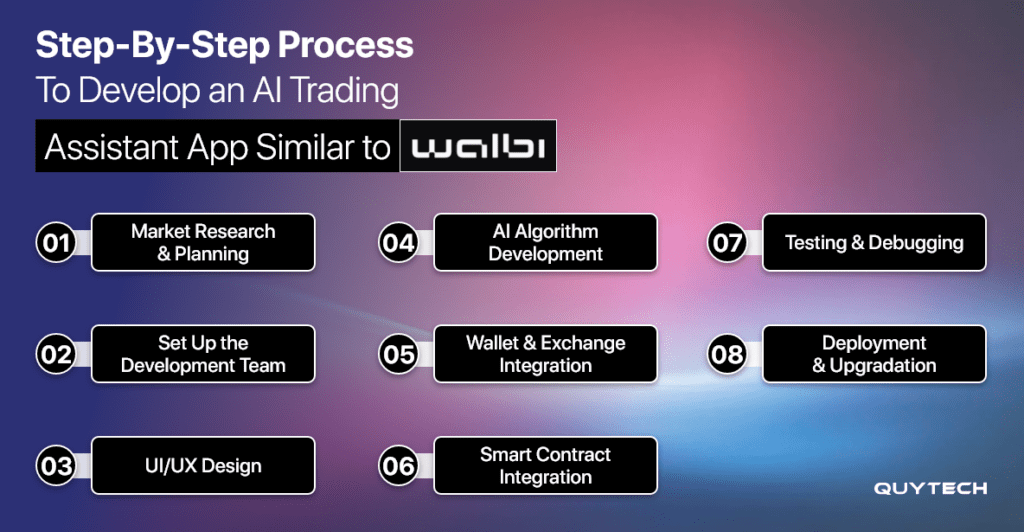
1. Market Research & Planning
Before starting to develop an AI trading assistant app like Walbi, you would require a strong foundation. You need to understand the current crypto trading landscape, run an AI trading platform comparison of your competitors, what users expect from AI trading assistant apps, and where the gaps are.
You need to define your target market. Determine whether you are building the app for retail traders who want automated help or pro traders who seek advanced tools and more customization.
Also, don’t forget industry compliance. Consult lawyers and legal experts to ensure that your app aligns with local laws, regulations, and licensing requirements before developing an app like Walbi.
2. Set Up the Development Team
The next step is to set up a development team. You can hire mobile app developers who have experience in building tailored AI trading assistant software and deep expertise in the technical and crypto domains.
Moreover, you can outsource the project to a leading offshore development company. It would be a more streamlined method of developing the app. The development company will handle the development part, and you will focus on your work.
3. Gather the Required Tech Stack
Here’s a table highlighting the required technology stack needed for developing the Walbi trading app:
| Component | Technology Stack |
| Frontend (Mobile App) | Flutter / React Native (for cross-platform development) |
| Frontend (Web App) | React.js / Vue.js |
| Backend | Node.js / Python (Django or FastAPI) |
| AI/ML Models | Python (TensorFlow, PyTorch, Scikit-learn) |
| Sentiment Analysis | NLP Models (BERT, GPT APIs, spaCy) |
| Crypto Wallet Integration | Web3.js / Ethers.js / WalletConnect |
| Exchange API Integration | Binance API, Coinbase Pro API, Kraken API, etc. |
| Database | PostgreSQL / MongoDB / Redis (for caching) |
| Authentication | OAuth 2.0, JWT, Multi-Factor Authentication (MFA) |
| Cloud & Hosting | AWS / Google Cloud / Azure |
| Push Notifications | Firebase Cloud Messaging (FCM), OneSignal |
| Security | SSL Encryption, Smart Contract Audits, DDoS Protection, OWASP Compliance |
| DevOps & CI/CD | Docker, Kubernetes, GitHub Actions, Jenkins |
| Analytics & Monitoring | Google Analytics, Mixpanel, Sentry, LogRocket |
*Please note that these are only recommendations. You can use other technology stacks too, if they align with your goals and requirements.
4. UI/UX Design
The UI/UX design plays a huge role in user trust and retention. Even powerful AI tools won’t help if users feel overwhelmed. So, it is necessary that you create the UI of your app to be intuitive and easy to navigate.
While designing the UI/UX, follow the industry best practices. Create minimalistic and clean interfaces that show market data, trade signals, charts, and P&L clearly.
Also, organize the features in a way that users can easily access them with one or two taps only. When creating the UI/UX for the Walbi-clone app, ensure that you create it for all screen sizes.
5. AI Algorithm Development
This is the core part of your AI trading assistant app development. You need to engage your mobile app developers to backtest models with market datasets. Collect data (historical data) for Bitcoin, Ethereum, and others.
Afterwards, use real-time APIs (like CoinGecko, Binance, or CryptoCompare) to feed current market data. Develop and train your machine learning trading systems to detect trends, reversals, and signals based on both technical indicators and external sentiment.
You can also leverage natural language processing (NLP) for sentiment analysis to sharpen your predictive trading analytics.
6. Wallet & Exchange Integration
To enable live trading, you must connect with crypto wallets and major exchanges. You can enable Hybrid Trading Options.
Just like Walbi, you can support CeFi (Centralized) trades via Binance, Coinbase, Kraken, etc, and DeFi (Decentralized) trades via WalletConnect, MetaMask, etc.
Also, use secure APIs provided by platforms like Binance, Coinbase Pro, Kraken, and others. These APIs will let your AI trading assistant app, like Walbi, fetch market prices, execute trades, and monitor portfolios in real time.
7. Smart Contract Integration
If you’re planning to offer DeFi features like staking, farming, or wallet-based trading in your AI trading assistant app, similar to Walbi, then you must develop smart contracts for your app.
Write smart contracts, get them audited by security firms to prevent hacks and exploits, and deploy on the testnets before going live.
Moreover, ensure that these smart contracts are gas-efficient and integrate smoothly with your Walbi-like app’s frontend.
8. Testing & Debugging
You will never want your app to crash when users are executing trades. Hence, you must test your smart trading assistant app thoroughly before going live.
Conduct load testing for Trade Engines. Simulate high-frequency trading environments to see how your backend handles spikes.
Additionally, check the security of your app. Ensure end-to-end encryption, protection from DDoS and SQL injection, and compliance with OWASP.
9. Deployment and Upgradation
Once everything is tested, it is time to launch the app. Publish your Walbi-clone app on the Google Play Store and Apple’s App Store. Also, release the web version for desktop traders.
Your app has been launched; however, the job is not finished yet. You need to monitor your app’s performance using different key performance indicators (KPIs).
Along with this, you also need to keep upgrading the app with the latest versions, functionalities, and technologies to keep the Walbi-clone AI trading assistant app relevant in the crypto space.
You Might Be Interested In: Complete Guide to Developing AI Crypto Tokens

Top Features to Integrate Into an AI Trading Assistant App like Walbi
The following are the best features to add to an AI trading assistant mobile app similar to Walbi.
1. AI-Powered Trading Assistant
This is an AI trading assistant that analyzes real-time market data and behavior to offer users automated trading suggestions and insights.
2. Real-Time Market Signals
This feature of the Walbi-clone app delivers buy/sell alerts based on AI analysis of charts, indicators, and sentiment trends.
3. Hybrid Trading (CeFi + DeFi)
This supports both centralized exchange trading and decentralized wallet transactions, giving flexibility to users.
4. Non-Custodial Wallet Integration
The wallet integration feature in the AI trading assistant app allows users to trade directly from their own crypto wallets without giving up custody of their assets.
5. Smart Order Execution
This AI-powered feature optimizes trade execution using algorithms that reduce slippage and enhance profitability for users.
6. Advanced Charting Tools
These are high-end tools that users can use for deep technical analysis. These come with indicators and overlays, enhancing users’ trading experiences.
7. Sentiment Analysis
Walbi-like app’s this feature uses artificial intelligence and NLP to scan social media and news to gauge market sentiment and inform trading decisions.
8. Leverage & Margin Trading Support
This feature enables high-risk traders to trade with leverage, offering potential for higher gains (with warnings/limits).
9. Staking & Yield Farming Options
The Staking and Yield Farming feature works like an automated investment assistant, offering users additional ways to earn passive income by locking assets or joining liquidity pools.
10. Referral & Loyalty Program
This feature of the AI trading assistant app incentivizes user growth with bonus rewards, NFTs, or commissions for bringing in new users.

Additional Considerations for the Walbi Clone AI Trading App Development
Here are some more considerations that you must implement when developing an AI trading assistant mobile app, similar to Walbi.
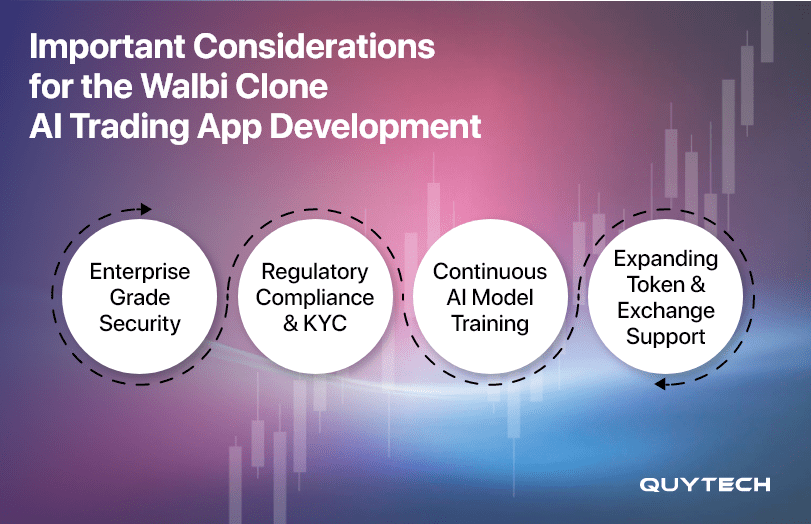
1. Enterprise-Grade Security
You must protect users’ assets and financial and personal information. So, you must implement high-end security measures into your app, such as end-to-end encryption, multi-factor authentication (MFA), and smart contract audits.
2. Regulatory Compliance & KYC
Crypto laws vary by country, and non-compliance can lead to shutdowns or bans. Therefore, you must integrate region-based KYC/AML workflows and give users optional identity verification. Along with these, stay updated with evolving financial regulations.
3. Continuous AI Model Training
AI’s intelligence is driven by the data it learns from. So, at frequent intervals, retrain your AI investment assistant using updated market data, user activity, and feedback to enhance the accuracy of trade signals and sentiment analysis.
4. Expanding Token & Exchange Support
Make your virtual trading assistant app like Walbi future-proof. How? By adding new cryptocurrencies, DeFi protocols, and popular exchange integrations to meet evolving market demands.
Read Also: How to Develop an Algorithmic Trading App?
How Quytech Can Help With Developing an AI Trading Assistant App Like Walbi
When it comes to building a powerful and feature-rich AI trading assistant app like Walbi, Quytech is the partner you can trust.
With years of experience in AI, blockchain, and fintech app development, our team brings the technical expertise and industry insight needed to build cutting-edge trading assistant AI platforms.
Our skilled developers have already delivered successful AI trading solutions, such as Project 10, Hazel, Patricia, and many others, that are helping users make smarter trading decisions and boost their profitability.
So, whether you want to develop an app like Walbi from the ground up or just integrate an intelligent market assistant in your existing trading app, our team can tailor every feature to your goals.
Conclusion
Crypto trading is on the rise. Traders are using high-tech apps and platforms to trade cryptos and make profits. However, there are also some platforms, such as Walbi, that make trading better.
AI trading assistant apps like Walbi provide help to users to understand the market better, create strategies for them, and help them execute the trades, so that they can maximize their profitability.
Such apps are in great demand right now. If you develop a Walbi-clone app, you can cater to a huge market in front of you. So, don’t wait anymore, and reach out to our team now.

Key Takeaways:
- The global AI trading platform market is on an exponential rise, going from $27.85 billion in 2026 to $45.74 billion in 2030.
- Walbi is an AI trading assistant app that assists users with crypto trading. The app offers an intelligent assistant and a blend of two trading models, DeFi and CeFi.
- The process of developing an app like Walbi begins with market research, team and requirement gathering, and UI/UX development. This is then followed by AI algorithm development, wallet and exchange integration, deployment, monitoring, and maintenance.
- Core features to integrate in a trading app include AI trading assistant, real-time market signals, hybrid trading, non-custodial wallets, smart order execution, advanced charting tools, and referral and loyalty programs.
- Some considerations for developing an AI trading assistant like Walbi are ensuring enterprise-grade security, regulatory compliance and KYC, continuous AI model training, and expanding token and exchange support.
Frequently Asked Questions
There are many popular AI trading assistant apps similar to Walbi, like 3Commas, Pionex, Kryll, and Stoic.
Yes, using AI trading apps is legal in most countries, as long as the platform complies with financial regulations like KYC/AML. However, always check your local laws before developing and launching such an app.
The cost to develop an AI-powered trading assistant app depends on the features, complexity, APIs, tech stack, development team, and more. If you want a feature-packed AI-powered application, the cost can be higher compared to a simpler one with fewer features.
To ensure that the AI trading assistant app is giving the right advice and recommendations, you need to train the AI with quality historical and live market data, regularly backtest trading models, and update algorithms to match current market conditions.
The time duration depends on the complexity of the app. For an MVP, the time duration can be around 4- 6 months. As for a fully-featured app, it can take 9–12 months or more.
Yes! You can build a trading app like Walbi without a large in-house AI team by partnering with an AI app development company. You can also hire AI developers for the same.
