If you keep up with the unfolding trends, you might be aware of the current most-talked-about topic, that is, AI in CCTV monitoring. Expected to unlock a value of $28.76 billion by 2030, AI-powered CCTV systems are bringing a significant transformation in surveillance.
Traditional surveillance tells the story well. Government agencies, corporations, and even people have installed CCTV cameras in public places, offices, malls, shops, private properties, and more. And the reason is quite obvious, CCTV cameras are the easiest way to ensure security or surveillance. But the main problem with them is that they can only record.
As these ain’t AI-powered CCTV systems, they do not analyze video to detect any kind of threat or inappropriate behavior of people, and alert the authorities in real-time.
The adoption of AI has addressed this problem completely. AI technology has made CCTV cameras smarter by enabling them to detect unusual patterns and alert surveillance teams immediately.
In this blog, we will explain to you the use of AI in CCTV video surveillance and monitoring, and how you can also implement intelligent video surveillance systems to enhance your property security. So, let’s start.
How AI is Impacting Video Surveillance
In traditional CCTV monitoring systems, the cameras capture live footage. This data, or footage, is then transmitted to the recording devices, such as a DVR, through coaxial cables.
The footage is stored on the DVR (digital video recorder) from where it can be accessed for further analysis. Moreover, in traditional CCTV systems, there is a need for monitoring staff who have to keep an eye on the screens of monitors 24/7 connected to the DVR to monitor for surveillance.
On the other hand, the innovative AI-powered smart CCTV surveillance system works by recording the footage and analyzing it, providing information, and alerting the authorities about any kind of suspicious activities in real-time.
These AI-powered CCTV systems leverage advanced machine learning algorithms to analyze live footage and detect objects, people, and their activities with utmost accuracy. These cutting-edge video surveillance solutions eliminate the need for human monitoring for surveillance.
The Numbers Behind Intelligent Video Surveillance
Source: Markets and Markets
- By the end of 2026, the global artificial intelligence for video surveillance market is expected to reach a value of $4.04 billion.
- The CAGR for this forecast period from 2026 to 2032 is estimated to be 17.9%
- Region-wise, the smart CCTV surveillance market is anticipated to be dominated by the Asia-Pacific region, with an estimated share of 45-50%.
- As for components, the software segment is expected to have a CAGR of 18-22% from 2026 to 2032.
Edge AI vs Cloud-based AI CCTV Monitoring
Here’s a table explaining the differences between edge AI vs cloud AI CCTV monitoring:
| Feature | Edge AI surveillance | Cloud AI surveillance |
| Processing location | All analysis happens directly on the device itself | Footage is sent to remote cloud servers for processing |
| Latency | Near-instant response with no network round-trips involved | Slightly delayed due to data traveling to and from the cloud |
| Internet dependency | Operates fully even when the internet connection is unavailable | Requires a stable, high-speed internet connection at all times |
| Real-time performance | Delivers faster alerts since processing never leaves the device | Moderate speed, affected by network latency and server load |
| Scalability | Scaling requires purchasing and installing additional hardware | Easily scales up or down by adjusting the subscription plan |
| Data privacy | Footage never leaves the premises, offering stronger privacy control | Privacy depends entirely on the cloud provider’s data handling policies |
| Storage | Capped by local hardware capacity, requiring manual upgrades | Virtually unlimited storage that grows automatically with demand |
How AI-Powered CCTV Monitoring Works
By now, you can tell that AI-based security monitoring is not a static process of recording environments like traditional ones. It proactively captures and analyzes every video feed in real-time. Here’s a section explaining how an AI video surveillance system works:
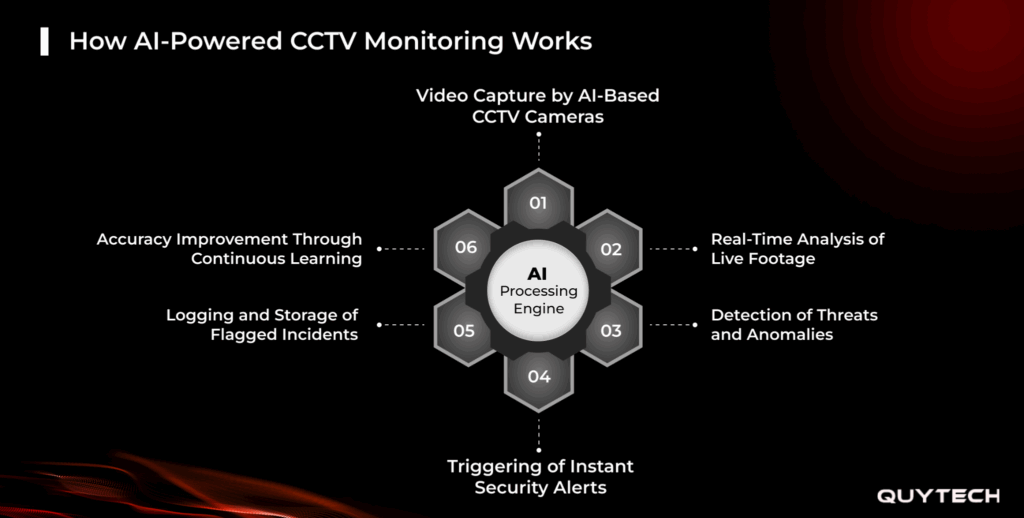
1. Video Capture by AI-Based CCTV Cameras
The first step in AI CCTV monitoring is similar to traditional monitoring systems. It begins with the AI-enabled CCTV camera capturing live video feeds.
2. Real-Time Analysis of Live Footage
Once the AI surveillance cameras capture the feeds, the real-time video analytics software transmits them to the AI processing engine, which begins its work. It analyzes the footage as it is captured and identifies objects, people, vehicles, and activities.
3. Detection of Threats and Anomalies
After analysis, the AI model compares the video against trained data. AI-powered CCTV threat detection comparison helps in identifying anomalies like weapons, unauthorized persons entering restricted areas, and similar activities.
4. Triggering of Instant Security Alerts
Once anomalies are detected, the AI video surveillance system triggers real-time security alerts instantly. This helps security personnel in taking action on the incident in real-time rather than acting after damage is done.
5. Logging and Storage of Flagged Incidents
The working mechanism of AI-based security monitoring systems does not end at detection and alerting. It logs and stores all the incidents for future referencing.
6. Accuracy Improvement Through Continuous Learning
Apart from storing analyzed feed data, AI-powered cameras and recording solutions also utilize every incident encountered to train themselves. This self-training helps the system in enhancing detection accuracy and adapting to evolving threats.
Top Use Cases of AI in CCTV Monitoring
Now, let’s discuss the top use cases of AI in CCTV systems for enhanced video surveillance and monitoring.
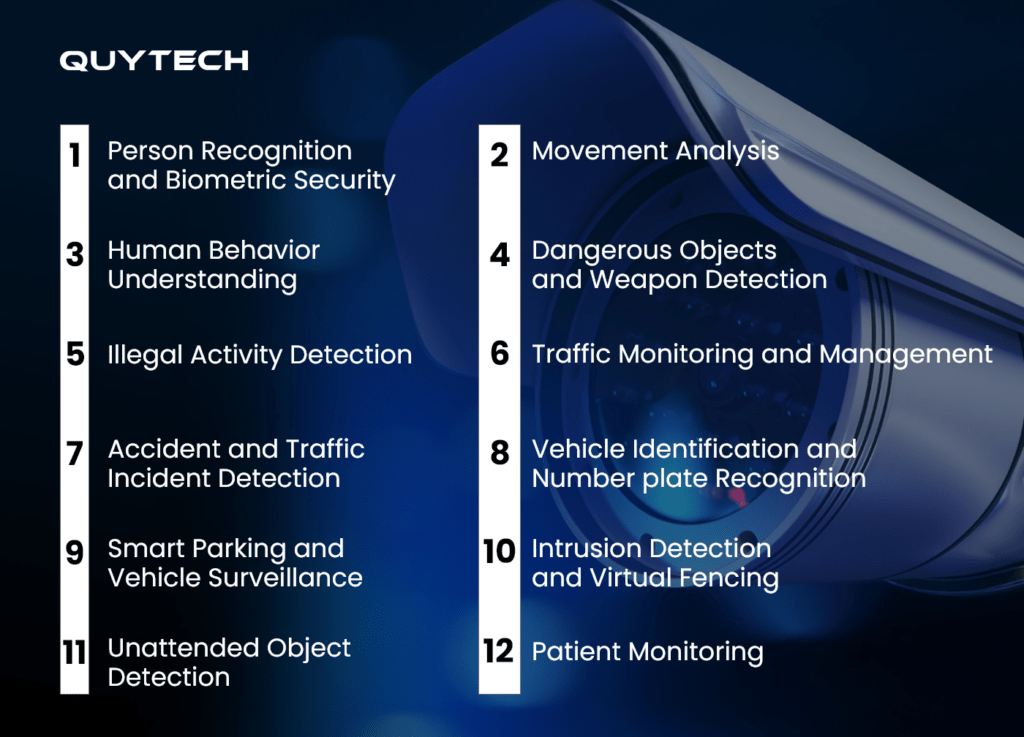
1. Person Recognition and Biometric Security
Artificial intelligence is used in CCTV video surveillance to identify persons by analyzing their facial features and body language, and is also utilized by organizations or for marking attendance. AI-powered CCTV attendance uses cameras that are leveraged by private and government institutions to capture and identify people, using facial recognition technology, in the video footage.
The AI captures the person’s image, crops the face area, and applies image classification to match it with the image databases. Security agencies leverage AI in CCTV monitoring to identify wanted persons.
2. Movement Analysis
Another use case of AI in CCTV monitoring is movement analysis, in which the artificial intelligence CCTV cameras capture the movements of people and vehicles, and analyze them using path modeling techniques to understand the movement patterns.
Moreover, CCTV-integrated monitoring systems are used to predict suspicious movements that may lead to something unfortunate. That is why AI CCTV monitoring is used in places like schools, malls, commercial locations, and other similar places.
3. Human Behavior Understanding
AI CCTV video surveillance is used to understand human behavior, leveraging predictive analytics. By evaluating behavior patterns, real-time CCTV monitoring using video analytics can flag unusual behavior and alert the authorities about any potential mishaps.
Human behavior understanding with the help of artificial intelligence plays a vital role in situations like brawls, robberies, terrorist attacks, mosh pits, and more. Security teams use AI to understand and detect unusual behaviors and take timely necessary actions.
4. Dangerous Objects and Weapon Detection
With object detection capabilities, AI-enabled CCTV monitoring systems are used to detect any kind of weapons carried by people at places like airports, hotels, political meetups, seminars, and more.
The artificial intelligence CCTV cameras record live footage, analyze it in real-time, and highlight any objects that may resemble weapons like pistols, knives, grenades, rifles, and others, alerting security authorities on time.
5. Illegal Activity Detection
AI-powered CCTV monitoring systems are used to detect illegal activities and events. The AI model in these monitoring systems leverages popular techniques, such as deep learning and pose estimation, to understand illegal activities and alert the security teams in real-time.
AI is integrated into CCTV monitoring systems to handle activities, such as crimes, smuggling, theft, and more, that violate the law.
Moreover, AI is also leveraged by private companies to detect activities that violate workplace guidelines, like phone use during work, employees sitting idle, unauthorized access to restricted areas, and more.
6. Traffic Monitoring and Management
AI-integrated CCTV surveillance is used by traffic administrators to monitor and manage traffic. The AI is used to analyze live traffic video footage to detect traffic violations, like wrong parking, rash driving, safety violations, etc., and issue tickets and fines against the violators.
Furthermore, traffic administrators leverage AI in CCTV to analyze traffic jams in the city and optimize routes to clear the congestion, improving traffic mobility
7. Accident and Traffic Incident Detection
Traffic management teams use AI in CCTV monitoring to detect accidents and incidents like landslides, roadway failures, and others, and take necessary steps to avoid any kind of fatal accidents.
These AI-powered surveillance solutions use deep learning, computer vision, and machine learning techniques to scan live footage and detect accidents or any other kind of incident that may lead to accidents.
8. Vehicle Identification and Numberplate Recognition
Another use of AI in traffic surveillance and management systems is identifying vehicles and their number plates.
Traffic management teams use AI CCTV cameras that leverage computer vision, object detection, Optical Character Recognition (OCR), and other techniques to recognize vehicles and their number plates from the live traffic footage.
AI is mainly used by security agencies when they are looking for suspected vehicles.
9. Smart Parking and Vehicle Surveillance
Artificial intelligence is used to power CCTV video surveillance to manage smart parking and monitor vehicles parked in the parking lot. lot
These video surveillance system AI use machine learning, computer vision, and deep learning to detect vehicles parked and inform about the empty spaces available, in real-time.
Also, the monitoring systems can be connected with various artificial intelligence-enabled smart cameras with the help of the Internet of Things (IoT) technology, allowing for remote vehicle monitoring and collecting data, such as the type of vehicle, entry time, time the vehicle is parked, and exit time.
These AI-powered CCTV monitoring systems allow parking businesses and attendants to manage vehicle parking and monitoring more efficiently.
10. Intrusion Detection and Virtual Fencing
Intrusion detection is another use case that enables property monitoring using video analytics and AI. This creates a virtual fence for restricted areas and monitors them around the clock. Whenever anyone intrudes on these virtual fences, alerts are sent to the concerned teams, enabling them to take timely action.
Many industries, such as the military, railways, property owners, and others, leverage AI CCTV monitoring to create virtual fencing and detect intrusions
11. Unattended Object Detection
AI technology powers CCTV monitoring systems to detect unattended objects in live footage. AI security camera monitoring enables security teams to find lost objects, such as luggage, and identify objects that might be placed there to cause a disaster.
The surveillance systems leverage object detection and computer vision AI to detect unidentified and unattended objects and send alerts to the concerned authorities.
12. Patient Monitoring
Lastly, AI CCTV monitoring is used in the healthcare industry to monitor patients and their movements. Healthcare professionals use AI in CCTVs to track patients and detect unusual activities or movements.
Moreover, it is also used by individuals to monitor elderly people and children at their homes.
The AI systems leverage computer vision and deep learning to detect usual patterns, and based on the analysis, they send an alert to the concerned person.

Benefits of Implementing AI in CCTV Monitoring
The advantages of integrating artificial intelligence (AI) in CCTV monitoring are as follows:
1. AI in CCTV Enhances Threat Detection
AI in CCTV monitoring has also enhanced threat detection by analyzing the live footage in real-time and detecting patterns that signal suspicious activities, allowing concerned authorities to intervene promptly.
2. AI in CCTV Monitoring Eliminates Errors
AI CCTVs have played a major role in eliminating errors in video surveillance. They have improved the accuracy and efficiency of intelligent video analytics with the help of AI face detection, AI object detection, car number plates, suspicious activities, etc., with high precision, reducing the chances of false alarms.
3. AI in CCTV Provides Advanced Analytics and Insights
Providing advanced analytics and insights is another way the AI in CCTV monitoring is benefiting video surveillance. AI extracts important data from video footage and allows authorities to get insights into people’s behavior, activity patterns, and other trends. Later, these insights are used to optimize operations and improve safety protocols.
4. AI in CCTV Reduces Workload
AI in CCTV monitoring reduces the workload of the security and surveillance teams. It analyzes footage in real-time, detects the faces of people and patterns of suspicious activities, and alerts the authorities. Thanks to AI in CCTV monitoring, there is no longer a need for a person to sit in front of screens and analyze footage manually.
5. AI in CCTV Offers Scalability and Adaptability
AI CCTV monitoring systems can be easily scaled and adapted to fulfill various security and video surveillance requirements. Moreover, it can be used in various industries, such as manufacturing, finance, retail, public services, education, healthcare, and others, for specific needs.
For instance, let’s go through these CCTV use cases in retail stores, where AI CCTV systems can be installed to detect shoplifting, in healthcare, these can be used for patient monitoring, and in educational institutions, these can be used to monitor students and detect events like bullying or fights.
6. AI in CCTV Saves Costs
Lastly, artificial intelligence in CCTV monitoring helps reduce costs by eliminating the need for human security personnel to be present on-site to watch for anything suspicious. AI can analyze the video footage and detect patterns in real-time, reducing dependency on human monitoring, thus reducing costs.
How to Implement AI-Powered CCTV Monitoring?
Follow these steps to implement AI-powered CCTV surveillance for your business.
1. Assess Your Surveillance Needs
To implement AI-powered CCTV monitoring, you need to first assess your surveillance needs. You need to figure out for what purpose you are integrating AI in your CCTV monitoring systems.
Is it for person recognition, human behavior understanding, detecting illegal activities, or any other reason? Also, you need to decide whether to hire AI developers for the task or outsource the project to a leading AI mobile app development company.
2. Choose the Right AI Technology
Depending on the purpose, you must choose the right technology to power your CCTV surveillance systems.
For instance, if your goal is to identify a person, you need to implement facial recognition technology, whereas if your goal is to detect unidentified objects, you will need object detection technology.
Different goals will require different technologies, hence you need to choose the right one as per your requirements.
3. Develop AI Software
After choosing the ideal technology, start building the AI software to power the AI-based video surveillance systems.
Develop AI algorithms that can perform video analysis in real-time, set up data infrastructure to store and manage footage, using cloud services or local storage solutions, and configure the systems to send notifications or alerts for detected events.
Moreover, ensure data privacy and security compliance while developing the AI for CCTV monitoring.
4. Integrate Existing Systems
Once the AI video analytics software is developed, integrate it with the existing CCTV monitoring systems. You need to ensure that your existing software is capable of handling the new AI software. If not, then you need to invest in bringing upgraded surveillance systems.
5. Testing
Run the AI-enabled CCTV monitoring systems to test their performance and accuracy. Identify bugs and glitches, if found, and fix them. You need to ensure that your AI CCTV monitoring systems are providing the relevant results before deploying them across your business.
6. Deploy
Once the testing is complete, deploy the AI CCTV monitoring in your business infrastructure. Also, you need to train your employees how to use the new monitoring systems efficiently to get maximum results. Start with small areas, and if successful, expand to the larger infrastructure.
7. Maintenance
Once you deploy the AI CCTV monitoring systems, you need to regularly update the software with new functionalities and data, so that it can adapt to new requirements. Also, you must maintain hardware and check its performance from time to time to ensure seamless operations.
Challenges of AI-Powered CCTV Monitoring and Their Solutions
Several challenges may negatively impact your AI-powered CCTV monitoring. Here, we have provided the top challenges of AI-enabled CCTV camera surveillance along with their solutions.
1. Privacy Concerns
A major challenge of AI-powered CCTV monitoring is the violation of privacy. The AI-powered CCTV monitoring systems capture footage and analyze people’s information. This raises a huge concern regarding the violation of privacy rights and infringement.
Solution
You can tackle the challenges related to privacy concerns by following guidelines that respect individual privacy, along with effective surveillance.
2. Data Security and Integrity
Another challenge in the use of AI in CCTV monitoring is data security and integrity. AI-powered CCTV surveillance systems gather crucial information about people and objects. Hence, there is a huge challenge to protect this information from unauthorized access and hacking.
Solution
To tackle this challenge, you can implement high-end cybersecurity measures and data protection laws to protect data from unauthorized access and maintain its integrity.
3. Technical Challenges
Developing software and AI agents to power CCTV monitoring solutions requires deep technical expertise in AI, machine learning, model training, deep learning, computer vision, and other technologies.
Solution
You can hire top AI developers and engineers to develop and deploy your automated surveillance systems. Moreover, you can also outsource the project to a leading offshore app development company to develop it efficiently.
4. Ethical Considerations
AI CCTV monitoring requires capturing and analyzing the faces and behaviors of individuals. The chances of algorithm biases and their unintended consequences raise ethical considerations.
Solution
You must use AI responsibly and follow ethical guidelines when using AI-powered CCTV monitoring systems to tackle this particular challenge.
Conclusion
AI is transforming traditional CCTV monitoring and allowing organizations to conduct surveillance more effectively. The advanced video analytics leverages different technologies and advanced algorithms, such as machine learning, facial recognition, object detection, OCR, deep learning, and computer vision, to capture and analyze video footage in real-time and provide useful insights to the security teams.
In this blog, we have explained 10+ use cases of AI in CCTV monitoring in different industries and for different purposes. If you are also interested in developing an AI-powered CCTV monitoring system or want to integrate AI into your existing systems, feel free to reach out to Quytech, the top AI development company.
We have developed numerous AI CCTV monitoring solutions and software for businesses and startups, tailored to their custom requirements. For more information, click here.
FAQs
An AI CCTV system is a surveillance solution powered by artificial intelligence. These systems can detect anomalies and threats in real time and send automated alerts accordingly.
Machine learning can be used for CCTV video surveillance for learning from historical footage data. It helps AI systems in learning to distinguish between normal and abnormal activities and objects when analyzing video feeds.
AI in CCTV features are advanced, like understanding behavioral context, recognizing faces, reading number plates, and generating intelligent alerts, which smart security systems do not provide. They offer basic features like motion detection and remote viewing through an app.
The industries seeing the most value from video surveillance use cases powered by AI are:
Retail
– Healthcare
– Transportation
– Banking, and
– Smart city infrastructure
Yes, existing CCTV cameras can be upgraded to AI CCTV systems, as it does not require changing hardware. AI CCTV surveillance systems are software-based and can be integrated within existing infrastructure.
Yes. AI camera monitoring systems can work in low-light or nighttime conditions if they are supported with infrared CCTV cameras.
An on-premise AI CCTV system offers complete data ownership to organizations. As for cloud-based AI CCTV surveillance systems, their data ownership depends on the conditions offered by the provider.
