Summary:
Automation is the driving factor in today’s business landscape. And AI agents and super agents are leading that charge. AI agents bring task automation, while super agents support end-to-end complex workflow automation. AI agents bring in advantages like autonomous decision-making and 24/7 availability, along with task automation and cost-efficiency. On the other hand, a super agent brings a goal-oriented approach. These include cross-platform orchestration, complex task automation, high adaptability, and scalability.
You might relate to how 2025 was dominated by AI agents. Every app, every headline, every conference was either about enterprises announcing AI agent adoption or racing to deploy the next automated workflow. This hype around AI agents led to a surge in its global market, unlocking a value of 7.63 billion in 2025. But here’s the truth: the early mover advantage is gone. The organizations that want to lead aren’t asking “should we adopt AI agents?” anymore. They’re already asking “what’s next?”
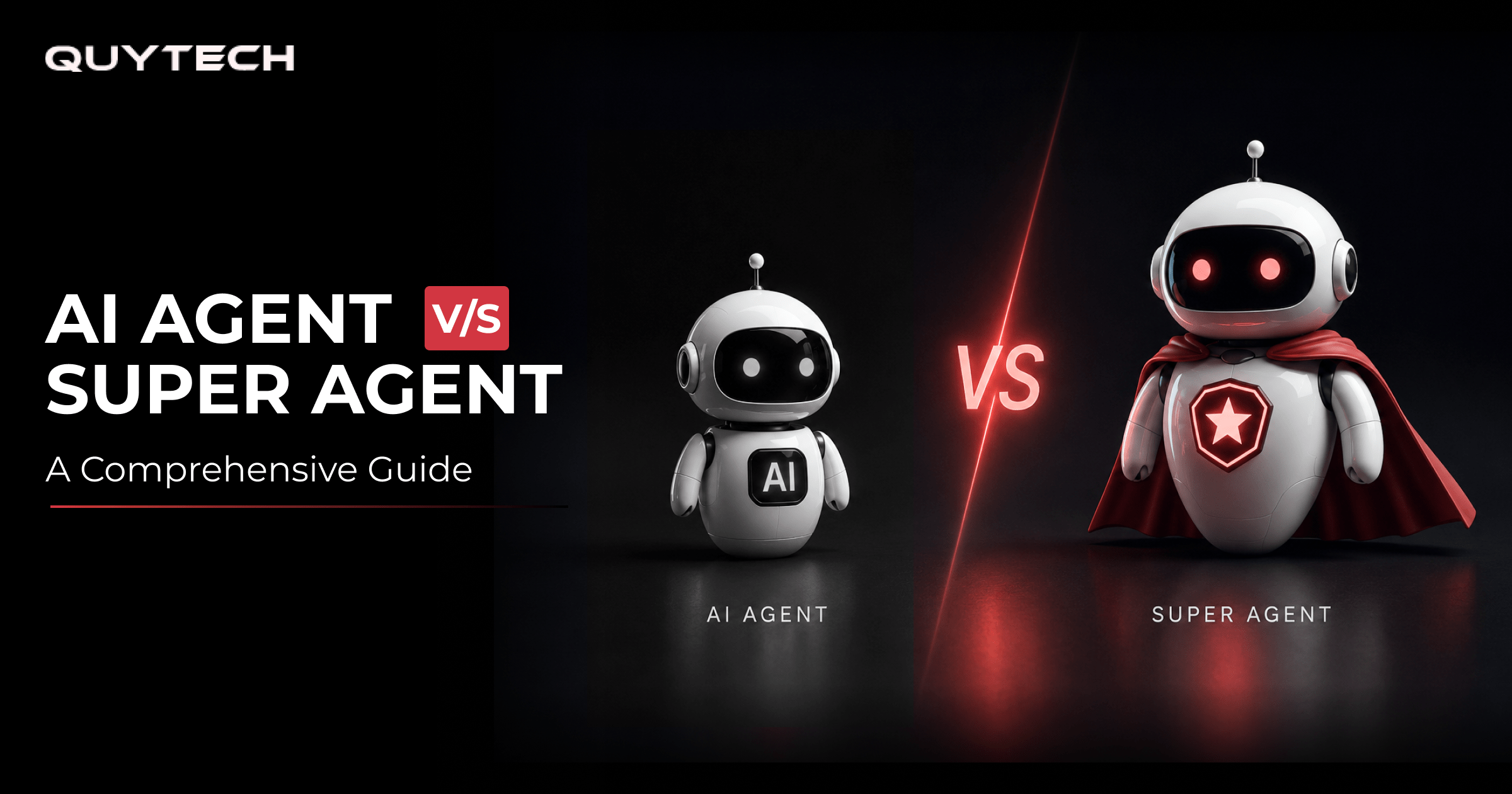
And the answer to that question is ‘super agents’. Similar to AI agents, super agents also carry out tasks, but what makes them different is that they are like managers handling subordinates(sub-agents) of different capabilities to automate entire workflows without needing constant human attention. Super agents autonomously orchestrate entire workflows and coordinate teams of specialized agents. But the differences between super agent vs AI agents run much deeper than that.
This blog takes a deep dive into the comparison of AI agents vs super agents, covering everything from definitive differences to technical ones, along with real-world use cases explaining where each applies.
What Is an AI Agent?
AI agents are software systems that are capable of performing assigned tasks automatically. Unlike traditional rule-based systems, AI agents do not require constant human intervention to function; they can execute their assigned tasks independently.
AI agents function by understanding the context, where they derive all the knowledge they would need to work on the assigned task. This step is followed by ‘thinking’, where the agent decides the best course of action to complete the task effectively. Once the agent creates a proper execution, it puts it into action. Along with this, the AI agents are also capable of observing and retaining short-term as well as long-term context.
Advantages of an AI agent
Here are some of the main advantages of an AI agent:
Autonomous Decision-Making
Autonomous AI agents do not need constant human intervention to carry out assigned tasks. They can make their own decisions on how to accomplish their goal and when to do that based on their environment.
24/7 Availability
Unlike human workers, AI agents do not get tired, take breaks, or leave work. They have 24/7 availability and work with the same efficiency throughout the day. This makes them ideal for routine tasks.
Faster Task Execution
AI agents are capable of executing tasks faster than humans can. This helps organizations complete work faster, avoid delays, and boost overall productivity, all while eliminating human error.
Scalability
AI agents are easily scalable. Unlike manual processes that require hiring more people to scale, new agents can be introduced without setting up a completely new system or disrupting the harmony of existing processes.
Cost-Efficiency
AI agents bring cost efficiency to organizations. They take over repetitive tasks, which helps in directing manual efforts into strategic areas, naturally bringing both operational and cost efficiency.
You Might Also Like: How Companies Are Using AI for Internal Knowledge Management
What Is a Super Agent?
A super agent is a software system that functions as an orchestrator. It manages how multiple sub-agents, tools, and workflows interact. In simple words, you can think of a super agent as a manager, handling everything from what tasks each subordinate has to do to how they will interact within the team and with other departments.
Being an orchestrator, the super agent does not execute tasks on its own; it analyzes the objectives, breaks them into smaller tasks, and allocates them to different agents after assessing their capabilities. It further ensures coordination among the tasks done by sub-agents. This helps in ensuring the timely execution of the overall objective.
Advantages of a Super Agent
Here are some of the main advantages of a super agent:
Goal-Oriented
Super agents take a goal-oriented approach rather than a task-focused one. They emphasize achieving the overall objective by ensuring the completion of sub-tasks by respective sub-agents.
Cross-Platform Orchestration
Unlike traditional AI agents, super agents have cross-platform orchestration capabilities. This means that they can easily connect different tools, systems, and workflows, saving time and increasing productivity.
Handles Complexity & Ambiguity
While AI agents are capable of handling defined tasks, super agents can tackle the complex and messier ones. They have intelligent planning capabilities, which help them work on objectives that do not have a clearly defined path of action.
Highly Adaptive
Super agents are highly adaptive in nature. They can adapt to all sorts of situations and sudden changes in real-time. This makes them capable of ensuring objective accomplishment even when the environment is not favorable.
Greater Scalability
Super agents offer greater scalability. They can manage increasing workloads, a larger user base, and multiple complex processes without needing infrastructural changes or significant additional resources.
People Also Like: Hyper-Personalization in Mobile Apps with Agentic AI
AI Agent vs Super Agent: Key Differences
Now, let’s explore some of the core differences between super agent vs AI agents with the help of this table:
| Aspect | AI Agent | Super Agent |
| Purpose | Designed to perform a specific task or solve a particular problem. | Manages and executes complex business objectives involving multiple tasks and systems. |
| Scope of Work | Handles individual tasks such as answering queries, generating content, or analyzing data. | Handles complete workflows. Coordinates multiple tasks from start to finish. |
| Decision-Making | Makes decisions within a limited and predefined context. | Makes broader, context-aware decisions across multiple processes, systems, and objectives. |
| Coordination | Works independently or within a single workflow. | Orchestrates and coordinates multiple AI agents, tools, and systems simultaneously. |
| Automation Level | Automates specific activities. | Automates end-to-end business processes and multi-step operations. |
| System Integration | Typically connects to a limited number of tools or data sources. | Integrates with multiple applications, databases, APIs, and enterprise platforms. |
| Scalability | Scales within its assigned function. | Scales across departments, workflows, and enterprise-wide operations. |
| Adaptability | Responds to task-specific inputs and conditions. | Dynamically adapts workflows, agent assignments, and actions based on changing business needs. |
| Example | A customer support agent who answers customer questions. | A customer experience super agent that manages support, analyzes customer sentiment, triggers marketing actions, and coordinates multiple specialized agents. |
| Role in AI Ecosystem | Functions as a specialist. | Functions as an orchestrator and coordinator of specialists. |
How Do AI Agents and Super Agents Work?
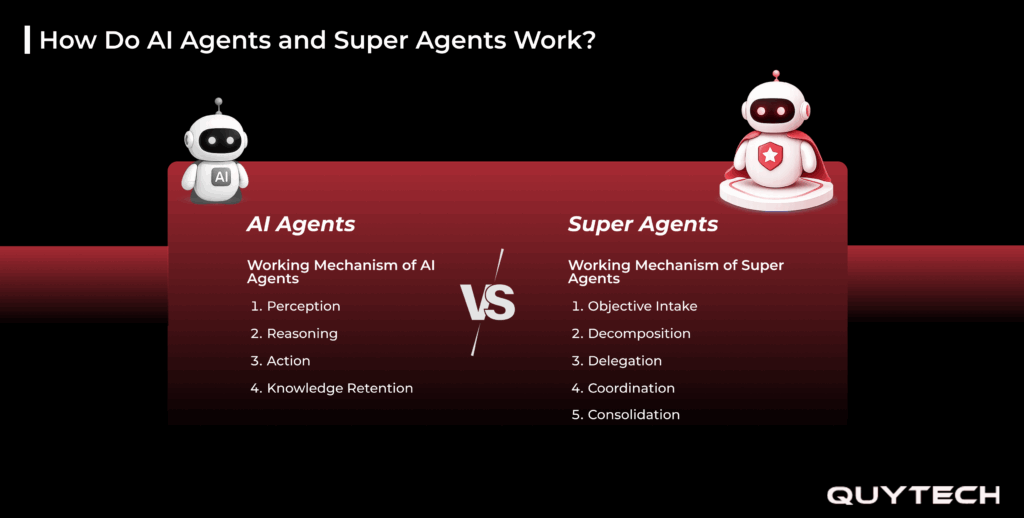
Now that you are aware of the key differentiating points of super agent vs AI agents, let’s walk you through the difference in their working mechanisms. Here’s how it goes:
Working Mechanism of AI Agents
Here’s how AI agents function:
1. Perception
AI agents operate by deriving the information they need from their environment. The information could be an input from a human user, a data feed, a system trigger, or a response.
2. Reasoning
After receiving input, AI agents begin their reasoning process by analyzing the input to understand what needs to be done and how it needs to be done. This is the process where AI agents create their action plan.
3. Action
In this step, AI agents take the action that they planned in the previous step. It generally includes responding to the input or triggering a workflow. This step is where the plan is actually acted upon.
4. Knowledge Retention
The final step in the working mechanism of AI agents is knowledge retention. Here, the agents observe the outcome of their actions, retain it, and learn from it to perform even better in the future.
Working Mechanism of Super Agents
Here’s how super agents function:
1. Objective Intake
The working mechanism begins when a super agent is given a complex goal. The agent starts by analyzing the objective, its risks, and the outcomes expected from the task.
2. Decomposition
After objective intake, the super agent begins decomposition. Here, it breaks down the overall objective into smaller units, assesses the dependencies among each unit, and analyzes the skills required to work on the units.
3. Delegation
Once decomposition is complete, comes delegation. This step involves the super agent allocating the sub-units of the objective to sub-agents by matching skills present with skills needed to complete the task.
4. Coordination
As each sub-agent does its part of the job, the super agent handles coordination among them. It ensures that dependencies are handled seamlessly and that outputs generated by each sub-agent are in the intended direction.
5. Consolidation
Once all the sub-agents complete their portion of the objective and have generated their respective outcomes, the super agent plays its role of consolidating all the outputs to deliver the final desired result.
Handpicked For You: AI Hallucinations in Enterprise: How to Detect, Manage, and Mitigate Them
What are the Real-World Applications of AI Agents vs. Super Agents
While both AI agents and super agents apply to the same industries, the depth of their functionalities is what differentiates them from each other. Here’s a table offering a glance at the real-world applications of AI super agent vs AI agents:
| Industry | AI Agent Application | Super Agent Application |
| Customer Support | Answers queries, resolves FAQs, and escalates complex issues to humans | Handles the entire customer journey, investigates, coordinates, resolves, and follows up end-to-end. |
| Healthcare | Schedules appointments, sends medication reminders, and checks symptoms | Monitors vitals, detects anomalies, notifies doctors, books appointments, and updates records simultaneously |
| Finance & Banking | Detects fraud, alerts users, and assists with transactions | Runs the full fraud investigation, freezes accounts, traces patterns, cross-references databases, and reports findings |
| E-Commerce & Retail | Recommends products, adjusts prices, and reorders low stock | Orchestrates the entire operation, forecasts demand, negotiates with suppliers, manages inventory, and handles post-purchase experience |
| Manufacturing | Predicts equipment failures and schedules maintenance | Manages the full operational response, reschedules maintenance, reorders parts, redistributes workload, and updates production timelines |
| Education | Personalizes lesson plans and tracks student progress | Acts as a full learning coordinator, builds individual curricula, assigns resources, and reports actionable insights to teachers |
| Software Development | Writes code, detects bugs, and suggests fixes | Manages the entire dev lifecycle, writes, tests, reviews, deploys, monitors, and rolls back if needed |
| Marketing | Runs and optimizes individual campaigns | Runs the full growth operation, creates content, and launches multi-channel campaigns. analyzes results, and iterates in real time |
| Real Estate | Qualifies leads and schedules property viewings. | Manages the full transaction. Matches buyers, schedules viewings, prepares documents, coordinates legal checks, and guides to closing. |
| Research | Summarizes research papers and extracts key findings. | Conducts autonomous research, scans thousands of papers, forms hypotheses, analyzes results, and drafts findings. |
| Legal & Compliance | Reviews contracts and flags risky clauses. | Handles end-to-end legal workflows, checks compliance across jurisdictions, prepares briefs, and summarizes risk reports. |
| Government & Public Services | Automates citizen queries and manages routine administrative tasks. | Coordinates large-scale operations. Manages disaster response, allocates resources, and communicates across multiple agencies simultaneously |
AI Agent or Super Agent: Which One Does Your Business Actually Need?
Since the applications of both AI agents and super agents relate to the same industries, how can organizations find the right fit for themselves? If that’s what you’re thinking, then worry no more because this section will help you choose the right agent approach for your business:
Choose AI Agents if:
Your tasks are repetitive and structured: If the tasks that you want to automate through agents are repetitive and structured, then you should opt for AI agents. This is because they are highly effective in handling routine tasks at scale.
You work within a single system: If your tasks do not involve interaction between multiple systems, then AI agents are the right choice. They are suitable for single platforms, as they can enable complete automation in their tasks.
Your steps can be defined in advance: If the tasks meant for automation can be defined in advance, i.e, have fixed steps and rules of performance, then choosing AI agents is beneficial.
You need a quick, cost-effective solution: If you want a quick and cost-effective solution for automating routine tasks, then AI agents are what you should choose. This is because AI agents can be deployed and integrated into existing systems more easily.
Choose Super Agents if:
Your workflows span multiple systems: If your organization’s workflows span multiple systems, then super agents are the right choice. Super agents are orchestrators and can easily interact with different systems.
Your tasks involve ambiguity and real-time judgment: If the tasks that you are planning to automate are ambiguous, do not follow a structured workflow, and require real-time judgment, then you should opt for super agents.
You need to coordinate multiple AI agents: If coordination among multiple AI agents is the concern, then super agents are the right choice. This is because super agents act like managers, ensuring that the output generated by every agent working independently is consistent, coordinated, and directed towards the main objective.
Your problems are complex: If the problems that the automated systems are expected to work on are complex, then super agents should be chosen. Super agents understand broader context, analyze risk, create optimal action plans, and execute them strategically, which helps them tackle highly complex problems.
You Might Also Like: Using AI for Software Quality Assurance: Benefits, Use Cases, and More
Challenges and Considerations
While both AI agents and super agents enable automation in routine as well as complex tasks, their implementation unlocks some challenges as well. Here are some of the core challenges and considerations that should be kept in mind when implementing AI and super agents into your business operations:
1. Integration Complexity
Integration complexity is a challenge that is often faced by organizations with outdated existing systems, often unable to connect with sophisticated agents. Integration challenges can be overcome by adopting API-first architectures and middleware to connect existing systems with AI and super agents.
2. Data Security and Privacy
Data security and privacy are yet another concern that results in a challenge during the integration of intelligent AI agents. The challenge arises when organizations feel skeptical about super agents accessing sensitive data for operation automation. Data security and privacy challenges can be overcome by adopting encryption, access control, and authentication practices.
3. Reliability and Error Management
Since super agents are orchestrators, they will often be seen weighing alternatives and making decisions regarding task automation. This factor again leads to skepticism among decision makers in terms of reliability and error management, as they may feel that an error in one component can hinder the overall ability of super agents. Such challenges can be overcome with robust monitoring, validation mechanisms, and fallback strategies.
4. Governance and Human Oversight
A very essential consideration that organizations should keep in mind when opting for super agent systems is governance and human oversight. It helps them establish the right balance between automation and human involvement. Human oversight helps in avoiding mistakes and maintaining accountability for outcomes.
How Quytech Helps You Build & Deploy Super Agents
Positioned among the top AI agent development companies, Quytech brings over 16 years of expertise and experience in deploying super agents across industries. We provide end-to-end super agent development services, closely connecting through each phase, be it ideation and development or deployment and maintenance.
Quytech has delivered over 150 AI agents across different industry verticals, reflecting our versatility and ability to deliver tailored super agent solutions for different business needs. Our team of dedicated developers builds super agents that fit right into your existing systems without disrupting workflows. Known for delivering quality while meeting timelines, super agents developed by Quytech not only exceed expectations in terms of functionality but are also secure and scalable.
Final Thoughts
When it comes to automating routine tasks, the first solution that comes to mind is AI agents, but when the question is about automating complex workflows, organizations always opt for super agents.
While AI agents excel at autonomously handling assigned tasks, super agents play the role of the orchestrator that assigns those tasks to their sub-agents. Super agents have advanced capabilities. With them, a super agent can analyze objectives, break them into smaller units, delegate tasks to the right agents, and consolidate outcomes to deliver desired results.
As businesses grow more complex and dynamic, the demand for intelligent automation deepens. And it is this very demand that has opened the doors for super agents. Their flexibility and intelligence help them tackle complex and ever-changing business environments, making them both the ideal choice and the competitive advantage in today’s world.
FAQs
The biggest AI agent architecture difference between an AI agent vs super agent is that an autonomous AI agent works as a standalone. Whereas the super agent acts as an orchestrator, supervising and ensuring coordination among sub-agents in agentic AI systems.
Enterprise AI agents are built for scale and collaboration across departments, while smaller use case ones are autonomous AI agents built to handle routine tasks.
Yes! Organizations with limited technical expertise can also build super agents. You can do so either by partnering with an AI development company. Hiring dedicated developers is also an option worth considering when looking for technical expertise.
Of course! Organizations can utilize both AI agents and super agents. They can use AI agents for routine task optimization and implement super agents for complex workflow delegation and automation.
The time duration for developing a super agent depends on the complexity of workflows and the number of agents the super agent will be handling.
Common practices that top agentic AI companies like Quytech use to ensure data security and privacy are:
– Data encryption
– Authentication
– Access controls, and
– Human-in-the-loop for data use supervision.
