Have you ever experienced a situation where you are searching for a particular document in piles of them and find everything except what you were actually looking for? Sounds very frustrating, doesn’t it? That’s the same frustration teams using a manual process for internal knowledge management feel.
But worry no more because, like every traditional process, AI is transforming knowledge management as well. It is eliminating the rigid rule-based system of keyword-based search with a semantic search that understands the actual intent a user brings. As a result, AI-powered internal knowledge management not only speeds up information retrieval and management but also helps in making quicker and more informed decisions.
This blog gives a detailed overview of how companies are using AI for internal knowledge management, covering everything from how AI is transforming internal knowledge management to its use cases and benefits.
What is AI in Internal Knowledge Management?
Before hopping into what AI is in internal knowledge management, let’s first understand what internal knowledge management actually is.
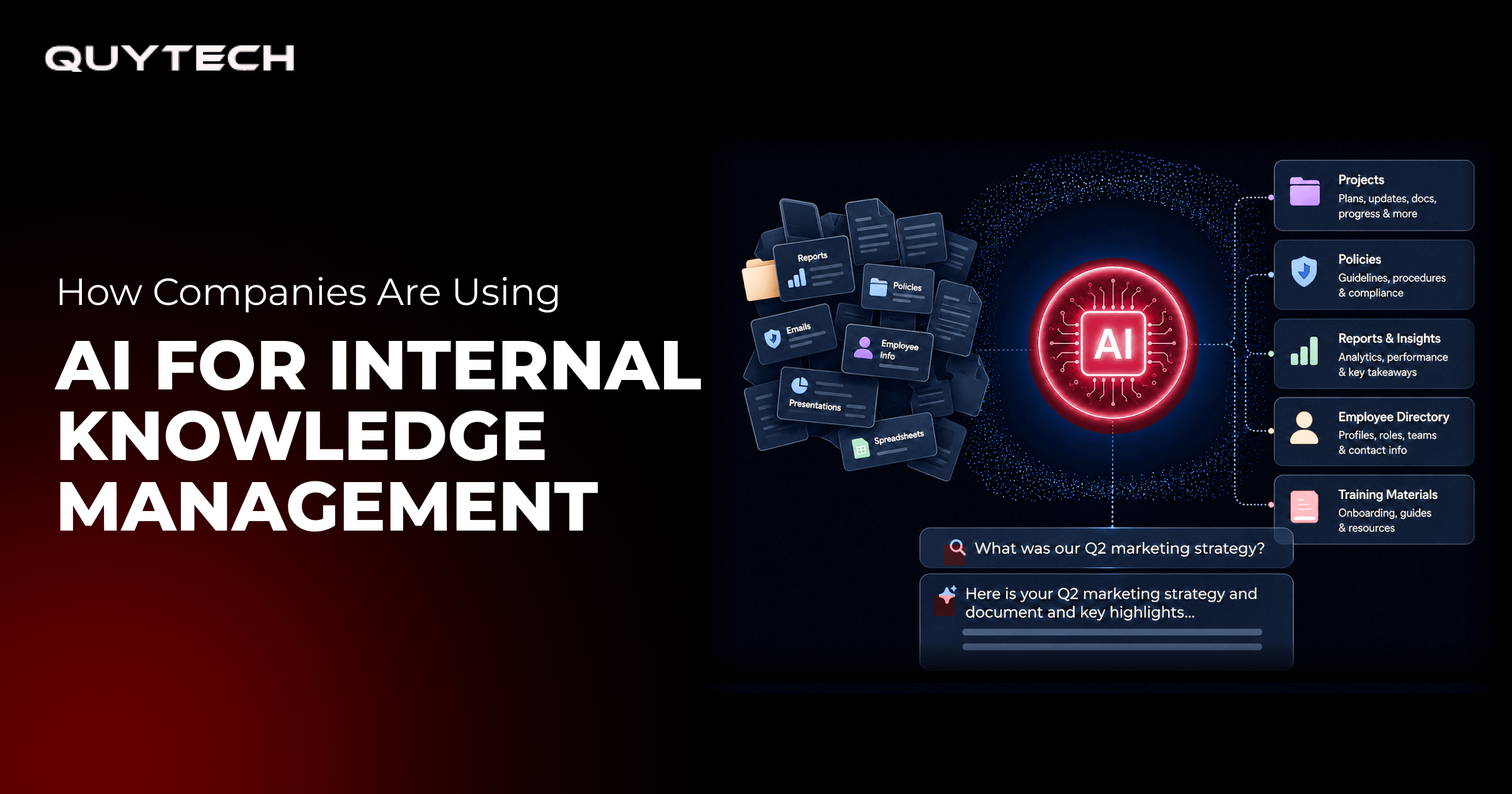
As the name makes it quite clear, internal knowledge management refers to the process by which a company collects, organizes, stores, and retrieves the knowledge it generates. This generally includes the projects, policies, reports, employee information, and every other information relating to the workflows within the organization.
Now, with AI in the picture, internal knowledge management turns into an automated process. It eliminates the need for manually handling tasks like information collection, organizing, and storing. AI brings its advanced technologies like natural language processing, machine learning, and so on.
These technologies make information organization and retrieval easy, as employees do not need to go through the complete history of the organization to access certain information; they can simply command AI to provide that, and AI provides exactly that in real-time. AI eliminates manual management and allows teams to access internal knowledge efficiently.

AI Knowledge Management vs. Traditional Knowledge Management
Let’s take a quick look at how AI knowledge management differs from traditional knowledge management:
| Aspect | Traditional Knowledge Management | AI-Powered Knowledge Management |
| Knowledge Capture | Relies on manual documentation and employee input. | Automatically captures knowledge from documents, conversations, emails, and business systems. |
| Information Retrieval | Users search using keywords and folder structures. | Uses natural language queries to deliver context-aware answers instantly. |
| Content Organization | Requires manual categorization and tagging. | Automatically classifies, tags, and organizes content using AI. |
| Search Accuracy | Results often depend on exact keywords and metadata. | Understands intent, context, and semantics for more relevant results. |
| Knowledge Updates | Updates must be performed manually and can become outdated. | Continuously updates and refreshes knowledge repositories in real time. |
| Accessibility | Information may be scattered across multiple systems and repositories. | Provides a unified access layer across connected data sources and platforms. |
| Employee Productivity | Employees spend significant time searching for information. | Reduces search time by delivering precise answers and recommendations. |
| Decision Support | Primarily serves as a storage and reference system. | Generates insights, recommendations, and actionable intelligence from stored knowledge. |
| Scalability | Becomes difficult to manage as content volume grows. | Efficiently handles large and rapidly expanding knowledge bases. |
| User Experience | Requires users to locate and interpret information themselves. | Delivers conversational, personalized, and context-aware knowledge assistance. |
You Might Also Like: Hyper Personalization in Mobile Apps with Agentic AI
Why Traditional Knowledge Management Systems Fall Short
The most obvious reason why traditional knowledge management systems fall short is that they are manual. And this core reason gives rise to many more such shortcomings. Here are some of them:
1. Information Is Scattered Across Systems
A traditionally managed knowledge management system is like a wardrobe. The location of information stored in it changes every time a certain piece of knowledge is searched for. This means that in the whole system, there is no specific place for specific knowledge; it is scattered.
Traditional knowledge management systems fall short exactly here, because in times when certain information is needed urgently, users would need to unravel the complete system to get what they need.
2. Search Capabilities Are Limited and Inefficient
Apart from scattered information, search capabilities also surface as a minus point of traditional knowledge management systems. This is because such systems are rule-based and follow this method of giving information based on the keyword searched. These systems do not have contextual intelligence and give outputs based on the rules they are trained on.
For example, if a user needs information regarding a certain client from the first quarter sales, they can access the knowledge only if they know the exact keyword with which the knowledge is stored. If they are not aware of the keyword or guess it incorrectly, they get irrelevant information.
3. Knowledge Quickly Becomes Outdated
As mentioned already, traditional knowledge management is carried out manually. Meaning, every update or new information entered in the system is done manually, which does not leave any sort of tag or highlight on which information is new and which is old.
This makes it hard to distinguish between fresh and old information. This lack of distinction often results in employees relying on wrong or outdated information for tasks and decision-making.
4. Lack of Contextual Relevance
Traditional knowledge management systems lack contextual relevance. They do not offer personalization or even basic memory containment. The output they give to every user is given as if they are interacting with the system for the first time.
Traditional systems do not consider factors like an employee’s role, position, past interactions, department, etc. It simply takes input and gives output. If the input given is common or matches other departments, the system may give that information to the user as well, often leading to information overload.
5. Difficulty in Scaling and Integrating with Modern Workflows
As organizations scale, the amount of information it has to handle multiplies, too. But as is known already, traditional knowledge management systems are manual, so handling large amounts of information manually would naturally require hiring more people.
Apart from this, integration challenges are also highlighted as the shortcomings of traditional systems. This arises when teams shift to sophisticated tools and workflows to enhance their performance, but being manual and outdated, integrating and maintaining them can be very resource-intensive.
Interesting Read: Using AI for Software Quality Assurance: Benefits, Use Cases, and More
How AI Is Transforming Internal Knowledge Management
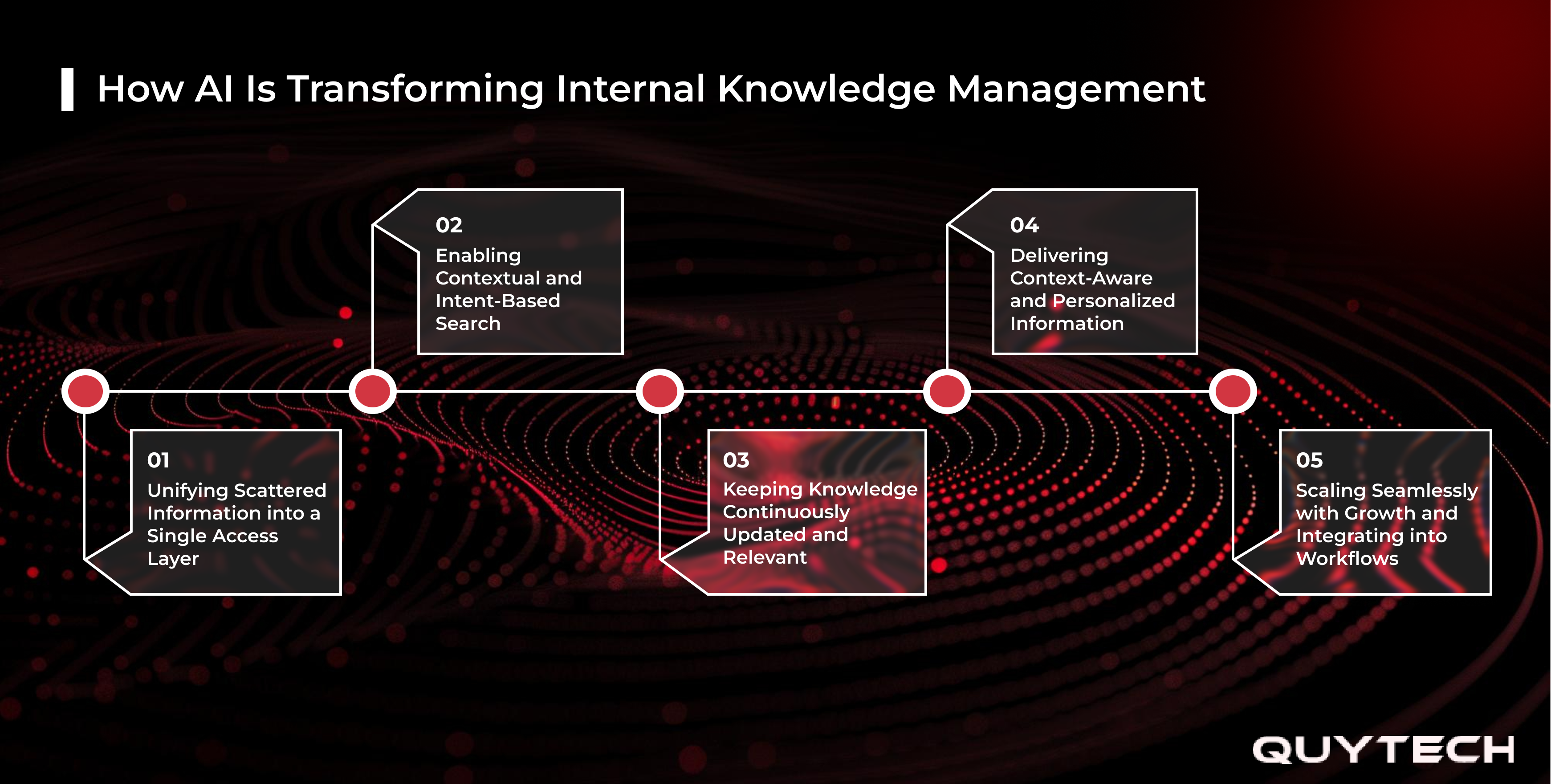
AI for internal knowledge management transforms the traditional scattered systems by connecting them all to a centralized access layer. But the list of transformations it brings doesn’t end just here! The following explains how AI makes internal knowledge management smarter:
1. Unifying Scattered Information into a Single Access Layer
AI-powered internal knowledge management overcomes the scattered information challenges. It indexes organizational information and connects data from multiple systems to a centralized access layer.
Unlike traditional systems, AI in knowledge management gives a specific place to every piece of knowledge in the system. This means that when a user searches for something specific, they do not need to search the complete knowledge system. It makes retrieving information easier and quicker.
2. Enabling Contextual and Intent-Based Search
Instead of being confined to pre-defined rules and keywords, AI in internal knowledge management understands the intent and context of the input provided by the users. It collects and analyzes the input to understand what the user actually wants and provides them with the same information.
AI-powered internal knowledge management is not limited to keywords. Even if the user does not know the keyword, they can access information by giving inputs in natural language.
3. Keeping Knowledge Continuously Updated and Relevant
As mentioned already, traditional knowledge systems are updated manually. And even after updates, figuring out which information is fresh is hard, as there’s no distinction between outdated and fresh knowledge.
AI in internal knowledge management ensures timely updates of the knowledge bases by tracking every piece of information stored in them. It analyzes them and alerts the designated personnel whenever it encounters any outdated, inconsistent, or contradictory information. Apart from this, AI also creates a clear distinction between new and old knowledge for the use of old knowledge for future reference.
4. Delivering Context-Aware and Personalized Information
Unlike traditional systems, AI-powered knowledge management systems are capable of delivering personalized information to users. They understand factors like the role the user plays, their department, past behaviour, and so on.
Based on these factors, AI understands the context behind the inputs the user gives and provides them with highly relevant information. And since AI is context-aware, it also remembers past interactions. Naturally, providing easy accessibility, tailored experiences, and precise outputs to users.
5. Scaling Seamlessly with Growth and Integrating into Workflows
AI in internal knowledge management supports growth seamlessly. Since it does not depend on manual intervention to collect, organize, store, and retrieve knowledge, AI can scale without needing additional manual effort.
Not only scaling, but integration is also much easier with AI. It can easily integrate with existing tools. AI eliminates workflow disruptions through this, as users do not need to leave their work to go search for something. They can access AI-powered internal knowledge management systems while working.
Handpicked For You: Hybrid Vs. Multi-Agents: What Enterprises Should Choose in 2026

How Companies Are Using AI for Internal Knowledge Management
Companies use AI for internal knowledge management to simplify their existing information storage and retrieval processes. These cover everything from collecting and maintaining knowledge bases to accessing and auditing them. Here are some core use cases of AI-powered internal knowledge management:
Smart Search and Knowledge Retrieval
Companies use AI-powered knowledge management to move beyond the basic keyword-based search. It lets users get the exact piece of information they need by simply giving a natural input instead of a pre-decided keyword. They can interact with the AI system through text or audio input.
And since AI has the ability to process and understand context and intent, it provides the most relevant information to the user from the entire knowledge base. With AI in play, users no longer have to remember the exact location or search through the knowledge base to access specific information.
Personalized User Experiences
Another area where organizations apply AI for internal knowledge management is for providing a personalized experience to every user. As mentioned already, the contextual awareness and intent recognition AI has helped it in understanding how each user is different.
It analyzes every user’s position, domain, past interactions, current needs, etc., with the help of machine learning. It also provides users with a tailored experience by utilizing recommendation engines. Altogether, these technologies help AI deliver knowledge that is different for each user.
Automated Knowledge Base Maintenance
Now, since AI is capable of providing tailored experiences to different users, that too in real-time, it’s obvious that it would have an updated knowledge base for that. Guess what? Even updating the knowledge base is something organizations use AI for.
AI for internal knowledge management uses machine learning and NLP techniques. These together not just collect, but also analyze, understand patterns, and update the knowledge bases as new data gets generated. And these updates are not limited to only uploading new data, but also finding inconsistencies, redundancies, and gaps in the information base.
Knowledge Analysis and Insight Generation
AI for internal knowledge management is not limited to only collecting and storing data; it goes way beyond this. Apart from maintaining the knowledge base, AI can also analyze it to generate insights that teams can use to make informed decisions.
AI does so by utilizing technologies like machine learning, data mining, and predictive analytics. Altogether, these technologies help AI in identifying data patterns, trends, and correlations. With the help of these derived patterns, predictive analytics provides insights that teams can use to make data-driven decisions.
Ethical and Compliance Standards Monitoring
Along with the above-mentioned, organizations also utilize AI for internal knowledge management to monitor ethical and compliance standards. It supervises every minor to major activity taking place within the knowledge management system. This is done to ensure that no anomaly goes undetected.
Through machine learning, AI understands what normal user behavior is like, and with anomaly detection modules, it flags whatever goes out of the norm. It monitors core sensitive areas like access controls, audits, etc.
Similar Read: 10 High-Impact Use Cases of AI Automation Transforming Industries in 2026
Benefits of Using AI for Internal Knowledge Management
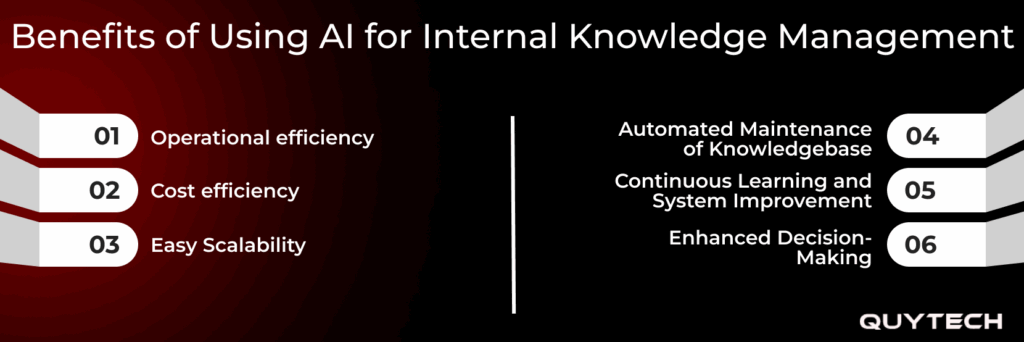
Implementing AI for internal knowledge management brings in operational efficiency along with easy scalability. Being easily scalable, it saves costs, automates knowledge base maintenance, and enhances decision-making ability as well. Let’s understand these benefits in detail:
Operational efficiency
The most obvious advantage AI brings for internal knowledge management is operational efficiency. It eliminates the need for teams to manually search through complete knowledge by introducing features like semantic search, which understands the intent and context behind the input provided by a user and provides them with relevant information in real-time.
Cost efficiency
AI for internal knowledge management helps organizations become cost-efficient. How so? Well, this can be understood by comparing the with and without AI scenarios. AI-powered internal knowledge management systems do not need a large team to manage them, and also provide access to information more quickly, which saves time and enhances productivity, which is something manual management of information fails to achieve.
Easy Scalability
As mentioned already, AI for internal knowledge management provides easy scalability. This is because it does not depend on human resources to function. In times when information datasets multiply, AI-powered systems adapt to their needs rather than requiring more human resources for management, unlike traditional knowledge management.
Automated Maintenance of Knowledgebase
Since AI for internal knowledge management handles everything from collecting and storing to retrieval and updating of knowledge, it automatically ensures the maintenance of the knowledge base. This naturally ensures that the data collected is consistent, available at a unified layer, and is accessible to all users.
Continuous Learning and System Improvement
AI-powered internal knowledge management learns from every interaction they have with users. It utilizes reinforcement learning and feedback loops, which help it understand and work on the feedback provided to it. Naturally, this continuous learning refines the system and improves its output accuracy.
Enhanced Decision-Making
AI for internal knowledge management enhances the decision-making ability of organizations. This is because it helps teams access accurate information in real-time. What it also does is that it generates insights from the knowledge stored, which often comes in handy when teams need to make quick yet informed decisions.
Interesting Read: Use Cases of Agentic AI in Enterprise Businesses
Challenges and Best Practices for Adopting AI in Knowledge Management
Adopting AI in knowledge management is quite beneficial, but only if it’s implemented with the right set of practices. This section will guide you through the common challenges that impact the adoption of AI for internal knowledge management, along with best practices to overcome them:
Lack of Data Privacy and Security
Whenever AI and data are blended, data privacy and security concerns become inevitable. The lack of data privacy and security concerns arises when AI accesses an organization’s information, which often includes sensitive data. This increases the risks of such data being intentionally or unintentionally exposed to users, which it wasn’t meant for.
Best Practices
Organizations can overcome data privacy and security concerns by adopting encryption and access control practices. Such practices ensure that no sensitive data gets accessed by users it wasn’t meant for, and even if they do access it, they get it encrypted, which is equal to having no access.
Resistance to Change by Employees
Another commonly faced challenge is resistance to change by employees. Such challenges commonly arise when employees do not trust AI tools because of the black box effect. They may also feel that AI is there as their replacement or might not have the right skills to work with it, hence resulting in resisting its adoption.
Best Practices
Resistance to change can be overcome by firstly, implementing explainability in AI, and secondly, by spreading awareness and conducting training sessions. Explainability will build trust as it will explain why AI made certain decisions, and awareness and training will help in changing the perspective of employees from seeing AI as a replacement to seeing it as a tool to enhance their skillset and ease their workload.
AI Hallucinations
Similar to the previous challenge, AI hallucinations are also somewhat related to the gap of trust employees have towards AI tools. AI hallucinations often end up showing incorrect, fabricated information, which, if used for operational purposes, can result in adverse consequences.
Best Practices
AI hallucinations can be addressed by ensuring that the information in the knowledge bases is correct. It can also be tackled by regularly fine-tuning AI models with high-quality datasets and implementing reinforcement learning, all while keeping humans in the loop.

Conclusion
Internal knowledge management has always been a critical function for organizations, but manual processes have long made it inefficient, unreliable, and difficult to scale. This is where AI comes to turn the tables.
Instead of relying on scattered knowledge sources and rigid, keyword-based systems, AI for internal knowledge management enables efficient knowledge search by unifying knowledge sources into a single access layer. As an experienced AI app development company, Quytech leverages advanced AI technologies to build intelligent knowledge management solutions that support context and intent-based search, helping organizations access critical information faster and more accurately.
Bringing in benefits from operational and cost efficiencies to automated knowledgebase maintenance and enhanced decision-making, AI knowledge management systems for enterprises transform the complete process. It converts the time-consuming, manually operated system to a smart and efficient one.
FAQs
Yes. AI can handle all types of data, even unstructured data, be it PDFs and emails, or chat logs and documents.
Yes, after understanding the positions and domains of different users, AI can easily provide personalized knowledge to them.
AI is capable of supporting knowledge management in multiple languages. This ensures that even if a user from a different linguistic background wants to access some knowledge stored in another language, they get properly translated and indexed versions.
Yes. AI-powered knowledge management systems can integrate with existing enterprise tools, as AI can connect with them and direct information from them to a centralized layer, which unifies the entire knowledge base of the organization in one place.
Here are some key prerequisites for implementing AI in internal knowledge management:
– Well-organized data
– Clearly defined knowledge sources
– System integration capabilities, and
– Proper access control mechanisms
Yes. Organizations with limited tech expertise can also implement AI for internal knowledge management. They can do so by partnering with the best AI solution development company. Another option is to hire dedicated developers.
