Summary:
In this blog, we will explain the core difference between native AI vs. traditional software. AI native software is one that is entirely built on machine learning and large language models. This software can handle multiple workflows of high complexity. The advantages of AI native software include continuous improvement, faster data-driven decision-making, and personalization at scale.
Traditional software is a system built on predefined rules. It helps in automating recurring tasks that follow fixed workflows. The advantages of traditional software are high predictability, low development cost, and enhanced compliance with regulatory requirements.
If you ask 5 people to define what native AI software is, you will end up with 5 different answers. Some will define it as digitally transforming legacy systems, while others may define any product with a chatbot as “AI-native.” What genuinely is alarming is how the confusion around native AI software and traditional software is shaping real business and product decisions.
But worry no more because we are here to clear that up for you. Through this blog, we will dive deep into the core differences between native AI and traditional software, explaining everything from a basic definition and working mechanism to each one’s characteristics and suitability based on different organizational needs.
Without further ado, let’s get started!
What is the Difference Between Native AI and Traditional Software?
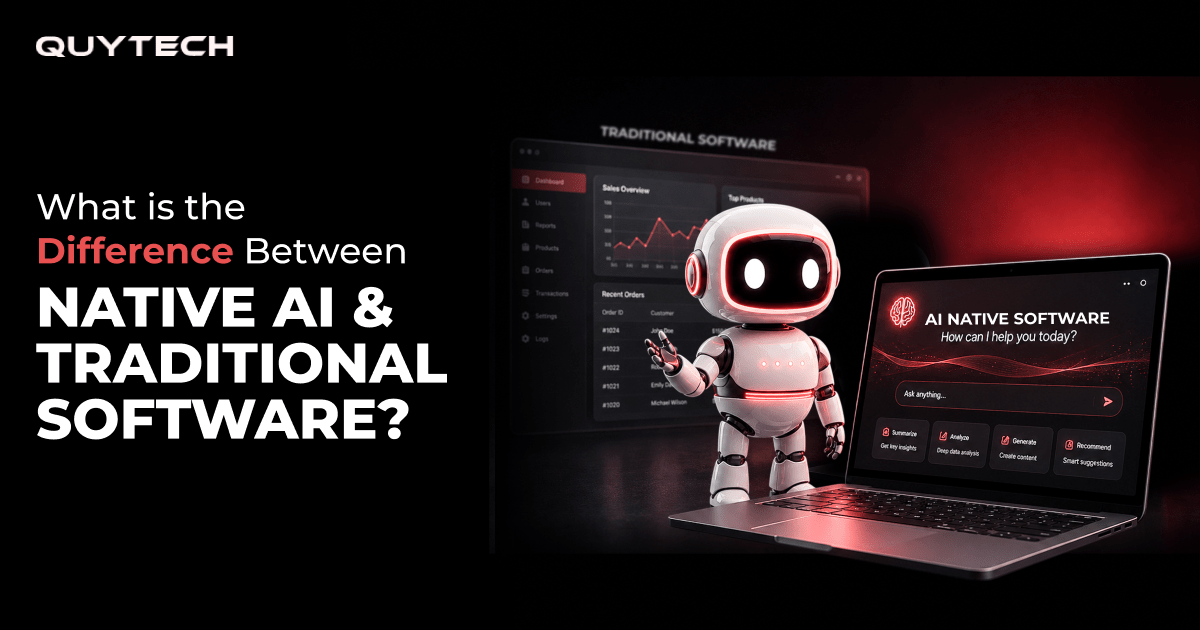
The primary difference between native AI and traditional software is that native AI software is intelligent, whereas traditional software is rule-bound.
Native AI software learns from data. It adapts to the environment, responds to it, and learns from every output it gives. Traditional software works as its rules define. It automates tasks with predictable outputs.
This distinction is becoming harder to ignore, especially as 88% of organizations now regularly use AI in at least one business function, as stated by McKinsey.
AI Native vs. Traditional Software at a Glance
Now let’s take a glance at the main differences between AI Native vs. Traditional Software through this table:
| Aspect | Traditional Software | Native AI |
| Core Logic | Fixed, human-written rules | Machine learning models that learn from data |
| Adaptability | Static; requires manual updates for new scenarios | Continuously learns and improves over time |
| Decision-Making | Follows predefined if-this-then-that logic | Reasons and makes context-aware decisions |
| Output Type | Deterministic and predictable | Probabilistic; can vary based on new inputs |
| Data Dependency | Minimal; works with structured input | Heavily dependent on large volumes of data |
| Context Understanding | None; processes input literally | Understands context, intent, and nuance |
| Maintenance | Manual code changes for every new rule or exception | Improves autonomously through feedback loops |
| Scalability | Scales within its defined function | Scales dynamically across complex, evolving use cases |
| Examples | ERP systems, calculators, billing software | AI copilots, material planning AI agents, recommendation engines, LLM-based apps |
| Best Fit For | Stable, rule-based, compliance-heavy processes | Dynamic, data-rich, personalization-driven processes |
Now that you know the core differences of AI Native vs. Traditional Software, let’s understand each software type in detail.
You Might Also Like: AI Agent vs Super Agent: A Comprehensive Guide
What is Traditional Software?
Traditional software is a system developed on a predefined set of rules. Such systems are utilized to automate tasks that have predictable outcomes and do not need reasoning or decision-making to execute. From start to finish, the actions that a traditional system has to take are already defined by developers through code. Outside of the rules, the software cannot make decisions or initiate actions by itself.
Traditional software has ‘if-this-then-that’ statements written that define its rules. Such code covers all the possible situations that the software is expected to handle, and how it should respond to them. If the software is given a certain input, it can only respond with predefined output.
This predictability is what makes traditional software reliable for tasks like billing systems, CRM tools, and calculators. However, this same predictability, rule-basedness, and lack of flexibility are also what limits a traditional software.
How Does Traditional Software Work?
Now let’s explore how traditional software works in practice:
1. Input
The working mechanism of traditional software begins when the system receives an input. The input usually is clicking a button, filling out a form, a system-triggered event, or an API call.
2. Rule Matching
Once an input is received, the system matches it against the predefined rules. It looks for the exact condition that matches the input received.
3. Logic Execution
After rule matching, the next step the system takes is executing the logic related to the rule. Here, the system follows the if-this-then-that instructions and carries out execution as defined by the rules.
4. Output
Once the logic is executed, the software reflects it as determined by the rules. This can be reflecting output on a dashboard, updating a record, or completing a transaction.
Handpicked For You: How Companies Are Using AI for Internal Knowledge Management
What are the Key Characteristics of Traditional Software?
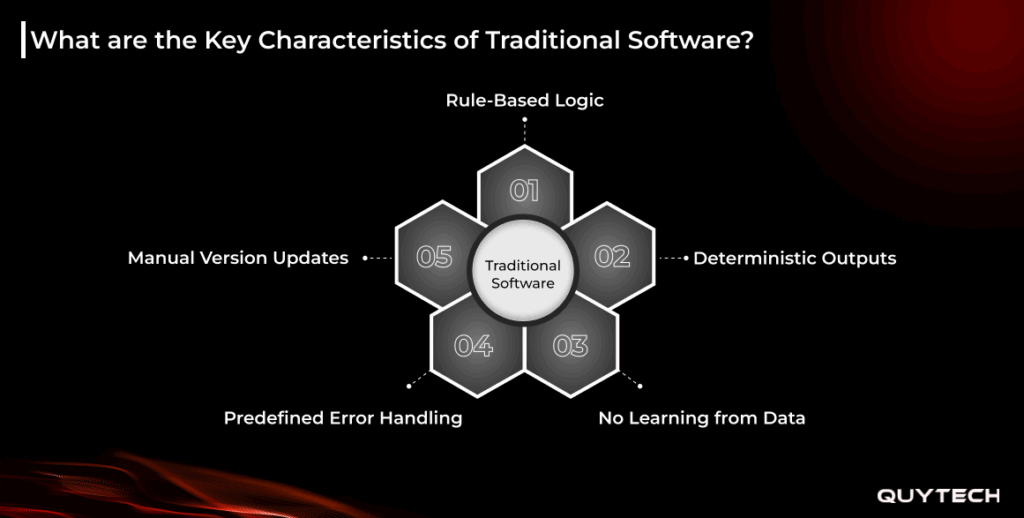
The key characteristics of traditional software are rule-based logic, deterministic outputs, predefined error handling, and manual version updates. Let’s explore them in detail:
Rule-Based Logic
Traditional software works on rule-based logic. This means that all the inputs and outputs are already defined in the code, so all the software needs to do is match received input with predefined ones, without needing interpretation or reasoning.
Deterministic Outputs
Traditional software always generates deterministic outputs. As mentioned already, all the inputs and outputs are predefined, which means that for a certain input, the output will always be the same.
No Learning from Data
Another characteristic of traditional software is that it does not learn from data. It can store and retrieve data, but it does not use it to learn or refine its future outputs through them.
Predefined Error Handling
Similar to actions, error handling is also predefined in traditional software. Apart from the usual process, any possible exception has to be anticipated and coded for in advance, as the system is not capable of adapting to a changing environment.
Manual Version Updates
Traditional software relies on manual version updates. If any capability needs to be upgraded, the software will need a manual update for it, as it is not capable of enhancing its features or outputs beyond its predefined limits.
People Also Read: Hyper-Personalization in Mobile Apps with Agentic AI
What is Native AI Software?
Native AI software refers to a system built with AI at its core. Such software is also called AI-first software. Unlike traditional software, AI-native software is capable of making its own decisions and executing them. It does not follow a predefined set of rules to carry out automation.
AI-native software is built with advanced artificial intelligence technologies like machine learning and LLMs. Together, these technologies power AI-native enterprise software to process information, reason through it, and deliver appropriate results. Such software does not follow a rulebook for generating responses. They are trained on large and diverse datasets, which help them understand what needs to be done under which conditions.
What makes them truly intelligent is their ability to self-update their knowledge with every new task they execute. These systems learn continuously and refine their outputs without needing manual updates. What’s more is that this intelligence shows up in real business outcomes too. According to HubSpot, the top 10 AI startups earn nearly 6X more revenue per employee than typical SaaS companies.
How Does Native AI Software Work?
Native AI software works by ingesting data, training models, and interpreting the input, followed by reasoning, output generation, and continuous learning. Let’s explore them in detail:
1. Data Ingestion
The working mechanism of AI-native enterprise software begins with data ingestion. Here, the software collects raw data like text, images, user behavior, or transaction history.
2. Model Training
The raw data collected in the primary step is utilized in this step to train the models of the software. This step enables the machine learning and LLM models to identify patterns, relationships, and context within the data.
3. Input Interpretation
Post-model training comes the process of input interpretation. Here, the AI-native enterprise software interprets the input by identifying the context, intent, and meaning behind it.
4. Reasoning and Inference
Once interpreted, the model begins reasoning. Based on this reasoning, the model generates output. The output can be in the form of a prediction, recommendations, or a response, whatever is best suited for the context.
5. Feedback Loop and Continuous Learning
After generating the response, comes the feedback loop. This helps the AI-native enterprise software understand how it performed, whether the output was accurate or not. Based on every piece of feedback gained and task executed, the software trains itself to perform better in the future.
Interesting Read: Using AI for Software Quality Assurance: Benefits, Use Cases, and More
What are the Core Characteristics of Native AI Software?
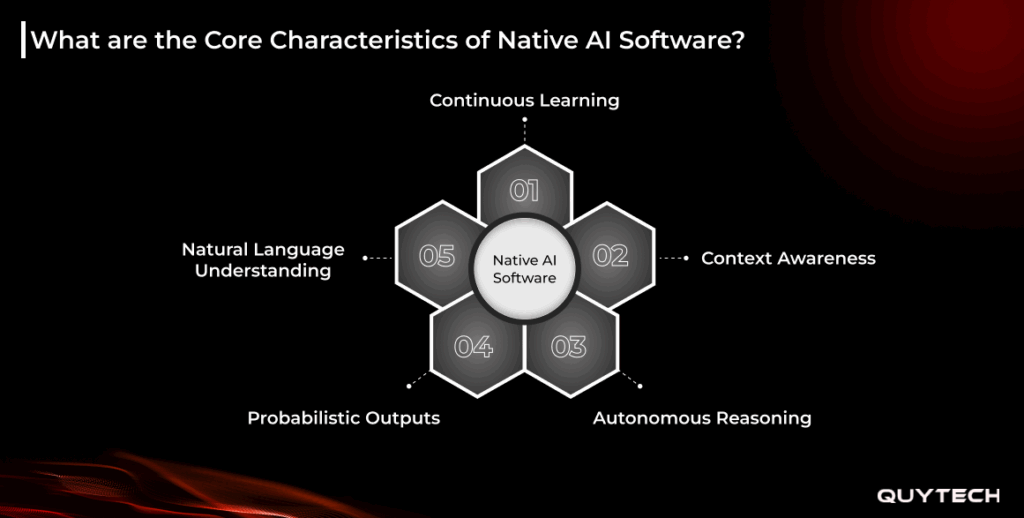
The core characteristics of native AI software are continuous learning, context awareness, autonomous reasoning, probabilistic outputs, and natural language understanding. Here’s a detailed section explaining them all:
Continuous Learning
As mentioned already, AI-native enterprise software is capable of learning continuously from every output and feedback. They do not depend on manual intervention to update and improve their performance.
Context Awareness
Native AI software is context-aware. It is capable of analyzing raw information, identifying patterns, relationships, and intent behind data, which is something traditional software cannot do.
Autonomous Reasoning
What truly makes native AI software intelligent is its ability of autonomous reasoning. The software is capable of understanding different situations, drawing conclusions, and making decisions without relying on predefined if-this-then-that rules.
Probabilistic Outputs
The outputs of AI-native enterprise software are probabilistic. This means that it does not have a fixed output for every input; instead, its responses change and even improve as it encounters new data.
Natural Language Understanding
As aforementioned, AI native software development involves utilizing large language models. These models power the software in understanding unstructured inputs like text and even generating natural language conversational outputs.
You Might Also Like: Hybrid Vs. Multi-Agents: What Enterprises Should Choose in 2026
Why Native AI Software is Different from AI-Enabled Software
A very common misconception in this space is that native AI software is the same thing as AI-enabled software. So while we’re at it, let’s help you understand why native AI software is different from AI-enabled software.
The difference here comes down to where AI sits in the software. In that sense, AI-enabled software can be defined as one that has a rule-based core system but has one or a few features like a chatbot, a recommendation widget, or a search filter powered by artificial intelligence.
From a progression perspective, traditional software is a starting point, with AI-enabled software as the next step, followed by native AI software as the final point.
In simple words, AI-enabled software can be explained as rule-based software with an AI-powered feature, whereas AI-native software has AI as its foundation, instead of a single feature.
Similar Read: AI in SaaS Software and Applications: Use Cases, Automation, and the Future
When Should Businesses Choose Traditional Software?
While traditional software isn’t flexible for unpredictable tasks, it does deliver efficiency when business processes are stable. Below are situations where traditional software fits the best:
Fixed Workflows
If your business workflows are fixed and of a recurring type, where you follow the same routine tasks every day, then you should opt for traditional software because it is best suited for situations that need a system to handle repetitive tasks.
Compliance-Heavy Operations
For organizations in industries with strict regulatory requirements, traditional software is the right choice. They are not intelligent and have a fixed, rule-based working mechanism, so when it comes to traceability and auditability, traditional software makes it easier than autonomous ones.
Budget Constraints
For organizations facing budget constraints, traditional software is the optimal solution. This is because traditional software is a budget-friendly option in terms of development and maintenance compared to intelligent software.
Low Data Availability
When faced with situations like low data availability, organizations should choose traditional software, as AI-native enterprise software requires large volumes of data to work efficiently and accurately, which is not the case with traditional software.
When Should Businesses Choose AI-Native Enterprise Software?
AI-native enterprise software becomes the right choice for organizations as their operations go beyond fixed schedules. Below are situations where native AI software fits the best:
Processing Large Volumes of Data
If your workflows require processing large volumes of data, then you should opt for AI-native enterprise software. This is because such software can analyze data, depict patterns, and offer insights based on them, which is something traditional software cannot do.
Delivering Personalized Customer Experiences
If delivering personalized customer experiences is your priority, then native AI software is the right choice. AI native software development can tailor experiences, recommendations, and responses to individual users based on their behavior and preferences, making it the right choice.
Automating Predictive Decisions
When it comes to automating decisions involving forecasting, organizations should go with AI native software development. Such software can generate data-based insights and predict possible outcomes, which is something traditional software cannot do.
Running Autonomous, Multi-Step Workflows
If your organization prioritizes automating multi-step workflows, then you should opt for AI native software development. Native AI software is autonomous. It is capable of making smart decisions and handling end-to-end workflows, and does not depend on constant human input to carry out tasks, which naturally makes it the right choice over traditional software.
Read More: AI in Social Media: Leverage the Automation & User Engagement
What are the Challenges of AI Native Software Development?
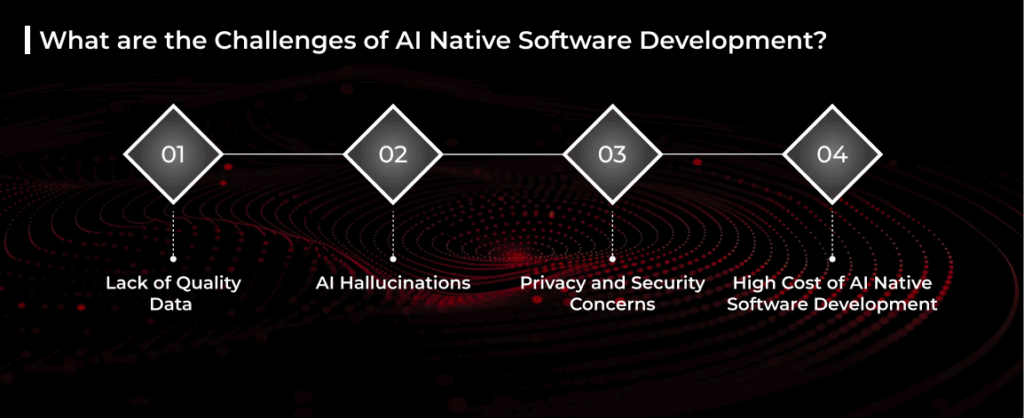
While AI native software development unlocks many benefits like intelligent workflow automation, reduced human dependency, and delivering personalization at scale, its development process brings a fair share of challenges as well. Here are some of the challenges of AI native software development:
Lack of Quality Data
As mentioned before, native AI software is completely reliant on data. Lack of quality data can impact how it performs, as low-quality, limited datasets affect the decision and response accuracy.
Data quality challenges in AI native software development can be overcome by ensuring availability of quality and large volume datasets.
AI Hallucinations
A very commonly faced challenge in AI native software development is tackling AI hallucinations. This usually happens when the AI model is asked to do something it wasn’t trained to do.
Hallucination challenges can be overcome by implementing human-in-the-loop practices to fact-check before making decisions on the response given by the software.
Privacy and Security Concerns
Privacy and security concerns are yet another AI native software development challenge. Since native AI software uses data to deliver accurate and personalized responses, it creates concern around how user data is stored, managed, and protected.
Organizations can overcome these challenges by using encryption practices, access controls, and compliance with data security regulations.
High Cost of AI Native Software Development
Another commonly faced challenge is the cost of AI native software development. Such software requires intensive investment in data infrastructure, model training, computing power, and human resources to make it work.
Organizations can overcome cost challenges by partnering with an experienced AI app development company that reduces upfront investment and avoids costly trial and error.
Why Choose Quytech for Native AI Software Development
When it comes to AI native software development, organizations need much more than a vendor. They need a technology partner who brings experience, expertise, and excellence in both artificial intelligence and software development. This is exactly where Quytech is positioned.
Backed by over 16 years of experience, Quytech combines deep AI expertise with strong software development capabilities across industries. We emphasize building tailored native AI software that not only aligns with your organization’s long-term needs but also grows with it.
Our team of dedicated developers connects with you right from the discovery phase all the way to post-deployment maintenance. Partnering with Quytech gives you the edge to build AI-native software that drives productivity in the present and is ready to adapt for future needs.
Wrapping Up
Understanding how AI native and traditional software are different comes down to their core architectures as well as the tasks they are built for.
Traditional software is built with a predefined set of if-this-then-that rules that define everything, right from the input the software will receive to the output it is supposed to provide. Such software is built to apply to areas that have fixed workflows and predictable outcomes.
AI native business applications include handling complex, multiple workflows that rely on data to make decisions and execute tasks end-to-end. AI native software is built around machine learning models and LLMs from the ground up. This allows it to learn from data, reason through context, and adapt over time.
Since both native AI and traditional software are built on fundamentally different architectures, their suitability naturally varies depending on an organization’s needs. However, as the need for handling larger volumes of data, dynamic customer expectations, and smarter decision-making grows, native AI is quickly becoming the approach built for where the future of software is headed.
Key Takeaways:
- Native AI software refers to a system built entirely on machine learning and LLMs. Such software relies heavily on data to function effectively.
- Traditional software refers to a system built on predefined rules written in code. Such software gives predictable outcomes and can automate tasks that have a fixed workflow.
- Core characteristics of AI native software are continuous learning, context awareness, autonomous reasoning, and response generation.
- As for traditional software, its core characteristics are rule-based logic, deterministic outputs, predefined error handling, and manual version updates.
- Common challenges faced in AI native software development are lack of quality data, AI hallucinations, privacy and security concerns, and high development costs.
FAQs
Native AI software development takes longer than traditional software development as it requires data prep and model training, while traditional software follows faster, fixed development cycles.
Traditional software runs on fixed rules, making it rigid, while AI-native software learns from data to reason, adapt, and improve over time.
The industries that benefit the most from AI native software engineering are healthcare, finance, retail, and logistics.
Some AI native business applications include AI copilots, fraud detection systems, recommendation engines, and autonomous customer support platforms.
Not directly, as it usually requires rebuilding core architecture around AI models. While traditional software cannot be converted, it can be transformed digitally by adding AI features, making it AI-enabled software.
