We have all seen the world’s longest traffic jam, which lasted for 12 days, in China in 2010. Even today, a typical driver in the United States loses 43 hours to traffic congestion. That is equal to a full work week.
To tackle problems like these and ensure that it does not happen again, traffic management authorities and government agencies are turning to AI in traffic management to manage traffic effectively, reduce congestion and accidents, and, more importantly, ensure the smooth flow of transportation.
In this blog, we will discuss the role and use of AI in traffic management and how authorities are leveraging it, along with other technologies like computer vision, IoT, and sensors, to shape the future of urban mobility.
The Rise of Artificial Intelligence in Traffic Management: What the Numbers Say
Source: Precedence Research
- The global AI traffic management system market was valued at $10.21 billion in 2025.
- The report also highlights that by the end of 2026, the market for AI in smart traffic management is anticipated to reach $13.48 billion.
- The compound annual growth rate for the forecast period (2026-2035) is estimated at 32.06%, resulting in a value of $164.72 by the final year.
- In 2025, North America dominated the AI for traffic management market, with AI road management software USA driving significant adoption, holding a value of $4.08 billion.
Traditional Traffic Management vs AI-Enabled Traffic Management
| Parameter | Traditional Traffic Management | AI-Powered Smart Traffic Management |
| Traffic Signal Control | Fixed timer-based signals with limited adaptability | Dynamically adjusts timings using adaptive signal timing and intelligent traffic signals based on real-time conditions |
| Traffic Monitoring | Manual CCTV observation and human supervision | Automated real-time traffic monitoring using computer vision traffic monitoring, and AI-powered traffic detection sensors |
| Congestion Detection | Delayed identification of traffic build-up | An AI traffic detection platform enables instant traffic congestion analysis and alerts |
| Traffic Prediction | Relies on historical assumptions and manual planning | Predictive traffic analytics and AI traffic forecasting through data-driven traffic management |
| Accident Detection | Depends on manual reporting or public complaints | AI-powered traffic detection technology identifies incidents instantly through video analytics and vehicle detection sensors |
| Response Time | Slower response due to human dependency | Automated traffic control system enables immediate alerts and faster rerouting decisions |
| Parking Management | Drivers manually search for parking spaces | Smart city traffic solutions guide drivers to available spots in real time |
| Human Dependency | Highly dependent on traffic personnel and operators | Intelligent transportation systems (ITS) enable automated decision-making with minimal human intervention |
| Emergency Vehicle Management | Limited coordination for emergency routes | Adaptive traffic signal control prioritizes emergency vehicles through AI-enabled traffic management |
| Environmental Impact | Higher fuel consumption and emissions due to congestion | AI traffic optimization reduces emissions through smart traffic light synchronization and improved traffic flow |
Major Causes of Traffic Congestion and Accidents
Before moving on to the solutions, it is crucial to understand the root cause of traffic congestion and accidents. The following are the major causes of traffic jams and accidents.
1. Inefficient Traffic Signal Management
There are several cities and places where there are still traditional traffic signals. These traffic signals are outdated and poorly synchronized; hence, they fail to adapt to real-time road conditions.
As a result, it leads to unnecessary delays in traffic movement and even increased risks of collisions at intersections. This is precisely where AI-based traffic signal control system technology is stepping in to replace outdated infrastructure.
2. Lack of Real-Time Traffic Data
Another major reason for traffic jams and accidents is a lack of real-time traffic data. People often take congested routes unknowingly, without having access to real-time traffic analytics. This results in further worsening traffic density in that specific area.
3. Road Accidents and Breakdowns
Vehicle breakdowns, accidents, and wrong parking also contribute to blocking roads, slowing down the overall traffic, and triggering traffic jams.
Moreover, this traffic congestion gets worse as more vehicles come onto the road, such as during peak hours, further prolonging the traffic jams.
4. Human Error and Reckless Driving
Other major reasons for traffic congestion and accidents are speeding, distracted driving, and failure to follow traffic rules.
These not only contribute to road accidents and endanger the lives of people, but also lead to jams for long hours.
5. Poor Infrastructure Planning and Maintenance
Poor road systems and planning often also lead to prolonged traffic congestion. Narrow roads, insufficient lanes, and potholes disrupt the traffic flow and slow it down.
Eventually, this slowed-down traffic becomes a persistent bottleneck, causing long hours of traffic jams and even accidents.
How AI is Used for Smart Traffic Management
The following are the top applications of AI in smart traffic management, reducing congestion and road accidents.
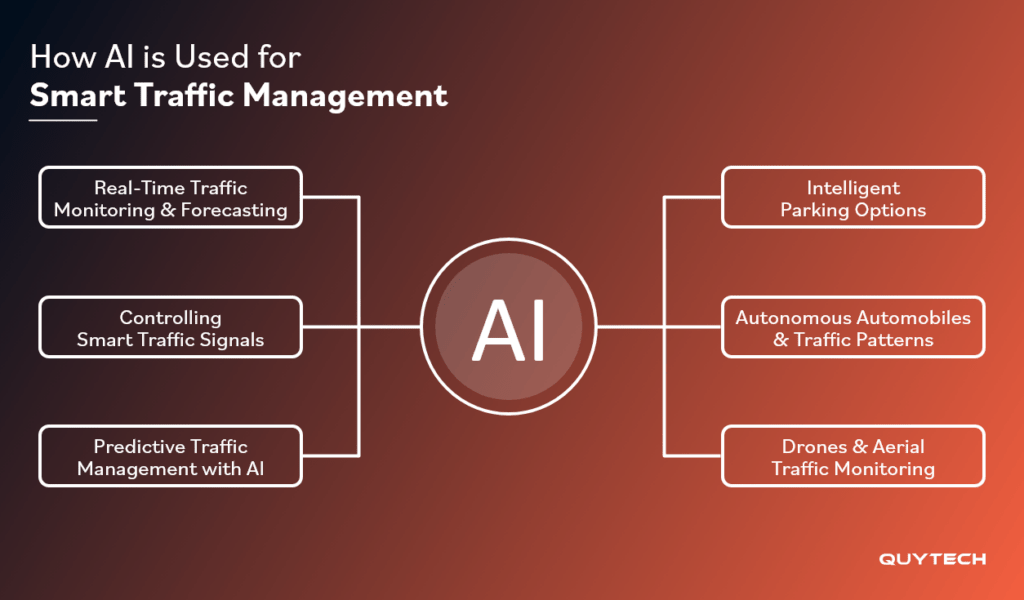
1. Real-Time Traffic Monitoring and Forecasting
The top use case of an AI-powered traffic management system is monitoring it in real-time. Many traffic management authorities use AI-enabled CCTV cameras and sensors to keep surveillance on traffic in real-time.
It helps authorities in two ways: keeping an eye on traffic and reducing traffic congestion and accidents. AI systems collect data from various real-time sources, such as CCTV feeds, GPS sensors, traffic apps, connected vehicles, and IoT-enabled infrastructure.
AI vehicle recognition and computer vision technology in the AI-based systems processes live video feeds to track vehicle count, speed, and lane occupancy. Moreover, Internet of Things (IoT) sensors are deployed on roads to collect data on vehicle density, speed, and road surface conditions.
The advanced AI-powered systems for smart traffic management are integrated with machine learning models and AI-driven traffic analytics, then analyze this data to detect current congestion levels, forecast traffic build-up, and dynamically adjust traffic controls to avoid congestion and accidents.
2. Controlling Smart Traffic Signals
The traditional traffic signals were programmed with preset timer schedules. No matter if there is a huge traffic jam or no one on the road, these signals are set to function at the set time, often leading to unnecessary delays, congestion, and frustration.
However, these outdated traffic signals have now been replaced by modern-day AI-based traffic signal control systems, resulting in smart traffic management and preventing congestion.
These AI-enabled traffic signals analyze traffic flow in real-time, and based on the traffic conditions, they optimize the traffic signal timings. These signals adjust dynamically based on traffic density, pedestrian presence, and nearby events or accidents.
For instance, if a road is clear, the signal may instantly switch to green with zero wait time. Conversely, if a high volume of vehicles is detected, the signal duration is extended to accommodate the traffic, reducing jams.
At the core of these smart traffic signals lies Reinforcement Learning (RL), which trains AI to find optimal timing strategies for traffic lights through simulation and feedback, improving its decision-making over time, adapting to evolving traffic patterns
Edge computing is used in developing these advanced traffic signal systems for traffic management, so that it can process the traffic data locally and respond faster. Moreover, in many countries, smart control of traffic light using artificial intelligence through V2I (Vehicle-to-Infrastructure) Communication has also been introduced, which plays a vital role in reducing traffic congestion and improving management.
The V21 allows vehicles to communicate with traffic signals and share movement data seamlessly, enabling AI traffic synchronization. This makes the flow of traffic smooth and reduces congestion and accidents.
3. Predictive Traffic Management with AI
Another use case of AI-based traffic management systems is making an accurate analysis of traffic congestion and allowing authorities to take measurable steps to reduce it. To achieve the same, traffic management authorities are now using AI systems powered with predictive analytics technology.
These predictive AI models use historical and live traffic data to anticipate traffic congestion, accidents, or traffic surges.
Using techniques like Time Series Forecasting, such as LSTM (Long Short-Term Memory) and ARIMA (AutoRegressive Integrated Moving Average), AI models can identify and predict fluctuations in traffic pattern analysis caused by various factors like peak hours, seasonal trends, and road usage patterns.
To enhance prediction accuracy, natural language processing (NLP) is used to analyze news, social media, and weather reports to predict external traffic influences, such as bad weather, ongoing construction, or events.
Based on insights provided, authorities can proactively deploy resources to clear the traffic, adjust traffic signal timings, divert vehicles, and inform commuters in advance through alerts or signage, ensuring smart traffic management and reducing congestion.
4. Intelligent Parking Options
Many times, the reason for traffic congestion is wrong or unplanned parking. Hence, authorities are now using AI systems to tackle congestion by tracking parking space availability using cameras and sensors, efficiently managing space availability, and guiding drivers to open spots in real time.
These smart parking systems utilize infrared, ultrasonic, or magnetic sensors embedded in parking lots or street surfaces to detect whether a space is occupied or vacant.
Moreover, in multi-level or outdoor parking areas, overhead cameras equipped with traffic flow detection and image recognition software detect vehicle presence and movement, allowing for space tracking without physical sensors.
People use AI-powered parking and EV charging station finder apps to find real-time parking availability and get directions to the nearest available spaces, reducing idle driving and circling.
5. Autonomous Automobiles and Traffic Patterns
Many countries have managed traffic smartly by deploying self-driving vehicles to reduce congestion and enhance road safety.
These vehicles rely heavily on a smart traffic management system using AI to perform essential driving functions, such as navigating complex environments, detecting objects, avoiding collisions, and adhering to traffic rules like lane discipline and speed limits.
Self-driving cars use deep learning for path planning, object detection, and real-time decision-making. They are also equipped with LIDAR & RADAR, which enables 3D environmental awareness.
Lastly, V2X (Vehicle-to-Everything) Communication allows autonomous vehicles to interact with traffic lights, signs, and other vehicles.
When a large number of vehicles on the road follow consistent, rule-based driving behaviors enabled by AI, it smoothens the traffic flow, lowers the number of traffic violations and human errors, and reduces the chances of severe traffic jams, like one that we have seen in China in 2010.
6. Drones and Aerial Traffic Monitoring
Lastly, AI-powered drones are used for intelligent traffic monitoring and ensuring a smooth flow. These drones monitor large-scale traffic conditions from the sky. They have cameras powered with AI and computer vision that interpret visual data from feeds in real time, and identify congestion points, accidents, or illegal driving behaviors with remarkable accuracy.
Some drones are designed with thermal imaging solutions, allowing them to operate effectively in low-visibility conditions such as fog, rain, or nighttime scenarios. This makes them significantly useful for 24/7 traffic monitoring and emergency response support.
Moreover, traffic management authorities also leverage Swarm AI to activate coordination between multiple drones to cover larger areas and ensure coordinated aerial surveillance for traffic coverage and monitoring.
Countries Leveraging AI for Traffic Management and Preventing Accidents
There are many countries that have started relying on artificial intelligence in traffic management for better management, reducing congestion, and dealing with accidents. Here are the top countries leveraging AI.
1. United States of America
The United States of America is one of the leading countries that is implementing ai powered traffic management system solutions for better traffic management and eliminating congestion.
In Los Angeles, the authorities have installed Automated Traffic Surveillance and Control (ATSAC) systems, which analyze real-time data from over 5,000 intersections and optimize traffic signal timing accordingly.
The result of this, the overall travel times have been reduced by up to 12% and improved emergency response times.
Similarly, in the city of Pennsylvania, the Surtrac AI-based traffic management systems have been implemented to control traffic using artificial intelligence. These systems use machine learning to adjust signals in real time based on traffic flow rather than fixed schedules.
As a result, the city has witnessed a 25% reduction in travel time, a 30% reduction in wait times, and a 20% drop in emissions.
2. United Kingdom
In the United Kingdom, cities like London and Manchester are adopting smart traffic management system solutions to tackle congestion and accidents.
The local government body, named Transport for London (TfL), has installed Real Time Optimiser (RTO) systems that use AI and predictive analytics to provide real-time insights about traffic. These insights, accordingly, are used to manage congestion zones and optimize public transport routes.
Similarly, in Manchester, AI in traffic signal control has improved bus punctuality and reduced road congestion.
This has led to a 20% decrease in congestion during peak hours in central London through improved signal phasing and route planning, and better public transport reliability and less commuter frustration in Manchester.
3. Saudi Arabia
Riyadh and Neom are at the forefront of AI-driven traffic analytics in Saudi Arabia. In Riyadh, the local government has introduced the Riyadh Smart Mobility Project that integrates AI to manage real-time traffic data, smart parking, and accident response.
This AI-powered smart traffic management project has delivered results in the early stages that show traffic congestion reduced by 15–20% and improved safety through quicker emergency response.
Furthermore, the Neom smart city project was launched, aiming for a zero-congestion and zero-accident future, with the use of autonomous vehicles, AI-based route prediction, and dynamic road usage patterns.
4. China
China is one of the most populous countries in the world; hence, there was a significant problem of traffic congestion and road accidents. However, China leveraged the use of AI in traffic management, along with other technologies like the Internet of Things (IoT), to tackle the same problem.
In China, cities like Hangzhou, Beijing, and Shenzhen have rapidly adopted AI for urban traffic control.
Hangzhou’s “City Brain” platform, developed by Alibaba, uses AI to manage traffic lights, monitor congestion, and direct emergency vehicles.
Since its implementation, the traffic congestion decreased by 15%, emergency response times dropped by 50%, and commuter satisfaction increased significantly. Notably, City Brain 3.0, launched in April 2025, now automatically detects 92% of traffic incidents, marking a major leap in AI traffic detection platform capabilities.
Similarly, Beijing and Shenzhen have also incorporated facial recognition and AI vehicle recognition surveillance to identify traffic rule violations and control pedestrian and vehicle flow more efficiently, thus reducing congestion and accidents.
5. Singapore
Singapore is known for its smart traffic management system using AI initiatives. One successful initiative was the Intelligent Transport System (ITS) for managing traffic congestion and enhancing transportation systems using AI.
The Land Transport Authority (LTA), an authority in Singapore, installed AI-powered systems to predict traffic patterns, optimize public transit schedules, and manage road usage dynamically. And, their efforts delivered more than the expected results. Using AI-powered data analytics, Singapore has achieved:
- A 25% reduction in traffic congestion
- 20% improvement in bus arrival time accuracy
- Enhanced safety with quicker identification and response to accidents
Moreover, another initiative, named Smart Mobility 2030, will continue to expand these benefits by integrating autonomous vehicles and AI-managed road infrastructure in Singapore for the next 15 years.
6. India
In India, major cities like Delhi, Mumbai, Bengaluru, and Hyderabad are beginning to implement traffic management system using artificial intelligence for traffic control, and surveillance systems.
Delhi launched the Integrated Traffic Management System (ITMS) on key corridors to automate traffic signal management and violation detection, reducing congestion and enabling real-time incident alerts.
This has resulted in reducing traffic signal wait times by up to 30% and improving compliance through automated fine systems.
In Bengaluru, one of the most congested cities in the world, the Adaptive Traffic Control System (ATCS) is being used for dynamic traffic signal adjustments, helping reduce travel time on key stretches by up to 12–15%. The city is also testing AI for smart camera networks that can detect traffic violations and predict congested zones.
Moreover, Hyderabad’s Command and Control Center has implemented AI for emergency response coordination, traffic analytics, and surveillance, leading to faster accident response and improved traffic discipline.
This is helping to manage traffic congestion smartly, enhance road safety by predicting accident-prone zones, and rerouting vehicles to reduce jams.
Role of Public and Private Sector Collaboration in Smart Traffic Management
To implement AI in smart traffic management effectively, public authorities like traffic management agencies and the government must collaborate with the top AI development companies.
In this collaboration, government agencies will offer the infrastructure, such as AI-compatible traffic lights, regulatory frameworks, and access to public data like details of traffic during peak hours, and the AI development partner will develop a smart traffic management system using AI solutions and software, and use the data to train the AI models.
For example, AI innovators like IBM and Google have worked with city corporations of different cities to optimize traffic signals and improve congestion analysis and control using real-time data.
When the partnership is done right, it enables smarter, faster decision-making, whether through data-sharing agreements, joint pilot programs, or co-developing intelligent transportation systems.
Moreover, these collaborations lead to faster deployment of scalable models that benefit both the public and private sectors. It is important to collaborate effectively to form the backbone of future-ready transportation systems.
Challenges and Best Practices for Smart Traffic Management System Implementation
Here are some common implementation challenges faced when implementing AI for smart traffic management:
Data Privacy and Security Concerns
A big challenge that implementation of smart traffic management system brings is data privacy and security challenge. Since such systems pose continuous surveillance along with facial and real-time data collection, doubts regarding how that data will be used, stored and accessed often impact the implementation process.
Best Practices:
Data privacy and security challenges can be addressed by establishing clear policies around data collection, storage, access, and citizen consent. This will not only public trust but will also ensure compliance with privacy regulations.
High Infrastructure and Deployment Costs
Another challenge that is commonly faced when implementing AI for smart traffic management is high infrastructure and deployment costs. Deploying AI-compatible traffic signals, sensors, cameras, and computing hardware across an entire city costs really high, which makes it hard for local governments to carry out implementation.
Best Practices:
Since a full-fledged deployment can be capital intensive, organizations and authorities should first begin will pilot deployments. This approach reduces risk and allows for traffic pattern analysis before full rollout.
Compatibility Issues with Legacy Systems
Compatibility issues with legacy systems are challenges that arise when existing hardware are not compatible with modern AI-enabled traffic management systems. Such citations elongate the implementation duration and may also require new hardware installations.
Best Practices
Compatibility challenges can be overcome with phased implementation process. This will help in implementing AI-based traffic control solutions without needing a complete hardware update.
Conclusion
AI in smart traffic management is an exceptional way that is helping traffic authorities across the world manage traffic effectively, reducing congestion and accidents, and ensuring the smooth flow of traffic.
An AI-powered traffic management system can help authorities monitor traffic conditions in real time efficiently. Also, it is used to power smart traffic signals, self-driving vehicles, and surveillance drones.
Moreover, AI-driven traffic analytics has been used by traffic management authorities to predict traffic conditions and manage parking to avoid traffic congestion.
Countries like the USA, UK, China, Saudi Arabia, Singapore, and India have already been using AI-based traffic management system for smarter traffic management, and in the coming years, this trend will rapidly expand as more governments and authorities realize AI’s potential.
How Quytech Can Help!
Quytech is a top AI development company that has contributed to the transformation of AI-based traffic management. We have successfully delivered intelligent traffic management solutions like RADaR, an advanced AI traffic management system, and Parken, a smart parking finder app that helps reduce congestion and improve parking efficiency.
Our solutions are designed to help cities and enterprises optimize traffic flow, detect incidents in real time, reduce emissions, and enhance commuter safety. For more details or to develop AI-powered traffic management solutions tailored to your needs, reach out to our team today.
FAQs
An AI-based traffic management system works by collecting data. It gathers data from road sensors, cameras, etc. The system processes collected data and takes steps like adjusting signals and rerouting vehicles accordingly.
The implementation of an AI traffic management system in a city can take 18 months to 5 years. Time majorly depends on city size and existing infrastructure.
Not necessarily. While large cities take less implementation time, AI traffic management is not limited to them. These solutions can be implemented in smaller towns and suburban areas as well.
Yes, AI traffic management works for pedestrians too. The cameras adjust crosswalk timings based on foot traffic. Many cities are integrating cyclist detection into their signal systems as well.
