Summary:
MCP and API both connect systems, but they weren’t built for the same caller. An API assumes a developer already knows what to call, while MCP assumes an AI agent has to figure that out on its own. This blog dives deep into the differences between MCP and API, breaking down everything from the functionality and architectural differences to the real-world applications, and showing where MCP, API, and a blend of both work the best.
97 million! That’s how many times the MCP SDK was downloaded in a single month by early 2026, up from roughly 100,000 in the month it launched. A 970x jump like that isn’t just adoption; it’s the beginning of a change, one that’s happening because something about the way software connects to software just stopped working.
We are talking about the rise of the Model Context Protocol, the standard transforming how AI agents connect with tools and data without depending on a developer to code every possible endpoint and workflow beforehand. Sounds amazing, right? While hyped in the current landscape, the discussions around it have led to a common misconception: that MCP is simply here to replace traditional APIs.
In this blog, we will break down the differences between MCP vs. API, covering everything from what they are and how they work, to their core differences, and real-world applications. Without further ado, let’s get started!
Model Context Protocol Statistics You Should Know in 2026
Before hopping into the details, let’s first take a quick look at the latest MCP market insights:
- According to Anthropic, there were more than 10,000 active public MCP servers in 2025.
- Anthropic’s report also sheds light on MCP being adopted by popular AI products like ChatGPT, Cursor, Gemini, Microsoft Copilot, and Visual Studio Code.
- According to Docker’s State of Agentic AI survey of 800+ developers, 85% said they were familiar with MCP.
What Is an API? A Quick Refresher
An API, or application programming interface, is a defined set of rules that allow a component of software to request data and functionality from another component. An API follows a predefined rulebook that explains what it has to do, how, and what response it has to generate, making it predictable and consistent in nature.
The model of APIs was designed with human developers as the decision-makers. Meaning that, based on the documentation, the human developer will be deciding what the API can do, how it will carry out its functions, and how the response will be handled. To put it simply, the functions of an API are defined by the code the developer writes. The API itself simply carries out the request it receives, without any awareness of who made it or why.
How Does an API Work?
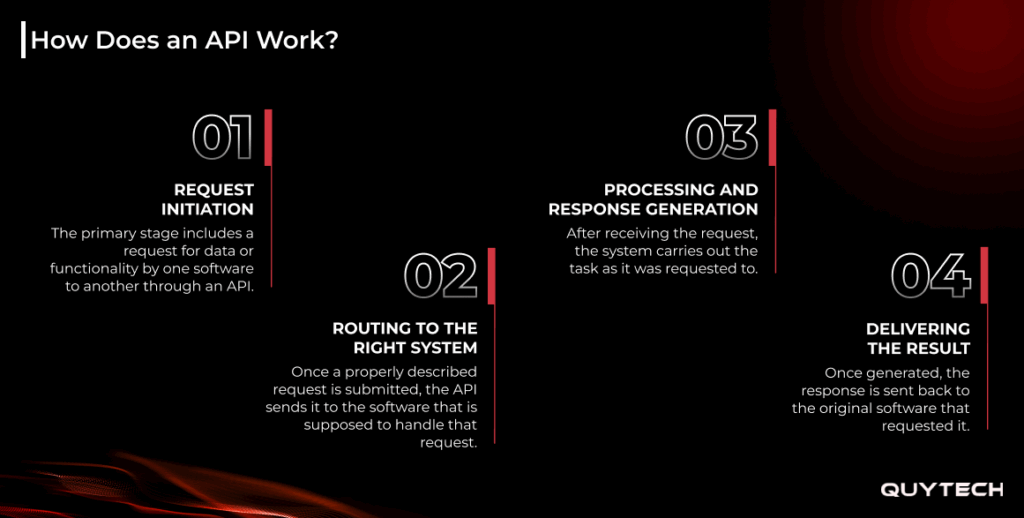
Now that we’ve had a glance at what an API is, let’s proceed with exploring how it works:
1. Request initiation
The primary stage includes a request for data or functionality by one software to another through an API. This request is sent to the API’s address. It includes all the key details, explaining what needs to be done and how.
2. Routing to the Right System
Once a properly described request is submitted, the API sends it to the software that is supposed to handle that request. It could be a server, database, or external service.
3. Processing and Response Generation
After receiving the request, the system carries out the task as it was requested to. It generates the defined response as per the request pushed.
4. Delivering the Result
Once generated, the response is sent back to the original software that requested it. The software can then display that response to the user or move on to the next step.
Handpicked for You: What is the Difference Between Native AI and Traditional Software?
What Is a Model Context Protocol(MCP)?
The Model Context Protocol (MCP) is an open standard that allows AI models to connect with external data sources and tools. MCP serves as a standardized layer that eliminates the need to configure a custom setup to link AI models to external tools. You can simply think of it as a language that enables models to communicate with tools, without needing manual integrations with each tool.
The model context protocol was introduced by Anthropic in November 2024. Before its introduction, the AI development process used to stall every time AI models needed a connection with external tools. Each connection needed developers to build a custom integration, even if a similar integration already existed for a different model. Through MCP, a common way was established that lets AI models check what tools are available to them and figure out how to use them, without depending on separate custom integration setups for each one.
How Does the MCP Work?
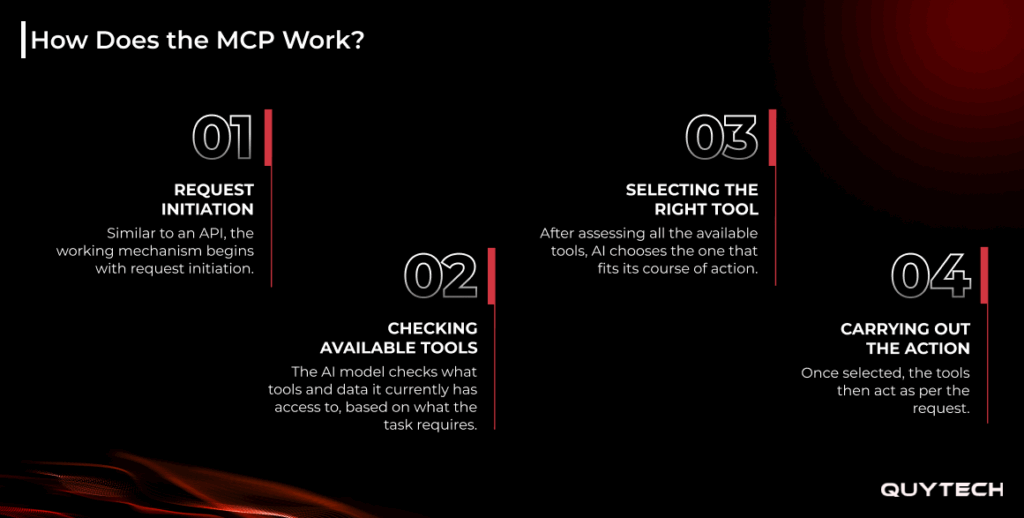
Here’s how the Model Context Protocol works:
1. Request Initiation
Similar to an API, the working mechanism begins with request initiation. However, here the sender is the AI model and the intermediary is the MCP. AI model sends the request on its own when it needs to access a tool or data.
2. Checking Available Tools
The AI model checks what tools and data it currently has access to, based on what the task requires.
3. Selecting the Right Tool
After assessing all the available tools, AI chooses the one that fits its course of action. Unlike in APIs, this selection phase is not predefined. The AI model carries it out as needed.
4. Carrying out the Action
Once selected, the tools then act as per the request. Here, the tool is connected with the MCP server as it carries out the task, like pulling information or updating a record.
5. Delivering the Result
Post-completion, the response is sent back through the MCP to the AI model. The AI model then decides its next course of action.
You Might Also Like: AI Agent vs Super Agent: A Comprehensive Guide
What is the Main Difference Between API and MCP?
The main difference between API and MCP comes down to who is making decisions and when.
For APIs, the entire connection and working mechanism is mapped out beforehand by a human developer. All the API does is just wait for pre-written requests, act on predefined rules, and generate predictable outcomes.
As for MCP, the decision-making lies with the AI model or agent. It lets the agent check what tools and data are available to it and decide which one to use without human intervention. MCP powers agents to make real-time decisions on how they can access tools and data, enabling systems that can act on their own mid-task.
MCP vs. API: Key Differences at a Glance
Let’s now take a glance at the key differences between MCP vs. API through this table:
| Aspect | Traditional API | MCP |
| Design intent | Built to exchange data or trigger actions through a fixed, predefined connection | Built to expose tools and data so an AI agent can find and use them at runtime |
| Discovery | Not supported. Endpoints must be known in advance, usually through documentation | Supported by default. A client can query what tools or resources are available |
| Integration approach | Built individually for each tool or system | One standardized interface works across multiple tools and servers |
| Statefulness | Each request is handled independently, unless state is added separately | Built to retain context across multiple steps in the same interaction |
| Authentication | Handled separately for each API, often with its own keys or OAuth setup | Centralized at the server level, increasingly standardized around OAuth 2.1 |
| Scaling across tools | Each new tool requires its own integration | New tools connect through the same interface, without a new build each time |
| Maintenance | Changes to a connected system often require manual updates to the integration | Capabilities can be re-queried at runtime, reducing manual upkeep |
| Primary consumer | A developer who has already decided what to call and when | An AI agent that determines what to use and when, at runtime |
People Also Like: Hyper-Personalization in Mobile Apps with Agentic AI
Real-World Applications: When Businesses Need API, MCP, or Both
Since both MCP and API aim to connect systems, how do you know which one is the right choice? If that’s what you were thinking, then worry no more, because this section explains the real-world applications of MCP and API, and guides you on when businesses should choose one or both:
Choose a Traditional API If:
- Your workflows are fixed and predictable:
If your application follows predefined workflows, then you should opt for traditional APIs as they are built to execute structured interactions without having to make real-time decisions.
- You integrate with a limited number of systems:
If your application has a fixed number of system integration requirements, then APIs are the right choice. They make integrations easy in such situations as they enable system connections without needing an additional layer.
- Your business logic is developer-defined:
You should choose traditional APIs if developers can define every integration path, endpoint, and workflow during development.
Choose MCP If:
- Your AI agents need to use multiple tools:
If your AI agent needs to access multiple tools, databases, applications, or external services, then opt for MCP. Its server layer makes it easy to connect with multiple tools without having to configure integration with each separately.
- Your workflows change based on context:
If your workflows cannot be completely predefined and need AI agents to adapt their actions based on the conditions, then MCP is the right choice as it offers the flexibility that’s needed to make dynamic decisions.
- You are building autonomous AI applications:
If you are building autonomous AI applications like AI copilots, research assistants, customer support agents, or workflow automation platforms, then you should choose MCP as it provides the architecture to support autonomous tool usage.
Choose Both API and MCP If:
- You want to build enterprise AI solutions:
Opting for both API and MCP is the right thing when building enterprise AI solutions. Here, APIs will allow the core systems to function without disruptions while allowing AI agents to access these systems and reason across them as needed.
- Your workflows include compliance-critical steps:
For organizations belonging to regulated industries like finance, healthcare, etc, using the blend of API and MCP is a good choice. It gives a fixed path to compliance-critical steps while enabling seamless AI agent orchestration around the adaptive tasks through MCP.
- You need the best of both approaches:
If you want to access the best of both approaches, then a mix of MCP and API is ideal. It will allow you to handle the predictable connections with API while allowing MCP to handle parts where the agent has to make real-time decisions.
Based on Your Preferences: Using AI for Software Quality Assurance: Benefits, Use Cases, and More
MCP vs. API: Understanding the Architectural Differences
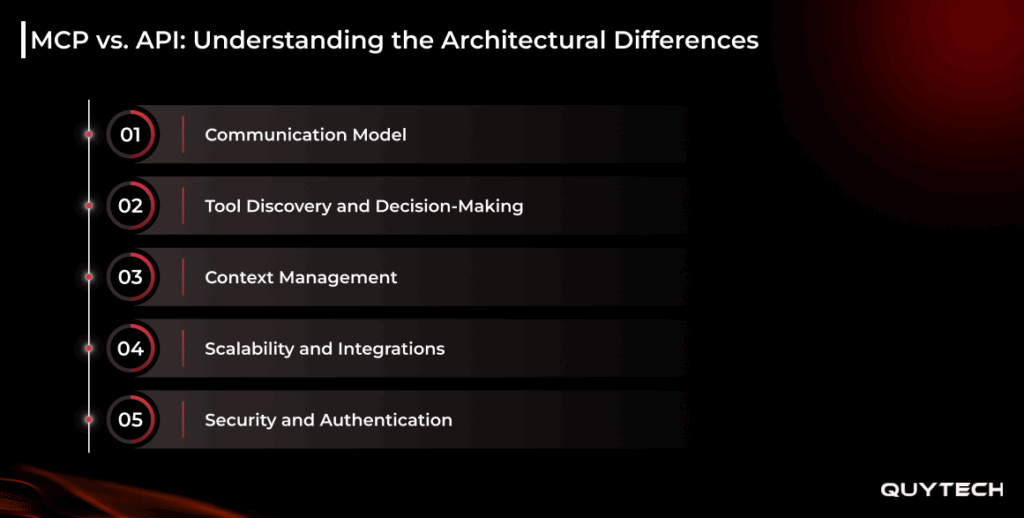
While both MCP and API power the communication of systems, their architecture is built very differently. APIs are designed for predecided connections, whereas MCP is designed for AI agents in the connection loop. Here’s a detailed breakdown of the architectural differences of MCP vs. API:
Communication Model
In an API, the communication model connects one application to one system. Here, the endpoints are fixed and already coded by a developer. As for MCP, its communication model adds a layer, called the MCP server, that acts as the link that allows the AI agent to communicate with other systems, without needing separate integrations.
Tool Discovery and Decision-Making
Tool discovery and decision-making in an API is pre-decided by the developer. They map out which service the API would call before the application is built. In the case of the model context protocol, the agent itself makes the decisions on what tools are available and which ones would be right at the moment.
Context Management
With APIs, every request is handled on its own, with no memory retained once the next request comes in. It does not maintain context across requests unless and until it is built to do that. As for MCP, it naturally holds context across multiple steps by default.
Scalability and Integrations
Scalability is challenging with APIs as every new tool asks for custom integration. MCP makes scaling and integration easy, as all that needs to be done to connect the agent with new tools is connecting the tools and the agent with an MCP layer. Every tool that connects with this layer can be easily accessed by AI agents.
Security and Authentication
With APIs, the security access is more rigid than MCP’s. The main reason for this is that, as with an API’s functionality and capabilities, its authentication and security are also handled by the human developer. While every API manages its own keys, tokens, and OAuth flow, it needs someone to configure the authentication flow when it comes to connecting with other APIs.
With MCPs, the security structure changes because the one requesting security access here is an AI agent. Unlike APIs, MCP centralizes permissions once, at the MCP server. The administrators set policies at the server level, which define and unify permissions and restrictions for every agent connecting through it. It’s increasingly built on standards like OAuth 2.1, so agent access can be governed just as strictly as human access.
Interesting Read: AI Hallucinations in Enterprise: How to Detect, Manage, and Mitigate Them
Where MCP Falls Short: Current Limitations of the Protocol
Despite overcoming integration challenges faced by AI agents, MCP is not the right option for every use case. But why so? Well, the main reasons behind this are the security and maturity factors.
MCP tells a server how to describe its tools, but it does not control how the server is actually built. This means that the security of the server depends on who’s building it. Poorly configured authentication, permissions, or access controls can expose risks, making proper implementation critical.
Being a new protocol, MCP is not yet mature enough and is in the early stage where developers
and organizations are testing it out or trying it in small projects, not running it fully in big, secure business systems. Hence, MCP can currently only coexist with APIs and is not mature enough to replace them.
Final Thoughts
The comparison of MCP vs. API has been quite the buzzword nowadays. While some see APIs as the universal answer for connecting applications with systems, others view MCP as the modern-day replacement for API. However, the real picture is something else.
APIs are the predefined set of rules that allow software components to connect, request data, or functionality. APIs are called ‘predefined’ as the endpoints, workflows, and authentication are coded by developers. While rigid, APIs are the right answer when it comes to connecting applications with fixed, predictable, and developer-defined workflows.
MCP, on the other hand, is an open standard that acts as a layer that ensures seamless connection of AI agents and models with external tools. It fits in perfectly when workflows change based on context, and AI agents need to connect with multiple tools, as it does not require separate configuration for each integration.
While both approaches provide a different kind of connection to systems, the smarter move isn’t choosing one over the other; it’s knowing that MCP is built for where software is heading, while APIs remain the backbone it’s built on.
Key Takeaways:
- The core difference between API and MCP is that APIs work on predefined rules while MCP works as a layer that lets AI agents make real-time decisions on their own.
- The working mechanism of an API begins with request initiation, followed by routing of the request, processing, response generation, and delivery.
- Similar to an API, MCP’s working mechanism also starts with request initiation, available tool analysis, tool selection, execution, and result delivery.
- APIs need a new integration for every new tool and manual updates when things change. MCP eliminates that by discovering capabilities at runtime and standardizing authentication across servers.
- API fit best when workflows are fixed, predictable, require limited integrations with tools, and have developer-defined logic.
- MCP is ideal when workflows involve connecting multiple tools, are unpredictable, and need an AI application to act autonomously.
Frequently Asked Questions
No! MCP is a layer that connects AI agents and models with external tools. It is not the same as APIs because APIs directly connect systems based on prewritten code.
AI agents can use regular APIs, but that would require developers to write every possible action the agent might take beforehand. Even if prewritten, APIs alone don’t work perfectly if anything outside the code is asked of the agent, which is why there is a need for an MCP, as it allows agents to decide what needs to be done, how, and with what tools.
No. Adopting MCP does not require rebuilding existing API infrastructure. Businesses can keep their APIs as they are and add an MCP server to ensure agents can access tools and systems.
You should use MCP instead of an API when connecting AI agents with tools for unpredictable workflows that require real-time decision-making. API is ideal for fixed and predictable workflows, while MCP is good for dynamic ones.
Not necessarily. A business can build its own MCP server in-house if it has the technical resources, or work with an AI development company to design and implement one around its existing systems.
